O'Donoghue's Pub: Dublin's Most Legendary Traditional Music Bar
Tucked on Merrion Row just steps from St. Stephen's Green, O'Donoghue's Bar is one of Dublin's best-known traditional music pubs. Famed as the launchpad for the Dubliners in the 1960s, it still draws serious trad musicians and curious visitors every night of the week.
Quick Facts
- Location
- 15 Merrion Row, Dublin 2
- Getting There
- Luas Green Line: St. Stephen's Green stop (5-min walk); multiple Dublin Bus routes on Baggot St
- Time Needed
- 1.5 to 3 hours, depending on whether a session is on
- Cost
- Free entry; drinks at standard Dublin pub prices
- Best for
- Traditional Irish music, history enthusiasts, solo travellers, authentic pub culture
- Official website
- www.odonoghues.ie
What O'Donoghue's Actually Is
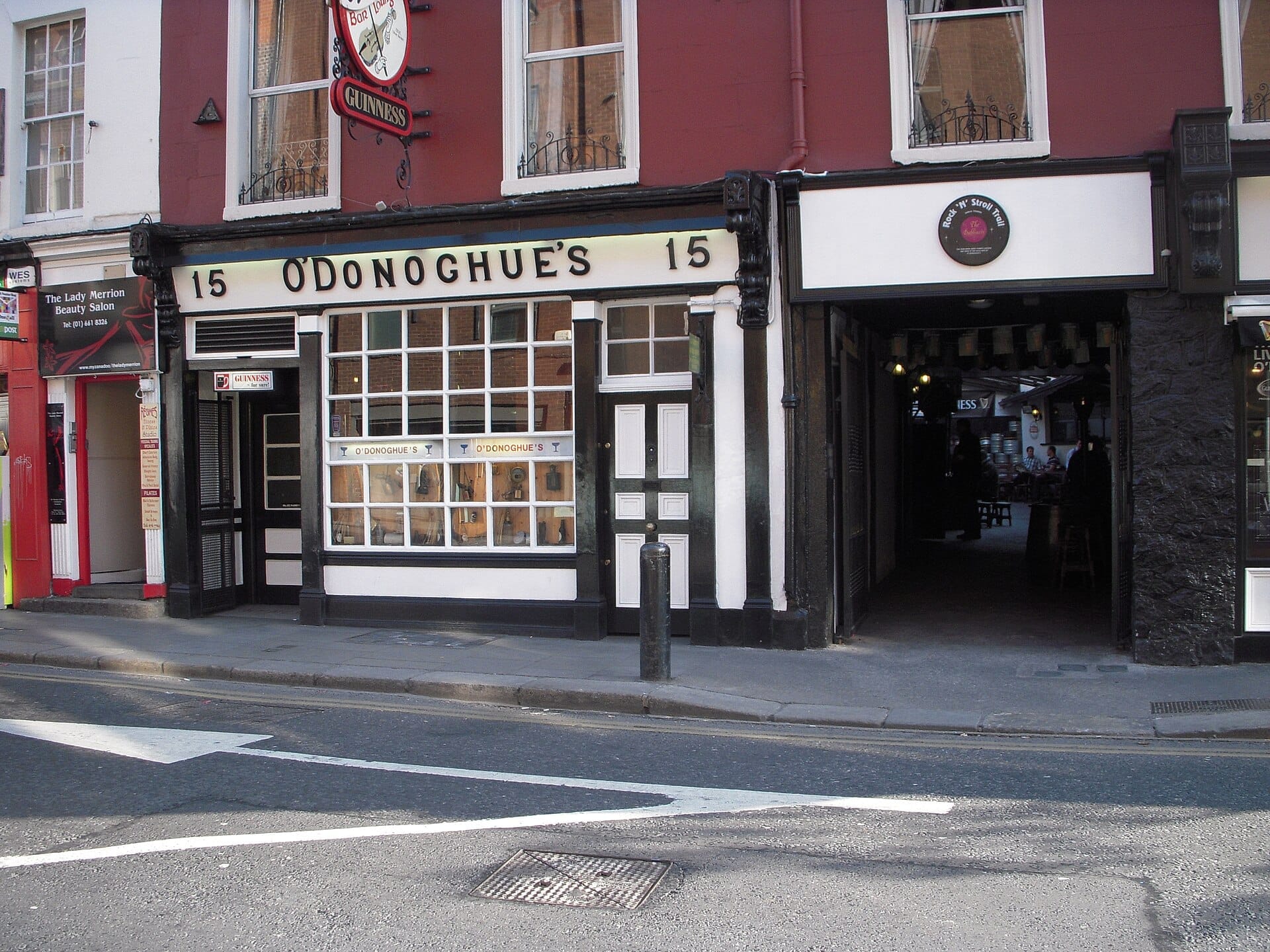
O'Donoghue's Bar, Lounge & Guesthouse at 15 Merrion Row is not a theme pub dressed up as a piece of history. It is the real thing: a Victorian-era corner pub that has barely altered its bones in decades, where the photographs on the wall are not decorative props but genuine records of the musicians who played here before most visitors were born.
The building itself dates to 1789, though the pub as most Dubliners know it began operating under Paddy and Maureen O'Donoghue in 1934. It sits at the junction of Merrion Row and Upper Baggot Street, two minutes on foot from St. Stephen's Green, and roughly equidistant from the Georgian squares that define this part of the city. The location matters: this is not Temple Bar's tourist corridor. Merrion Row has always served a mixed crowd of office workers, civil servants, students, and visitors who know to look for it.
ℹ️ Good to know
No ticket or cover charge applies. You pay for drinks, nothing else. Live trad music is scheduled Monday–Thursday from 8pm, Friday from 6:30pm, Saturday from 5:30pm, and all day Sunday, though informal sessions can sometimes start earlier or spill past midnight.
The Dubliners Connection: Why This Pub Matters
The detail that separates O'Donoghue's from dozens of other Dublin pubs with old photographs on their walls is this: the Dubliners, arguably the most influential traditional Irish folk group of the twentieth century, effectively began here. Ronnie Drew, Luke Kelly, Barney McKenna, and Ciaran Burke started playing informal sessions at O'Donoghue's in the early 1960s, when the pub had neither a stage nor any expectation that it would become a music venue of consequence. The sessions were spontaneous. The corner of the bar where musicians gathered was improvised, not installed.
That origin matters for understanding what you are walking into. O'Donoghue's did not build a reputation around a gimmick. It built one around consistent, credible traditional music over six decades, and the reputation brought better musicians, which reinforced the reputation. The black-and-white photographs lining the walls, including images of Luke Kelly and Ronnie Drew, are not licensed stock; they are the actual archive of those sessions. Spend five minutes reading them before the music starts.
For broader context on Dublin's cultural geography, the pub sits in the same southside belt as the National Gallery of Ireland and Merrion Square, a neighbourhood that in the 1960s was still strongly associated with the professions, the civil service, and the arts. The trad revival that O'Donoghue's helped seed was, in part, a reaction to that environment, and to the rapid modernisation of Irish society at the time.
Tickets & tours
Hand-picked options from our booking partner. Prices are indicative; availability and final rates are confirmed when you complete your booking.
Giant's Causeway, Dark Hedges, and Belfast Tour from Dublin
From 85 €Instant confirmationFree cancellationDublin self-guided audio tour
From 10 €Instant confirmationBird of Prey, Cliffs of Moher and Aillwee Cave from Dublin
From 201 €Instant confirmationFree cancellationGame of Thrones Studio tour with return transfer from Dublin
From 63 €Instant confirmationFree cancellation
What the Space Looks and Feels Like
The interior is compact and uneven in the way that Victorian pubs tend to be: a narrow front bar with a worn wooden counter, bar stools that have seen better decades, a back lounge that opens up slightly, and walls so dense with framed photographs and memorabilia that your eye never quite settles. The ceiling is low. On a cold evening, the combination of body heat, slow-poured Guinness, and the smell of old timber creates an atmosphere that no amount of interior design can replicate.
When a session gets going, the musicians typically set up wherever space allows, often in the back lounge or in the corner near the bar. There is no elevated stage. The accordion, uilleann pipes, fiddle, and bodhrán are at elbow height, which means you feel the music physically rather than watching it from a distance. Conversations between sets are short and honest. The musicians are generally not performing for tourists; they are playing because this is where they play.
Outside on warm evenings, the pavement along Merrion Row fills up with drinkers standing with their pints, and the sound of whatever session is inside drifts out toward the street. This outdoor presence gives the pub a different character in summer, more social and diffuse, compared to the close, concentrated energy inside in winter.
When to Go and What to Expect at Different Times
Arriving between 5pm and 7pm on a weekday gives you a pub that is busy but navigable. Office workers from the surrounding area fill the front bar, and you can usually secure a seat at the counter or near the back. This is a good time to read the wall, order unhurriedly, and get a sense of the room before it gets loud.
By 8pm on a Thursday through Sunday, space becomes genuinely scarce. The pub does not operate a reservation system for casual drinkers, and queues at the bar can be slow when it is full. If you are planning to stay for a full session, arrive early and commit to your position. Trying to navigate through a packed O'Donoghue's mid-session is unpleasant for everyone involved.
💡 Local tip
Sunday sessions at O'Donoghue's are the most consistent in terms of music quality and duration. The pub is open all day Sunday, and afternoon sessions often start earlier than the official listed times. If you want live trad without the Friday or Saturday crowd levels, Sunday afternoon is the practical choice.
Photography during sessions is worth some thought. The low light and close quarters mean phone cameras struggle. More importantly, the musicians are not performing a show, and pointing a camera at someone mid-tune without acknowledgment is noticeable. A nod of acknowledgment beforehand tends to be appreciated.
Getting There and Practical Details
O'Donoghue's is at 15 Merrion Row, Dublin 2. The Luas Green Line stops at St. Stephen's Green, a five-minute walk away. Multiple Dublin Bus routes serve Baggot Street nearby. If you are coming from Grafton Street, walk south through or around the Green and Merrion Row is the first left-hand street as you exit the park's east side. The walk takes about eight minutes.
The opening hours commonly listed on Tripadvisor are approximately 10:30am to midnight Monday through Thursday, 10:30am to 1am Friday and Saturday, and 12:30pm to midnight Sunday. Live music schedules on the official website list start times rather than full bar hours. These details are subject to change, and checking the official website at odonoghues.ie before visiting is advisable, particularly for confirmed session times.
⚠️ What to skip
Accessibility: No detailed accessibility information is published on the official website. The pub occupies a period Victorian building on a corner site. Anyone with mobility requirements should contact the pub directly before visiting, as older Dublin pub interiors often have split-level floors, narrow aisles, and no step-free access.
Who Will Get the Most from O'Donoghue's (and Who Might Not)
O'Donoghue's works best for people who are willing to stand, wait at a bar, and accept that the experience is shaped by whoever shows up to play that evening. The music is not a ticketed show with a setlist. Some nights are transcendent; others are a competent but unremarkable session. The consistency comes from the room and the history, not from a guaranteed performance standard.
Travellers who prefer a choreographed cultural experience, a set menu, or a guaranteed seat would be better served elsewhere. For context on what the wider trad and folk scene looks like across the city, the Dublin nightlife guide covers a broader range of venues and formats.
Families with young children should be aware that this is a working pub with no particular child-oriented facilities and that sessions run late. O'Donoghue's is oriented toward adults who want to sit with a drink and listen to music. Groups of more than six will find the space genuinely difficult to manage without pre-coordination.
For those planning a full day in the area, O'Donoghue's pairs naturally with a circuit of the immediate neighbourhood. The Merrion Square Park and the National Gallery are both within a ten-minute walk, as are several of the Georgian streets that make this part of Dublin architecturally distinct from the Northside.
Insider Tips
- The back lounge offers slightly more space than the front bar during sessions, and you are often closer to where the musicians actually set up. Head there first when you arrive.
- The pub's Guinness is consistently well-poured. The bar staff know the routine and a slow pour here is standard practice, not a delay. Budget an extra two minutes per pint.
- If you want to talk to the musicians, do it between sets, not during. The trad session etiquette at O'Donoghue's is relaxed but real, and interrupting a tune mid-flow is noticed.
- The guesthouse upstairs (officially O'Donoghue's Bar, Lounge & Guesthouse) means some guests staying on site have the slightly surreal experience of a trad session directly below their room. If you are a light sleeper considering this as accommodation on a weekend, factor that in.
- Check the official website's music schedule before arriving on a weeknight. Monday to Wednesday sessions are listed but can occasionally vary. Friday and Saturday are the most reliably packed nights.
Who Is O'Donoghue's Pub For?
- Traditional Irish music enthusiasts who want sessions without a stage or ticketing setup
- Solo travellers comfortable with bar conversation and unstructured evenings
- History and folk music buffs interested in the origins of the Dubliners
- Visitors looking for a pub that functions as a genuine local rather than a tourist production
- Anyone spending a full afternoon or evening in the St. Stephen's Green and Merrion Square area
Nearby Attractions
Other things to see while in St Stephen's Green & Grafton Street:
- George's Street Arcade
Built in 1881 as Ireland's first purpose-built shopping centre (later rebuilt after an 1892 fire), George's Street Arcade is a red-brick Victorian market hall on South Great George's Street, Dublin 2. Free to enter and open daily, it houses a mix of vintage clothing, records, antiques, food stalls, and independent retailers beneath a soaring glazed roof.
- Grafton Street
Grafton Street is Dublin's most recognisable shopping street, running 500 metres through the heart of the city from St Stephen's Green to College Green. Pedestrianised in the early 1980s, it draws everyone from commuters and coffee-seekers to tourists and street musicians. Entry is free and the street is open daily.
- Iveagh Gardens
Tucked behind the National Concert Hall on Clonmel Street, Iveagh Gardens is a free, formally designed Victorian park covering around 5 acres in the heart of Dublin 2. Opened to the public after years of restoration, it offers fountains, a rosarium, a cascade waterfall, and woodland walks with a fraction of the foot traffic you'll find at nearby St. Stephen's Green.
- Little Museum of Dublin
Housed in a Georgian townhouse at 15 St. Stephen's Green, the Little Museum of Dublin distills over a century of city life into a compact series of rooms and thousands of donated artefacts. Entry is by guided tour only, making this one of Dublin's most intimate and unexpectedly absorbing cultural experiences.