Ninenzaka & Sannenzaka: Kyoto's Most Atmospheric Historic Streets
Ninenzaka and Sannenzaka are two interconnected stone-paved lanes in Higashiyama that form part of the historic approach to Kiyomizu-dera. Free to walk and open around the clock, they offer a rare glimpse of preserved historic streetscape amid traditional teahouses, pottery shops, and matcha cafes.
Quick Facts
- Location
- Higashiyama-ku, Kyoto (near Kiyomizu-dera and Yasaka Pagoda)
- Getting There
- City Bus No. 206 or 100 to Kiyomizu-michi or Gojo-zaka stop, then 5–10 min walk
- Time Needed
- 1–2 hours for a relaxed walk; longer if you stop at shops
- Cost
- Free to enter (streets are public); most shops open roughly 10:00–17:00 or 18:00
- Best for
- Architecture lovers, photographers, culture seekers, couples
- Official website
- http://www.2nenzaka.ne.jp/EN
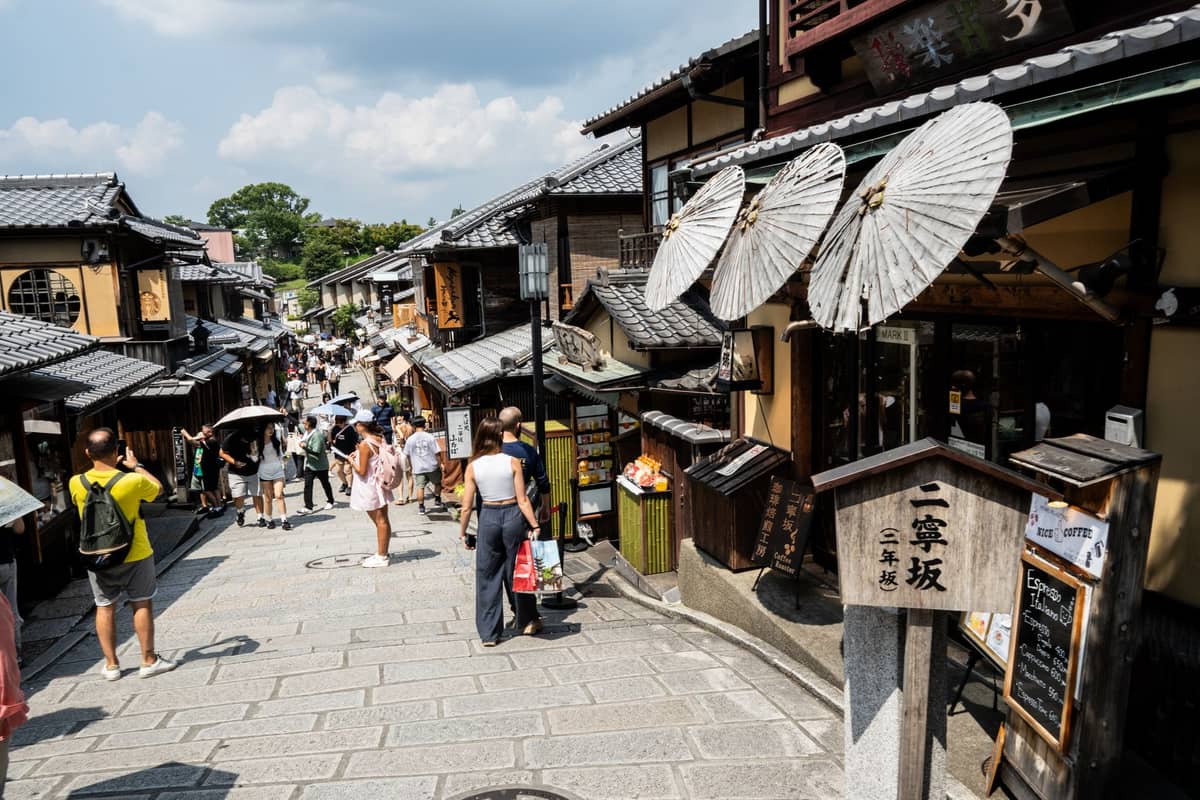
What Are Ninenzaka and Sannenzaka?
Ninenzaka (二寧坂) and Sannenzaka (産寧坂) are two short, stone-paved pedestrian lanes that wind up the lower slopes of Higashiyama, forming part of the approach to the precinct of Kiyomizu-dera. Together they form one of the most intact examples of Edo-period urban streetscape surviving anywhere in Japan. The lanes are designated as an Important Preservation District for Groups of Traditional Buildings, a national-level classification that restricts modern alterations and keeps the wooden machiya townhouses largely in their original form.
Ninenzaka, the lower and longer of the two, was established as an early Heian-period pilgrimage approach route to Kiyomizu-dera. Sannenzaka follows immediately above it and also dates from the Heian period, running a short distance before opening onto the broader approach to Kiyomizu-dera. The names translate loosely as 'Two-Year Slope' and 'Three-Year Slope,' and local legend holds that anyone who trips on Sannenzaka's uneven stones will face misfortune within two or three years. Whether that deters careful footsteps or encourages them, the cobblestones tend to command people's attention.
💡 Local tip
Arrive before 9:00 on weekdays for a near-empty experience. Tour groups typically arrive from 10:00 onward, and by midday the lanes can feel congested. The streets, as public roads, are effectively open at all hours with no entry fee.
The Experience: Walking the Lanes from Bottom to Top
The most natural approach begins at the lower end of Ninenzaka, reached after a 5–10 minute uphill walk from the Kiyomizu-michi bus stop. The first thing you notice is the texture underfoot: wide, slightly irregular stone slabs polished smooth by a millennium of foot traffic, flanked by shallow drainage channels. The lane narrows as it rises, with two-story wooden buildings pressing close on both sides. Roof lines are dark tile, facades are pale plaster and warm timber, and potted plants crowd the ground-floor entrances.
At street level, Ninenzaka is lined with a dense mix of ceramics shops, confectionery sellers, pickled vegetable stalls, and matcha-flavored dessert stands. The smells shift in short intervals: roasted green tea, sesame, cedar wood, incense drifting down from an unseen altar. In the morning before the shops open, the only sounds are birdsong and the occasional sweep of a broom. By mid-morning, the lane fills with the low murmur of Japanese conversation and the click of phone cameras.
At the junction between Ninenzaka and Sannenzaka sits a small open square with benches, a good place to pause and check your footing before the steeper second lane begins. Sannenzaka's gradient is noticeably sharper, with stone steps rather than a continuous slope. The lantern-shaped street lights, which are lit from dusk, give this section a particularly photogenic quality in the early evening. For a broader sense of the Higashiyama neighborhood, it helps to read theHigashiyama area guide before planning your route through these streets.
Tickets & tours
Hand-picked options from our booking partner. Prices are indicative; availability and final rates are confirmed when you complete your booking.
Kyoto Coast, Amanohashidate and Ine Bay 1-Day Trip from Osaka or Kyoto
From 46 €Instant confirmationFree cancellationKyoto Sanzen-in, Arashiyama and Bamboo Grove Full Day Tour
From 47 €Instant confirmationFree cancellationKyoto Arashiyama insider walking tour
From 66 €Instant confirmationFree cancellationMatcha green tea tour in Kyoto's Uji Market
From 130 €Instant confirmationFree cancellation
How the Streets Change Through the Day
Early morning, roughly 7:00 to 9:00, is when the lanes most resemble the historical photographs taken in the early 20th century. The light is soft, the stone is sometimes damp with overnight moisture, and the absence of crowds lets you see the architectural proportions clearly. A few shopkeepers begin washing down their entry stones and arranging goods, but most doors stay shut. This is the window for serious photography without the challenge of moving people in every frame.
From 10:00 through the afternoon, the lanes reach their commercial peak. This is when they are most practical for shopping, since everything is open and well-stocked, but it is also when the narrow width makes passing awkward during peak tourist months. Cherry blossom season in April and autumn foliage season in November are the most congested periods; on peak weekends during these times, the crowd density on Sannenzaka can make forward progress genuinely slow.
Evening, after the shops close around 18:00, brings a different quality entirely. The lane empties quickly as tour groups depart, the stone lanterns along Sannenzaka illuminate, and the wooden facades take on a warm amber tone. Couples and solo walkers dominate at this hour. The streets are still open and safe to walk, and many visitors find this the most evocative time, though you should note that almost nothing will be open to buy or eat.
⚠️ What to skip
During cherry blossom season (late March to mid-April) and autumn leaf season (mid-November), weekend crowds can make the lanes feel more like queuing than strolling. If visiting during these periods, a weekday morning arrival before 9:00 is strongly advisable.
Historical and Cultural Context
Both lanes were laid out during the early Heian period as formal approach routes to Kiyomizu-dera, which was itself established in 778. For over a thousand years, pilgrims, merchants, and later tourists have been walking the same stones. The townhouses lining the lanes are primarily from the Edo period (1603–1868), built in the machiya style typical of Kyoto commercial architecture: narrow street frontages, deep interior lots, latticed wooden facades, and distinctive roof tiles.
The national preservation classification these streets carry is significant. It means the neighborhood association, local property owners, and the city of Kyoto collectively regulate what can be built, modified, or displayed on facades. Modern signage is controlled, utility lines have been partially buried, and new construction must conform to historical proportions. This is why the streets look coherent rather than piecemeal, unlike many urban heritage areas where a convenience store sits between two historic buildings. Kiyomizu-dera itself, which rises above Sannenzaka, is explored in depth on theKiyomizu-dera attraction page.
What to Buy and Eat
The shops along Ninenzaka lean toward quality crafts: Kiyomizu-yaki pottery (the local style of painted ceramics), bamboo products, lacquerware, and handmade sweets. Sannenzaka's upper section has a higher concentration of teahouses and dessert shops, many specializing in matcha soft-serve, warabi mochi dusted with roasted soybean powder, and yatsuhashi in various forms.
Pickled vegetables, particularly the salty-sour tsukemono varieties, are sold in small open-front shops and make good, lightweight souvenirs. If you are interested in Kyoto's broader food culture, theKyoto food guidecovers the context behind many of these regional specialties. For a more structured tasting experience, several shops along Ninenzaka offer small sit-down tastings of matcha paired with seasonal sweets, typically for a few hundred yen; no reservation is needed for most.
Prices in the shops here are generally not bargain-level, reflecting the prime location and the quality of traditional craft goods. Street food items like matcha soft-serve typically run around 400–600 yen. For souvenirs that are both practical and genuinely local, the ceramics shops offer pieces starting around 1,000 yen for small cups, with hand-painted pieces running considerably higher.
Getting There and Practical Notes
From Kyoto Station, take City Bus No. 206 or 100 to Kiyomizu-michi or Gojo-zaka stop, then walk uphill for about 10 minutes. From Keihan Gion-Shijo Station, you can walk through Higashiyama to the lanes in roughly 20 minutes or take a local bus toward Kiyomizu-michi. If you are walking from Keihan Kiyomizu-Gojo Station, allow about 15–20 minutes for the uphill walk. Taxis and ride-hailing apps (including the GO app used for taxi dispatch in Kyoto) can drop you at the base of the approach roads, but the lanes themselves are pedestrian-only.
Both lanes are stone-paved with steps and uneven surfaces. They present real challenges for wheelchairs and strollers, and the national preservation status limits how much barrier-free infrastructure can be added. Comfortable, closed-toe shoes are strongly recommended regardless of ability. The Higashiyama area connects naturally to a broader walking route that includes theYasaka Pagoda visible at the top of Sannenzaka, and the Hanamikoji Street further north in Gion.
Photography note: in the early morning before shops open, shooting toward the top of Sannenzaka with the Yasaka Pagoda in the background produces the iconic image most associated with these lanes. A standard wide-angle lens is sufficient; the alley width limits any opportunity for long telephoto compression. In full summer, the light falls directly onto the lane from around 10:00, which can produce harsh contrasts; the overcast days of early June actually provide more even light for photography.
ℹ️ Good to know
Ninenzaka and Sannenzaka are free to walk at any hour as public streets. Most shops open around 10:00 and close by late afternoon or early evening, often by 17:00–18:00. There is no ticket booth or entry gate.
Who Should Consider Skipping This
If your priority is cultural depth over scenic appeal, be aware that the lanes are primarily a shopping and walking experience. There are no museums, no interiors to enter (beyond shops), and limited interpretive signage in English. Visitors seeking significant historical narrative will find more intellectual substance at nearby temples.
Travelers with limited mobility will find the stone steps and uneven paving genuinely difficult, not merely inconvenient. The preservation district status means the terrain is unlikely to change. Travelers on a very tight schedule who have already visited Kiyomizu-dera should know that the lanes are the connector route, not a separate add-on, and most people walk through them naturally as part of aHigashiyama walking route. If you only have one hour in the area and crowds are heavy, the lanes can feel frustratingly slow to navigate.
Insider Tips
- The small side lane off the Ninenzaka-Sannenzaka junction, leading toward Ishibei-koji, is almost always quieter than the main lanes and gives a sense of what the neighborhood looks like when it isn't oriented toward tourism.
- The stone drainage channels along the edge of Ninenzaka collect rainwater and are genuinely slippery after rain; the legend about tripping may be rooted in practical experience rather than superstition.
- If you want a seated matcha experience without queuing, aim for a teahouse on Ninenzaka rather than Sannenzaka; the lower lane's shops tend to have shorter waits even on busy mornings.
- Evening after 18:30 is when locals sometimes walk the lanes; the tourist pressure drops sharply once shops close, and the stone lanterns create a noticeably different atmosphere worth experiencing even if it means returning a second time.
- Carry small bills and coins. Several street-front sweets vendors prefer cash, and many artisan shops post prices but may not have change for large notes.
Who Is Ninenzaka & Sannenzaka For?
- Photographers looking for the classic Kyoto townhouse composition, especially at dawn
- Couples wanting a slow, scenic walk connecting Gion to Kiyomizu-dera
- Craft and ceramics shoppers interested in Kiyomizu-yaki pottery and locally made goods
- First-time visitors to Kyoto wanting a condensed, walkable impression of the city's Edo-period aesthetic
- Travelers building a half-day Higashiyama walking itinerary that combines temples, historic lanes, and food
Nearby Attractions
Other things to see while in Higashiyama:
- Ishibe-koji Lane
Tucked behind Kodai-ji temple in the Higashiyama district, Ishibe-koji Lane is a narrow, stone-paved passage lined with traditional machiya townhouses, lantern-lit inns, and discreet restaurants. Free to walk at any hour, it offers a rare glimpse of old Kyoto that the bigger sightseeing streets rarely deliver.
- Kiyomizu-dera
Kiyomizu-dera is a UNESCO World Heritage Buddhist temple perched on the forested slopes of Higashiyama in eastern Kyoto. Its vast wooden stage, supported by 139 pillars without a single nail, overlooks a valley of maples and cedars that shifts dramatically with the seasons. This guide covers exactly what to expect, when to go, and how to make the most of a visit.
- Kyoto National Museum
The Kyoto National Museum holds one of Japan's most significant collections of pre-modern Japanese and East Asian art, spanning painting, sculpture, ceramics, textiles, and calligraphy. Housed in a landmark Meiji-era building beside Sanjusangen-do, it rewards slow, careful visitors far more than rushed ones.
- Sanjusangen-do Temple
Sanjusangen-do is a 13th-century Buddhist temple hall in Higashiyama, Kyoto, stretching 120 meters and housing 1,001 statues of Kannon. It is one of the most visually overwhelming religious spaces in Japan, and one of the most accessible. Here is everything you need to know before you visit.