Yasaka Pagoda (Hokan-ji): Kyoto's Most Iconic Five-Story Tower
Standing about 46 metres above the cobbled lanes of Higashiyama, the Yasaka Pagoda is the defining silhouette of Kyoto's eastern hillside district. The exterior is free to view any hour of the day, while the interior is generally open from around 10:00 to 15:00 on certain days for a modest fee. Here is everything you need to plan your visit well.
Quick Facts
- Location
- 388 Yasakakamimachi, Kiyomizu, Higashiyama-ku, Kyoto 605-0862
- Getting There
- City bus No. 100 to Kiyomizu-michi or No. 206 to Kiyomizu-michi or Higashiyama Yasui stop, then 5–10 min walk east
- Time Needed
- 20–40 min for exterior; add 30 min if the interior is open
- Cost
- Exterior: free. Interior: ¥400 per adult (visitors below junior high school age are not admitted inside). Verify opening days before visiting.
- Best for
- Architecture lovers, photographers, and anyone walking the Higashiyama heritage trail
What Is the Yasaka Pagoda?
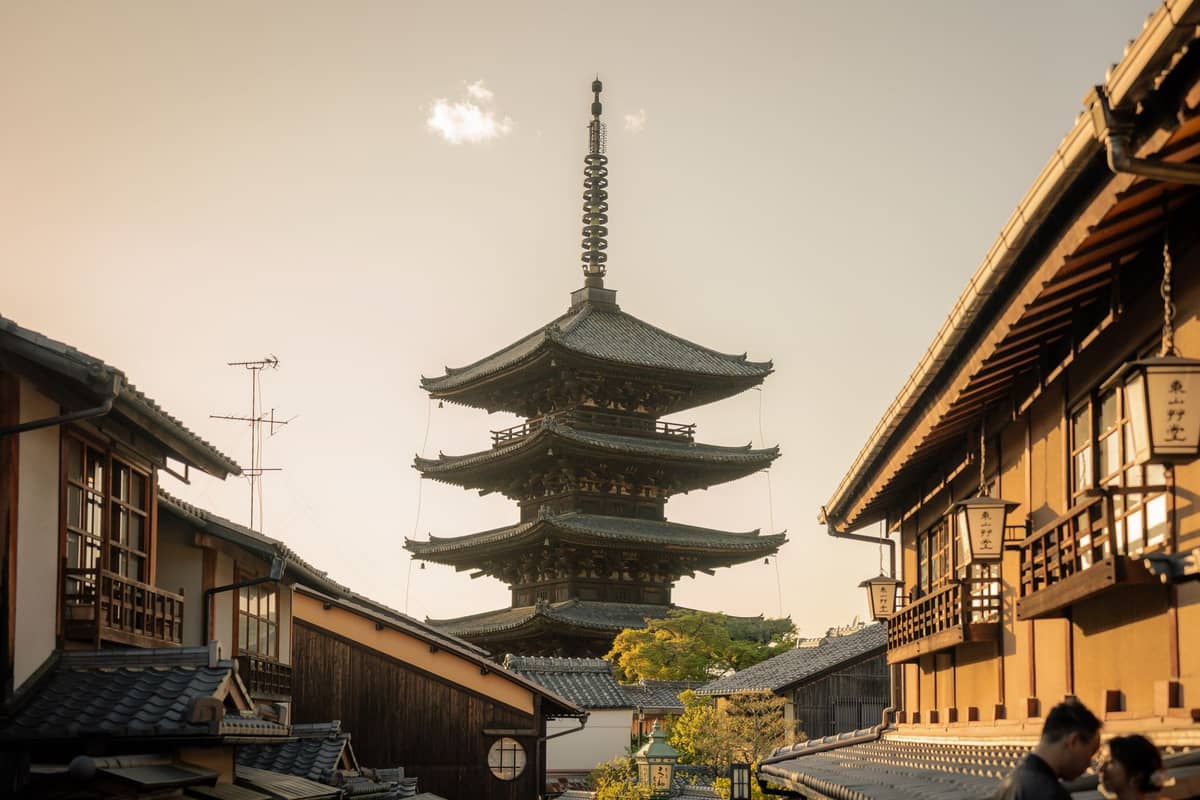
The Yasaka Pagoda, formally part of Hokan-ji Temple (法観寺), is a five-story wooden pagoda standing about 46 metres tall in the heart of Kyoto's Higashiyama district. It is one of the most recognisable structures in the city and one of a small number of surviving five-story pagodas in Japan. The pagoda predates most of what surrounds it and serves as an unmistakable anchor for the entire eastern hillside neighbourhood.
Unlike many of Kyoto's major temple complexes, Hokan-ji is a compact site. There is no sweeping garden or grand gate corridor. What you get is the tower itself, the narrow lanes that frame it, and the layered texture of traditional rooftiles spreading out below when you reach the interior viewing level. That simplicity is, in part, what makes it so useful as a landmark and so enduring as a photograph.
ℹ️ Good to know
The interior is generally open on certain days, usually from around 10:00 to 15:00. Weekday visits are often exterior-only. There is no official temple website confirming current hours, so check recent visitor reports or arrive prepared for exterior viewing only.
Historical Context: A Structure Older Than Most of Kyoto's Famous Sites
Hokan-ji is among the oldest temple sites in Kyoto, with origins attributed to the early Heian period and an original pagoda first said to have been built in 592. The current pagoda structure dates to the Muromachi period, reportedly rebuilt in the late fifteenth century under the patronage of the Ashikaga shogunate. This puts it centuries ahead of many of the temples and shrines that draw larger crowds today. The pagoda has stood through fires, political upheaval, and the large-scale urban changes of the Meiji era largely intact.
The five-story form carries Buddhist cosmological symbolism, with each level representing one of the five elements: earth, water, fire, wind, and sky. That architectural tradition arrived in Japan from China via Korea and became one of the defining structural forms of Japanese religious architecture. Seeing the Yasaka Pagoda is not just about a photogenic tower but about encountering a continuous thread of built heritage reaching back over a thousand years.
The pagoda sits within the broader Higashiyama district, a preserved swathe of traditional streetscapes running along the base of Kyoto's eastern mountains. Its prominent height means it is visible from multiple points along the walking routes that connect Kiyomizu-dera to the north toward Gion, giving the whole area a visual coherence it might otherwise lack.
Tickets & tours
Hand-picked options from our booking partner. Prices are indicative; availability and final rates are confirmed when you complete your booking.
Kyoto Coast, Amanohashidate and Ine Bay 1-Day Trip from Osaka or Kyoto
From 46 €Instant confirmationFree cancellationKyoto Sanzen-in, Arashiyama and Bamboo Grove Full Day Tour
From 47 €Instant confirmationFree cancellationKyoto Arashiyama insider walking tour
From 66 €Instant confirmationFree cancellationMatcha green tea tour in Kyoto's Uji Market
From 130 €Instant confirmationFree cancellation
Visiting the Exterior: Lanes, Light, and the Street-Level Experience
The exterior of the Yasaka Pagoda can be viewed any time, day or night, at no cost. This is worth emphasising: the experience many visitors come for, the view of the pagoda rising above the stone-paved lane of Yasakakamimachi, is always accessible. In the early morning, usually before 8:00, the alley is almost empty. The wooden facades of nearby machiya townhouses catch the low angled light, and the pagoda's tiered eaves are sharp against a pale sky. The smell of damp stone and occasional incense drifting from nearby shrines gives the scene a sensory depth that midday photography rarely captures.
By mid-morning the lanes fill quickly, particularly during spring cherry blossom season and autumn foliage season, when Higashiyama becomes one of the most crowded pedestrian corridors in Kyoto. Tour groups and individual visitors converge on the same vantage point in front of the pagoda, and getting a clear photograph without other people in the frame requires patience or an early start. By 09:30 on a good-weather weekend, the lane is already busy.
Late afternoon, particularly in the hour before sunset, offers a second window of quality light without the full morning crowds. The western sun illuminates the pagoda's upper tiers at an angle that brings out the texture of aged cypress wood and clay tiles. This is also when the surrounding lane takes on a warmer tone, making it one of the more rewarding times to explore the area slowly.
💡 Local tip
For the classic shot of the pagoda framed by the narrow lane, position yourself on the downhill side of Yasakakamimachi and shoot upward. A slightly wider lens or phone on portrait mode tends to compress the alley walls and emphasise the pagoda's height. Arrive before 08:00 for crowd-free frames.
Visiting the Interior: What to Expect When It Is Open
On days when the interior is accessible, admission is ¥400 per adult and opening hours are generally from roughly 10:00 to 15:00. Visitors below junior high school age are not permitted inside. The interior opening is irregular and unannounced; there is no official temple website. Some visitors arrive on weekdays and find it closed entirely. Plan for exterior-only access and treat any interior access as a welcome bonus.
Inside, the structure is compact and the climb involves wooden stairs through the pagoda's five levels. The space is not large; this is not a spacious observation tower but a working Buddhist structure with religious objects and dim interior lighting. The views from the upper level look out over the Higashiyama rooftops, and on a clear day extend toward the mountains surrounding Kyoto's basin. The experience is brief but offers a perspective on the district's density and the way traditional rooflines tessellate across the hillside.
⚠️ What to skip
The interior stairs are steep and narrow within a historic wooden structure. There is no elevator. The approach involves walking uphill on paved but uneven stone lanes. For wheelchair users or visitors with limited mobility, the interior is not accessible, and the surrounding lanes present their own challenges.
Getting There and Combining With Nearby Attractions
From Kyoto Station, take city bus No. 100 to Kiyomizu-michi or No. 206 to either the Kiyomizu-michi or Higashiyama Yasui stop, then walk east for five to ten minutes into the hillside lanes. The walk itself passes through the lower end of the Higashiyama district, which is lined with souvenir shops, ceramics stalls, and tea houses. It is an easy, mostly flat approach until the final uphill stretch toward the pagoda.
The Yasaka Pagoda sits at a natural midpoint on the Higashiyama walking trail. To the south, a fifteen-minute walk leads toKiyomizu-dera, via the preserved stone lanes of Ninenzaka and Sannenzaka. To the north, continuing past Yasaka Shrine brings you into the edge of the Gion district. The pagoda functions well as either a starting point or a turning point for a longer half-day walk through eastern Kyoto.
If you are planning a full day in the area, the Hanamikoji Street and Gion Shirakawa canal are within a twenty-minute walk north, and Kyoto walking tour routes commonly thread through the pagoda as a visual landmark.
Weather, Seasons, and When the Visit Changes
Spring (late March to early May) and autumn (mid-October to late November) are the peak seasons for Higashiyama. Cherry blossoms in spring and maple foliage in autumn transform the hillside lanes dramatically, and the pagoda appears against a different backdrop depending on which season you visit. Both seasons bring significantly higher visitor numbers and crowded lanes from mid-morning onward. Accommodation in the area books out weeks in advance during peak periods.
Summer visits (July and August) involve high heat and humidity in Kyoto's basin geography. Temperatures regularly reach 32 to 33°C, and the lanes can feel airless by midday. Early morning visits are strongly recommended in summer. Winter, from December through February, sees far fewer visitors and offers clear, cool air that sharpens views across the rooftops. Light snow occasionally dusts the pagoda's eaves, creating one of the more striking seasonal versions of the scene. Temperatures drop to near 0°C overnight, so dress accordingly.
For a broader view of how seasons shape the Kyoto experience, thebest time to visit Kyoto guidecovers each period in detail, including how crowd patterns, transport, and accommodation shift across the year.
Honest Assessment: Is It Worth Your Time?
The Yasaka Pagoda is not a full-day destination. The exterior visit takes fifteen to twenty minutes, and even with an interior climb you are looking at under an hour. Its value is strongest as part of a longer Higashiyama walk rather than as a standalone excursion. If you are already in the area heading to or from Kiyomizu-dera, walking past the pagoda requires almost no detour and the visual payoff is significant.
Those hoping for a meditative temple experience with extensive grounds, garden views, or cultural programming will not find it here. Hokan-ji is a small, active Buddhist site that happens to contain one of Kyoto's most architecturally important structures. The crowds around it on busy days can detract from any sense of quiet, particularly between 10:00 and 15:00 during peak seasons. Visitors who prefer calm over sightseeing efficiency may find the early morning exterior visit more rewarding than any interior access.
Insider Tips
- The best unobstructed view of the pagoda against the surrounding roofscape is from the small elevation on Yasakakamimachi, looking uphill. Walk slightly past the pagoda and turn back for a different angle that most visitors miss entirely.
- Interior access is genuinely unpredictable. Rather than planning around it, treat any open day as fortunate. Checking recent reviews on Google Maps or travel forums within a day or two of your visit gives the best current signal on whether it is open.
- The lane directly in front of the pagoda is at its quietest between 06:30 and 08:00. Arriving at dawn also means better directional light on the eastern-facing structure during early morning hours.
- In winter, a thin layer of frost on the stone lanes can make the uphill approach slippery. Shoes with grip matter more here than at many other Higashiyama sites.
- The pagoda is illuminated at night during certain seasonal events, including some cherry blossom and autumn foliage periods. Evening light-up schedules vary by year; check local event listings if you are visiting during those windows.
Who Is Yasaka Pagoda (Hokan-ji) For?
- Architecture and heritage enthusiasts wanting to see one of Japan's surviving Muromachi-period pagodas
- Photographers targeting the classic Kyoto roofline shot at dawn or dusk
- Walkers combining the Higashiyama trail between Kiyomizu-dera and Gion
- Travellers on a budget who want a meaningful cultural landmark accessible at no cost
- Visitors to Kyoto in winter who want atmospheric, uncrowded streetscapes
Nearby Attractions
Other things to see while in Higashiyama:
- Ishibe-koji Lane
Tucked behind Kodai-ji temple in the Higashiyama district, Ishibe-koji Lane is a narrow, stone-paved passage lined with traditional machiya townhouses, lantern-lit inns, and discreet restaurants. Free to walk at any hour, it offers a rare glimpse of old Kyoto that the bigger sightseeing streets rarely deliver.
- Kiyomizu-dera
Kiyomizu-dera is a UNESCO World Heritage Buddhist temple perched on the forested slopes of Higashiyama in eastern Kyoto. Its vast wooden stage, supported by 139 pillars without a single nail, overlooks a valley of maples and cedars that shifts dramatically with the seasons. This guide covers exactly what to expect, when to go, and how to make the most of a visit.
- Kyoto National Museum
The Kyoto National Museum holds one of Japan's most significant collections of pre-modern Japanese and East Asian art, spanning painting, sculpture, ceramics, textiles, and calligraphy. Housed in a landmark Meiji-era building beside Sanjusangen-do, it rewards slow, careful visitors far more than rushed ones.
- Ninenzaka & Sannenzaka
Ninenzaka and Sannenzaka are two interconnected stone-paved lanes in Higashiyama that form part of the historic approach to Kiyomizu-dera. Free to walk and open around the clock, they offer a rare glimpse of preserved historic streetscape amid traditional teahouses, pottery shops, and matcha cafes.