Hanamikoji Street: The Heart of Kyoto's Geisha District
Hanamikoji Street is the main artery of Gion Kobu, Kyoto's best-preserved geisha district. A one-kilometre stretch of wooden machiya townhouses, lantern-lit ochaya teahouses, and the occasional glimpse of a geiko or maiko at dusk, it distills old Kyoto into a single walk. Entry is free and the street is open around the clock.
Quick Facts
- Location
- Gionmachi Minamigawa, Higashiyama Ward, Kyoto City, Kyoto Prefecture (postal code: 605-0074)
- Getting There
- Keihan Gion-Shijo Station (3–5 min walk, Exit 5 or 6); Hankyu Kyoto-Kawaramachi Station (7 min walk); City Bus 100 or 206 to Gion stop from Kyoto Station (20–30 min)
- Time Needed
- 30–60 minutes for the street itself; 2–3 hours including the surrounding Gion area
- Cost
- Free to walk (no admission). Individual restaurants and teahouses charge separately.
- Best for
- Architecture, atmosphere, evening photography, cultural immersion, romantic strolls
What Hanamikoji Street Actually Is
Hanamikoji Street (花見小路通, literally "flower-viewing lane") is the central spine of Gion Kobu, the most prominent of Kyoto's five geisha districts. Running roughly one kilometre north to south throughGion, it connects the Sanjo area in the north with the gates of Kennin-ji Temple at its southern end. The name predates the modern tourist era by centuries, though the street's current character as a preserved ochaya district solidified during the Edo and Meiji periods.
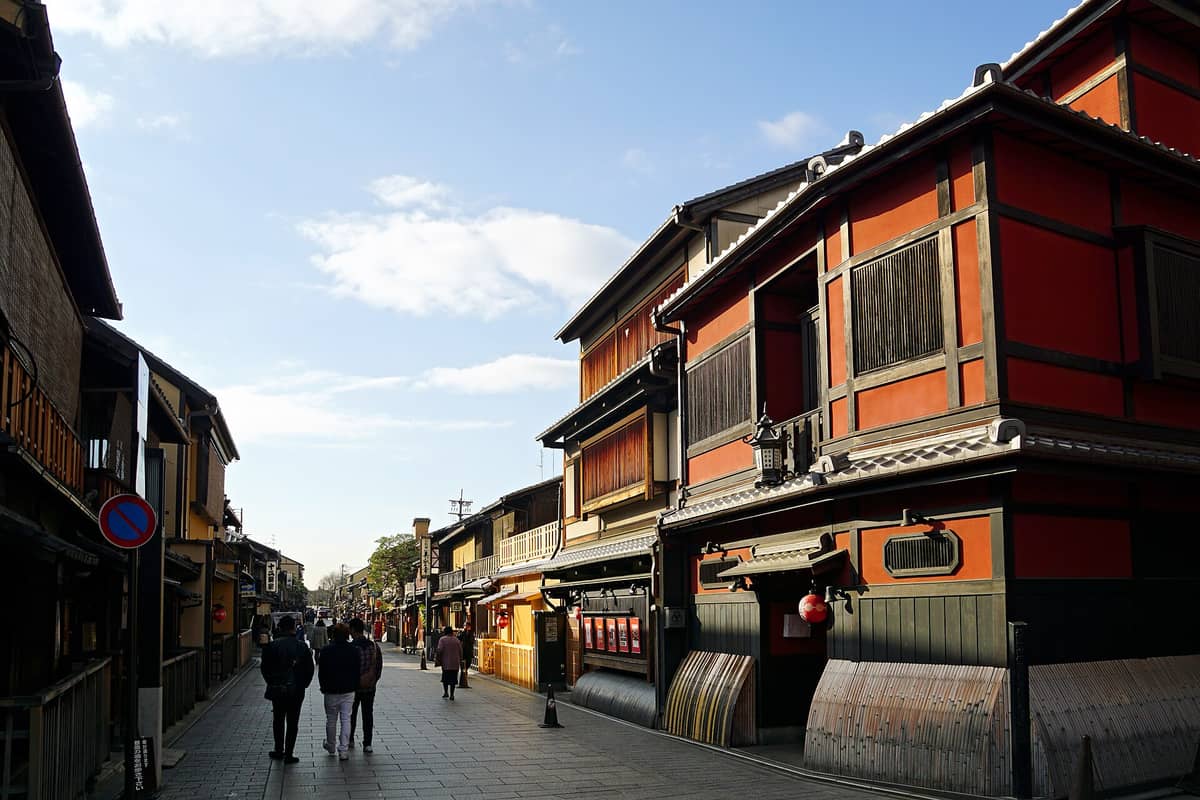
Both sides of the street are lined with traditional machiya townhouses, their narrow wooden facades darkened with age, latticed windows screening the interiors from view. Many are functioning ochaya, or teahouses, where geiko and maiko entertain private clients. These establishments are closed to the general public by default; the culture inside operates on introductions and long-standing relationships, not walk-in bookings.
The southern half of Hanamikoji is generally considered the more atmospheric section. North of Shijo-dori the street becomes more commercial, with restaurants and souvenir shops that are easier for visitors to enter. South of Shijo is where the older ochaya architecture concentrates and where the chance of seeing a geiko or maiko on the way to an evening appointment is highest.
ℹ️ Good to know
Hanamikoji Street is a public street, open 24 hours, with no ticket gates or entry points. Walking it costs nothing. The experience is almost entirely about observation, architecture, and atmosphere rather than access to buildings.
The Experience by Time of Day
Morning: Quiet and Unhurried
Before 9 AM, Hanamikoji is largely to yourself. Delivery trucks make their rounds at the teahouses, and the occasional shopkeeper sweeps the entrance to their machiya with a bamboo broom. The street smells of wood, old stone, and faintly of food preparation. The lanterns are off, and the grey light of morning makes the cedar and cypress facades look almost black. It is a genuinely different place at this hour, stripped of drama but rich in texture.
This is also the best window for photography without crowds. The reflective stone surface of the lane and the precise geometry of the wooden lattices photograph beautifully in soft morning light, without the mobile phones and tour group umbrellas that fill the frame by mid-morning.
Midday and Afternoon: Peak Crowds
Between 11 AM and 4 PM, especially on weekends and during cherry blossom or autumn foliage season, the street can become genuinely congested. Groups move slowly, smartphones go up constantly, and the narrow pavements create bottlenecks. The ochaya remain shut to passersby regardless of hour, so there is nothing to enter or queue for, which paradoxically makes the midday period feel somewhat purposeless if atmosphere is what you came for.
That said, afternoon is when the shops and accessible restaurants on the northern section are open and lively. If you want to sit down for kaiseki, tofu cuisine, or a coffee in a converted machiya, the afternoon hours work well for that practical component of the visit.
Dusk and Evening: The Essential Hour
The hour between 5 PM and 7 PM is when Hanamikoji becomes the place most visitors imagine before they arrive. The paper lanterns outside the ochaya illuminate in soft amber. The stone paving glows under street lamps. And if you position yourself patiently near the southern section on a weekday evening, you may see a geiko or maiko in full kimono and okobo wooden sandals, moving purposefully toward an appointment. These sightings are not staged, not guaranteed, and increasingly brief, as both geiko and maiko are understandably unwilling to be stopped for photographs.
The visual composition of the street at dusk is close to what appears in photography books on Kyoto. If capturing that atmosphere matters to you, this is one of the more reliable spots in the city. For a broader view of Gion after dark,Gion Shirakawa canalis a five-minute walk northeast and offers a complementary atmosphere with willow trees overhanging the water.
Tickets & tours
Hand-picked options from our booking partner. Prices are indicative; availability and final rates are confirmed when you complete your booking.
Kyoto Coast, Amanohashidate and Ine Bay 1-Day Trip from Osaka or Kyoto
From 46 €Instant confirmationFree cancellationKyoto Sanzen-in, Arashiyama and Bamboo Grove Full Day Tour
From 47 €Instant confirmationFree cancellationKyoto Arashiyama insider walking tour
From 66 €Instant confirmationFree cancellationMatcha green tea tour in Kyoto's Uji Market
From 130 €Instant confirmationFree cancellation
Architecture and Historical Context
The machiya townhouses that define Hanamikoji are a specific Kyoto building type: long, narrow wooden structures built on equally narrow plots, with a public-facing facade of dark timber lattice (koshi) and an interior that extends surprisingly deep from the street. The design evolved partly to reduce taxable street frontage while maximising interior space. In the ochaya context, the depth allows for multiple private dining and entertainment rooms arranged around inner gardens.
Gion Kobu, the district Hanamikoji anchors, developed during the Edo period (1603–1868) around the precincts of Yasaka Shrine. Its ochaya culture formalised during this era as a licensed entertainment district, and the architecture you see today largely reflects Meiji-era (1868–1912) rebuilding after fires, with later preservation efforts protecting the streetscape from the demolition that affected much of Kyoto's urban centre in the 20th century.
Gion Kobu remains home to the annual Miyako Odori, a traditional dance performance staged in spring at the Gion Kobu Kaburenjo Theatre, located just off Hanamikoji. This is one of the few ways visitors can experience Gion's performing arts in a formal setting. The broader context of geisha culture in Kyoto is detailed in ourKyoto geisha guide.
Practical Walkthrough: How to Do It
The most straightforward approach is to arrive at Keihan Gion-Shijo Station, use Exit 5 or 6, and walk west along Shijo-dori for roughly three minutes until you hit the stone-paved lane crossing at Hanamikoji. Turn south, cross the Shijo intersection, and continue into the quieter lower section. The full walk south to Kennin-ji takes about fifteen minutes at a relaxed pace.
From Kyoto Station, take city bus 100 or 206 toward Gion (about 20–30 minutes, depending on traffic) and alight at the Gion stop.Getting around Kyoto by bus and railcovers IC card options and day passes that make this journey cheaper if you plan to make multiple stops.
Wear comfortable shoes. The southern section has stone pavers that are attractive but uneven in places. After rain, some sections become slick. Heels are a poor choice, and while the street is technically flat and level, the surface texture makes it awkward for strollers and wheeled luggage.
💡 Local tip
For the best light and manageable crowds, visit on a weekday, arrive at the southern end around 5:30 PM, and walk slowly northward as the lanterns come on. Autumn (October–November) evenings are particularly atmospheric, with cooler air and occasional maple colour from temple gardens nearby.
Etiquette, Photography, and What Not to Do
Gion has become a focal point of Kyoto's ongoing conversation about overtourism and visitor behaviour. The core issue is that Hanamikoji is not a film set or a museum: it is a working district where geiko and maiko live and work. Pursuing, photographing without consent, or blocking the path of a geiko or maiko is considered disrespectful and has caused significant friction between the local community and visitors in recent years.
Private alleyways off Hanamikoji are marked with signs asking visitors not to enter. These are genuine working premises, not decorative backdrops. Street photography of the architecture, lanterns, and public spaces is generally fine. Photography of individuals requires judgment: if someone is moving quickly and clearly working, let them pass.
⚠️ What to skip
In some of Gion's private lanes, local district associations have posted notices discouraging photography and trespassing. These requests have no formal legal force for public streets, but ignoring them creates tension with local residents and degrades the experience for everyone. Treat the area as a neighbourhood first and a tourist attraction second.
If you want to understand the full etiquette framework for temple and shrine visits nearby, ourKyoto temple and shrine etiquette guideapplies many of the same principles of respectful visiting.
What to Combine It With
Hanamikoji is at the centre of a walkable cluster of Kyoto's best traditional streetscapes. Five minutes south brings you to Kennin-ji, the oldest Zen temple in Kyoto. Walking north and east from Shijo leads to theGion Shirakawa canal district, a quieter area of willow-lined waterways and preserved teahouse facades. The broader Higashiyama walking route, connecting Yasaka Shrine southward to Kiyomizu-dera, starts just a few blocks away.
If you are visiting in the evening and want to continue the night in Gion, Pontocho Alley is a roughly ten-minute walk west across the Kamo River, offering a dense concentration of restaurants and bars in a similarly preserved laneway. For a broader Gion evening plan, see our guide toYasaka Shrine, which anchors the northern end of Hanamikoji's broader district and is open around the clock.
Honest Assessment: Is It Worth Your Time?
If you visit at the wrong time, Hanamikoji can underwhelm. On a Saturday afternoon in late March or early November, the street is so crowded that its atmosphere largely disappears under the noise and density of visitors. At those times, the ochaya look like backdrops for selfies rather than working institutions, and the whole thing can feel like a lot of anticipation for a short walk.
Visited correctly, though, the street earns its reputation. There are very few places in any major Japanese city where centuries-old architecture, a functioning traditional arts culture, and a visually coherent streetscape coexist this intact. The experience rewards patience, timing, and an understanding of what you are actually looking at. Visitors who treat it purely as a photography backdrop leave having seen the surface. Those who slow down and watch how the street actually operates come away with something more durable.
People who should consider skipping or minimising time here: those travelling with very young children who cannot maintain quiet, visitors who feel frustrated by not being able to enter any of the buildings, and anyone visiting solely on weekend afternoons during peak season without the patience for crowds.
Insider Tips
- The best position to see geiko and maiko departing for evening engagements is on the western side of the street, south of Shijo-dori, between roughly 5:30 PM and 7:00 PM on weekdays. Weekends are less predictable because many ozashiki engagements shift accordingly.
- The northern half of Hanamikoji, above Shijo-dori, is far less photographed but contains some accessible restaurants serving kaiseki in converted machiya settings. Booking ahead is essential for the better ones.
- Early November is the intersection of manageable temperatures (averaging around 17°C) and the very beginning of autumn colour in nearby temple gardens. It is arguably the single best window of the year for visiting Hanamikoji in terms of aesthetics versus crowd balance.
- The Gion Kobu Kaburenjo Theatre, just off Hanamikoji, hosts the Miyako Odori dance performances in April. Tickets can be booked in advance and this is one of the only legitimate, public-facing ways to experience Gion's performing arts tradition from the inside.
- If the street feels too crowded, duck west into the narrower lanes between Hanamikoji and the Kamo River. The block or two immediately west of the main street retains a quieter, less curated version of the same architecture without the foot-traffic density.
Who Is Hanamikoji Street For?
- Travellers who want Kyoto's most iconic traditional streetscape and are willing to time their visit for dusk on a weekday
- Architecture and photography enthusiasts drawn to Edo and Meiji-era machiya wooden townhouse design
- Couples looking for a romantic evening walk in a preserved historic setting
- Cultural travellers interested in geisha history and traditional Japanese performing arts
- First-time visitors to Kyoto who want to understand the city's traditional identity in a single, walkable street
Nearby Attractions
Other things to see while in Gion:
- Gion Corner
Gion Corner offers two nightly performances showcasing seven classical Japanese art forms, from tea ceremony to maiko dance, inside a compact theatre steps from Gion's lantern-lit streets. It is one of the few places in Kyoto where visitors can experience the breadth of traditional performing arts in a single sitting, without needing to book multiple separate events.
- Gion Shirakawa
Gion Shirakawa is a free, open-air canal promenade in Kyoto's historic Gion district. Stone-paved paths run alongside the narrow Shirakawa Canal, past traditional ochaya teahouses, weeping cherry trees, and willow branches that trail into the water. It is one of the most photographed streetscapes in Japan, and one of the few places in Kyoto that rewards a visit at any hour of the day.
- Maruyama Park
Designated a National Place of Scenic Beauty, Maruyama Park is Kyoto's oldest public park and its most democratic green space: free to enter, open around the clock, and set directly beside Yasaka Shrine in the Gion district. Whether you arrive at dawn for quiet reflection or after dark during cherry blossom season, the park shows a different face each time.
- Yasaka Shrine
Yasaka Shrine stands at the eastern end of Shijō Street in Kyoto's Gion district, free to enter at any hour of the day or night. Dedicated to Susanoo-no-mikoto and dating to at least the 9th century, it anchors one of Japan's most storied neighborhoods and serves as the ceremonial heart of the Gion Matsuri festival every July.