Yasaka Shrine: Kyoto's Gion Landmark, Open Around the Clock
Yasaka Shrine stands at the eastern end of Shijō Street in Kyoto's Gion district, free to enter at any hour of the day or night. Dedicated to Susanoo-no-mikoto and dating to at least the 9th century, it anchors one of Japan's most storied neighborhoods and serves as the ceremonial heart of the Gion Matsuri festival every July.
Quick Facts
- Location
- 625 Gion-cho, Higashiyama-ku, Kyoto — eastern end of Shijō Street, Gion district
- Getting There
- City bus to 'Gion' stop, directly adjacent. Also walkable from Keihan Gion-Shijō Station (about 5 min) or along Shijō Street from central Gion.
- Time Needed
- 30–60 minutes for the grounds; longer if you linger in Maruyama Park next door
- Cost
- Free to enter the grounds. Shrine office (amulets, goshuin stamp) open approximately 9:00–17:00.
- Best for
- Night visitors, shrine architecture enthusiasts, festival season travelers, and anyone walking the Gion area
- Official website
- www.yasaka-jinja.or.jp/en
What Yasaka Shrine Actually Is
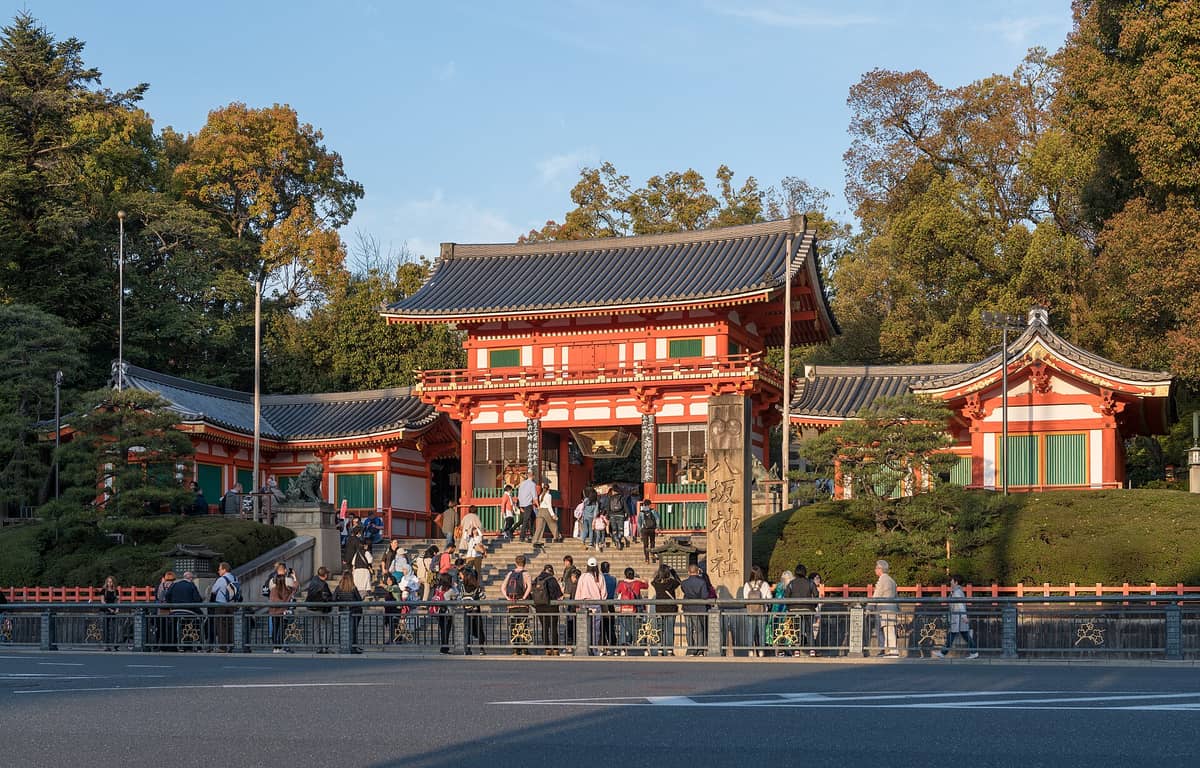
Yasaka Shrine (八坂神社) sits at the western gateway to the Higashiyama hills, where Shijō Street ends and the traditional streetscape of Gion begins. It is a working Shinto shrine, not a museum piece. On any given morning you will find local residents clapping their hands in prayer before the main hall, office workers pausing on their commute, and tourists photographing the dramatic two-story Nishirōmon gate from the street. All of this happens simultaneously and without particular friction — the shrine absorbs them all.
The grounds cover a significant area, with the main hall at the center, a large covered stage used for ritual dance performances, and a scattering of smaller subsidiary shrines dedicated to different deities. Stone lanterns line the approaches, and the smell of incense drifts from the main hall during active worship hours. The overall texture of the place is stone, aged wood, and packed gravel — nothing manicured or polished in the way a designed garden would be.
ℹ️ Good to know
Yasaka Shrine grounds are open 24 hours a day, every day of the year, with no admission fee. The shrine office (for purchasing amulets and receiving the goshuin calligraphic stamp) operates approximately 9:00–17:00, with possible variation during festivals or special ceremonies.
History and Cultural Significance
The shrine's recorded origins reach back to the Jōgan era, around 876 CE, when a Buddhist priest named Ennyo from Nara built a temple and enshrined Susanoo-no-mikoto at this location. Susanoo is one of the principal deities in the Shinto tradition: a storm god, a protector against plague, and in some traditions a god of the sea. The choice of deity was not arbitrary — the shrine's founding coincided with a period of epidemic, and prayers for protection from disease have been central to Yasaka's identity ever since.
That protective role directly explains the Gion Matsuri, the massive festival held every July that draws enormous crowds to Kyoto. The festival originated as a purification ritual sponsored by the shrine to ward off pestilence, and while it has grown into one of Japan's largest and most photographed cultural events, Yasaka Shrine remains its ceremonial anchor. If you plan to be in Kyoto during July, theGion Matsuri guidewill help you understand how the festival unfolds across the neighborhood.
The current main hall, registered as an Important Cultural Property of Japan, was rebuilt in 1654 under Tokugawa patronage. Its architectural style — combining the main worship hall and the inner sanctuary under a single sweeping roof — is known as Gion-zukuri, a style specific to this shrine and used as its name elsewhere. The roof's scale and proportions are best appreciated from the stone steps directly in front of the main hall, where you can trace the full span without obstruction.
Tickets & tours
Hand-picked options from our booking partner. Prices are indicative; availability and final rates are confirmed when you complete your booking.
Kyoto temples, shrines, and Kimonos guided day tour
From 8.800 €Instant confirmationFree cancellationShiga Day Trip with Miho Museum, Lake Biwa and Waterbird Shrine
From 70 €Instant confirmationFree cancellationKyoto Coast, Amanohashidate and Ine Bay 1-Day Trip from Osaka or Kyoto
From 46 €Instant confirmationFree cancellationKyoto Sanzen-in, Arashiyama and Bamboo Grove Full Day Tour
From 47 €Instant confirmationFree cancellation
The Experience at Different Times of Day
Early morning, before 8:00, is when Yasaka Shrine operates closest to its actual function. The lanterns above the entrance gate are still illuminated. A handful of worshippers move through quietly, the gravel crunching underfoot, and you can hear the wooden clap of hands at the main hall without any background noise from the street. The light at this hour, especially in autumn and winter, comes in low and golden through the gate's upper story. Photography here is straightforward — no crowds obscuring sightlines, and the warm lantern glow contrasts cleanly against a cool sky.
By mid-morning, tour groups arrive from the direction of the Shijō bus stop, and the atmosphere shifts. The shrine is large enough that it never feels claustrophobic, but the pace changes. Midday on weekends during cherry blossom season or autumn foliage can bring significant crowds, particularly given the shrine's proximity to Maruyama Park, which draws its own large numbers.
After dark is when Yasaka Shrine offers something genuinely different from most Kyoto temples, which close at dusk. The stone lanterns along the main path are lit, the gate glows red-orange against the night sky, and the footfall drops to a trickle. The surrounding streets of Gion take on a different quality after 20:00 — quieter, with the occasional sound of wooden sandals from a nearby ozashiki. Walking to Yasaka from the Nishiki Market area along Shijō at night and arriving at the illuminated gate is one of Kyoto's more atmospheric transitions.
💡 Local tip
The best photographs of the Nishirōmon gate are taken from Shijō Street, slightly to the west, where the full gate frame stands clear of surrounding structures. At night with the lanterns lit, a wide-angle lens or phone portrait mode works well. In the early morning, the gate faces east and catches directional light from behind the Higashiyama hills.
Walking the Grounds
The main entrance from Shijō Street involves climbing a broad stone staircase to reach the gate, then continuing up to the main hall plaza. This staircase is the visual centerpiece of the shrine from the street, but it is not wheelchair accessible. Visitors with mobility limitations should enter via the rear entrance through Maruyama Park, which connects to the main hall area, though that route includes a steep section and runs partially on the road surface. Accessible toilets are not on the shrine grounds; the nearest accessible restrooms are in Maruyama Park itself.
Once inside, the main hall is directly ahead. To the sides, smaller subsidiary shrines dot the grounds — including the Okuninushi-sha, associated with romance and marriage, which draws visitors hoping to tie small wooden ema plaques to the frames. Behind the main hall, the grounds open towardMaruyama Park, Kyoto's most central public park, where the flow between shrine and park is seamless. In cherry blossom season, the weeping cherry tree in Maruyama Park is visible from this rear section of the grounds.
The covered dance stage, called the Honden-mae Butai, stands to one side of the main hall plaza. During festivals and certain ceremonies, traditional dance and music performances take place here. Outside those periods, it stands empty — a large, beautifully proportioned wooden structure worth examining for the craft of its joinery and roof brackets.
Fitting Yasaka Into Your Gion Visit
Yasaka Shrine sits at the natural endpoint of a walk through the Gion district, which makes it easy to combine with the surrounding area without requiring a dedicated visit. Walking east from the Kamo River along Shijō Street, the shrine's gate appears at the top of the road after about 10 minutes. From the shrine, you can continue south into Higashiyama along the preserved lanes ofNinenzaka and Sannenzaka, which lead eventually to Kiyomizu-dera. You can also head north into the quieter streets ofGion Shirakawa, where narrow canals and willow trees line the back lanes used by the geisha districts.
For a coherent half-day, consider arriving at Yasaka in the early morning, walking south through Higashiyama toward Kiyomizu-dera, then returning through the covered shopping lanes ofHanamikoji Streettoward the Kamo River. This route passes through most of the historic core of eastern Kyoto without requiring any bus connections. The full walking picture of this part of the city is covered inKyoto walking tour routes if you want a structured itinerary.
Practical Details and What to Bring
Admission to the shrine grounds is free at all hours. The shrine office, where you can purchase omamori (protective amulets) or receive a goshuin calligraphic stamp in your stamp book, is open approximately 9:00–17:00. Hours may vary around major festivals or private ceremonies, so if the goshuin stamp is important to you, arriving before 16:00 gives comfortable margin.
The Gion city bus stop is very close to the main gate on Shijō Street, making the shrine one of the most directly accessible major shrines in Kyoto. Keihan Gion-Shijō Station is a 5-minute walk west along the river. There is no car parking at the shrine, and the streets of central Gion are narrow, so self-driving is not practical.
The shrine grounds are predominantly stone and packed gravel, which becomes slippery when wet. Comfortable shoes with grip are worth wearing year-round, but especially in rainy season (June through early July) and winter. Kyoto winters can drop close to 0°C at night, and if you plan an evening visit between December and February, layering is necessary — the open stone plaza at the main hall has no shelter from wind.
⚠️ What to skip
During the Gion Matsuri festival in July, the area around Yasaka Shrine becomes extremely crowded, particularly during the major processions. Streets close to vehicle traffic, crowds can be dense along Shijō Street, and accommodation in the surrounding area books out months in advance. If you are not specifically there for the festival, visiting outside July will be significantly more comfortable.
Who This Shrine Is and Isn't For
Yasaka Shrine works well for visitors who are walking the Gion area regardless of any strong interest in Shinto. It costs nothing, it is always open, the architecture is genuinely impressive, and it gives geographic and cultural context to the neighborhood around it. For first-time visitors to Kyoto, it is a logical anchor point for a day in eastern Kyoto.
Visitors looking for a contemplative, quiet temple experience may find the daytime atmosphere too transient — people move through without lingering, and the energy is closer to an active public square than to the meditative calm of a garden temple like Ryoan-ji. If that kind of stillness is the priority, arriving before 7:30 in the morning is the practical solution.
Travelers who are specifically chasing Kyoto's most spectacular visual experiences — the moss gardens, the vertiginous hillside views, the sea of torii gates — may find Yasaka more workmanlike than wow-inducing on its own. It is not the destination that appears on most bucket lists, but it is the kind of place that gives the rest of the area its coherence.
Insider Tips
- The stone lanterns inside the grounds are lit every evening, but the atmosphere peaks on the evenings around the Setsubun festival in early February and the Obon period in mid-August, when additional lanterns are placed throughout the grounds and the number of worshippers increases noticeably without reaching festival-level crowds.
- If you want the goshuin calligraphic stamp — increasingly popular among travelers as a meaningful keepsake — bring your own stamp book (goshuincho), which you can purchase at many shrine and temple gift shops across Kyoto. The shrine will stamp directly into the book in real time. Loose sheets of paper are sometimes accepted, but books are preferred.
- The rear exit toward Maruyama Park connects directly to the park's main pathways and is a useful shortcut during the day when the Shijō Street gate is congested with tour groups. Entering from Maruyama and walking toward the main hall gives you the approach in reverse — slightly quieter and without the staircase crowd.
- In late July during the Gion Matsuri, the shrine hosts the Mikoshi Togyo procession, in which portable shrines are carried through the streets. The departure point is Yasaka Shrine itself, making the shrine grounds an excellent place to witness the early ritual preparations before the procession departs — often less photographed than the procession itself.
- The subsidiary Okuninushi-sha within the grounds is specifically associated with en-musubi, the tying of bonds and relationships. It draws a quiet but steady stream of local visitors who come specifically for this, not the main shrine — it is easy to miss if you walk only to the main hall.
Who Is Yasaka Shrine For?
- Night owls and evening walkers who want a landmark accessible after most Kyoto temples have closed
- Travelers building a half-day route through Gion and Higashiyama who need a logical start or endpoint
- Festival enthusiasts visiting Kyoto in July for the Gion Matsuri
- Architecture and craftsmanship observers interested in the Gion-zukuri building style and Edo-period shrine construction
- Budget travelers, since the grounds are entirely free and adjacent to several other free or low-cost sights
Nearby Attractions
Other things to see while in Gion:
- Gion Corner
Gion Corner offers two nightly performances showcasing seven classical Japanese art forms, from tea ceremony to maiko dance, inside a compact theatre steps from Gion's lantern-lit streets. It is one of the few places in Kyoto where visitors can experience the breadth of traditional performing arts in a single sitting, without needing to book multiple separate events.
- Gion Shirakawa
Gion Shirakawa is a free, open-air canal promenade in Kyoto's historic Gion district. Stone-paved paths run alongside the narrow Shirakawa Canal, past traditional ochaya teahouses, weeping cherry trees, and willow branches that trail into the water. It is one of the most photographed streetscapes in Japan, and one of the few places in Kyoto that rewards a visit at any hour of the day.
- Hanamikoji Street
Hanamikoji Street is the main artery of Gion Kobu, Kyoto's best-preserved geisha district. A one-kilometre stretch of wooden machiya townhouses, lantern-lit ochaya teahouses, and the occasional glimpse of a geiko or maiko at dusk, it distills old Kyoto into a single walk. Entry is free and the street is open around the clock.
- Maruyama Park
Designated a National Place of Scenic Beauty, Maruyama Park is Kyoto's oldest public park and its most democratic green space: free to enter, open around the clock, and set directly beside Yasaka Shrine in the Gion district. Whether you arrive at dawn for quiet reflection or after dark during cherry blossom season, the park shows a different face each time.