Nationaltheatret (National Theatre Oslo): The Stage at the Heart of the City
Oslo's National Theatre, Nationaltheatret, has been the country's most prestigious stage since 1899. Occupying a grand neo-baroque building between the Royal Palace and the Storting, it stages everything from Ibsen classics to contemporary Norwegian drama. Even if you never buy a ticket, the building itself tells you something important about how seriously Norway takes its cultural institutions.
Quick Facts
- Location
- Johanne Dybwads plass 1, 0161 Oslo — Sentrum
- Getting There
- Nationaltheatret station (T-bane lines 1–5, tram lines 13 & 19, regional train)
- Time Needed
- 30–45 min for the exterior and surroundings; 2–3 hours for a full performance
- Cost
- Free to view from outside; performance tickets vary by production
- Best for
- Architecture lovers, theatre-goers, Ibsen fans, first-time Oslo visitors
- Official website
- www.nationaltheatret.no
What Is Nationaltheatret?
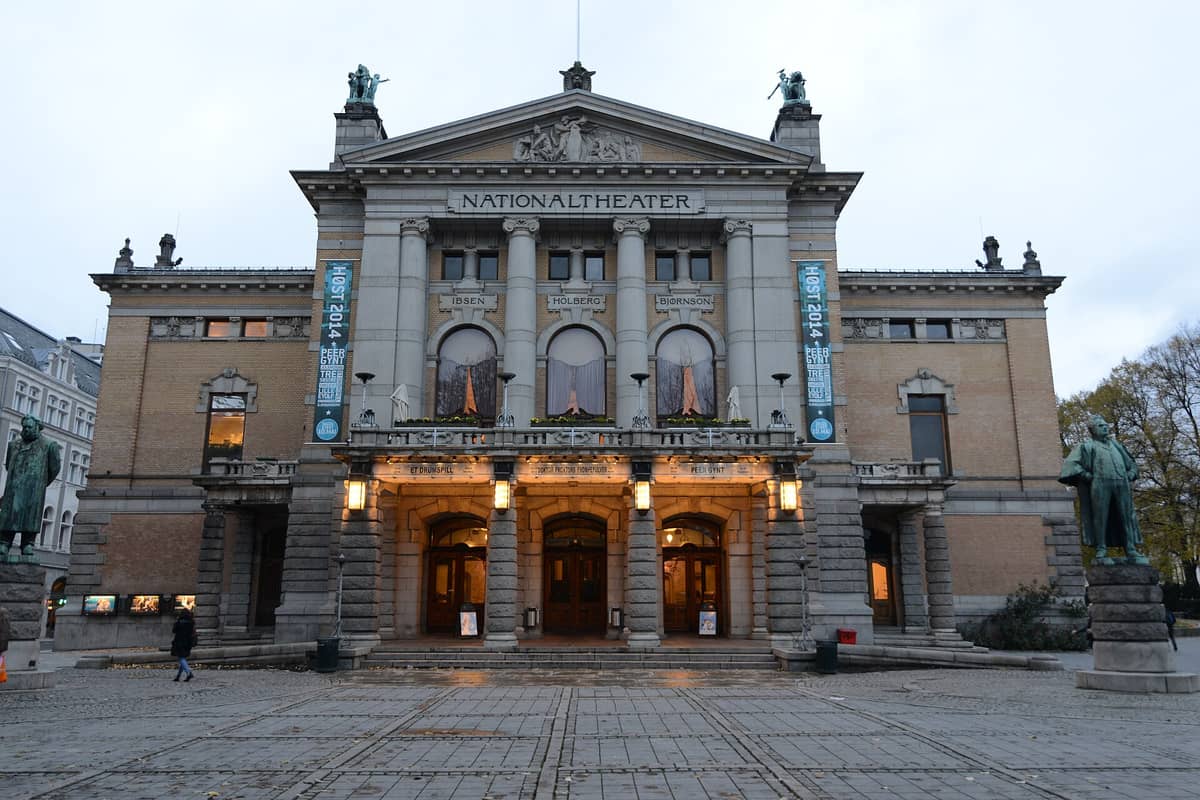
The National Theatre, known in Norwegian as Nationaltheatret, is Norway's principal theatre and one of the most recognisable buildings in Oslo's city centre. Opened on 1 September 1899, it was built specifically to serve as a permanent home for Norwegian-language drama at a time when the country was still in a political union with Sweden and Norwegian cultural identity was a matter of active national debate. The building was designed by architect Henrik Bull in a style that blends neo-baroque ornamentation with the more restrained Nordic sensibility of its era.
More than a century on, the theatre still operates as a producing house, staging original Norwegian work alongside international classics, with a particular emphasis on Henrik Ibsen, whose statue stands with Bjørnstjerne Bjørnson's at the main entrance. If you know anything about Ibsen's relationship to modern drama, standing in front of this building carries a particular weight. This is not just a civic monument. It was built to make a point about what Norwegian culture was capable of.
The Building: Architecture Worth Pausing Over
Nationaltheatret sits on its own small plaza, Johanne Dybwads plass, set back slightly from Stortingsgata. The facade is symmetrical and self-assured, clad in pale stone with arched windows, decorative friezes, and a central portico that signals importance without becoming pompous. Henrik Bull was in his late thirties when he won the competition to design it, and the result reflects both the ambitions of the era and a genuine architectural confidence.
The bronze statues flanking the entrance are worth stopping for. The one on the left is Henrik Ibsen; the one on the right is Bjørnstjerne Bjørnson, the playwright and poet who won the Nobel Prize in Literature in 1903. Both men were instrumental in shaping what Norwegian theatre became, and placing them here in bronze was a deliberate act of cultural canonisation. Locals walk past them daily without a glance. Visitors tend to stop, which tells you something about the building's quiet power.
💡 Local tip
The best light for photographing the facade falls in the late afternoon, when the low Oslo sun hits the stone from the west. The plaza itself is calm enough on most mornings to compose a clean shot without crowds.
The theatre is framed by Karl Johans gate, Oslo's main ceremonial boulevard, which runs from the Royal Palace at the western end down to Oslo Central Station in the east. The Nationaltheatret sits almost exactly at the midpoint of this axis, which gives the building a civic centrality that no amount of renovation could manufacture.
Tickets & tours
Live prices and dates from our booking partner. If you book, we may earn a commission at no extra cost to you.
Oslo Fjord sightseeing audio-guided electrical boat tour
From 35 €Instant confirmationFree cancellationFjord cruise with live jazz music
From 64 €Instant confirmationFree cancellationLuggage Storage in Oslo
From 6 €Instant confirmationFree cancellationPicturesque dinner cruise in Oslo
From 137 €Instant confirmationFree cancellation
The Stages and What Gets Performed
The main building contains three performance spaces: the Main Stage (Hovedscenen), the Amfiscene, and the Malersalen. Each has a distinct character. The Main Stage is a traditional horseshoe-shaped auditorium with tiered balconies, red velvet, and the kind of gilded detail that makes you sit up straight. The Amfiscene is more intimate, used for smaller productions and experimental work. The Centrumscenen occupies the basement level and accommodates the most unconventional programming.
The repertoire skews toward Norwegian classics and contemporary European work. Ibsen is a perennial presence, but the theatre also commissions new Norwegian plays and stages international work in translation. Performances are conducted in Norwegian, which means non-Norwegian speakers are attending for the stagecraft, the design, and the cultural experience rather than the text. That is a legitimate reason to go. Norwegian theatrical production values are high, and a well-staged Ibsen in the Main Stage is worth attending even without full comprehension of the language.
Check the programme on the official website well in advance. Popular productions sell out weeks ahead, and the Main Stage fills quickly for marquee premieres. There is no standard ticket price because every production is priced individually. The ticket counter is normally open Monday to Friday from 13:30 until performance (Saturdays from 12:30), while reception phone hours are Monday to Friday, 09:00 to 15:30, and most ticket purchases are handled online or at the venue on performance nights.
The Surrounding Area: What You'll Find on Foot
The Nationaltheatret sits at one of the most walkable intersections in central Oslo. To the west, Karl Johans gate leads uphill toward the Royal Palace and the gardens of Slottsparken. To the east, the same street carries you past the Storting (parliament) and down toward Oslo Cathedral and the commercial centre of Sentrum.
Directly across Stortingsgata to the south is Studenterlunden, a small park that fills with office workers during lunch hours on dry days. A few minutes further south, the street opens out toward Oslo City Hall and the waterfront at Aker Brygge. The concentration of significant buildings within a ten-minute walk is one of the genuine advantages of staying in or near Sentrum.
On the north side of the theatre, the Nationaltheatret station sits below street level, one of the busiest transit hubs in the city. T-bane lines 1 through 5 all stop here, as do tram lines 13 and 19, making this one of the easiest major attractions to reach from anywhere in Oslo without a car.
Time of Day: How the Experience Changes
In the mornings, the plaza around Nationaltheatret is quiet. Commuters filter through without stopping, and the building reads as part of the city's background rather than a destination. This is actually an ideal time to examine the architecture without distraction. The stone detail on the upper facade and the ironwork on the entrance gates are worth a close look, and you will have the statues of Ibsen and Bjørnson largely to yourself.
By early evening, especially on performance nights, the mood shifts considerably. Theatre-goers gather outside before curtain, and the foyer lights up in a way that makes the whole building feel purposeful. In winter, when Oslo is dark by mid-afternoon, the illuminated facade against the black sky is one of the better incidental images the city offers. The smell of damp wool coats and cold air is part of the experience.
Summer brings a different quality. Oslo's long evenings mean performances that start at 19:00 or later are bathed in soft natural light well into the first act. Audiences gather outside in shirt sleeves, the palace gardens are green at the far end of Karl Johans gate, and the theatre feels like the centre of a city that has temporarily forgotten it is in northern Europe. If you are visiting between June and August, an evening performance is worth planning around.
ℹ️ Good to know
Oslo's summer solstice brings nearly 18 hours of daylight. An evening performance in June means you'll walk out at 22:00 into a city that still looks like late afternoon.
Ibsen, Bjørnson, and the Cultural Weight of This Building
It would be easy to treat Nationaltheatret as simply a grand Victorian theatre, but the building is more loaded than that. When it opened in 1899, Norway had no independent state (independence from Sweden came in 1905). Building a national theatre was a cultural-political act, a statement that Norwegian language and Norwegian drama deserved a permanent, monumental home. Henrik Ibsen's works, including A Doll's House, Hedda Gabler, and Ghosts, had by then transformed European drama. The decision to place his likeness at the entrance was not decorative. It was a declaration.
For visitors with a serious interest in Ibsen's life and legacy, the cultural Oslo trail extends well beyond this building. But the theatre remains the most immediate architectural expression of what Ibsen and his contemporaries meant to Norwegian self-understanding. Even if you skip the performance, standing in front of this building and knowing a little of that context changes what you see.
Practical Notes for Visitors
There is no admission fee to walk the plaza, view the exterior, or photograph the building. The interior is accessible to ticket holders on performance nights and during official guided tours when available. The reception (Monday to Friday, 09:00 to 15:30) can answer questions by phone about upcoming productions and tour availability.
Accessibility is taken seriously. Wheelchair spaces are bookable digitally for all three stages, and holders of recognised companion documentation receive a free companion ticket. The station directly beneath the theatre is lift-accessible from street level, making this one of the more straightforward major venues to reach by public transit for visitors with mobility needs.
If you are planning a broader cultural day in Sentrum, the Nationaltheatret pairs naturally with the National Museum, which is a short walk to the west, and the Nobel Peace Center near the waterfront. For a fuller picture of Oslo's arts and culture scene, the Oslo museums guide covers how to sequence the major institutions efficiently.
⚠️ What to skip
Performances are in Norwegian with no English subtitles as standard. Check the programme notes carefully before booking if language comprehension is a priority for your visit.
Who Should Consider Skipping
If you have no interest in theatre and architecture leaves you cold, this is not a destination attraction in the way that a major museum is. The exterior is impressive but takes ten minutes to absorb. The real value is in attending a performance, and that requires either comfort with Norwegian or a willingness to experience drama without following every word. Visitors on tight schedules who are choosing between this and the major Bygdøy museums will likely get more from a day on the peninsula.
Insider Tips
- Book performance tickets directly through the official website at nationaltheatret.no as soon as you know your travel dates. The Main Stage sells out well in advance for major productions, particularly Ibsen revivals and Norwegian-language premieres.
- The Nationaltheatret T-bane station has separate entrance halls decorated with original artwork as part of Oslo's tradition of commissioning art for metro stations. The westbound platform hall is worth a look even if you are not catching a train.
- Late afternoon on a weekday, the plaza is at its quietest and the light hits the facade from the west at a useful angle. The statues of Ibsen and Bjørnson photograph better in this light than in flat midday overcast.
- If attending a winter performance, dress warmly for the wait outside. The foyer opens to ticket holders shortly before curtain, and Oslo evenings from October through March are genuinely cold. Standing in a queue in dress clothes on a December night is less charming than it sounds.
- For performance nights, the surrounding streets have several good pre-theatre dining options within a five-minute walk. Arrive with time to eat nearby rather than relying on the foyer bar alone.
Who Is National Theatre (Nationaltheatret) For?
- Architecture and history enthusiasts who want to understand the civic ambitions of late 19th-century Oslo
- Theatre-goers comfortable attending performances in Norwegian or interested in experiencing a world-class European stage
- Ibsen and Bjørnson devotees who want to see the building built in their cultural honour
- Visitors doing a Karl Johans gate walking tour who want context for the buildings along the route
- Travellers visiting in summer who can combine a long-light evening performance with a walk through Slottsparken before curtain
Nearby Attractions
Other things to see while in Sentrum (City Centre):
- Akershus Castle and Fortress
Akershus Fortress (Akershus slott og festning) is a medieval royal stronghold that has guarded Oslo's harbour since around 1299. The fortress grounds are free to enter year-round, offering sweeping Oslofjord views, cobblestone courtyards, and a castle interior that spans seven centuries of Norwegian history.
- Damstredet & Telthusbakken
Two short streets in central Oslo preserve what the rest of the city lost to fire and modernisation: timber houses from the late 1700s and early 1800s, still inhabited, still cobbled. Free to walk at any hour, Damstredet and Telthusbakken offer a rare glimpse of pre-industrial Oslo just minutes from the parliament building.
- Historical Museum (Historisk Museum)
Housed in a grand early 20th-century building on Tullinløkka in central Oslo, the Historical Museum holds some of Norway's most remarkable ancient objects, from Viking gold jewelry to Egyptian mummies and Arctic indigenous artifacts. It is one of the most substantive indoor experiences the city offers, and it rewards visitors who take their time.
- National Museum (Nasjonalmuseet)
The National Museum (Nasjonalmuseet) is Norway's largest museum for art, architecture, and design, housed in a landmark building on the Oslo waterfront. From Edvard Munch's original Scream to Norwegian design and painting and centuries of decorative arts, it holds the country's most significant cultural collections under one roof.
Planning a trip? Discover personalized activities with the Nomado app.