Damstredet & Telthusbakken: Oslo's Forgotten Wooden Streets
Two short streets in central Oslo preserve what the rest of the city lost to fire and modernisation: timber houses from the late 1700s and early 1800s, still inhabited, still cobbled. Free to walk at any hour, Damstredet and Telthusbakken offer a rare glimpse of pre-industrial Oslo just minutes from the parliament building.
Quick Facts
- Location
- Central Oslo — between Akersveien and Fredensborgveien / Maridalsveien
- Getting There
- Bus lines 34 and 54 to the foot of Telthusbakken; approx. 15-min walk from Stortinget (Parliament)
- Time Needed
- 30–60 minutes for a relaxed walk through both streets
- Cost
- Free — public streets, open 24 hours year-round
- Best for
- Architecture lovers, photographers, history walkers, anyone curious about pre-modern Oslo
What You're Actually Looking At
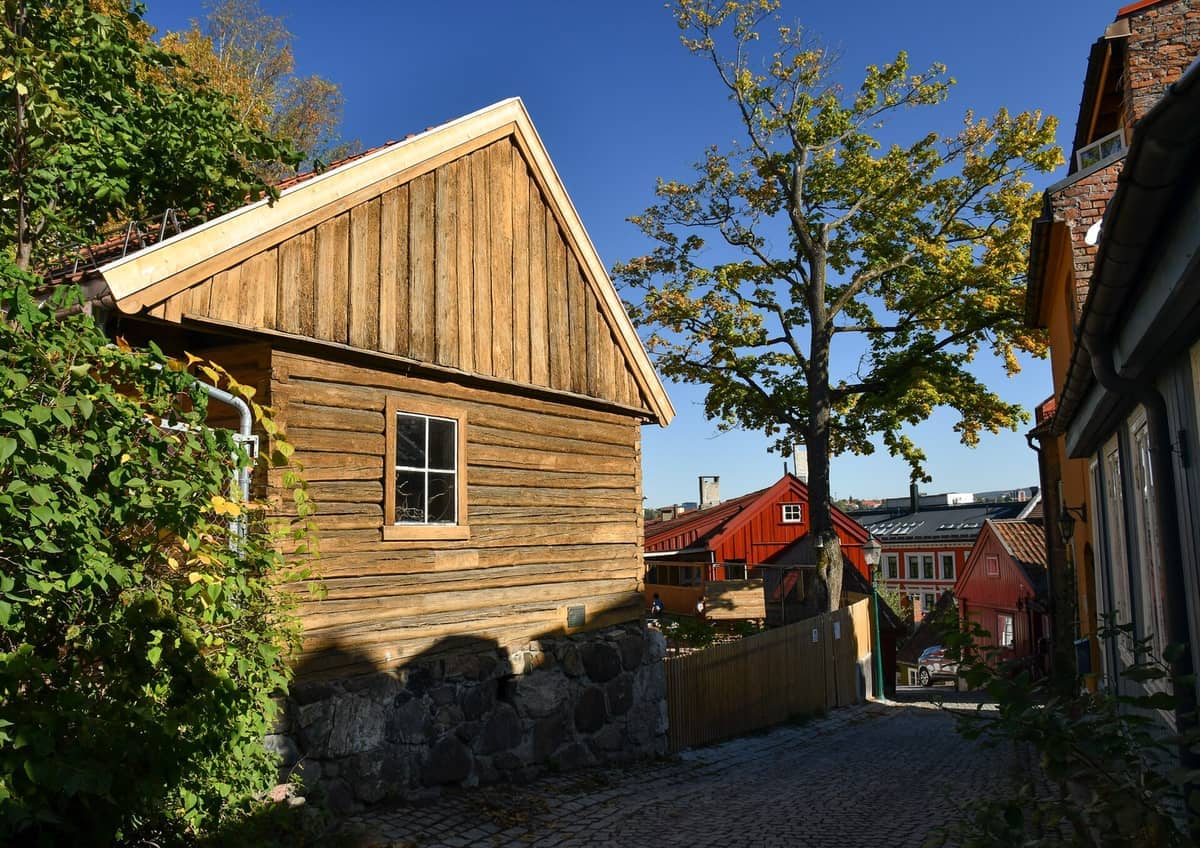
Most of Oslo's historic wooden buildings are gone. Fire, wartime redevelopment, and the relentless logic of urban expansion swept them away over the 19th and 20th centuries. What survives on Damstredet and Telthusbakken is therefore remarkable not just aesthetically but historically: two short streets where low timber houses from the late 1700s and early 1800s still stand, still carry residents, and still face cobblestones rather than asphalt.
Damstredet is the shorter of the two at around 160 metres, running between Akersveien and Fredensborgveien. The houses along it are mostly from the first half of the 19th century, painted in the muted earth tones typical of Norwegian vernacular architecture — ochres, deep reds, pale yellows. The street itself is narrow enough that the eaves feel close overhead, and the texture underfoot shifts constantly between worn stone sets and packed earth at the edges.
Telthusbakken is longer (roughly 260 metres) and considerably steeper, climbing from Maridalsveien up to Akersveien with small wooden houses lining one side and the Egebergløkka allotment gardens on the other. Above the roofline at the top of the hill, the tower of Gamle Aker Church — Oslo's oldest surviving building, dating to the 12th century — comes into view. The combination of medieval church, 18th-century timber houses, and active kitchen gardens in one eyeline is quietly extraordinary.
ℹ️ Good to know
Both streets are lived-in residential areas, not open-air museums. Residents come and go throughout the day. Keep voices down in the early morning and evening, and stay on the pavement rather than stepping into private garden spaces.
How the Streets Change Through the Day
Morning light, particularly in spring and summer, hits the south-facing facades of Damstredet at a low angle that brings out the grain of the painted timber and deepens the shadows between window frames. Between roughly 7am and 9am, the street sees its quietest pedestrian traffic: the occasional resident heading out, cats on windowsills, and the smell of wood and damp stone warming in the sun. This is the best window for photography — the soft light, the absence of crowds, and the stillness make it feel genuinely removed from the city.
Midday on a weekday brings a modest but noticeable increase in walkers, particularly in summer when tourists make the short detour from the centre. Even then, the streets rarely feel crowded. The residential scale simply doesn't allow for the kind of mass tourism that gathers at the Royal Palace or the Opera House. By late afternoon, the quality of light shifts again on Telthusbakken — the western-facing allotment gardens catch the sun while the wooden houses on the eastern side fall into softer shadow, making the climb up toward Gamle Aker particularly photogenic.
In winter, the streets take on a different character entirely. Snow settles on the low roof pitches and between the cobblestones, and the bare branches of garden trees frame the facades clearly. The combination of frozen cobbles and steep gradient on Telthusbakken demands attention underfoot — sturdy shoes with grip are genuinely necessary, not a guidebook cliche, between November and March.
Tickets & tours
Live prices and dates from our booking partner. If you book, we may earn a commission at no extra cost to you.
Oslo Fjord sightseeing audio-guided electrical boat tour
From 35 €Instant confirmationFree cancellationFjord cruise with live jazz music
From 64 €Instant confirmationFree cancellationLuggage Storage in Oslo
From 6 €Instant confirmationFree cancellationPicturesque dinner cruise in Oslo
From 137 €Instant confirmationFree cancellation
Historical Context: Why These Streets Survived
Oslo — known as Christiania until 1925 — expanded rapidly through the 19th century, and most of the low wooden buildings that once characterised the city's inner districts were demolished to make room for brick apartment blocks. The fact that Damstredet and Telthusbakken survived is partly geographic luck (the steep terrain made large-scale redevelopment less attractive) and partly the result of later preservation efforts. The houses here represent the kind of modest urban vernacular that once housed Oslo's working population: craftsmen, small traders, and labourers who lived close to the medieval core of the city. The area sits at the edge of what was historically the northern boundary of the city, close to Gamle Aker Church, which has stood on its hill since the 12th century and remains Oslo's oldest building in continuous use. For a deeper look at how this medieval layer connects to the rest of the city, the Historical Museum Oslo provides useful context on the city's development from medieval settlement to modern capital.
The preservation of inhabited wooden houses in a capital city is genuinely unusual in Scandinavia. Stockholm has Gamla Stan; Copenhagen has Nyhavn. Oslo's equivalent — less polished, more quietly authentic — is here, on these two streets that most visitors walk past on their way to somewhere else.
Walking the Streets: A Practical Route
The most logical approach is to start at the lower end of Telthusbakken on Maridalsveien, walk the full length uphill to Akersveien, then turn right and continue briefly to the start of Damstredet, walking its length down to Fredensborgveien. The full circuit takes 20 to 30 minutes at a relaxed pace; allow longer if you're stopping to photograph or simply standing to look at the buildings.
From the city centre, the walk takes around 15 minutes on foot from Stortinget. The route up through St. Olavs plass and along Akersveien is straightforward and passes several cafes if you want to stop before or after. Alternatively, bus lines 34 and 54 stop near the foot of Telthusbakken on Maridalsveien. The streets are part of a wider area worth exploring: the Akerselva river walk begins nearby and extends northward through some of Oslo's most interesting post-industrial landscapes.
⚠️ What to skip
Telthusbakken is steep and the cobblestones are uneven. For wheelchair users or anyone with significant mobility limitations, the street is not accessible. Damstredet is flatter but still cobbled, with narrow pavements that can be tricky on wet or icy days.
Photography: What Works, What Doesn't
These streets photograph better than most Oslo attractions, but they reward patience. The tight street widths mean wide-angle lenses cause significant distortion; a 35mm or 50mm equivalent gives more natural proportions for the facades. On Damstredet, position yourself at the Akersveien end and shoot down the street toward Fredensborgveien for the best compression of the rooflines. On Telthusbakken, the view looking up from near the allotment gardens with Gamle Aker Church in the background works well in morning and late-afternoon light.
Overcast days are actually preferable to harsh midday sun here: the diffuse light brings out the subtlety of the painted timber colours without burning out the whites. If you're building a photography itinerary around Oslo's architectural character, combining these streets with Ekebergparken Sculpture Park and a walk through Grünerløkka covers a good range of the city's architectural eras in a single day.
What's Around the Streets
The immediate neighbourhood is quiet and residential, but there are a handful of cafes within a few minutes' walk on Akersveien and toward St. Olavs plass. The area is part of Oslo's broader Sentrum district, which connects easily to several major cultural sites. Akershus Fortress is about 20 minutes on foot to the south, and the National Museum is a similar distance to the west. If you're planning a broader day exploring the city's less-touristed corners, the medieval remains at Gamlebyen are worth adding to the route — they represent another layer of Oslo's history that survives largely off the main tourist track.
For a complete Oslo walking itinerary that includes both of these streets and situates them within the city's wider geography, the Oslo walking tours guide covers several self-guided routes that pass through the area.
Clear Assessment: Is It Worth the Detour?
If you're expecting a polished heritage attraction with interpretive signage, a gift shop, and a clear narrative arc, you'll be disappointed. There is none of that here. Damstredet and Telthusbakken are simply two streets that happen to have survived, and what they offer is the specific pleasure of walking through a place that looks and feels genuinely old without being curated or commercialised.
Visitors who appreciate urban texture, architectural history, or the quieter corners of cities will find them genuinely rewarding. Those expecting a high-impact, Instagram-obvious spectacle should be aware that the appeal is subtler: the scale of the houses, the quality of the light on old timber, the sense that ordinary life has continued here for two centuries while the rest of the city changed beyond recognition.
For anyone visiting Oslo on a clear morning with an hour to spare, the combined walk takes no more than 45 minutes including the climb up Telthusbakken to Gamle Aker Church. That's an efficient use of time for what is, on its own modest terms, one of the most authentic streetscapes in the Norwegian capital.
Insider Tips
- Walk Telthusbakken uphill rather than down — the view of Gamle Aker Church appearing above the roofline as you climb is the best reveal the street offers, and you lose it entirely if you approach from above.
- The allotment gardens on the west side of Telthusbakken are at their most photogenic in late spring and early summer, when the plots are in active use and the contrast with the old wooden houses is sharpest.
- Combine the walk with Gamle Aker Church at the top of the hill — it's Oslo's oldest building, free to enter when open, and almost completely unknown to casual tourists. The churchyard offers a high vantage point back over the streets below.
- Avoid midday in July if you want the streets to yourself. The summer tourism peak brings more foot traffic, and the narrow scale of Damstredet means even a small group of people can fill the street. Early morning or early evening are noticeably quieter.
- The surrounding blocks between Akersveien and Fredensborgveien contain several independent cafes that serve the local residential community rather than tourists — prices are accordingly lower than in the city centre.
Who Is Damstredet & Telthusbakken For?
- Architecture and urban history enthusiasts who want to see pre-modern Oslo outside a museum context
- Photographers looking for natural light on old timber facades, away from crowds
- Walkers building a half-day route through the older northern parts of central Oslo
- Travellers who have already covered the main sights and want something quieter and less visited
- Anyone interested in Scandinavian vernacular building traditions and how they survived in a modern capital
Nearby Attractions
Other things to see while in Sentrum (City Centre):
- Akershus Castle and Fortress
Akershus Fortress (Akershus slott og festning) is a medieval royal stronghold that has guarded Oslo's harbour since around 1299. The fortress grounds are free to enter year-round, offering sweeping Oslofjord views, cobblestone courtyards, and a castle interior that spans seven centuries of Norwegian history.
- Historical Museum (Historisk Museum)
Housed in a grand early 20th-century building on Tullinløkka in central Oslo, the Historical Museum holds some of Norway's most remarkable ancient objects, from Viking gold jewelry to Egyptian mummies and Arctic indigenous artifacts. It is one of the most substantive indoor experiences the city offers, and it rewards visitors who take their time.
- National Museum (Nasjonalmuseet)
The National Museum (Nasjonalmuseet) is Norway's largest museum for art, architecture, and design, housed in a landmark building on the Oslo waterfront. From Edvard Munch's original Scream to Norwegian design and painting and centuries of decorative arts, it holds the country's most significant cultural collections under one roof.
- National Theatre (Nationaltheatret)
Oslo's National Theatre, Nationaltheatret, has been the country's most prestigious stage since 1899. Occupying a grand neo-baroque building between the Royal Palace and the Storting, it stages everything from Ibsen classics to contemporary Norwegian drama. Even if you never buy a ticket, the building itself tells you something important about how seriously Norway takes its cultural institutions.
Planning a trip? Discover personalized activities with the Nomado app.