Ekebergparken Sculpture Park: Art, Views, and Forest Trails Above Oslo
Ekebergparken Sculpture Park sits on a wooded hillside southeast of Oslo's city center, combining a rotating collection of contemporary sculpture with sweeping views over the Oslofjord. Entry is free, the park is open around the clock, and the experience shifts dramatically depending on what time of day and season you visit.
Quick Facts
- Location
- Kongsveien 23, 0193 Oslo — hillside southeast of the city center
- Getting There
- Tram 13 or 19 to Ekebergparken; Bus 34 or 74 to Ekeberg Camping. Parking is limited — public transport strongly recommended.
- Time Needed
- 1.5 to 3 hours for the main loop; longer if you take forest detours
- Cost
- Free — park has no admission fee; museum exhibition is generally free during opening hours
- Best for
- Art lovers, urban hikers, families, photographers, and anyone wanting Oslo views without paying for them
- Official website
- ekebergparken.com/en
What Ekebergparken Actually Is
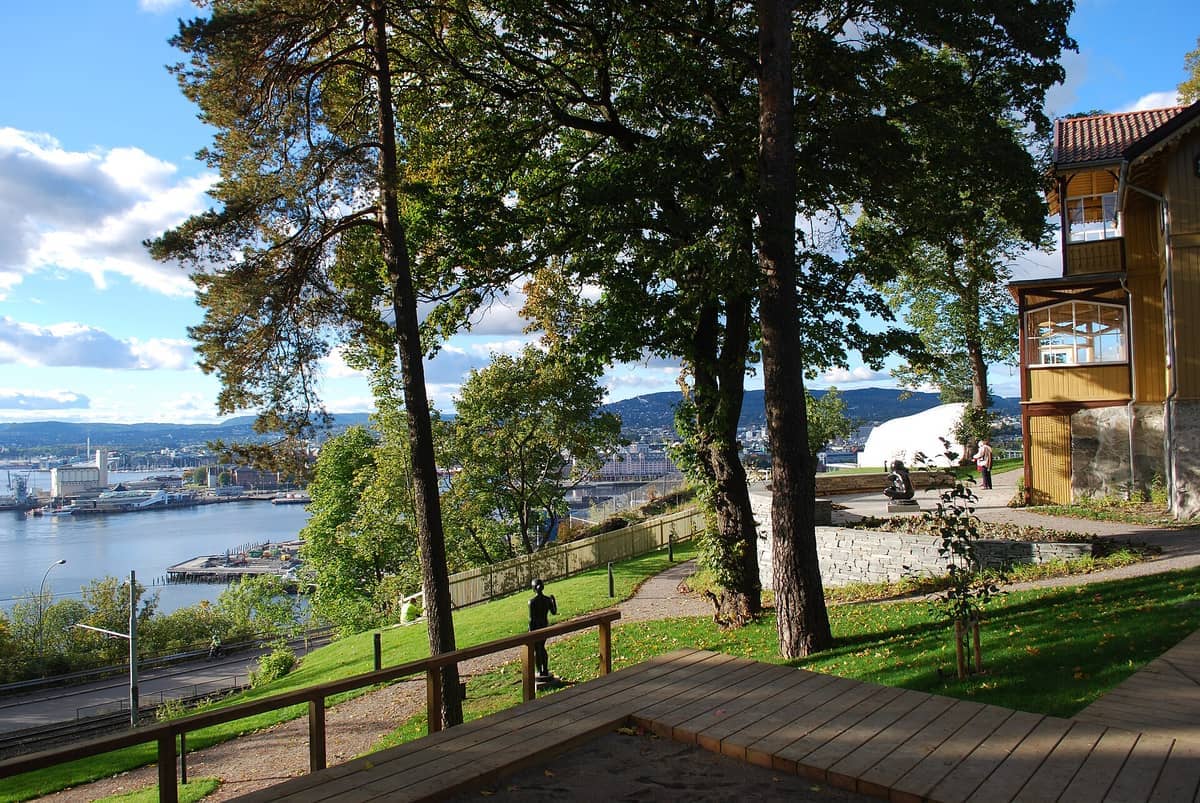
Ekebergparken Sculpture Park is a roughly 25-hectare (63-acre) public park on the Ekeberg ridge, about two kilometers southeast of Oslo's city center. It opened in its current form in 2013 after private investment transformed a long-neglected municipal green space into one of Scandinavia's most ambitious open-air sculpture collections. Today it holds more than 40 permanent works by artists including Louise Bourgeois, Tracey Emin, Salvador Dalí, and Damien Hirst, set among oak woodland, lawns, and steep forest paths.
What makes the park unusual is the layering. You are walking through a place with Bronze Age rock carvings, a history of use as a wartime military area, and a panoramic overlook that once inspired Edvard Munch. Contemporary sculpture is scattered across this terrain without fencing or ropes. You can stand directly beside works that would require a timed ticket and a museum guard in any other context. That open, unchoreographed quality is the park's defining characteristic.
ℹ️ Good to know
The park is open 24 hours a day, every day of the year, and free to visit. The Ekebergparken Museum and shop (Lunds hus) has separate, seasonal hours — see the official website for current times before visiting.
The View: Why the Location Matters
The park sits on a natural platform above the city, and the view from the main lawn area is genuinely arresting. On clear days you can trace the full sweep of the inner Oslofjord from the Akershus peninsula west to the Bygdøy headland, with the Oslofjord islands visible beyond. The Oslo Opera House, the Barcode high-rise block, and the harbor cranes at Filipstad are all laid out below in a single unobstructed frame.
This vantage point has historical weight. Munch lived nearby on Ekeberg for a period in the late 1800s, and art historians widely associate the view from this ridge with the exact location where he developed the imagery behind The Scream. A small plaque marks the approximate spot. Standing there in late afternoon with the city below and a colored sky overhead, the connection feels less like a tourist talking point and more like a genuine place memory.
For photographers, the overlook faces roughly southwest, which means the best natural light falls in the late afternoon and early evening during summer. In winter, when the sun stays low, the golden-hour light can appear as early as 2pm and creates long shadows across the lawns and sculpture. Bring a wide lens if you want to capture both the art and the cityscape in the same frame.
Tickets & tours
Live prices and dates from our booking partner. If you book, we may earn a commission at no extra cost to you.
Oslo Fjord sightseeing audio-guided electrical boat tour
From 35 €Instant confirmationFree cancellationFjord cruise with live jazz music
From 64 €Instant confirmationFree cancellationLuggage Storage in Oslo
From 6 €Instant confirmationFree cancellationPicturesque dinner cruise in Oslo
From 137 €Instant confirmationFree cancellation
Walking the Park: Main Loop and Forest Trails
The park has two distinct zones that require different footwear and fitness levels. The main loop follows wide gravel paths across the open sections of the hillside and is reasonably accessible for most visitors, including those with pushchairs. The surface is compacted gravel rather than tarmac, so it is stable underfoot in dry weather but can become slick after rain. This loop takes around 60 to 90 minutes at a relaxed pace and covers the majority of the major sculptures.
The forest trails branch off the main loop into denser woodland, where several artworks are deliberately placed in more isolated settings. These paths are narrower, often steep, and unpaved. They are worth doing if you have sturdy shoes and are comfortable with uneven terrain, but they are not suitable for wheelchairs or strollers. The contrast between the manicured lawn areas and the darker, quieter forest sections is one of the park's more interesting qualities. Some works only make full sense when you encounter them in the shade of the trees, at some distance from the main path.
💡 Local tip
Wear shoes with grip. The hillside paths, especially in the forest sections, become genuinely treacherous when wet or icy. In winter, sections may be covered in compacted snow. The park does not always clear all trails promptly after snowfall.
If you plan to combine Ekebergparken with other Oslo green spaces, it pairs naturally with a walk along the Akerselva river trail or a visit to the Botanical Garden in Tøyen. Both are reachable by tram or a moderate walk.
How the Experience Changes by Time and Season
On weekday mornings before 10am, the park is close to empty. You will encounter joggers completing laps of the main loop and the occasional dog walker, but the sculptures are largely yours to approach without competing with other visitors. This is the best window for unhurried photography and for reading the interpretive signs beside each work without someone waiting behind you.
Weekend afternoons in summer bring a different crowd entirely. Families spread out on the main lawn, groups of young people settle near the viewpoint, and tour groups occasionally arrive in sequence from the tram stop. The park is large enough that the crowds disperse fairly quickly, and the forest paths remain quieter even when the open areas are busy. But if solitude is your priority, come on a weekday or arrive before 9am.
Winter visits have their own logic. Snow on the sculptures and the silence of the frozen oak woodland create a completely different atmosphere from the summer visit most travel photos document. The views of the city are often clearer in winter due to lower humidity, and the low sun produces dramatic light across the hillside. Oslo in winter has a reputation for short, dark days, but Ekebergparken is one of the places that rewards the effort of getting outside. See our guide to visiting Oslo in winter for more context on what the city is like in the colder months.
The Sculpture Collection and the Museum
The collection is curated rather than encyclopedic. Works are selected for how they interact with the landscape rather than to cover movements or periods. Louise Bourgeois's large spider sculpture occupies a clearing where its scale reads against the tree canopy rather than a white gallery wall. Tracey Emin's neon text pieces glow at dusk in ways that are impossible to reproduce inside. The placement is deliberate, and spending time looking at how each work relates to its specific location is more rewarding than ticking off names.
The Ekebergparken Museum, housed in Lunds hus, a heritage building on the park grounds, runs a permanent exhibition on the history and natural character of Ekeberg. It covers the Bronze Age rock carvings found in the area, the ridge's role in Oslo's development, and the ecological features of the woodland. The exhibition is free. The museum has an elevator and an entrance ramp, and accessible toilet facilities are available during opening hours. It is worth spending 30 to 45 minutes here if you want the geological and historical context to sit alongside the art.
ℹ️ Good to know
Museum hours are seasonal. As of the current schedule: Tuesday to Friday 11:00–16:00, Saturday and Sunday 12:00–17:00, closed Monday. Verify current hours at ekebergparken.com before visiting.
Practical Details: Getting There, Accessibility, and What to Bring
Trams 13 and 19 stop at Ekebergparken, which is the most straightforward option from the city center; journey time from Oslo S is around 10 minutes. Bus routes 34 and 74 stop at Ekeberg Camping, a short walk from the park entrance. The park strongly recommends arriving by public transport because on-site parking is very limited and the access road is narrow.
If you are holding an Oslo Pass, public transport is included, which makes this an easy add-on to a day that might also include the Oslo Opera House in Bjørvika just below the ridge. The walk between the two is steep but possible in good weather. Check the Oslo Pass guide for what transport is covered.
Accessibility is mixed, and it is worth being precise about this. The main gravel loop is the best-designed route for visitors with mobility considerations, and it gives access to a significant portion of the collection. The museum building has an elevator and ramp. However, the forest paths are steep, unpaved, and uneven, and the hillside terrain means that the park as a whole is not flat. Visitors using wheelchairs or with limited mobility will have a partial but still worthwhile experience if they stay on the main loop. A toilet block with accessible facilities is available at Villahagen (card payment accepted) and the museum has an HC toilet during opening hours.
There is a restaurant and café on the park grounds (Ekebergrestauranten), a historic building with terrace seating and views over the city. It operates independently of the park and has its own pricing and hours. Bringing a thermos and something to eat is a perfectly reasonable alternative, and picnicking on the main lawn is common.
Who Might Not Enjoy This
Visitors who prefer dense, curated museum experiences with audio guides, climate control, and clear interpretive frameworks may find the open-air format frustrating. The outdoor context means some works are weathered or partially obscured by vegetation at certain times of year, and there is no guarantee that a piece you saw in a photograph will look the same when you visit. Contemporary sculpture also divides opinion, and if the names Tracey Emin or Damien Hirst produce a negative reaction, the collection here is unlikely to change your mind.
Visitors who are primarily motivated by Oslo's Viking history or maritime heritage will find more directly relevant content at the Norwegian Folk Museum or the Fram Museum on Bygdøy. Ekebergparken is a different kind of Oslo experience entirely.
Insider Tips
- The Munch viewpoint plaque is easy to walk past if you are not looking for it. It is positioned near the main overlook area, slightly to the side of the main path. Ask at the museum if you want the precise location.
- Evening visits in summer (late June through early August) are especially good because the long Nordic twilight means you get dramatic ambient light well past 9pm. The neon works in the collection are particularly striking at dusk.
- The park map available at the entrance or on the official website is essential. Several forest-section sculptures are genuinely hard to find without it, and the signage on the trails is minimal.
- If you visit on a cold or wet weekday morning, the main restaurant terrace is almost always empty. Even if you are not eating, the terrace itself offers one of the better unobstructed viewpoints in the park.
- Bronze Age rock carvings are preserved within the park boundary. They are not prominently advertised but are referenced in the museum exhibition. Ask museum staff for directions if the exhibition is open during your visit.
Who Is Ekebergparken Sculpture Park For?
- Art-interested visitors who want to engage with a serious contemporary collection without spending money or standing in queues
- Photographers looking for Oslo cityscape and fjord views with interesting foreground subjects at different times of day
- Families with older children who can handle uneven terrain and have some interest in outdoor exploration
- Visitors who want a proper walk in green space close to the city center, without committing to a full day hike
- Travelers visiting Oslo in winter who want outdoor culture that works even in cold, low-light conditions
Nearby Attractions
Combine your visit with:
- Drøbak
Drøbak is a compact coastal town on the eastern shore of the Oslofjord, about an hour south of Oslo by bus. Known for its well-preserved wooden architecture, Sunday shopping tradition, and proximity to the historic Oscarsborg Fortress, it offers a genuine change of pace from the capital without requiring an overnight stay.
- Ekeberg Viewpoint
Perched on Ekebergåsen hill southeast of central Oslo, Ekebergparken combines one of the city's most sweeping viewpoints with an open-air sculpture park, ancient rock carvings, and forested walking trails. It is free to enter, open around the clock, and far less crowded than most Oslo attractions.
- Emanuel Vigeland Mausoleum
Tucked into a quiet residential street in the Slemdal neighborhood, the Emanuel Vigeland Mausoleum is one of Oslo's most singular and least-visited art experiences. A barrel-vaulted chamber covered floor-to-ceiling in frescoes depicting the human life cycle, with acoustics so extreme that a whisper lingers for twenty seconds. Open Sundays only, with timed entry slots and advance booking recommended.
- Fredrikstad Old Town (Gamlebyen)
Fredrikstad Gamlebyen is one of the best-preserved fortified towns in the Nordic region, founded in 1567 and still encircled by its original star-shaped ramparts. Just about an hour south of Oslo by train, it offers cobblestone lanes, working artist studios, waterfront cafés, and a ferry crossing that costs nothing. Entrance to the fortress area is free.
Planning a trip? Discover personalized activities with the Nomado app.