MUNCH Museum Oslo: The Scream, the Collection, and the Tower Worth Climbing
The MUNCH museum in Oslo's Bjørvika district holds the world's largest collection of works by Edvard Munch, spanning 13 floors of a purpose-built waterfront tower. It's one of the most significant single-artist museums in Europe, and its fjord-facing top floor alone justifies the entry price.
Quick Facts
- Location
- Edvard Munchs plass 1, Bjørvika, Oslo
- Getting There
- Bjørvika tram/bus stop (~250 m); 10 min walk from Oslo Central Station
- Time Needed
- 2–3 hours minimum; 4+ hours for serious visitors
- Cost
- 280 NOK adult (10:00–18:00); 200 NOK 18:00–21:00; under 25: 100 NOK; 0–17: free. Free entry Wed 18:00–21:00 (not in Jul–Aug)
- Best for
- Art lovers, architecture fans, rainy-day culture, families with older children
- Official website
- www.munch.no/en
What MUNCH Actually Is
The MUNCH museum — officially branded simply as MUNCH — is the permanent custodian of the world's largest collection of works by Norwegian artist Edvard Munch. The collection is owned by the City of Oslo and includes over 26,000 works: paintings, drawings, prints, watercolors, sculptures, and personal archives. No other institution comes close to this concentration of Munch material.
The museum opened in its current location in October 2021, replacing the former Munchmuseet in Tøyen, which had housed the collection since 1963. The move was controversial among Oslo residents for years, but the new building delivers something the old one never could: scale, natural light, and a physical relationship with the fjord that feels genuinely appropriate for an artist whose work is saturated with water, sky, and anxiety about the horizon.
MUNCH sits in the Bjørvika waterfront district, Oslo's most architecturally ambitious neighborhood, less than 500 meters from the Oslo Opera House. The two buildings anchor this stretch of reclaimed harbor, and together they've shifted Oslo's cultural center of gravity eastward from the old city center.
The Building: Lambda
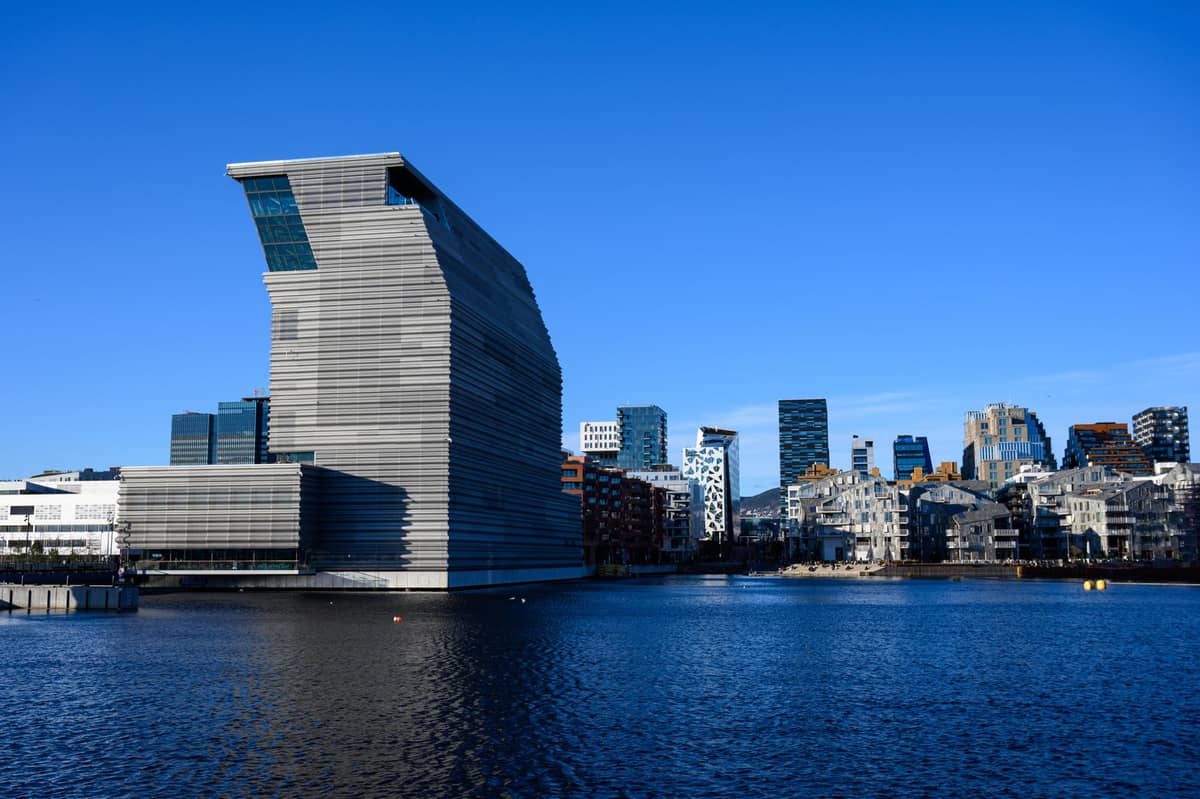
The structure is called Lambda, designed by the Spanish-Uruguayan architecture firm Estudio Herreros. It rises 13 floors and tilts noticeably toward the fjord as it climbs, giving it a leaning silhouette visible from the water. The facade is perforated aluminum, which shifts in tone depending on light conditions: flat silver in overcast weather, warm gold in afternoon sun, and almost translucent on bright summer evenings when Oslo's long light catches it at a low angle.
The building drew criticism during its planning phase, and some of that skepticism is still audible in Oslo conversations. From certain angles along the harbor walk, Lambda's bulk does compete visually with the Opera House. Up close, though, the interior spaces are generous and well-proportioned, with gallery floors that allow real breathing room around large-scale works.
💡 Local tip
Take the elevator to the top floor (floor 13) before you begin the galleries. The panoramic view over Oslofjord, the Opera House roofline, and the city behind you provides useful orientation — and on a clear day it's one of the better elevated views in central Oslo without requiring a separate ticket.
Tickets & tours
Live prices and dates from our booking partner. If you book, we may earn a commission at no extra cost to you.
Oslo Fjord sightseeing audio-guided electrical boat tour
From 35 €Instant confirmationFree cancellationFjord cruise with live jazz music
From 64 €Instant confirmationFree cancellationLuggage Storage in Oslo
From 6 €Instant confirmationFree cancellationPicturesque dinner cruise in Oslo
From 137 €Instant confirmationFree cancellation
The Collection: Beyond The Scream
Yes, MUNCH holds one version of The Scream — the 1910 tempera on board version that Munch kept in his own possession until his death. (The more frequently reproduced 1893 version is at the National Museum.) Visitors who come only for The Scream will find it, but centering your visit on a single work misses the depth of what's here.
The collection's real power is in the sheer quantity of works produced across Munch's long career (1880s through 1944), allowing the museum to show how his obsessions evolved. The Frieze of Life series — his major thematic cycle exploring love, anxiety, and death — is represented extensively. You'll see multiple versions of the same motifs: different Madonnas, different Melancholies, different iterations of figures on bridges. Watching how Munch returned to the same compositions over decades is more instructive about his psychology than any single painting.
The print collection is less visited but remarkable. Munch was one of the most technically inventive printmakers of his era, working in etching, woodcut, and lithography in ways that directly influenced Expressionism across Europe. The graphic works rooms on the mid-floors are often quieter than the main painting galleries, making them worth prioritizing if you visit during peak hours.
For broader context on how Munch fits into Norwegian and European art history, the National Museum Oslo — which holds several major Munch paintings including the 1893 Scream — makes a natural companion visit, about 20 minutes away by tram.
How the Experience Changes by Time of Day
Mornings from opening (10:00) until about 11:30 are the quietest window. Tour groups typically arrive around midday, and the galleries can feel congested on summer afternoons between 12:00 and 15:00. If your schedule allows, plan to arrive at opening or shift your visit to a Wednesday–Saturday evening when the extended hours (until 21:00) coincide with lower crowds.
The top-floor views change significantly with light. A gray morning visit gives the fjord a steely, almost Munchian quality that feels oddly appropriate. Late afternoon in summer, when the sun angles across the water from the northwest, the view turns cinematic. In winter, the museum is open during the short Oslo daylight window, and the glass-facing spaces fill with a low, diffuse Nordic light that flattens shadows in interesting ways.
ℹ️ Good to know
Wednesday evening admission (18:00–21:00) is free of charge during most of the year, though this may be suspended in July and August. Confirm on the official MUNCH website before planning your visit around it.
The evening hours on Wednesdays through Saturdays (closing at 21:00) attract a different visitor profile: fewer families with young children, more locals, and a calmer pace in the galleries. The museum's restaurant and bar on the upper floors stays open during these hours, and a drink with a fjord view at dusk is a legitimate Oslo experience in its own right.
Getting There and Practical Logistics
The museum address is Edvard Munchs plass 1, 0194 Oslo. The Bjørvika tram and bus stop is approximately 250 meters from the entrance. From Oslo Central Station (Oslo S), the walk takes about 10 minutes along the harbor, passing the Opera House — a pleasant approach on any dry day. There is no dedicated parking at the museum; the nearest garages are at Sørenga and around Oslo S.
The building is fully wheelchair accessible, with elevators to every floor, wide gallery corridors, and accessible toilets on multiple levels. Visitors arriving by car can drop off at the entrance. Accessible parking with valid disability permits is available on the east side of the Opera House, near Oda Lassons Bridge, and along Operagaten.
If you're planning several Oslo museums in a day or across a trip, the Oslo Pass covers MUNCH admission and is worth calculating against individual ticket prices. See our Oslo Pass guide for a current breakdown of whether it makes financial sense for your itinerary.
Photography Inside the Museum
Personal photography without flash is generally permitted in the permanent collection galleries. Temporary exhibitions may have different rules — look for posted signs at each gallery entrance and follow staff guidance. The top-floor panoramic space and the building's public areas are fully photographable and reward wide-angle compositions. The exterior, particularly from the harbor walkway below, gives good architectural shots that include both Lambda and the Opera House in the same frame.
Clear Assessment: Is It Worth the Ticket Price?
At 280 NOK for daytime adult admission, MUNCH is not cheap by Oslo's already elevated standards. The honest answer is that it depends entirely on what you're bringing to it. If you have genuine interest in Edvard Munch, Expressionism, or early 20th-century European art, this museum is one of the most rewarding single-artist institutions on the continent. The collection is deep enough to surprise even visitors who know the work well.
If your interest is more casual — you know The Scream and you're curious — the building and views justify a shorter visit, and the evening discount (200 NOK after 18:00) makes that version more palatable. The free Wednesday evening option, when available, removes the value question entirely.
Visitors looking for more context on Oslo's cultural landscape before committing to multiple museum tickets might find our Oslo museums guide useful for planning which institutions suit their interests.
⚠️ What to skip
Who should skip: If art museums aren't your thing, the ticket price is hard to justify. The building's architecture can be appreciated from the harbor for free. Families with very young children may find the large galleries and elevator waits challenging, though children under 18 enter free.
The Neighborhood Around MUNCH
Bjørvika is worth treating as a half-day destination rather than a single stop. The Oslo Opera House is a 5-minute walk and its roof is publicly accessible for free — a completely different architectural experience from Lambda, and useful for comparing how two major Oslo landmarks engage with the waterfront differently.
The Sørenga Sjøbad outdoor swimming area is about 10 minutes on foot south of the museum, making it a practical post-visit stop in summer. The Deichman Bjørvika public library is within the same walkable zone and is one of the most architecturally striking public buildings in modern Oslo — worth 20 minutes even if you're not a library visitor.
Insider Tips
- Go to the top floor (floor 13) first, before entering any galleries. The orientation it gives you — both geographic and atmospheric — makes the artwork feel more grounded, and you avoid the fatigue of climbing after two hours of gallery walking.
- The print collection rooms on the mid-floors are consistently less crowded than the main painting galleries, even on busy days. If you arrive during peak afternoon hours, start there and work backward to the major paintings as crowds thin.
- Wednesday evenings offer free admission (18:00–21:00) outside July and August. This is also when the crowd shifts toward Oslo locals rather than tourists, which changes the atmosphere in the galleries noticeably.
- The museum café and restaurant on the upper floors are not the cheapest in Oslo, but the fjord-facing seating at the top is genuinely good. Coffee or a glass of wine at dusk with that view is a worthwhile splurge for a special evening.
- If you're combining MUNCH with the National Museum on the same day, do MUNCH first. The National Museum is more encyclopedic and comprehensive; saving it for second means you end your day with broader context rather than narrower focus.
Who Is MUNCH (Munch Museum) For?
- Art and museum enthusiasts with specific interest in Edvard Munch or European Expressionism
- Architecture followers who want to experience one of Norway's most discussed contemporary buildings from the inside
- Rainy or cold-weather days when outdoor Oslo activities are less appealing
- Travelers on the Oslo Pass who want to maximize value across multiple museum visits
- Evening visitors looking for a culturally substantial experience combined with a fjord-view drink
Nearby Attractions
Other things to see while in Bjørvika & the Opera Quarter:
- Barcode Project
The Barcode Project is a row of 12 narrow high-rise buildings along Dronning Eufemias gate in Bjørvika, Oslo's former docklands. Free to walk through and steps from Oslo Central Station, it's one of Norway's most debated urban developments — and one of its most photographed.
- Deichman Bjørvika (Main Public Library)
Deichman Bjørvika is Oslo's main public library and one of the most striking modern buildings in the Norwegian capital. Located in the Bjørvika waterfront district steps from Oslo Central Station, it offers free entry, long opening hours, and a surprisingly rich experience for visitors who have never set foot in a library as a tourist before.
- Oslo Opera House
The Oslo Opera House (Operahuset Oslo) is one of Scandinavia's most striking pieces of contemporary architecture, rising from the Bjørvika waterfront like a glacial slab meeting the fjord. Whether you come for a performance or simply to walk its sloping marble roof, it rewards visitors at every level of engagement.
- Sørenga Seawater Pool (Sørenga Sjøbad)
Sørenga Sjøbad is Oslo's most popular urban seawater pool, set on the Oslofjord waterfront at Sørengkaia. Free to enter, it offers a 50-metre pool, diving boards, a children's pool, and one of the city's best waterfront atmospheres.
Planning a trip? Discover personalized activities with the Nomado app.