Oslo Opera House: The Building You Can Walk On
The Oslo Opera House (Operahuset Oslo) is one of Scandinavia's most striking pieces of contemporary architecture, rising from the Bjørvika waterfront like a glacial slab meeting the fjord. Whether you come for a performance or simply to walk its sloping marble roof, it rewards visitors at every level of engagement.
Quick Facts
- Location
- Kirsten Flagstads plass 1, Bjørvika, Oslo
- Getting There
- Oslo S (Central Station), 5–10 min walk; Bjørvika bus/tram stops nearby
- Time Needed
- 30 min (rooftop walk) to 3 hours (guided tour + performance)
- Cost
- Rooftop access is free; guided tours and performances priced separately — check operaen.no
- Best for
- Architecture lovers, culture seekers, evening walkers, families, first-time Oslo visitors
- Official website
- www.operaen.no/en
What Is the Oslo Opera House?
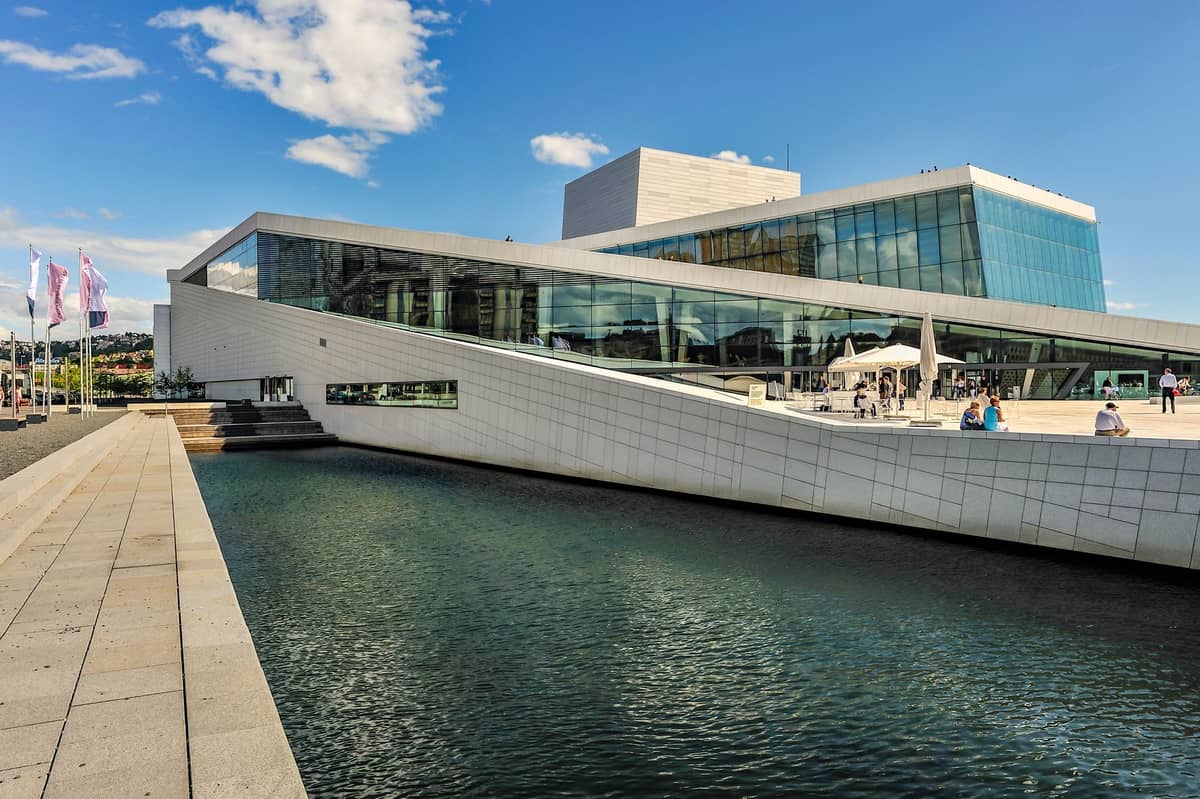
The Oslo Opera House, officially known as Den Norske Opera & Ballett or Operahuset Oslo, opened in 2008 on the eastern edge of the Bjørvika waterfront. It is the home of the Norwegian National Opera and Ballet, and it was designed by the Norwegian architectural firm Snøhetta. The building won the European Union Prize for Contemporary Architecture (Mies van der Rohe Award) in 2009, and it is widely considered one of the most important public buildings constructed in Norway in the modern era.
The defining feature is the roof, a broad inclined plane of Italian Carrara marble and white granite that slopes from sea level up to a height of roughly 20 metres, allowing anyone to walk from the waterfront all the way to the top without entering the building. This was not an accident of design. Snøhetta's concept was explicitly democratic: the building belongs to the public, not only to ticket-holders. That philosophy shapes every visit, whether you attend a Verdi premiere or simply cross the roof on your way to work.
💡 Local tip
You do not need a ticket to access the rooftop. It is open to the public at most hours of the day, including into the evening on performance nights. Wear shoes with grip — the marble is genuinely slippery when wet.
The Architecture in Detail
From the fjord side, the building reads as three distinct elements. The main auditorium — the largest of the three performance spaces, with 1,364 seats — is wrapped in a dark, angled oak cladding that Snøhetta calls the 'factory.' It rises above the wave-like roof as a solid, almost blunt mass. The contrast between this dark volume and the white marble below is one of the reasons the building photographs so well in low light.
The roof surface itself is worth examining up close. The Carrara marble arrives in honed slabs, pale grey-white with faint veining, interrupted at intervals by bands of glass that allow daylight into the foyers below. At roof level you can see the full geometry of the building clearly: the long diagonal slope, the asymmetric ridgeline, and the way the southern edge touches the water almost exactly at fjord level. On a clear morning the reflection of the white surface doubles in the harbour, and the building appears to float.
The surrounding Bjørvika district was a former industrial port that has been redeveloped since the early 2000s. The opera house anchored that transformation. Nearby, the Barcode Project — the row of tall commercial towers to the northwest — and the Deichman Bjørvika public library show the scale of what has changed in this part of Oslo. Understanding the building as part of that urban project, rather than as an isolated monument, makes the visit more coherent.
For a deeper dive into contemporary Norwegian design in this and other parts of the city, the Oslo architecture guide covers the key buildings with the context that a single attraction page cannot.
Tickets & tours
Live prices and dates from our booking partner. If you book, we may earn a commission at no extra cost to you.
Oslo Fjord sightseeing audio-guided electrical boat tour
From 35 €Instant confirmationFree cancellationFjord cruise with live jazz music
From 64 €Instant confirmationFree cancellationLuggage Storage in Oslo
From 6 €Instant confirmationFree cancellationPicturesque dinner cruise in Oslo
From 137 €Instant confirmationFree cancellation
The Rooftop Experience at Different Times of Day
Early morning, before 9 am, the roof is almost empty. The marble is cool underfoot, the harbour is quiet, and the views across the Oslofjord to the south and east are unobstructed. This is the best hour for photography: the light comes from the southeast, raking across the textured stone surface and defining the ridgeline sharply against the sky. On summer mornings, the long Scandinavian dawn means you can arrive at 6 am and still have soft golden light.
By mid-morning on weekends and throughout summer, the rooftop becomes a social space. Locals jog up the slope as part of their morning run. Families with small children treat it as a kind of outdoor ramp, which it effectively is. Tour groups arrive from Oslo Central Station and tend to gather near the upper ridgeline for the fjord view. The building remains photogenic at any hour, but the sense of calm discovery belongs to early risers.
Evening visits on performance nights carry a different quality entirely. The interior foyers are lit warmly through the glass panels in the roof, casting patterns across the marble. Well-dressed opera-goers arrive in the hour before curtain, and the contrast between formal concert attire and tourists in hiking shoes on the same white slope is distinctly Oslo. The Oslofjord at dusk, with the islands visible on the horizon, provides a backdrop that no interior can match.
⚠️ What to skip
In winter, the marble roof can become icy. The building management typically applies grit or closes sections of the slope in severe conditions. Check weather before visiting between November and March, and treat wet marble with respect — the slope is steeper than it appears from photographs.
Inside the Building: Foyers, Tours, and Performances
The public foyer areas of the opera house are open Monday to Saturday from 11:00 to 16:00, and Sunday from 12:00 to 16:00. On performance days, the building stays open until the end of the show or the last interval. Even without a performance ticket, the main foyer is worth entering. The wave wall — a curved interior surface covered in more than 15,000 individually shaped oak sticks — dominates the eastern foyer and shifts in appearance depending on where you stand relative to it. It was designed by the artist Astrid Løvaas and Kirsten Wagle, and it is one of the most disorienting, absorbing large-scale art installations in Oslo.
Guided tours of the building run on a seasonal schedule and typically take 45 to 60 minutes, covering backstage areas, the main auditorium, and production facilities that are otherwise off-limits. The tour is the only way to see the 1,364-seat main hall outside of a performance, and the scale of the stage machinery — with its hydraulic platforms and fly tower — is genuinely impressive. Check the official website for current tour times and prices, as these vary by season.
Performance tickets range from affordable to premium depending on production, seating position, and whether you book during the subscription season or for individual shows. The Norwegian National Ballet and Norwegian National Opera share the main stage throughout the season, which typically runs from late August through June. For visitors who want to attend a show, booking well in advance is advisable for popular productions. The box office can be reached through the official website.
ℹ️ Good to know
The main auditorium seats 1,364. Two additional performance spaces seat around 400 and 200 respectively, used for chamber concerts, contemporary opera, and smaller productions. These smaller venues often have better sightlines and a more intimate atmosphere.
Getting There and Getting Around Bjørvika
The opera house is a five-minute walk from Oslo Central Station (Oslo S), one of the city's main transport hubs for metro, regional trains, trams, and buses. From Oslo S, follow the waterfront south and east past the Barcode towers and you will see the white marble slope ahead of you. The Bjørvika bus and tram stops serve routes from across the city. If you are using the Oslo Metro (T-bane), Jernbanetorget station at Oslo S is the closest stop. For public transport zone information and current fares, check Ruter's official site.
The opera house sits at the western end of the Bjørvika waterfront promenade, which continues east past the Munch Museum (a short walk along the water) and the outdoor swimming area at Sørenga Sjøbad. In summer, this stretch of waterfront is one of Oslo's most pleasant walks, linking architecture, contemporary art, and open-air bathing in a single route.
Cycling is a practical alternative: the Bjørvika waterfront is served by Oslo's city bike scheme, and dedicated lanes run from the city centre to the fjord. Parking is available in the area, but it is expensive and unnecessary given how close Oslo S is.
Practical Notes: Accessibility, Photography, and What to Bring
Accessibility at the opera house is thorough. Step-free access is available throughout, including to the rooftop (via an internal ramp and elevator that brings you to roof level). Automatic doors, an elevator, clearly signposted accessible toilets, and dedicated wheelchair spaces in the auditorium are all confirmed by the venue. Companion ticket arrangements are available — contact the box office in advance for specifics.
Photography on the roof and in the public foyers is permitted freely. The building is a genuine visual subject: wide-angle lenses suit the roof's geometry, while a standard 50mm equivalent works well in the foyers where the wave wall rewards close framing. Tripods are allowed on the roof but not inside the building. Drone use is not permitted without advance authorisation.
What to wear depends on your plans. For the rooftop only, dress for the weather: wind off the fjord can be sharp even on warm days, and the marble surface is cold underfoot in winter. For a performance, smart casual is the prevailing standard, though the opera house does not enforce a formal dress code. For a guided tour, comfortable shoes are useful as you cover a fair amount of ground backstage.
If you are planning a broader day in the area, the 3-day Oslo itinerary slots the opera house and Bjørvika into a logical sequence with the city's other major sites.
Insider Tips
- The view from the upper ridgeline of the roof looks directly south across the Oslofjord toward the island of Hovedøya. On clear days in summer you can see ferries moving between the city and the islands — bring binoculars if you are interested in the fjord traffic.
- The café inside the main foyer serves food and drinks during opening hours and stays open during performance intervals. Prices are high by Norwegian standards (which is saying something), but the window seating over the harbour makes it worthwhile for a coffee.
- If you want the roof to yourself, aim for a Tuesday or Wednesday morning in September or October. Summer weekends are crowded; early autumn weekdays are not. The light in September is also considerably warmer and more photogenic than the flat midday light of July.
- Performance tickets for the Norwegian National Ballet tend to sell faster than opera tickets. If you want to see a ballet production, book as soon as the season programme is published, typically in spring for the following autumn.
- The opera house exterior is one of the best vantage points in Bjørvika for photographing the Munch Museum's distinctive tilted tower, which rises to the east along the waterfront. The two buildings in the same frame capture a decade of Oslo's architectural ambition.
Who Is Oslo Opera House For?
- Architecture and design enthusiasts who want to understand contemporary Norwegian public building
- First-time visitors to Oslo looking for a free, iconic experience that requires no advance booking
- Evening walkers who want a waterfront view at dusk with the added atmosphere of a performance night
- Families with children: the sloping roof functions as a wide, open ramp with no barriers, and children consistently enjoy it
- Culture travellers who want to combine opera or ballet with the broader Bjørvika arts district
Nearby Attractions
Other things to see while in Bjørvika & the Opera Quarter:
- Barcode Project
The Barcode Project is a row of 12 narrow high-rise buildings along Dronning Eufemias gate in Bjørvika, Oslo's former docklands. Free to walk through and steps from Oslo Central Station, it's one of Norway's most debated urban developments — and one of its most photographed.
- Deichman Bjørvika (Main Public Library)
Deichman Bjørvika is Oslo's main public library and one of the most striking modern buildings in the Norwegian capital. Located in the Bjørvika waterfront district steps from Oslo Central Station, it offers free entry, long opening hours, and a surprisingly rich experience for visitors who have never set foot in a library as a tourist before.
- MUNCH (Munch Museum)
The MUNCH museum in Oslo's Bjørvika district holds the world's largest collection of works by Edvard Munch, spanning 13 floors of a purpose-built waterfront tower. It's one of the most significant single-artist museums in Europe, and its fjord-facing top floor alone justifies the entry price.
- Sørenga Seawater Pool (Sørenga Sjøbad)
Sørenga Sjøbad is Oslo's most popular urban seawater pool, set on the Oslofjord waterfront at Sørengkaia. Free to enter, it offers a 50-metre pool, diving boards, a children's pool, and one of the city's best waterfront atmospheres.
Planning a trip? Discover personalized activities with the Nomado app.