Deichman Bjørvika: Oslo's Architectural Library Worth Visiting Even If You Never Read a Book
Deichman Bjørvika is Oslo's main public library and one of the most striking modern buildings in the Norwegian capital. Located in the Bjørvika waterfront district steps from Oslo Central Station, it offers free entry, long opening hours, and a surprisingly rich experience for visitors who have never set foot in a library as a tourist before.
Quick Facts
- Location
- Anne-Cath. Vestlys plass 1, Bjørvika, 0150 Oslo
- Getting There
- Oslo S (Central Station) – 5 min walk; tram, bus, and T-bane all serve Jernbanetorget
- Time Needed
- 45 minutes to 2 hours depending on interest
- Cost
- Free entry; some events may require separate tickets
- Best for
- Architecture lovers, families, rainy-day visits, remote workers, curious travelers
- Official website
- deichman.no/in-english
What Is Deichman Bjørvika?
Deichman Bjørvika is the main branch of Oslo's municipal public library system and one of the most architecturally ambitious public buildings to open in Norway in recent decades. It sits in the Bjørvika waterfront district, a neighborhood that has transformed over the past fifteen years from a post-industrial freight yard into one of the city's most concentrated clusters of contemporary architecture. The library shares this stretch of the fjord with the Oslo Opera House and the Munch Museum, making Bjørvika one of the most rewarding short walks in the entire city.
The building replaced the former main branch at Hammersborg and opened as the new heart of the Deichman system. Where the old location was functional but unremarkable, Deichman Bjørvika is a genuine architectural statement: a building that feels designed to draw people in rather than intimidate them. Entry is free for everyone, no library card required, and the doors stay open until 22:00 on weekdays (shorter hours on weekends).
💡 Local tip
You do not need a library card or any registration to walk in and explore. Simply arrive and go. The building is a public space open to everyone.
The Architecture: What You Are Actually Looking At
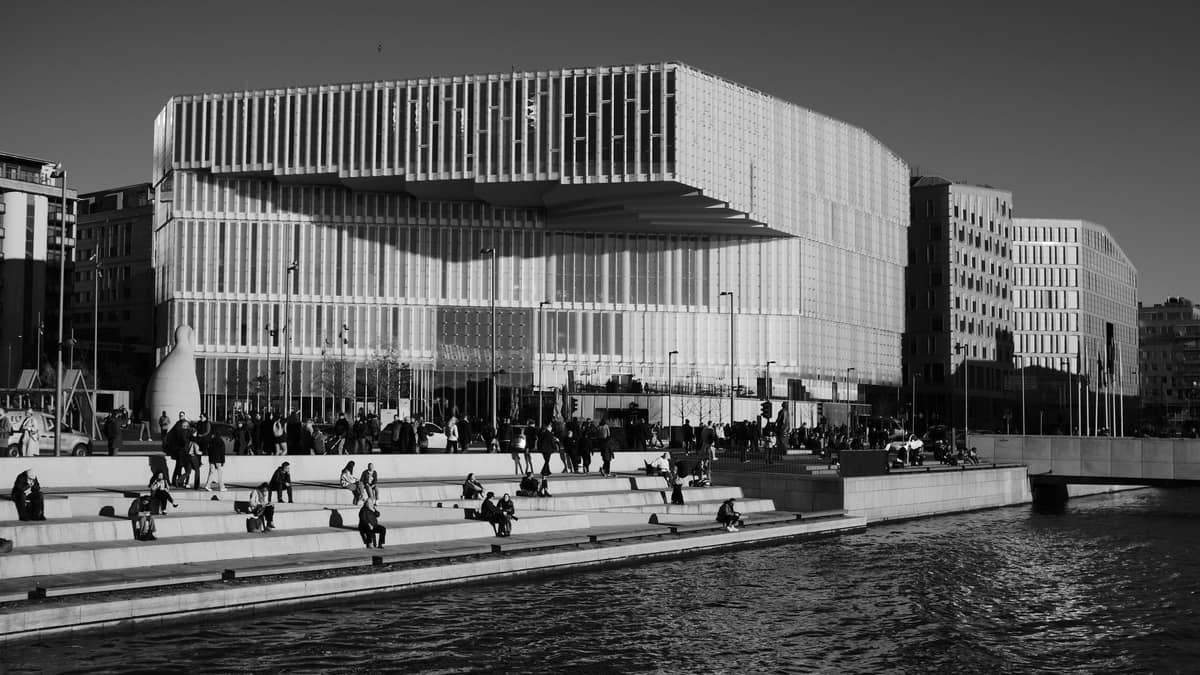
The building was designed by the Norwegian architecture firm Lund Hagem together with Atelier Oslo, with construction completed in time for its 2020 opening. The exterior reads as a series of stacked and cantilevered volumes clad in pale, perforated metal panels, creating a facade that shifts appearance depending on the angle and light conditions. From the waterfront promenade, the building appears to lean slightly forward over the plaza, an effect that makes it look larger and more dynamic than its footprint suggests.
Inside, the spatial logic becomes immediately clear. The ground floor is open and civic in character, with wide staircases and generous sightlines up through the stacked floors. Each level is slightly offset from the one below, creating a series of terraced interior spaces rather than a conventional multi-storey stack. Natural light enters through large facade openings and a central void that pulls daylight deep into the building. The materials are honest and warm: raw concrete, pale timber, and exposed structural elements throughout.
For anyone with an interest in Scandinavian architecture, Deichman Bjørvika belongs in the same conversation as the Opera House next door. It represents a school of Norwegian public building design that prioritizes openness, material quality, and the careful management of natural light over visual spectacle for its own sake.
Tickets & tours
Live prices and dates from our booking partner. If you book, we may earn a commission at no extra cost to you.
Oslo Fjord sightseeing audio-guided electrical boat tour
From 35 €Instant confirmationFree cancellationFjord cruise with live jazz music
From 64 €Instant confirmationFree cancellationLuggage Storage in Oslo
From 6 €Instant confirmationFree cancellationPicturesque dinner cruise in Oslo
From 137 €Instant confirmationFree cancellation
Floor by Floor: What to Explore
The ground floor functions as the building's social hub. There is a cafe near the entrance, comfortable seating in clusters designed for both reading and conversation, and a children's section that is one of the best-equipped and most thoughtfully designed in the city. On weekday mornings, you will find parents with young children here well before the tourist crowd arrives. The noise level on the ground floor is noticeably higher than a traditional library: conversations happen at normal volume, and the atmosphere is closer to a well-run community center than a hushed reading room.
As you move up through the building, the energy shifts. The upper floors are quieter, with more space dedicated to collections, study areas, and the kind of focused reading that the building's lower levels deliberately do not prioritize. The terrace floors offer changing views over the Bjørvika harbor and toward the Oslofjord. On a clear day, the water view from the upper levels provides a genuinely impressive perspective on Oslo's relationship with the fjord. For broader views across the city, the best viewpoints in Oslo require going higher, but as a complimentary view from a free building, this is hard to beat.
The library also houses a dedicated gaming zone with consoles and computers available for public use, a recording studio that can be booked by members, a cinema screening room used for film programming and events, and maker-space facilities. These functions make it genuinely distinct from a conventional library visit: this is a building designed for the full range of ways people consume and produce culture, not just the reading of physical books.
How It Changes by Time of Day
Arriving between 08:00 and 09:30 on a weekday gives you the building largely to yourself. The morning light enters from the east-facing windows and fills the interior with a clean, pale quality that makes the timber and concrete surfaces glow in a way they simply do not later in the day. The cafe opens early and the coffee is decent by Oslo standards, which is saying something in a city where even pedestrian-looking cafes take their espresso seriously.
By midday, the building fills noticeably with a mix of local workers on lunch breaks, students, and tourists who have just come from the Opera House. The ground floor becomes lively and social. Weekend afternoons, particularly Saturdays between 12:00 and 16:00, are the busiest periods. If you want to photograph the interior architecture cleanly, a weekday morning or an early Saturday visit before 11:00 will give you far better results.
Evening visits on weekdays, particularly from 19:00 onward, reveal yet another character. The building empties of families and fills instead with students, solitary readers, and people who have clearly made the library part of their after-work routine. The artificial lighting takes over, and the building feels more intimate. The 22:00 closing time on weekdays is one of the most visitor-friendly policies of any cultural institution in Oslo, making it a reliable option even after dinner.
ℹ️ Good to know
Opening hours: Monday to Friday 08:00–22:00, Saturday and Sunday 10:00–18:00. Verify current hours at deichman.no before visiting, as holiday schedules and special events may differ.
Getting There and Getting Around the Neighborhood
Deichman Bjørvika is one of the easiest major attractions in Oslo to reach. Oslo Central Station (Oslo S) is roughly a five-minute walk away, and the station is served by the T-bane (metro), multiple tram lines, regional buses, and the Flytoget airport express. From the station, follow the waterfront toward the Opera House and continue east along the harbor promenade; the library appears on your left before you reach the Munch Museum.
The Bjørvika waterfront walk itself is worth doing slowly rather than rushing. The entire stretch from the Opera House to the library to the Munch Museum covers architecture and public art of considerable quality in under fifteen minutes of walking. This makes Deichman Bjørvika a natural addition to a half-day itinerary in the area. For a fuller sense of the neighborhood and how it fits into the city's development, the Bjørvika neighborhood guide covers the full context.
The building is fully accessible. Step-free access is available throughout, automatic door openers are installed at entrances, and lifts connect all floors. Accessible toilets are available and clearly signposted on every level. Emergency exits are adapted for wheelchair users.
Clear Assessment: Who This Is For and Who Might Be Disappointed
Deichman Bjørvika rewards visitors who appreciate architecture and thoughtful public space design. If you have already visited the Opera House and want another example of contemporary Norwegian public building at a high level, this is exactly that, and it is free. It also works well as a practical stop: the cafe is comfortable, the WiFi is reliable, the seating is plentiful, and it is genuinely one of the better places in central Oslo to sit down without spending money. Travelers looking for things to do in Oslo that don't require a ticket will find it a strong option alongside the many free experiences the city offers.
Travelers who are not particularly interested in architecture or in libraries as cultural institutions may find the visit brief. There is no permanent exhibition with interpreted content about Norwegian history or culture, and no audioguide. You are essentially walking around a working library. If you are on a tight itinerary and must choose between this and a major museum, the Munch Museum or the National Museum will deliver more content. But if you have an hour and are curious, Deichman Bjørvika consistently surprises people who expect nothing more than a nice building.
Families with children will find the children's section on the ground floor genuinely excellent, with well-designed play and reading areas that can occupy small children for longer than many paid attractions. Combined with a walk along the harbor and a stop at the Opera House roof, it makes for a practical and cost-free family morning. For more ideas on family-appropriate Oslo experiences, the Oslo with kids guide has a full breakdown.
Insider Tips
- The building's upper terrace floors offer a clear view toward the Oslofjord that most visitors miss entirely because they stay on the ground floor. Take the main staircase all the way to the top before settling anywhere.
- The recording studio and maker-space facilities require a library card to book, but walking through and observing the setup is free and gives a strong sense of what the building is actually trying to do beyond housing books.
- If you are visiting in winter and need to escape the cold between the Opera House and the Munch Museum, Deichman Bjørvika is the best free shelter on the waterfront, with seating, warmth, and a cafe at no obligation.
- The cinema screening room hosts a regular program of films and talks that are sometimes free or very low cost. Check the Deichman events calendar at deichman.no before your trip if you are spending more than a day or two in Oslo.
- Photography is generally permitted throughout the building for personal, non-commercial use. The interior staircases and the view back toward the harbor from the upper-floor windows are the two best compositions in the building.
Who Is Deichman Bjørvika (Main Public Library) For?
- Architecture and design enthusiasts wanting to compare Oslo's contemporary public building with the Opera House next door
- Families with young children looking for a free, indoor, all-weather option in central Oslo
- Travelers on a budget who want quality indoor spaces without spending money
- Remote workers or anyone needing reliable WiFi and comfortable seating in central Oslo
- Curious visitors who want to understand how Norwegian cities invest in public infrastructure beyond museums and monuments
Nearby Attractions
Other things to see while in Bjørvika & the Opera Quarter:
- Barcode Project
The Barcode Project is a row of 12 narrow high-rise buildings along Dronning Eufemias gate in Bjørvika, Oslo's former docklands. Free to walk through and steps from Oslo Central Station, it's one of Norway's most debated urban developments — and one of its most photographed.
- MUNCH (Munch Museum)
The MUNCH museum in Oslo's Bjørvika district holds the world's largest collection of works by Edvard Munch, spanning 13 floors of a purpose-built waterfront tower. It's one of the most significant single-artist museums in Europe, and its fjord-facing top floor alone justifies the entry price.
- Oslo Opera House
The Oslo Opera House (Operahuset Oslo) is one of Scandinavia's most striking pieces of contemporary architecture, rising from the Bjørvika waterfront like a glacial slab meeting the fjord. Whether you come for a performance or simply to walk its sloping marble roof, it rewards visitors at every level of engagement.
- Sørenga Seawater Pool (Sørenga Sjøbad)
Sørenga Sjøbad is Oslo's most popular urban seawater pool, set on the Oslofjord waterfront at Sørengkaia. Free to enter, it offers a 50-metre pool, diving boards, a children's pool, and one of the city's best waterfront atmospheres.
Planning a trip? Discover personalized activities with the Nomado app.