Sørenga Sjøbad: Oslo's Beloved Fjord Swimming Pool
Sørenga Sjøbad is Oslo's most popular urban seawater pool, set on the Oslofjord waterfront at Sørengkaia. Free to enter, it offers a 50-metre pool, diving boards, a children's pool, and one of the city's best waterfront atmospheres.
Quick Facts
- Location
- Sørengkaia, 0194 Oslo (Bjørvika/Sørenga peninsula)
- Getting There
- 15-minute walk from Oslo Central Station (Oslo S) via the Opera House waterfront path
- Time Needed
- 1–3 hours depending on whether you swim or just soak up the atmosphere
- Cost
- Free entry. Toilets are paid; nearby cafés charge normal Oslo prices
- Best for
- Summer swimmers, families, early-morning lap swimmers, and winter bathing enthusiasts
What Sørenga Sjøbad Actually Is
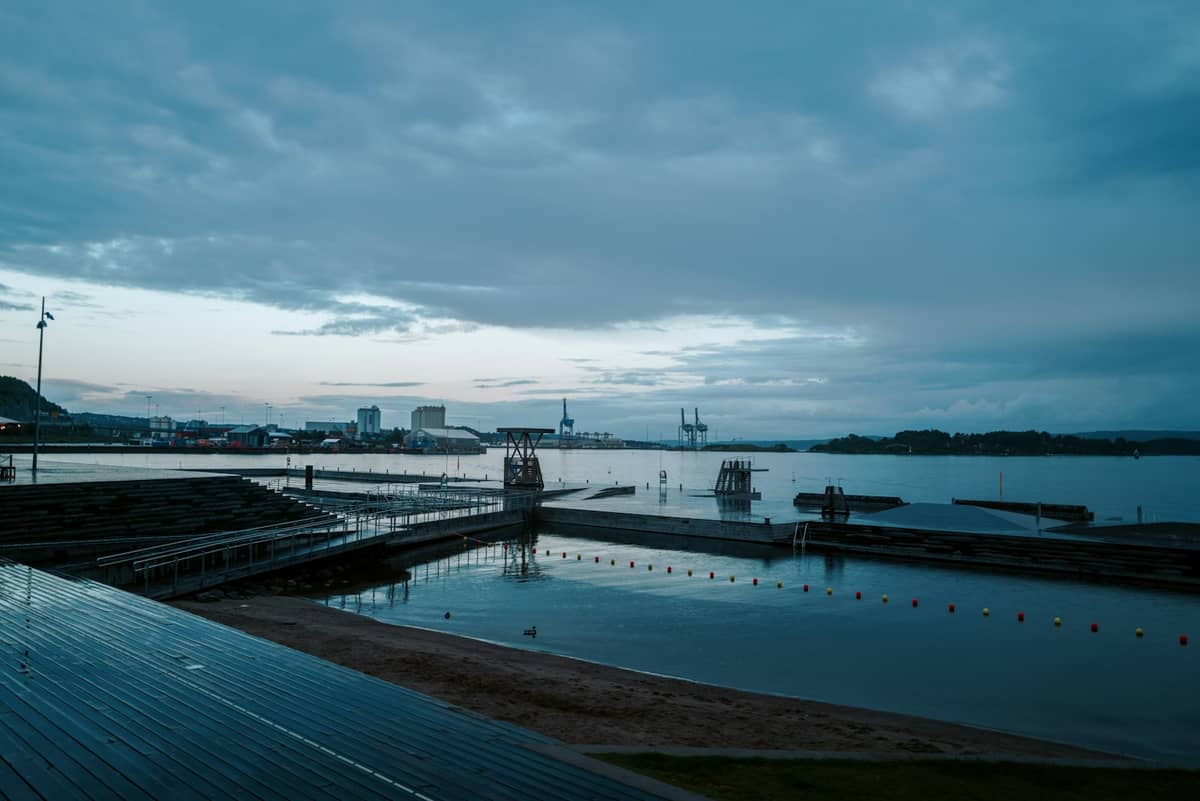
Sørenga Sjøbad is an open-air public seawater bathing facility built on the edge of the Sørenga peninsula in Oslo's inner Oslofjord. It is municipally run, free to enter, and operates with daily opening hours throughout the year. The complex sits on waterfront structures jutting into the fjord, giving swimmers direct access to the salt water of the Oslofjord rather than artificially heated pool water.
The facility includes a 50-metre pool with marked swim lanes, a separate shallow pool for children, a wheelchair-accessible pool, and diving platforms and trampolines that launch jumpers directly into the open fjord. Broad timber sundecks surround the pools, and in summer they fill up with Osloites on towels, in folding chairs, with coffee cups and sunscreen.
This is not a tourist attraction in the conventional sense. It is infrastructure for everyday city life, and its popularity among locals tells you a great deal about how Oslo relates to its waterfront. For context on how the swimming pool fits into Oslo's wider relationship with the fjord, see the Oslo Fjord guide.
ℹ️ Good to know
Opening hours: 07:00–22:00 daily in the bathing season (1 April–14 October). Winter hours are 07:00–16:00 daily (15 October–31 March). Lifeguards are on duty 12:00–20:00 daily during school summer holidays.
How the Experience Changes Through the Day
Arrive before 09:00 in summer and the pool is a genuinely calm place. The swim lanes are occupied by serious morning swimmers doing structured laps, the water is cool and clear, and the only sounds are the soft mechanical churn of the fjord, distant tram bells, and the occasional splash. The air smells of salt water and sunscreen warming on timber boards. The city skyline to the north, including the slanted white roof of the Oslo Opera House, reflects quietly in the fjord.
From midday onward on warm summer days, the character shifts entirely. Families arrive with young children who gravitate toward the shallow pool. Groups of teenagers compete on the diving boards. Every square metre of the sundecks is claimed by late morning, and there is a companionable noise of music from phone speakers, children shouting, and the thudding percussion of jump after jump off the platforms. It feels less like a municipal facility and more like a beach festival.
Late afternoon, roughly 17:00–19:00, brings a second wave as office workers make their way from the city centre. This is the busiest window of a weekday and can feel genuinely crowded. The light turns amber across the water and the atmosphere becomes more festive. If you want photographs of the pool from the sundecks without crowds photobombing every frame, early morning is the only realistic option.
💡 Local tip
The best swim is on a weekday before 09:00 in July or August. Lanes are free, water temperature is typically 18–22°C at peak summer, and the air has a crispness that disappears once the sun is fully up.
Tickets & tours
Live prices and dates from our booking partner. If you book, we may earn a commission at no extra cost to you.
Oslo Fjord sightseeing audio-guided electrical boat tour
From 35 €Instant confirmationFree cancellationFjord cruise with live jazz music
From 64 €Instant confirmationFree cancellationLuggage Storage in Oslo
From 6 €Instant confirmationFree cancellationPicturesque dinner cruise in Oslo
From 137 €Instant confirmationFree cancellation
The Pool in Winter: Ice Bathing and Off-Season Solitude
Sørenga Sjøbad does not close in winter. This is significant, because cold-water bathing has a devoted following in Norway, and the pool functions as one of Oslo's main sites for winter swimming. Water temperatures in January can drop below 5°C, and small groups of regulars arrive in the early morning to take a short, sharp dip before changing back into dry clothes and going to work.
The sensory experience in winter is opposite to summer in almost every way. The decks are empty, the fjord is flat grey, and condensation rises from the water when the air temperature is below freezing. The silence is substantial. Some visitors use the facility during these months simply for the contrast with summer crowds, others for the well-documented physiological effects of cold-water immersion. Either way, the reduced winter hours (closing at 16:00) mean the early morning window is important.
If the concept of winter swimming in Oslo interests you, the Oslo floating sauna guide covers the wider cold-water bathing scene, including sauna options that pair well with a post-swim warm-up.
The Sørenga Waterfront: Context and Getting There
Sørenga is a recently developed residential and recreational peninsula that extends into the inner Oslofjord, southeast of the Oslo Opera House. The area was previously industrial harbour land. Its transformation into a mixed-use waterfront neighbourhood is one of the most significant urban development projects in Oslo's recent history, and Sørenga Sjøbad is the centrepiece of its public waterfront.
The walk from Oslo Central Station takes roughly 15 minutes. You pass the Opera House, continue along the harbour promenade past the Munch Museum, cross a floating bridge onto the Sørenga peninsula, and follow the waterfront path to the pool. The route is flat, clearly signposted, and fully accessible by wheelchair. Cyclists can ride to the Sukkerbiten Oslo Bysykkel station before the bridge and continue by bike or lock up and walk the final stretch.
The surrounding neighbourhood also deserves time. The Bjørvika waterfront connects Sørenga to the Munch Museum and the Oslo Opera House, making a half-day waterfront loop easy to plan.
💡 Local tip
There is no car park directly at Sørenga Sjøbad. Public transport or cycling is strongly recommended. Parking in the broader Bjørvika area exists but fills quickly on summer weekends.
Facilities, Accessibility, and What to Bring
The facility includes outdoor showers for rinsing off salt water, paid toilets, and a nearby café. The timber decks have space for towels and gear but no lockers, so leave valuables at your accommodation. There is no changing room in the conventional sense, though changing areas are available.
Accessibility has been designed into the structure from the outset. A wheelchair-accessible pool is separate from the main lanes and children's pool, with ramp access into the water. The approach from the peninsula path is level throughout.
- Bring your own towel and sunscreen. No rental equipment on site.
- Swimwear is required in the pools. The diving platforms are in open fjord water — jumping from height into cold water carries real risk for inexperienced swimmers.
- The fjord water is saline and unheated. Expect 18–22°C in peak summer, significantly colder in spring and autumn.
- Sun protection is essential in July and August, especially on the south-facing timber decks where shade is limited.
- Dogs are not permitted in the bathing area.
Clear Assessment: Strengths and Limitations
The location is genuinely excellent. The combination of fjord water, city views, and free access makes Sørenga Sjøbad one of the most rewarding spots on Oslo's waterfront, particularly for travellers who want to experience how the city actually functions rather than what it displays to visitors. Osloites swim here, not tourists primarily.
The main limitation is weather dependency. On an overcast July day with a cold wind off the fjord, the appeal drops sharply. The fjord water is also considerably colder than a heated pool, which can be surprising for visitors expecting Mediterranean bathing conditions. Water that feels refreshing at 20°C feels genuinely cold at 15°C, and the fjord is often around the latter temperature in June and September.
Peak summer weekends, particularly in July, can make the sundecks genuinely uncomfortable unless you arrive before 10:00. The pool lanes fill up, towel space disappears, and the noise level becomes continuous. Visitors who want a peaceful fjord swim should treat this as a morning-only destination on weekends.
Travellers looking for quieter alternatives might consider the Oslofjord islands for swimming. The Oslo island hopping guide covers ferry-accessible bathing spots across the fjord that rarely reach the same crowd levels as Sørenga on a summer weekend.
⚠️ What to skip
The diving boards and trampolines are popular with teenagers and experienced jumpers. The fjord depth at the jump zones is sufficient, but the cold water shock at lower summer temperatures is real. Children should not use the diving platforms unsupervised, and inexperienced adult swimmers should assess conditions before jumping.
Photography and Practical Notes
The pool is photogenic in the right conditions. The best angles are from the outer timber decks looking back toward the city skyline, particularly in the hour after sunrise when the Opera House roof catches the light. A waterproof case for a phone or camera is worth considering, especially around the jumping zones.
Sørenga Sjøbad is included in the category of free Oslo experiences. For a broader picture of what Oslo offers at no cost, the guide to free things to do in Oslo puts it in context alongside parks, walking routes, and open public spaces around the city.
Insider Tips
- The 50-metre lanes see the least competition on weekday mornings before 09:00 in June and early July, before the school holidays begin in earnest. After mid-July, expect lanes to be occupied by 08:00.
- The southern end of the sundecks, furthest from the children's pool, tends to be quieter and attracts a slightly older crowd. If noise is a concern, position yourself there.
- Winter bathers often bring a thermos of coffee or hot tea. There is no indoor warm-up space inside the facility itself, so having something warm to drink immediately after a cold-water dip matters more than you'd expect.
- The floating bridge onto the Sørenga peninsula is itself worth pausing on. Standing on it midway across, you get a clear 180-degree view of the inner Oslofjord with the Opera House to the west and the open fjord to the east — one of the better waterfront panoramas in Oslo.
- Paid toilet facilities at Sørenga cost a few kroner. Bring small coins or a payment card, and verify current payment options on site.
Who Is Sørenga Seawater Pool (Sørenga Sjøbad) For?
- Early-morning lap swimmers who want fjord water rather than a chlorinated indoor pool
- Families with children during the supervised summer season (lifeguards on duty 12:00–20:00)
- Winter cold-water bathing enthusiasts looking for a dedicated urban cold-plunge site
- Travellers on a budget who want a genuine Oslo experience at zero cost
- Anyone building a Bjørvika waterfront half-day that combines the Opera House, Munch Museum, and a swim
Nearby Attractions
Other things to see while in Bjørvika & the Opera Quarter:
- Barcode Project
The Barcode Project is a row of 12 narrow high-rise buildings along Dronning Eufemias gate in Bjørvika, Oslo's former docklands. Free to walk through and steps from Oslo Central Station, it's one of Norway's most debated urban developments — and one of its most photographed.
- Deichman Bjørvika (Main Public Library)
Deichman Bjørvika is Oslo's main public library and one of the most striking modern buildings in the Norwegian capital. Located in the Bjørvika waterfront district steps from Oslo Central Station, it offers free entry, long opening hours, and a surprisingly rich experience for visitors who have never set foot in a library as a tourist before.
- MUNCH (Munch Museum)
The MUNCH museum in Oslo's Bjørvika district holds the world's largest collection of works by Edvard Munch, spanning 13 floors of a purpose-built waterfront tower. It's one of the most significant single-artist museums in Europe, and its fjord-facing top floor alone justifies the entry price.
- Oslo Opera House
The Oslo Opera House (Operahuset Oslo) is one of Scandinavia's most striking pieces of contemporary architecture, rising from the Bjørvika waterfront like a glacial slab meeting the fjord. Whether you come for a performance or simply to walk its sloping marble roof, it rewards visitors at every level of engagement.
Planning a trip? Discover personalized activities with the Nomado app.