Emanuel Vigeland Mausoleum: Oslo's Dark, Forgotten Masterpiece
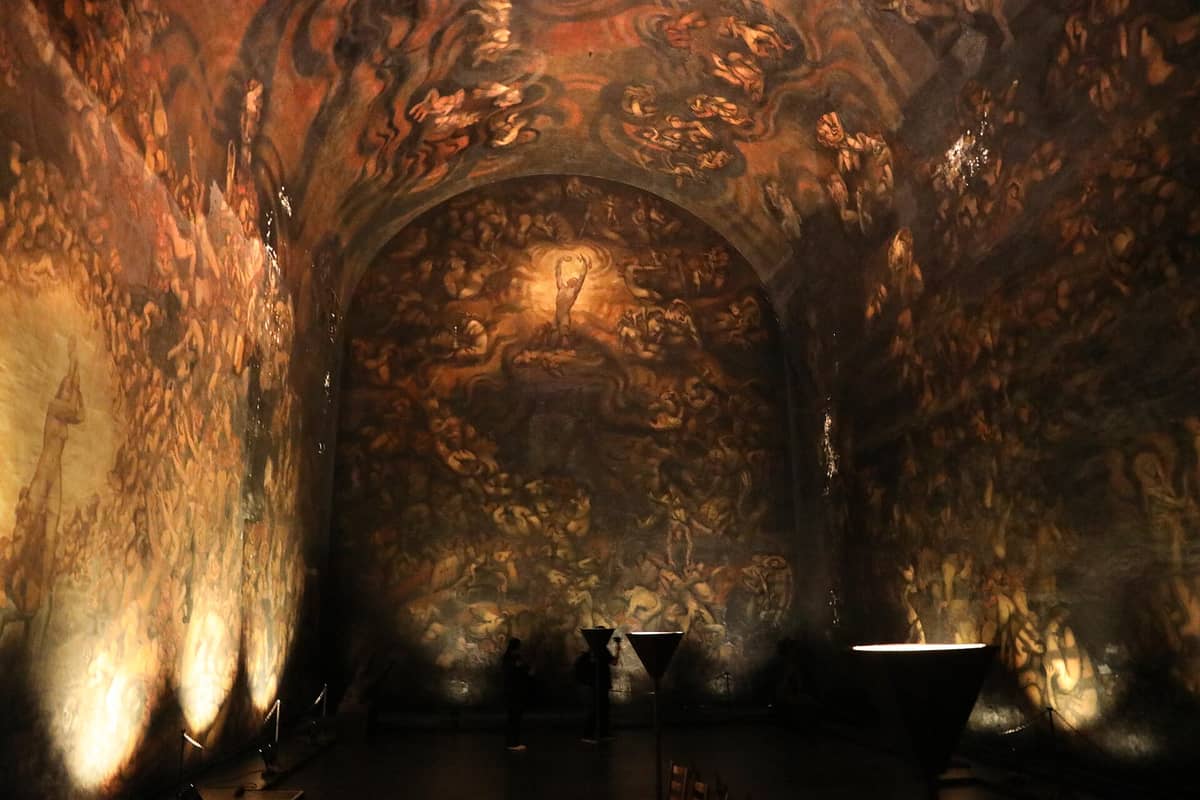
Tucked into a quiet residential street in the Slemdal neighborhood, the Emanuel Vigeland Mausoleum is one of Oslo's most singular and least-visited art experiences. A barrel-vaulted chamber covered floor-to-ceiling in frescoes depicting the human life cycle, with acoustics so extreme that a whisper lingers for twenty seconds. Open Sundays only, with timed entry slots and advance booking recommended.
Quick Facts
- Location
- Grimelundsveien 8, Slemdal, Oslo
- Getting There
- T-bane to Slemdal station (line 1), then a short walk
- Time Needed
- 45–90 minutes
- Cost
- 120 NOK adults, 90 NOK students/seniors, free under 18
- Best for
- Art lovers, architecture enthusiasts, seekers of the unconventional
- Official website
- www.emanuelvigeland.museum.no/information.htm
What the Emanuel Vigeland Mausoleum Actually Is
The Emanuel Vigeland Mausoleum is not a conventional gallery, and approaching it as one will leave you disoriented in the best possible way. The building at Grimelundsveien 8 was originally constructed as the artist's private studio and completed in 1926. Emanuel Vigeland intended it from the start as his tomb and life's work combined. When he died in 1948, his ashes were placed in the entrance vestibule above the door, precisely as he had planned. The museum opened to the public in 1959, and the experience has changed very little since., and the experience has changed very little since.
Inside, a single barrel-vaulted hall stretches before you, its brick walls and curved ceiling covered entirely in frescoes painted by Vigeland himself. The imagery is explicit: writhing human figures at every stage of life, from conception and birth through erotic union, aging, and death. There is no separation between the art and the architecture. The frescoes are the room, and the room is the artwork. Nothing about the exterior, a modest brick building on a residential street, prepares you for what is inside.
ℹ️ Good to know
The mausoleum is open every Sunday year-round, from 11:30 to 16:00. Timed entry slots are used. Advance booking is strongly recommended, particularly in summer. Verify current availability on the official museum website before your visit.
Emanuel Vigeland: The Other Vigeland
Visitors often arrive knowing the name Vigeland from the famous sculpture park in Frogner, which was the work of Gustav Vigeland. Emanuel was Gustav's younger brother, also a sculptor and artist of significant ability, but he spent much of his career in the shadow of his more celebrated sibling. The two brothers had a difficult relationship, and the contrast between their legacies is stark: Gustav's work fills a public park visited by hundreds of thousands every year, while Emanuel's masterpiece sits quietly in a residential neighborhood, open four and a half hours per week.
Emanuel studied in Italy and absorbed Renaissance fresco technique with genuine rigor. The scale and ambition of what he eventually executed in the mausoleum reflects that training directly. Where Gustav's sculptures celebrate life with a kind of monumental optimism, Emanuel's frescoes are darker, more erotic, more obsessive. The two works, taken together, offer a fascinating counterpoint. If you plan to visit both, the Vigeland Sculpture Park in Frogner is easily combined with a day that ends at the mausoleum, though they are about 4 kilometers apart.
Tickets & tours
Live prices and dates from our booking partner. If you book, we may earn a commission at no extra cost to you.
Enjoy Vigeland Park in a private tour
From 46 €Instant confirmationFree cancellationDiscover photogenic spots in Oslo's Vigeland Park with a local
From 109 €Instant confirmationFree cancellationExplore the Instaworthy spots of Vigeland Park in Oslo with a local
From 81 €Instant confirmationFree cancellationOslo Fjord sightseeing audio-guided electrical boat tour
From 35 €Instant confirmationFree cancellation
Stepping Inside: What the Experience Feels Like
You enter through a low vestibule and You enter through a low vestibule and pass beneath the urn containing Vigeland's ashes above the entrance door.. The transition from the quiet Sunday street outside to the interior is abrupt. The room is deliberately dim, lit to allow the frescoes to dominate without the distraction of bright overhead light. Your eyes need a moment to adjust.
Then the acoustics register. The mausoleum has a reverberation time of approximately 20 seconds, one of the longest of any enclosed space in Norway. This is not an accident. Vigeland designed the proportions of the room with these acoustics in mind. A single footstep on the stone floor sends a wash of sound rolling across the vault and back again. If another visitor shifts position, you hear it. If someone coughs, the room transforms it into something cathedral-like. Most visitors instinctively stop speaking at full volume within seconds of entering.
The frescoes themselves reward slow looking. The imagery covers every surface above the floor: human figures in densely layered compositions that move from the erotic and fleshy at eye level up through increasingly skeletal and abstract forms toward the apex of the vault. The palette runs from warm terracotta and ochre to deep shadow. There is a formal logic to the progression if you follow it from entrance to far wall, though many visitors simply stand in the center and look upward.
⚠️ What to skip
The frescoes contain explicit sexual imagery and are not suitable for young children. The room is also very dark, with uneven stone steps at the entrance. Visitors with noise sensitivity should be aware that even small sounds are dramatically amplified.
Getting There: Practical Directions
The most straightforward approach is Oslo Metro line 1, which runs northwest from the city center through Majorstuen and up into the residential hills. Alight at Slemdal station and walk south through the neighborhood for roughly 7 minutes. The streets are quiet and residential; the museum building is identified by a small sign rather than any grand exterior. Allow extra time on your first visit, as the area is not heavily signposted for tourists. The streets are quiet and residential; the museum building is identified by a small sign rather than any grand exterior. Allow extra time on your first visit, as the area is not heavily signposted for tourists.
If you are using the Oslo Pass for transport, it covers the T-bane fare. For a broader overview of how the pass works across Oslo's museums and transit, the Oslo Pass guide covers the key details. Note that the Emanuel Vigeland Mausoleum is not included in the Oslo Pass for free entry; admission is paid separately.
By car, the address is Grimelundsveien 8, 0775 Oslo. Street parking is available in the surrounding residential streets, but Oslo's parking rules apply. On Sundays the area is quiet and parking is generally easier than on weekdays.
Timing Your Visit
Because the museum opens only on Sundays between 11:30 and 16:00, your timing options are limited by definition. Advance booking is recommended, and the number of visitors in the room at any one moment is controlled, which is genuinely important for the experience. A full room of people breaks the quiet that the acoustics depend on. Arriving at or near opening time tends to mean smaller groups in the early slots., which is genuinely important for the experience. A full room of people breaks the quiet that the acoustics depend on. Arriving at or near opening time tends to mean smaller groups in the early slots.
Summer Sundays in July and August draw more visitors than the rest of the year, since Oslo's tourist season peaks then. If you are visiting in the shoulder months of May, September, or October, you are more likely to find the room with only a handful of other people, which is the preferable way to encounter it. Winter visits in January or February carry the added atmosphere of arriving through a snow-quiet neighborhood to an already-silent interior.
For a broader sense of when Oslo rewards a visit for different reasons, the best time to visit Oslo guide covers seasonal considerations across the city.
Photography and the Darkness Inside
Photography policies should be confirmed on the museum's official website before your visit, as these can change. The interior is genuinely dark, and flash photography, if allowed, would be disruptive to other visitors and acoustically jarring in a space where every sound reverberates. A camera or phone capable of handling low light without flash will serve you better than any external lighting. A camera or phone capable of handling low light without flash will serve you better than any external lighting.
Wide-angle lenses or wide-angle phone modes help capture the scale of the vault, but no single frame fully communicates the experience of standing inside it. The most honest photographs tend to be detail shots of individual fresco sections rather than attempts to encompass the whole room.
Accessibility and Practical Limitations
The building sits on a residential street approached by a short walk from the metro. The entrance involves steps, and the interior floor is uneven stone. The museum says it is not built for wheelchair users, though the outside steps are low and it may be possible to enter with assistance. Visitors with specific accessibility requirements are encouraged to contact the museum directly by email before visiting. Visitors with specific accessibility requirements are encouraged to contact the museum directly by email before visiting, as the museum does indicate it can make special arrangements.
The extreme reverberation means the space is not comfortable for visitors with auditory sensory sensitivities. Every sound, from footsteps to whispering to the movement of clothing, returns amplified. This is a feature for most visitors, but it is worth knowing in advance if you or a companion finds prolonged exposure to reverberant environments difficult.
Who Should Consider Skipping This
Visitors looking for a broad overview of Oslo's art scene on a tight schedule may find the Sunday-only opening too constraining. The mausoleum rewards those who come specifically for it rather than those tagging it onto a packed itinerary. Families with young children should be aware of the explicit content. If you are working through Oslo's major art institutions more generally, the and the offer broader collections with more flexible opening hours. The mausoleum rewards those who come specifically for it rather than those tagging it onto a packed itinerary. Families with young children should be aware of the explicit content. If you are working through Oslo's major art institutions more generally, theNational Museum and the Munch Museum offer broader collections with more flexible opening hours.
Visitors who prefer art in well-lit, spacious, conventional gallery settings will likely find the confined darkness of the mausoleum uncomfortable. This is a space designed to envelop rather than display, and it does exactly that.
Insider Tips
- Book your timed entry slot in advance through the museum's official website, especially for summer Sundays. Walk-ins are sometimes possible but not guaranteed.
- Stand in the center of the room and speak at a normal volume just once. The 20-second reverberation is most clearly felt through your own voice rather than someone else's footstep. Then stay silent.
- The vestibule where Vigeland's ashes rest is easy to pass through quickly. Pause there before entering the main hall. The transition from ordinary street to mausoleum is more powerful if you give it a moment.
- Combine the visit with a walk through the Slemdal neighborhood itself. The residential streets are well-maintained and reflect a side of Oslo that most tourists do not see: quiet, prosperous, and without any tourist infrastructure.
- Carry a layer regardless of season. The stone interior holds a consistent chill even in summer, and you will likely stand still for longer than expected once the frescoes absorb your attention.
Who Is Emanuel Vigeland Mausoleum For?
- Art lovers interested in early 20th-century fresco technique and symbolist imagery
- Architecture and acoustics enthusiasts drawn to deliberately designed sensory spaces
- Travelers who have already seen Oslo's main attractions and want something genuinely different
- Those interested in the biography of the Vigeland family and the contrast between the two brothers' legacies
- Visitors who value quiet, unhurried encounters with singular works of art
Nearby Attractions
Combine your visit with:
- Drøbak
Drøbak is a compact coastal town on the eastern shore of the Oslofjord, about an hour south of Oslo by bus. Known for its well-preserved wooden architecture, Sunday shopping tradition, and proximity to the historic Oscarsborg Fortress, it offers a genuine change of pace from the capital without requiring an overnight stay.
- Ekeberg Viewpoint
Perched on Ekebergåsen hill southeast of central Oslo, Ekebergparken combines one of the city's most sweeping viewpoints with an open-air sculpture park, ancient rock carvings, and forested walking trails. It is free to enter, open around the clock, and far less crowded than most Oslo attractions.
- Ekebergparken Sculpture Park
Ekebergparken Sculpture Park sits on a wooded hillside southeast of Oslo's city center, combining a rotating collection of contemporary sculpture with sweeping views over the Oslofjord. Entry is free, the park is open around the clock, and the experience shifts dramatically depending on what time of day and season you visit.
- Fredrikstad Old Town (Gamlebyen)
Fredrikstad Gamlebyen is one of the best-preserved fortified towns in the Nordic region, founded in 1567 and still encircled by its original star-shaped ramparts. Just about an hour south of Oslo by train, it offers cobblestone lanes, working artist studios, waterfront cafés, and a ferry crossing that costs nothing. Entrance to the fortress area is free.
Planning a trip? Discover personalized activities with the Nomado app.