Ekeberg Viewpoint: Oslo's Best Panorama, Sculpture Park, and Hilltop Escape
Perched on Ekebergåsen hill southeast of central Oslo, Ekebergparken combines one of the city's most sweeping viewpoints with an open-air sculpture park, ancient rock carvings, and forested walking trails. It is free to enter, open around the clock, and far less crowded than most Oslo attractions.
Quick Facts
- Location
- Kongsveien 15, 0193 Oslo — on the Ekebergåsen ridge southeast of the city centre
- Getting There
- Tram lines 13 and 19 stop at Ekebergparken; the nearest bus stop is Ekeberg Camping on routes 74 and 34
- Time Needed
- 1.5 to 3 hours depending on pace and trail choice
- Cost
- Free entry — 0 NOK — open 24/7 year-round
- Best for
- Panoramic city views, sculpture lovers, walkers, and photographers at golden hour
- Official website
- ekebergparken.com
What Ekebergparken Actually Is
Ekebergparken is a public park spread across the forested Ekebergåsen ridge southeast of Oslo's city centre. The park combines three distinct identities in one continuous green space: a panoramic viewpoint over Oslo and the Oslofjord, an open-air sculpture park displaying works by internationally recognised artists, and a site containing prehistoric rock carvings that date back thousands of years. All of it is free to access, all of it is open at any hour.
That combination is unusual even by Scandinavian standards, and it means the park rewards different kinds of visitors. You can arrive with a camera purely for the view, spend an hour tracing outdoor sculptures through beech and pine forest, or look for Bronze Age petroglyphs carved into the bedrock. Most first-time visitors do some version of all three without realising how much ground they have covered.
💡 Local tip
The main viewpoint terrace is busiest on clear summer evenings. For a quieter experience with equally good light, arrive in the late morning on a weekday or come on a clear winter day when the snow-dusted city skyline is visible below.
The View: What You See and When It Works Best
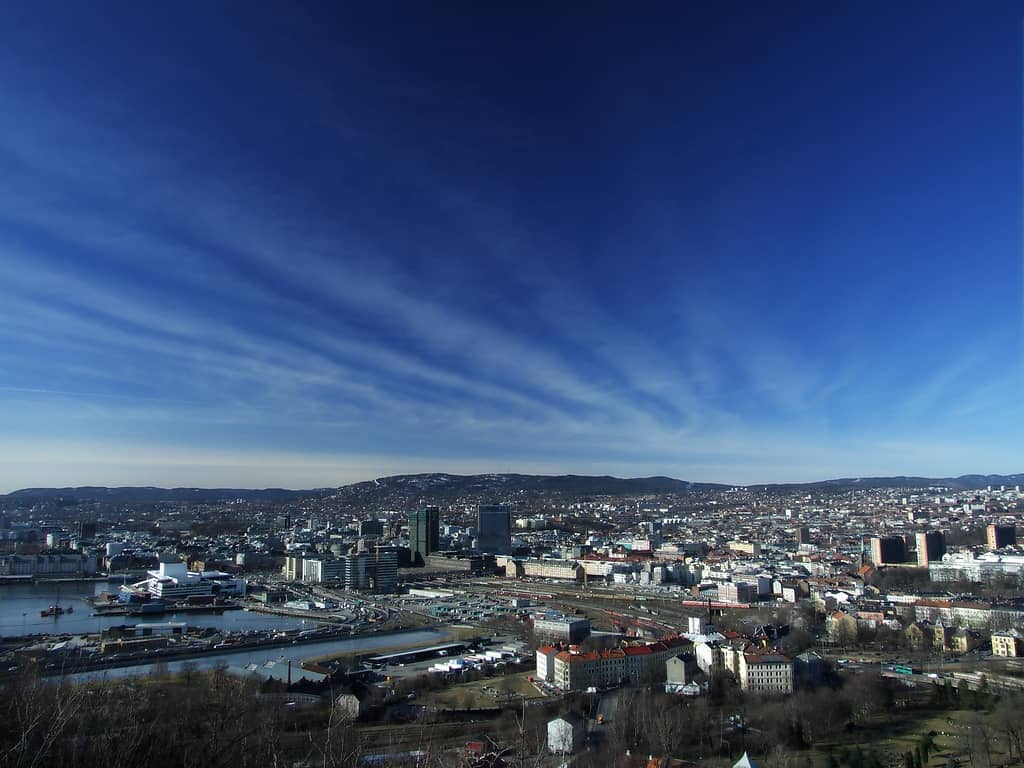
The signature panorama from Ekebergparken looks northwest across the Oslo city rooflines toward the fjord and the hills of Nordmarka beyond. On clear days, the Opera House roof and the glass towers of the Barcode district are immediately identifiable below, framed by the wide blue-grey surface of the Oslofjord stretching southward. The Holmenkollen ski jump is visible on the forested ridge to the northwest, confirming just how comprehensively the view captures the city's geography.
The view is genuinely one of Oslo's best, though it works on a specific condition: clear sky. Low cloud, which is common in autumn and early winter, can completely obscure the fjord. Oslo's weather is most reliably clear between late May and August, and again on cold, high-pressure winter days. For context on planning around weather, see the guide to the best time to visit Oslo.
At sunset in midsummer, the light turns golden against the water, and the park's main terrace fills with Osloites who have brought picnic blankets and thermoses. This is not a scene manufactured for tourists. It is simply where locals come to watch the evening. In winter, if the city has fresh snow and the sky is sharp and blue, the view takes on a monochrome clarity that summer cannot match.
Tickets & tours
Live prices and dates from our booking partner. If you book, we may earn a commission at no extra cost to you.
Oslo Fjord sightseeing audio-guided electrical boat tour
From 35 €Instant confirmationFree cancellationFjord cruise with live jazz music
From 64 €Instant confirmationFree cancellationLuggage Storage in Oslo
From 6 €Instant confirmationFree cancellationPicturesque dinner cruise in Oslo
From 137 €Instant confirmationFree cancellation
The Sculpture Park: Art in the Forest
The sculpture collection at Ekebergparken features works by artists including Auguste Rodin and a number of major Norwegian sculptors. The pieces are distributed along marked trails through the woodland, meaning you encounter them at intervals rather than in a concentrated gallery-style layout. The effect is that sculpture and landscape comment on each other in ways that a white-walled interior never could.
This approach makes Ekebergparken a genuinely interesting counterpoint to Oslo's indoor sculpture institutions. Where Vigeland Sculpture Park in Frogner presents an overwhelming concentration of work by a single artist in a formal park setting, Ekebergparken feels more like a discovery. You round a bend in the path and find a bronze figure half-concealed in tree shadow, or stumble on a large-scale installation in a clearing. The signage is present but unobtrusive.
The trails are generally well-maintained and suitable for ordinary footwear in dry conditions. In wet weather or after snow, some of the forest paths become slippery, and ankle-supporting shoes are worth wearing. A printed or digital map of the sculpture trail, available via the official website, is useful for ensuring you don't miss pieces located on secondary paths.
History on the Hill: Rock Carvings and Older Oslo
Ekebergåsen has been significant to Oslo's inhabitants for far longer than the sculpture collection implies. The rock carvings found within the park area date from prehistoric times, making this hillside one of the oldest continuously significant sites in the Oslo region. The carvings, which include figures and symbols typical of Scandinavian Bronze Age petroglyphs, are protected and marked for visitors. They are not monumental in scale, but their presence on the same ridge now known for contemporary art creates an inadvertently resonant context.
Ekebergåsen also carries weight in the cultural history of Norwegian painting. Edvard Munch is believed to have stood on this ridge when he conceived his most famous work, and the area's association with Norwegian artistic identity is recognised locally. For more on Munch's presence in Oslo, the dedicated guide to Munch in Oslo covers the key sites and the Munch Museum in detail.
Getting There and Moving Around the Park
Tram lines 13 and 19 serve the park with a stop called Ekebergparken. From the city centre, the tram journey takes roughly ten to fifteen minutes depending on the route, and nearby bus routes 74 and 34 stop at Ekeberg Camping. Both approaches involve some uphill walking and take longer, but they are pleasant enough routes if you are combining the park with exploration of the surrounding residential neighbourhoods.
If you are working through Oslo on a multi-day itinerary, Ekebergparken fits naturally into an afternoon that also takes in the nearby waterfront. The Oslo Opera House and the Barcode project are visible from the viewpoint above and are a short tram or walk from the base of the hill. A 3-day Oslo itinerary guide covers how to sequence these areas efficiently.
ℹ️ Good to know
The park has marked WC locations on its official map, available at ekebergparken.com. These are worth locating before heading deeper into the forest trails, particularly on longer visits.
Photography Notes and Seasonal Variations
The main viewpoint faces northwest, which means afternoon and evening light is ideal for photography. Morning light falls from behind the viewpoint and can create flat, washed-out conditions on the city below. Golden hour in summer arrives late, often after 9 pm, giving photographers a long window to work with. A wide-angle lens captures the full sweep from the Holmenkollen ridge to the fjord; a telephoto pulls in the Opera House, the Barcode towers, and the bridge structures in the harbour.
In winter, snow on the ground and on rooftops below creates high contrast with the dark fjord water. Frost on the tree branches near the viewpoint terrace adds foreground texture. The low winter sun in Oslo, which barely clears the southern horizon between November and January, produces long-shadow light almost all day. This is not necessarily a disadvantage for photography. Midday in January at Ekeberg can produce the same quality of light you might wait hours for in summer.
For a broader picture of where this viewpoint sits among Oslo's panoramic spots, the guide to Oslo's best viewpoints compares Ekeberg, Holmenkollen, and the Opera House roof from a photographer's and general visitor's perspective.
Clear Assessment: What Works and What Doesn't
Ekebergparken is not a polished tourist attraction in the conventional sense. There is no visitor centre, no audio guide, no cafe directly at the main viewpoint terrace. The restaurant in the park building serves food, but it operates on its own hours and price level. Visitors expecting the kind of structured experience offered by Oslo's larger museums will find the park relatively sparse in terms of interpretation.
The sculpture collection is also uneven. Some pieces are striking in their woodland context; others feel underlit or placed without obvious purpose. The rock carvings require patience and some instruction to appreciate fully — without prior reading, they can look simply like weathered marks on stone. The park's value is highest for those willing to walk slowly, tolerate ambiguity, and find meaning in the layering of ancient carving, 20th-century art, and live city panorama in a single forested hillside.
Visitors with limited mobility should note that the forest trails are uneven. The main viewpoint terrace is accessible by paved path from the tram stop, but the sculpture trail and the paths toward the rock carvings involve rougher terrain. The official park map identifies key locations, and reviewing it before arrival helps in planning a route that stays within comfortable ground.
⚠️ What to skip
On clear summer evenings, the main terrace can feel crowded as locals gather for sunset. If the social scene isn't what you're after, arrive earlier in the afternoon when the light is still good but the terrace is quieter.
Insider Tips
- Download or screenshot the official Ekebergparken map before you arrive. Mobile signal is reliable on the main terrace but can drop in the denser forest sections of the sculpture trail.
- The tram stop is named Ekebergparken on lines 13 and 19. When returning, note that trams heading back toward the city centre can fill up on summer evenings — the wait is short, but standing room only is common on the first departure after sunset.
- The rock carvings are easier to spot in low, raking light — early morning or late afternoon. In flat midday light they blend into the stone surface and are easy to walk past without noticing.
- The park is genuinely pleasant in early November before serious cold sets in. Autumn colour in the beeches and birches peaks in mid-October, and the viewpoint is often fog-free in the clear spells that follow autumn rain.
- If you want a meal with a view, the Ekebergrestauranten inside the park occupies a functionalist building from 1929 with fjord-facing windows. It is a full-service restaurant rather than a cafe, so budget accordingly and check current hours before visiting.
Who Is Ekeberg Viewpoint For?
- Photographers and view-seekers who want Oslo's skyline and fjord in a single frame without paying an admission fee
- Walkers and hikers looking for a forested circuit close to the city centre that connects art, history, and landscape
- Families with older children who can manage uneven forest paths and will engage with an open-air sculpture trail
- Visitors who have already seen Vigeland Sculpture Park and want a lower-key, more eclectic alternative
- Anyone visiting Oslo in winter looking for a panoramic viewpoint that rewards cold, clear-sky conditions
Nearby Attractions
Combine your visit with:
- Drøbak
Drøbak is a compact coastal town on the eastern shore of the Oslofjord, about an hour south of Oslo by bus. Known for its well-preserved wooden architecture, Sunday shopping tradition, and proximity to the historic Oscarsborg Fortress, it offers a genuine change of pace from the capital without requiring an overnight stay.
- Ekebergparken Sculpture Park
Ekebergparken Sculpture Park sits on a wooded hillside southeast of Oslo's city center, combining a rotating collection of contemporary sculpture with sweeping views over the Oslofjord. Entry is free, the park is open around the clock, and the experience shifts dramatically depending on what time of day and season you visit.
- Emanuel Vigeland Mausoleum
Tucked into a quiet residential street in the Slemdal neighborhood, the Emanuel Vigeland Mausoleum is one of Oslo's most singular and least-visited art experiences. A barrel-vaulted chamber covered floor-to-ceiling in frescoes depicting the human life cycle, with acoustics so extreme that a whisper lingers for twenty seconds. Open Sundays only, with timed entry slots and advance booking recommended.
- Fredrikstad Old Town (Gamlebyen)
Fredrikstad Gamlebyen is one of the best-preserved fortified towns in the Nordic region, founded in 1567 and still encircled by its original star-shaped ramparts. Just about an hour south of Oslo by train, it offers cobblestone lanes, working artist studios, waterfront cafés, and a ferry crossing that costs nothing. Entrance to the fortress area is free.
Planning a trip? Discover personalized activities with the Nomado app.