Norwegian Museum of Cultural History (Norsk Folkemuseum): What to Know Before You Go
The Norwegian Museum of Cultural History, known in Norwegian as Norsk Folkemuseum, is Norway's largest open-air museum, spreading across 14 hectares on the Bygdøy peninsula. More than 160 historic buildings relocated from across the country, a medieval stave church, and one of Scandinavia's most significant folk culture collections make this one of Oslo's most substantive half-day experiences. make this one of Oslo's most substantive half-day experiences.
Quick Facts
- Location
- Museumsveien 10, Bygdøy, Oslo (approx. 5 km from city centre)
- Getting There
- Bus 30 toward Bygdøy; seasonal ferry from Rådhusbrygge 3 to Dronningen
- Time Needed
- 2.5–4 hours; full day if attending demonstrations
- Cost
- NOK 200 adults / NOK 140 students / NOK 160 seniors (67+) / Children 0–17 free (2026 prices)
- Best for
- Norwegian history, architecture, families, open-air culture
- Official website
- norskfolkemuseum.no/en
What Is Norsk Folkemuseum?
Founded in 1894 by Hans Aall, the Norwegian Museum of Cultural History, or Norsk Folkemuseum, is one of the oldest and largest open-air museums in the world. The concept was bold for its era: rather than displaying artifacts inside glass cases, Aall's vision was to physically relocate historic buildings from around Norway to a single site, preserving them in reconstructed environments that showed how people actually lived. Today the museum occupies 14 hectares on the Bygdøy peninsula and holds more than 160 historic structures alongside a collection of roughly 160,000 objects.
This is not a theme park dressed up as history. The buildings are authentic, sourced from Norwegian farms, towns, and fishing communities spanning several centuries. Walking the grounds feels less like touring an exhibition and more like stepping through a compressed timeline of Norwegian rural and urban life, from medieval timber construction to 20th-century apartment interiors.
💡 Local tip
Pick up a free site map at the Visitor Centre when you arrive. The open-air grounds are large, and without a map it is easy to loop back on yourself or miss entire sections, particularly the urban district near the northern end of the grounds.
The Open-Air Grounds: Buildings, Farmsteads, and the Stave Church
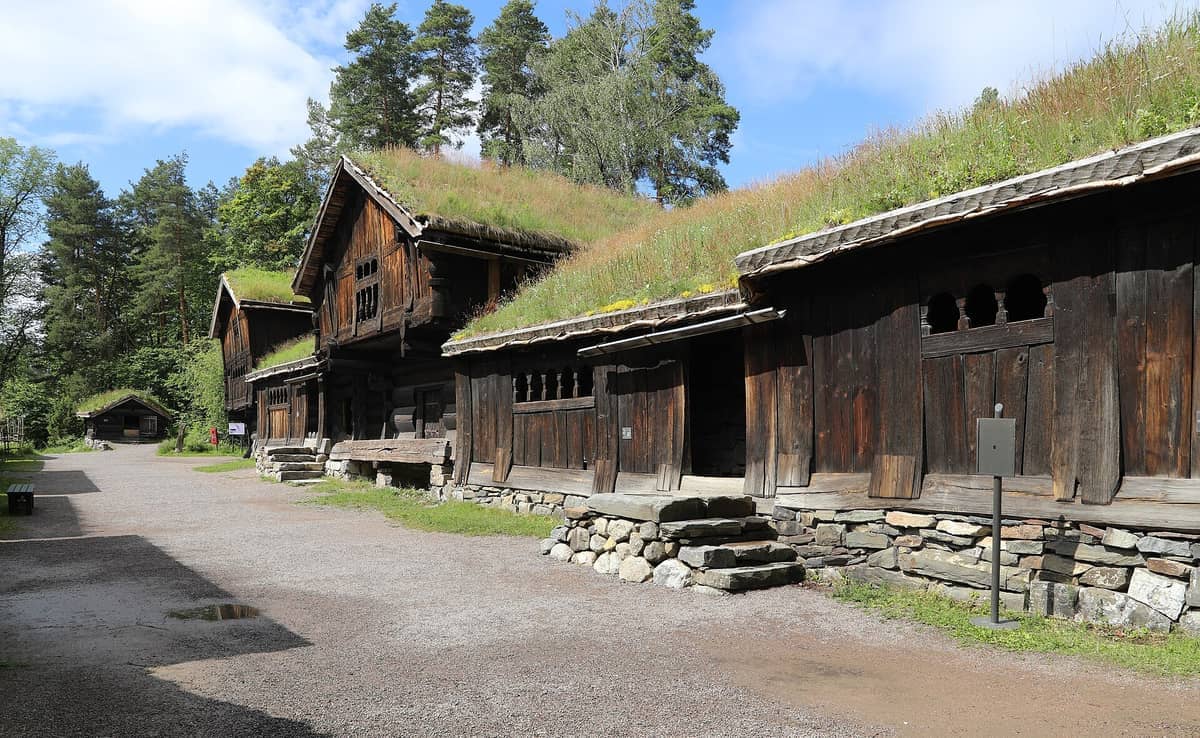
The outdoor section is the museum's core, and it rewards slow, deliberate exploration. The buildings are organized into loose regional groupings: you move from Telemark and Numedal farmsteads to Setesdal interiors, each cluster reflecting the distinct building traditions of its home region. Turf roofs, low doorways, and the smell of aged timber are constants throughout. In summer, staff in period dress demonstrate crafts like weaving, baking flatbread, and woodcarving, adding a layer of texture that most indoor museums cannot replicate.
The Gol Stave Church is the single most significant structure on the grounds. Moved from Gol in Hallingdal and reconstructed at Bygdøy at the end of the 19th century, it dates to the Middle Ages, though the exact construction period is debated. The interior is dark and intimate, with carved wooden details and traces of painted decoration. Even at peak visiting hours in July, the interior stays relatively calm because the space holds only a small number of visitors at once. Arrive in the morning when light enters through the small windows at a low angle; by midday the contrast between the dim interior and bright exterior makes photography difficult. it dates to the Middle Ages, though the exact construction period is debated. The interior is dark and intimate, with carved wooden details and traces of painted decoration. Even at peak visiting hours in July, the interior stays relatively calm because the space holds only a small number of visitors at once. Arrive in the morning when light enters through the small windows at a low angle; by midday the contrast between the dim interior and bright exterior makes photography difficult.
The urban district section is easy to underestimate. A reconstructed city street with late 19th and early 20th-century shopfronts, interiors, and apartment rooms illustrates how Norwegian city life evolved during industrialization. It complements the rural sections rather than duplicating them, and it connects naturally to themes explored across the rest of Bygdøy and Oslo's broader cultural history.
Tickets & tours
Live prices and dates from our booking partner. If you book, we may earn a commission at no extra cost to you.
Oslo Fjord sightseeing audio-guided electrical boat tour
From 35 €Instant confirmationFree cancellationFjord cruise with live jazz music
From 64 €Instant confirmationFree cancellationLuggage Storage in Oslo
From 6 €Instant confirmationFree cancellationPicturesque dinner cruise in Oslo
From 137 €Instant confirmationFree cancellation
How the Experience Changes by Season and Time of Day
Summer, specifically late June through August, is when the museum operates at full intensity. Outdoor demonstrations run throughout the day, the grounds are fully accessible, and the café is open. The Hardanger fiddle might be playing near the farmyard, and there are often organized activities for children. If you arrive at opening (10:00 from 1 May to 4 October), you will have the farmsteads largely to yourself for the first hour. If you arrive at opening (10:00 from 1 May to 4 October), you will have the farmsteads largely to yourself for the first hour.
Late afternoon in summer has its own appeal. The low Nordic light after 15:00 is warm and directional, making the timber facades glow in a way that midday light does not produce. Visitor numbers drop noticeably after 15:30 as families with young children start to leave. If photography is a priority, the combination of late light and thinner crowds makes this the best window.
The winter experience is quieter and more austere. From 5 October through 30 April, the museum opens Tuesday to Sunday only (11:00–16:00) and Mondays are closed entirely. The outdoor grounds are accessible but demonstrations are limited. Snow on the turf roofs and frost on the timber walls make certain buildings look exactly as they would have for generations of Norwegian farmers during long winters. The atmosphere is contemplative rather than festive, and it suits visitors who want unhurried access to the indoor collections.
⚠️ What to skip
The museum is closed on Mondays during the winter season. Showing up on a Monday in November will mean a locked gate. Double-check the seasonal hours on the official site before visiting outside summer. Showing up on a Monday in November will mean a locked gate. Double-check the seasonal hours on the official site before visiting outside summer.
The Indoor Collections
The main Visitor Centre houses permanent indoor exhibitions that cover Norwegian folk art, traditional dress (bunad), furniture, religious objects, and everyday domestic items. The Sami collection is one of the museum's most important holdings, documenting the material culture of Norway's indigenous Sami people through clothing, tools, and objects related to reindeer husbandry and traditional livelihood.
The collection's depth means that a single visit will not cover everything. Visitors with specific interests, in textile history, folk painting traditions, or Sami culture, will find it worth planning ahead by reviewing the museum's online exhibition descriptions before arriving. The indoor galleries are also a useful refuge when afternoon rain arrives, which it does unpredictably even in July.
Getting There: Transit and Practical Logistics
The museum is at Museumsveien 10, on the Bygdøy peninsula, approximately 5 km west of Oslo city centre. Bus 30 runs from Oslo city centre to the stop Folkemuseet; in the warmer months, a seasonal passenger ferry departs from Rådhusbrygge 3 to Dronningen, with a walk from there to the museum.
If you hold an Oslo Pass, admission to Norsk Folkemuseum is included, along with free travel on public transit. For a full calculation of whether the pass saves money given your itinerary, see the Oslo Pass guide.
Accessible parking (designated HC spaces) is available near the main entrance. The Visitor Centre has accessible toilets, and companions holding a valid companion card are admitted free. The open-air grounds are largely navigable by wheelchair, though some of the older building interiors have uneven floors and low thresholds that limit access.
Combining Norsk Folkemuseum with Nearby Bygdøy Museums
Bygdøy is one of Oslo's most concentrated museum areas. Within a short walk of Norsk Folkemuseum, you will find the Fram Museum, which houses the actual polar exploration vessel used by Fridtjof Nansen and Roald Amundsen, and the Kon-Tiki Museum, home to Thor Heyerdahl's original raft. Most visitors combine two or three Bygdøy museums in a single day.
One practical reality: museum fatigue sets in faster than most people anticipate. Norsk Folkemuseum alone warrants at least two and a half hours if you engage seriously with both the outdoor grounds and the indoor collections. If you plan to visit multiple Bygdøy museums in one day, start here first when your energy is highest. For a structured approach to the whole peninsula, see the Oslo museums guide.
Is It Worth Your Time? A Clear Assessment
Norsk Folkemuseum is not for everyone. Visitors seeking fast-paced, high-stimulation experiences will find the pace slow and the subject matter demanding. The museum rewards curiosity and patience rather than spectacle. If Norwegian rural history does not interest you, two hours of walking past 17th-century wooden barns may feel repetitive, regardless of their authenticity.
For travellers with a genuine interest in Scandinavian history, vernacular architecture, or folk culture, this is one of the strongest attractions in Oslo. The depth of the collection and the quality of the setting are difficult to replicate. It sits alongside the National Museum as one of the city's most serious cultural institutions, though the two occupy entirely different registers.
Families with children between the ages of six and twelve tend to respond very well to the outdoor section, particularly when demonstrations are running. The scale of the grounds means children have space to move, and the hands-on nature of some activities makes the experience less passive than a conventional indoor museum.
Insider Tips
- The Gol Stave Church gets the most visitors between 11:00 and 13:00. Head there immediately after the gates open and you will often have the interior almost to yourself, which changes the atmosphere completely.
- The on-site café is a reasonable stop for lunch, but the queue grows quickly after midday in summer. Eat before noon or bring food. The museum allows picnicking on the grounds.
- Seasonal ferry arrivals at Bygdøy pier drop you slightly closer to the Fram and Kon-Tiki museums than to Norsk Folkemuseum. Budget an extra five minutes of walking or use it as an opportunity to orient yourself to the whole peninsula before deciding your route.
- The urban district section near the northern end of the grounds is frequently the least crowded part of the outdoor museum, even on busy summer days. It is also where some of the most detailed interior reconstructions are found.
- If you visit in summer and see a demonstration or performance listed on the day's schedule board (usually posted at the main entrance), plan your route around it. These timed events are the best reason to visit in high season and change day by day.
Who Is Norwegian Museum of Cultural History (Norsk Folkemuseum) For?
- Travellers with a genuine interest in Norwegian folk culture, architecture, or Scandinavian history
- Families with children aged 6 and up, especially in summer when outdoor demonstrations run
- Photography enthusiasts drawn to vernacular timber architecture and Nordic light
- Visitors on a multi-museum Bygdøy day who want the most contextually rich starting point
- Anyone seeking a substantial, unhurried experience away from Oslo's city centre crowds
Nearby Attractions
Other things to see while in Bygdøy Peninsula:
- Bygdøy Coastal Path
The Bygdøy Coastal Path traces roughly 10 kilometres of shoreline around one of Oslo's most storied peninsulas, connecting fjord beaches, royal farmland, and quiet coves. It is free to walk year-round, easily reached by bus or seasonal ferry, and one of the few places in Oslo where the city completely disappears behind the treeline.
- Fram Museum
The Fram Museum on Oslo's Bygdøy peninsula houses the actual polar exploration ship Fram, the vessel that carried Nansen, Sverdrup, and Amundsen on their most ambitious expeditions. This is not a replica. It is the real thing, and you can walk its decks.
- Holocaust Center (HL-senteret)
Housed in the former wartime residence of Nazi collaborator Vidkun Quisling, the Holocaust Center (HL-senteret) on Bygdøy is one of Oslo's most historically charged sites. The permanent exhibition confronts Norway's role in the Holocaust with clarity and care, making it essential for anyone serious about understanding 20th-century Norwegian history.
- Huk Beach
Huk Beach (Huk badeplass) sits at the southern tip of the Bygdøy peninsula, offering sandy coves, grassy sunbathing lawns, and direct access to the Oslofjord. It is free to visit, served by bus from central Oslo, and gets seriously busy on warm summer afternoons — so timing your visit matters.
Planning a trip? Discover personalized activities with the Nomado app.