Kon-Tiki Museum: Where Thor Heyerdahl's Impossible Voyages Become Real
The Kon-Tiki Museum on Oslo's Bygdøy peninsula houses the original balsa-wood raft that Thor Heyerdahl sailed 8,000 kilometres across the Pacific in 1947. Beyond the raft, the museum tells the full story of Heyerdahl's lifetime of expeditions through original vessels, artifacts, and film. It is compact, well-curated, and quietly gripping.
Quick Facts
- Location
- Bygdøynesveien 36, 0286 Oslo — Bygdøy peninsula
- Getting There
- Bus 30 from Jernbanetorget/Rådhuset to Bygdøynes; or seasonal Bygdøy ferry from Rådhuskaien 4 to Bygdøynes stop (Apr–Oct), 200 m walk
- Time Needed
- 1.5 to 2.5 hours
- Cost
- Adult NOK 180 / Child (6–17) NOK 70 / Senior NOK 140 / Student NOK 70 / Family (2 adults, up to 5 children) NOK 400. Oslo Pass holders enter free.
- Best for
- History lovers, families with older children, anyone curious about exploration and human endurance
- Official website
- www.kon-tiki.no
What the Kon-Tiki Museum Actually Is
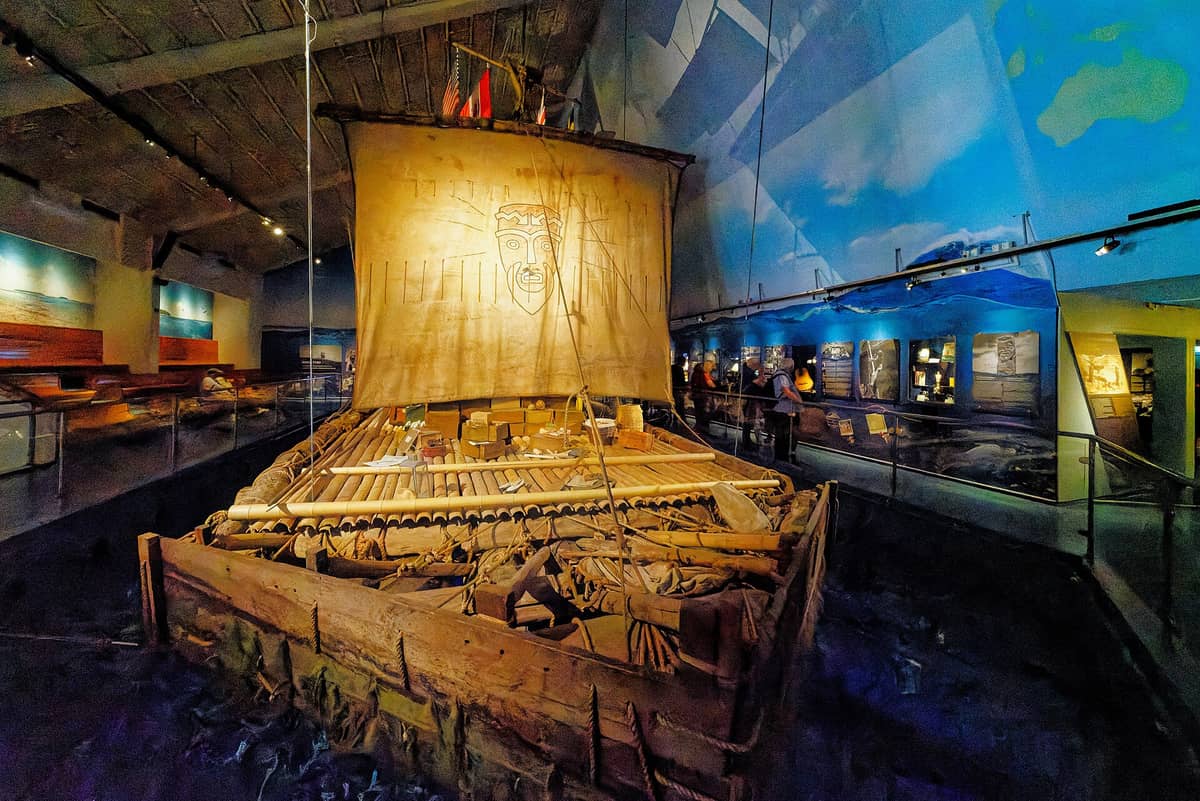
The Kon-Tiki Museum is a single-subject museum dedicated to the expeditions of Norwegian explorer Thor Heyerdahl, and it is more absorbing than that narrow focus might suggest. At its centre is the Kon-Tiki raft itself: the original balsa-log vessel on which Heyerdahl and five companions drifted roughly 8,000 kilometres from Peru to Polynesia in 101 days in 1947. The raft sits inside the main hall under dramatic lighting, close enough to touch the worn, salt-bleached wood through the barrier.
Heyerdahl built the Kon-Tiki to prove a contested anthropological theory: that pre-Columbian South Americans could have reached Polynesia by raft, using only materials and techniques available to them at the time. The academic establishment was sceptical. He went anyway. The museum does not just celebrate the adventure; it contextualises the science, the debate, and the method, which makes it considerably more interesting than a pure adventure shrine.
The museum sits on the Bygdøy peninsula, Oslo's cultural headland, clustered alongside the Fram Museum and the Norwegian Folk Museum. Visiting two or three of these in one half-day is entirely manageable, and it is one of the better ways to spend a day in Oslo without rushing.
The Main Exhibits: Raft, Boats, and Film
The Kon-Tiki raft dominates the ground floor. It measures roughly 14 metres in length, constructed from nine balsa logs lashed together with hemp rope — no nails, no glue. The small bamboo cabin amidships, where six men lived for three and a half months, looks impossibly cramped. A parrot named Lorita also made the crossing. The scale of the raft against the scale of the Pacific is something the museum handles well through maps and the original documentary film shot during the voyage.
The Ra papyrus boats occupy a second hall. Heyerdahl built Ra I and Ra II in 1969 and 1970, using ancient Egyptian-style construction techniques, to test whether early Egyptians could have crossed the Atlantic. Ra I broke apart around 600 kilometres short of Barbados. Ra II, built with refinements suggested by Bolivian craftsmen from Lake Titicaca, completed the crossing in 57 days. Both vessels are present in the museum, their papyrus reeds now dry and compacted but still visually striking.
A third vessel, the Tigris, a reed boat Heyerdahl sailed across the Indian Ocean in 1977, is represented through photographs and artefacts. The museum also holds a substantial collection from Heyerdahl's archaeological excavations on Easter Island and the Galapagos, including stone figures and pre-Columbian ceramics. These exhibits add a quieter, more academic dimension to what could otherwise feel like a pure spectacle museum.
💡 Local tip
The original 50-minute Kon-Tiki documentary film, shot during the 1947 crossing and winner of the 1951 Academy Award for Best Documentary Feature, screens on a loop in the museum's cinema room. Watching even 15 minutes of it before examining the raft up close changes the experience significantly — the footage of open Pacific swells makes the raft's dimensions suddenly very uncomfortable.
Tickets & tours
Live prices and dates from our booking partner. If you book, we may earn a commission at no extra cost to you.
How the Experience Changes by Time of Day
Weekday mornings, particularly between opening and 11:00, are the quietest periods. The main hall with the Kon-Tiki raft can feel almost private at that hour, which matters because the exhibit rewards slow looking. The detail in the rigging, the worn ropes, the carefully preserved bamboo cabin — these things are easier to absorb without school groups moving through at pace.
By midday in summer, the museum fills steadily. Groups tend to move through the main raft hall quickly and then disperse into the Ra exhibit and the cinema room, so congestion is rarely severe. The building itself is well-ventilated and cool, which makes it a sensible option on warmer Oslo days when outdoor queues at nearby museums can stretch considerably. Late afternoon, roughly 16:00 onwards, sees a second quieter window as tour groups complete their Bygdøy circuits.
In winter, with opening hours running 10:00 to 17:00, the museum is genuinely uncrowded on most days. The low northern light through the skylights gives the raft hall a particular quality in those months, and the lack of crowds allows for more conversation with the staff, who are knowledgeable and generally happy to expand on exhibits.
Getting to Bygdøy and Planning Your Visit
Bus 30 runs from Jernbanetorget (central Oslo) and Rådhuset roughly every 10 minutes and stops directly at Bygdøynes for the museums. Journey time from the city centre is about 15 minutes. This is the most reliable year-round option. The Bygdøy ferry from Rådhuskaien 4 operates from April through October, departing approximately every 20 minutes and stopping at Bygdøynes, a 200-metre walk from the museum entrance. The ferry costs the same as a standard Ruter bus fare and offers a brief, pleasant crossing of the inner harbour.
If you hold an Oslo Pass, museum entry is included along with the ferry fare and bus travel, making it straightforward to combine this visit with the Fram Museum next door. The Oslo Pass guide explains how to calculate whether the card makes financial sense for your itinerary.
ℹ️ Good to know
Opening hours by season: June to August, 09:30 to 18:00. May, 10:00 to 18:00. September to April, 10:00 to 17:00. Christmas Eve and New Year's Eve, closes at 15:00. The museum is open every day of the year.
Visitors with accessibility requirements are advised to contact the museum directly before arriving, as the official site does not comprehensively detail step-free access routes or tactile aids. Phone: +47 23 08 67 67. Email: kon-tiki@kon-tiki.no. The museum is listed with Museum for All, indicating some provision for visitors with specific needs.
Photography and Practical Considerations
Photography is permitted throughout the museum. The main raft hall is artificially lit, mostly with warm directional light on the Kon-Tiki itself. A standard smartphone camera handles it well; wide-angle lenses capture the full raft length most effectively. The Ra hall has slightly lower ambient light. Flash photography is not appropriate given the age of the reed material. The glass barriers around the raft reflect light at certain angles, so a polarising filter or shooting slightly off-axis reduces glare.
There is no strict dress code. The interior is temperature-controlled and comfortable in any season. A coat check is available near the entrance. The museum shop near the exit carries a solid selection of Heyerdahl's books in English and Norwegian, as well as models and prints — more considered than the average museum shop.
Who This Museum is For — and Who Might Not Connect With It
The Kon-Tiki Museum works particularly well for adults and older teenagers who arrive with some prior interest in exploration, anthropology, or maritime history. The exhibits are not interactive in the modern children's-museum sense; they rely on objects, text, and film. Younger children can engage with the sheer size and drama of the raft, but they may move through the space quickly.
For travellers focused on Norwegian cultural history rather than exploration, the Norwegian Folk Museum on the same peninsula offers a broader sweep of Norwegian life across centuries, and may feel more directly relevant. For maritime history specifically tied to Norwegian seafaring and polar exploration, the Fram Museum next door covers the great Norwegian polar expeditions with similarly impressive original vessels.
Travellers who find the Heyerdahl expeditions genuinely fascinating — and the 1947 Pacific crossing remains one of the most audacious navigational experiments in modern history — will find the museum proportionate to its subject: clear, well-organised, and anchored in a central exhibit that is more affecting in person than in photographs. It is not large, but it is not thin either.
⚠️ What to skip
The Kon-Tiki Museum is sometimes dismissed as 'just one raft.' That undersells it considerably. Between the Ra boats, the Easter Island archaeology, the documentary film, and the surrounding context about Heyerdahl's contested theories, a thorough visitor can spend two hours here without stretching. That said, if you arrive without curiosity about the subject, the exhibits will feel sparse by contemporary museum standards.
Combining Bygdøy: Making the Most of the Peninsula
Bygdøy is dense with museums and the Kon-Tiki sits at the far end of the peninsula near Bygdøynes. The Norwegian Maritime Museum and the Fram Museum are both within a two-minute walk. In summer, the Huk beach area at the tip of the peninsula is accessible on foot from the museum — a useful addition if you are visiting with children who need open space after indoor exhibits.
The Oslo museums guide outlines how to sequence Bygdøy's institutions across a half-day or full day without museum fatigue. In practice, two museums per visit is the comfortable upper limit for most adults; three in one day is possible but tends to compress attention.
Insider Tips
- Watch the documentary film first, even just 15 minutes of it, before studying the raft. The footage of open ocean swells makes the physical scale of the balsa logs feel genuinely alarming rather than merely historic.
- The museum's upper floor contains Heyerdahl's Easter Island archaeological collection, which is routinely overlooked by visitors who treat the raft as the destination and leave. The stone figures and ceramic pieces are well-documented and add real depth to understanding Heyerdahl's broader theoretical project.
- If you are visiting Bygdøy by ferry (April to October), take the ferry out and the bus back, or vice versa. The approach to Bygdøynes by water gives a useful sense of the harbour geography and is a nicer arrival than a bus stop.
- Family tickets (2 adults, up to 5 children) at NOK 400 represent meaningful savings over individual adult and child tickets for larger families. If your group has three or four children, the family rate is worth confirming at the ticket desk.
- The museum shop carries English-language editions of Heyerdahl's own account of the Kon-Tiki voyage. It is one of the best-written adventure narratives in Norwegian non-fiction and reads very differently after you have stood next to the raft.
Who Is Kon-Tiki Museum For?
- Adults and older teenagers with interest in exploration, anthropology, or maritime history
- Families with children aged 8 and above who can engage with narrative exhibits and documentary film
- Travellers doing a Bygdøy half-day combining multiple museums
- History readers who want to encounter original objects rather than reproductions
- Anyone curious about the limits of what humans will attempt to prove a point
Nearby Attractions
Other things to see while in Bygdøy Peninsula:
- Bygdøy Coastal Path
The Bygdøy Coastal Path traces roughly 10 kilometres of shoreline around one of Oslo's most storied peninsulas, connecting fjord beaches, royal farmland, and quiet coves. It is free to walk year-round, easily reached by bus or seasonal ferry, and one of the few places in Oslo where the city completely disappears behind the treeline.
- Fram Museum
The Fram Museum on Oslo's Bygdøy peninsula houses the actual polar exploration ship Fram, the vessel that carried Nansen, Sverdrup, and Amundsen on their most ambitious expeditions. This is not a replica. It is the real thing, and you can walk its decks.
- Holocaust Center (HL-senteret)
Housed in the former wartime residence of Nazi collaborator Vidkun Quisling, the Holocaust Center (HL-senteret) on Bygdøy is one of Oslo's most historically charged sites. The permanent exhibition confronts Norway's role in the Holocaust with clarity and care, making it essential for anyone serious about understanding 20th-century Norwegian history.
- Huk Beach
Huk Beach (Huk badeplass) sits at the southern tip of the Bygdøy peninsula, offering sandy coves, grassy sunbathing lawns, and direct access to the Oslofjord. It is free to visit, served by bus from central Oslo, and gets seriously busy on warm summer afternoons — so timing your visit matters.
Planning a trip? Discover personalized activities with the Nomado app.