Norwegian Maritime Museum: Norway's Seafaring Story on Bygdøy
The Norwegian Maritime Museum (Norsk Maritimt Museum) on Bygdøy traces over a thousand years of Norway's relationship with the sea, from Viking-age coastal trade to modern shipping and polar exploration. Set on a peninsula jutting into the Oslofjord, it pairs serious maritime history with an outdoor setting that rewards visitors who linger.
Quick Facts
- Location
- Bygdøynesveien 37, Bygdøy peninsula, Oslo
- Getting There
- Bus 30 to Bygdøynes, or seasonal ferry (line 91) from Rådhusplassen — approx. 10 min from city centre
- Time Needed
- 1.5 to 2.5 hours inside; add 30–45 min if walking the Bygdøy waterfront
- Cost
- Adults 180 NOK; seniors 67+ and disabled 150 NOK; students 120 NOK; children 0–17 free; Oslo Pass holders free
- Best for
- History enthusiasts, families with older children, naval and boat lovers, rainy-day culture seekers
- Official website
- marmuseum.no/en
What the Norwegian Maritime Museum Actually Is
The Norwegian Maritime Museum, known locally as Norsk Maritimt Museum, is Norway's national museum of maritime history and coastal culture. It has occupied its current waterfront site at Bygdøynesveien 37 since the 1970s, though the institution itself dates back to 1914. The building sits right at the tip of the Bygdøy peninsula, where the land drops into the Oslofjord — the same fjord that defined Oslo's identity as a trading and shipbuilding city for centuries.
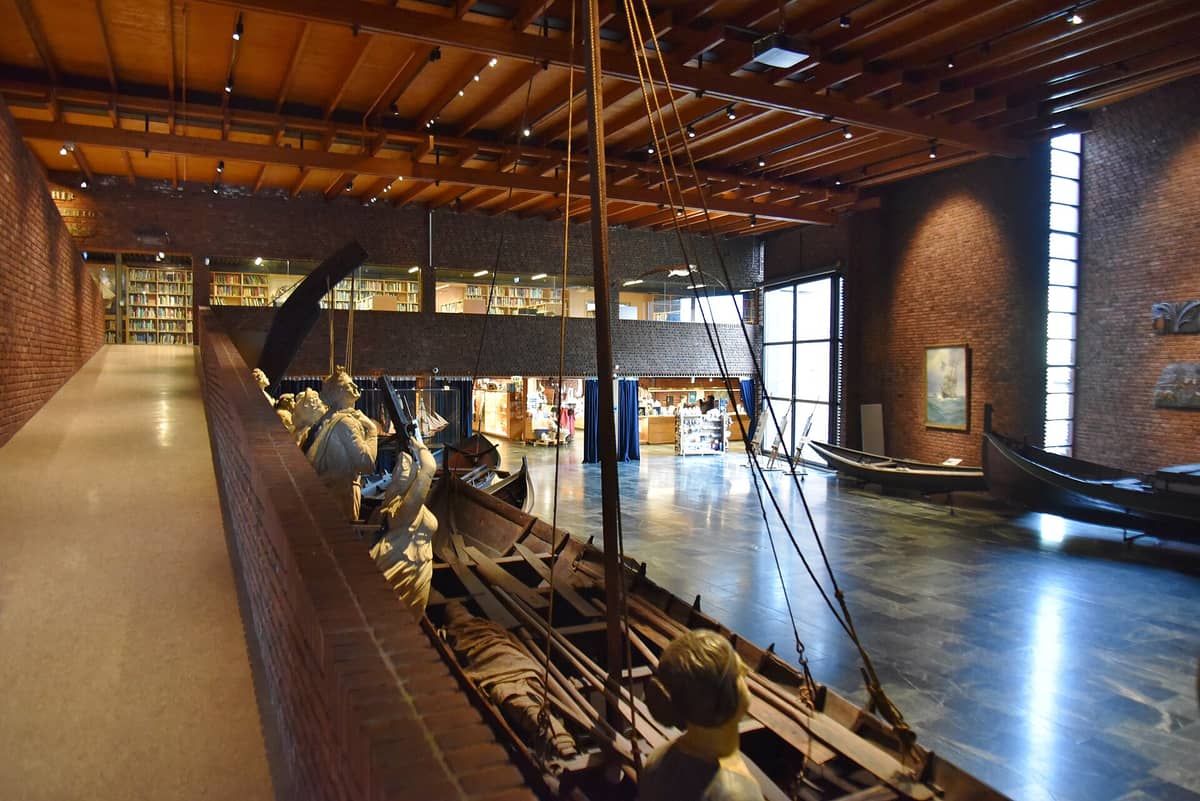
Norway's relationship with the sea is not decorative history. This is a country whose economy has long run on fishing, shipping, and more recently offshore oil. The museum takes that seriously. The permanent collections cover coastal living traditions, boat-building craftsmanship, merchant shipping, polar voyages, and the evolution of maritime safety — all grounded in actual objects rather than abstract timelines. Historic vessels, navigational instruments, ship models spanning several centuries, and reconstructed coastal environments give the exhibitions a tactile quality that purely documentary museums often lack.
💡 Local tip
If you hold an Oslo Pass, entry is free. The pass also covers several other Bygdøy museums on the same peninsula, making it practical to combine visits in a single half-day.
Getting to Bygdøy: Ferry vs. Bus
Bygdøy is a short trip from central Oslo but requires a deliberate journey — there is no T-bane (metro) stop on the peninsula. The two realistic options are Bus 30, which runs year-round from the city centre and stops at Bygdøynes right outside the museum, and the seasonal passenger ferry, line 91, which departs from the quay at Rådhusplassen. The ferry takes roughly 10 minutes and arrives directly at the Bygdøynes pier, steps from the museum entrance.
The ferry is the more atmospheric approach, particularly in summer: the crossing gives you an early sense of Oslo as a fjord city, with the opera house and city skyline receding as the green Bygdøy headland comes into view. Both the bus and ferry use standard Ruter zone tickets, so no special fare is required. For more detail on getting around Oslo by public transport, see the getting around Oslo guide.
Tickets & tours
Live prices and dates from our booking partner. If you book, we may earn a commission at no extra cost to you.
Typical Norwegian Ut pa Tur, Aldri Sur private walking tour
From 41 €Instant confirmationFree cancellationOslo Fjord sightseeing audio-guided electrical boat tour
From 35 €Instant confirmationFree cancellationFjord cruise with live jazz music
From 64 €Instant confirmationFree cancellationLuggage Storage in Oslo
From 6 €Instant confirmationFree cancellation
Inside the Museum: What You'll Find
The main exhibition building is purpose-built rather than a converted historic structure, which means the interior layout is functional and accessible. Natural light from large windows oriented toward the fjord works in your favor in most weather conditions, though the building does not feel architecturally striking from inside or out. The experience is about the contents, not the container.
Permanent highlights include a full-scale section of a 19th-century sailing vessel, an extensive model ship collection tracing the development of Norwegian merchant and naval craft across several centuries, and exhibitions on the country's fishing communities — the small harbors, boathouses, and seasonal rhythms that shaped coastal Norway long before tourism arrived. The polar exploration angle connects naturally to the Fram Museum next door, where Roald Amundsen's actual ship is housed, but the maritime museum provides the broader context: why Norway developed the shipbuilding expertise and navigational culture that made polar voyaging possible in the first place.
The museum also holds a notable collection of maritime art — oil paintings from the 18th and 19th centuries depicting Norwegian coastal scenes, storms at sea, and port life. These are worth a slower look than most visitors give them: the works record landscapes and vessel types that no longer exist in anything like their original form.
ℹ️ Good to know
Opening hours change by season. From 1 April to 4 October: daily 10:00–17:00. From 5 October to 31 March: Tuesday–Sunday 11:00–16:00, closed Mondays. Closed 17 May, 23–25 December, 31 December, and 1 January.
Time of Day and Crowd Patterns
Bygdøy is one of Oslo's most concentrated cultural zones. Within a short walk of the Norwegian Maritime Museum sit the Fram Museum, the Kon-Tiki Museum, and the Norwegian Folk Museum. This means tour groups and families descend on the area mid-morning and tend to work their way through multiple sites in sequence. The maritime museum is typically quieter than its immediate neighbors — it draws fewer first-time Oslo visitors than the Fram or Kon-Tiki, which means you can often move through the permanent collection without congestion even during peak summer hours.
If you visit between late June and mid-August, arriving at opening time (10:00) gets you ahead of tour groups. The early morning light across the fjord is also noticeably better for photography from the museum's outdoor areas. Weekday afternoons in the shoulder season, particularly September and early October, offer the most relaxed experience: school groups have typically cleared out by mid-afternoon, and the autumn light on the water is genuinely striking.
⚠️ What to skip
The ferry from Aker Brygge to Bygdøynes operates seasonally — typically late spring through early autumn. Outside this period, Bus 30 is your only direct public transport option. Check current Ruter schedules before planning your visit.
The Outdoor Setting and the Bygdøy Waterfront
One aspect of the Norwegian Maritime Museum that travel guides tend to understate is the quality of the site itself. The museum's position at Bygdøynes means the outer walls face directly onto the Oslofjord. There is a modest outdoor area where historic vessels are exhibited on the water, and the adjacent pier offers unobstructed views across the fjord toward the islands.
If weather cooperates, spending 20–30 minutes outside after the indoor visit adds a dimension that the exhibition rooms cannot replicate: you are standing at the edge of the same body of water that Norwegian sailors, fishermen, and traders have used as their highway for over a millennium. The Bygdøy coastal path begins nearby and extends around the peninsula — a logical extension if you have the time and footwear for it.
Historical and Cultural Context
Norway's maritime history is inseparable from its geography. The country has a coastline of over 25,000 kilometers when fjords and islands are counted, and for most of Norwegian history, the sea was faster and more reliable than any road. Trade, warfare, fishing, and migration all moved by water. Oslo itself was founded and grew as a trading port — its position at the head of the Oslofjord made it a natural collection point for goods moving between the interior and the open sea.
The maritime museum frames this in national terms, but also in human ones. The sections on coastal communities document how ordinary Norwegians lived and worked alongside the sea, which connects to broader themes explored at the Norwegian Folk Museum a short walk away. Together, the two institutions offer one of the more complete pictures available of pre-industrial Norwegian life — the folk museum handling the land-based side, the maritime museum the coastal and seafaring dimension.
For visitors specifically interested in Norway's polar exploration legacy, the maritime museum provides useful grounding before or after visiting the Fram Museum next door, where Fridtjof Nansen and Roald Amundsen's actual polar ships are preserved. The Fram Museum is more spectacular in raw visual terms — the ships are enormous and the building is built around them — but the maritime museum explains the centuries of shipbuilding and navigational expertise that made those expeditions conceivable.
Practical Notes: Accessibility, Photography, and What to Bring
The museum offers discounted admission (150 NOK) for people with disabilities, and companions or carers enter free with valid documentation. The main building is single-level and accessible, though the outdoor vessel exhibits may involve uneven surfaces near the waterfront.
Photography is generally permitted in the permanent galleries for personal use; flash photography near the maritime art collection should be avoided as a courtesy. The large windows mean that indoor photographs work better in the morning when natural light comes from the fjord side — early afternoon can produce stronger glare depending on season.
Dress practically for the outdoor sections, particularly in shoulder season. Wind off the fjord can be sharp even on days that feel mild in central Oslo. The museum has a small café, which is useful if you are spending a full Bygdøy half-day covering multiple sites. There is no on-site parking outside of a limited number of bicycle spaces, so private car access is not encouraged and the area can get congested in peak summer.
Is It Worth Your Time? A Clear Assessment
The Norwegian Maritime Museum is a serious, well-curated institution that deserves more attention than it typically receives. It sits slightly in the shadow of the Fram Museum and Kon-Tiki Museum, both of which offer more immediately dramatic displays. If you have limited time on Bygdøy, those two will feel more immediately rewarding to casual visitors.
But for anyone with a genuine interest in Norwegian history, coastal culture, or seafaring tradition, the maritime museum is the richer experience. It connects the story of the sea to everyday Norwegian life in ways the other Bygdøy museums do not, and it does so without condescension or oversimplification. Combined with the fjord setting and the walkable Bygdøy environment, it fits naturally into a three-day Oslo itinerary as part of a dedicated Bygdøy half-day.
Travelers who dislike indoor museums with text-heavy panels and prefer purely visual or interactive experiences may find the pacing slower than expected. The permanent collection is substantial but not flashy. If your interest in maritime history is limited, an hour is enough to cover the highlights; if it genuinely engages you, two hours will pass quickly.
Insider Tips
- Combine your visit with the Fram Museum directly next door — the two institutions are genuinely complementary, and a combined visit covers Norway's maritime and polar story more completely than either does alone. Budget at least three hours for both.
- The seasonal ferry (line 91) from Aker Brygge is the most enjoyable way to arrive, but check the current Ruter schedule before you go — service typically runs late spring through early autumn only.
- Children under 18 enter free, making this one of the better-value Bygdøy stops for families. The boat-building and fishing sections tend to hold children's attention better than the maritime art galleries.
- If you plan to visit multiple Bygdøy museums, an Oslo Pass makes clear financial sense — it covers entry to the Norwegian Maritime Museum, Fram Museum, Kon-Tiki Museum, and Norwegian Folk Museum, among many others across the city.
- The outdoor pier area at the museum's waterfront is open without requiring a ticket. It offers a clean, unobstructed view across the Oslofjord and is worth a stop even if you decide not to go inside.
Who Is Norwegian Maritime Museum For?
- History and cultural travelers who want substance over spectacle
- Families with children aged 8 and up, particularly those interested in boats and the sea
- Visitors on rainy days looking for a well-curated indoor option on Bygdøy
- Anyone doing a full Bygdøy museum day wanting context beyond the polar ships
- Oslo Pass holders looking to maximize value across the Bygdøy cluster
Nearby Attractions
Other things to see while in Bygdøy Peninsula:
- Bygdøy Coastal Path
The Bygdøy Coastal Path traces roughly 10 kilometres of shoreline around one of Oslo's most storied peninsulas, connecting fjord beaches, royal farmland, and quiet coves. It is free to walk year-round, easily reached by bus or seasonal ferry, and one of the few places in Oslo where the city completely disappears behind the treeline.
- Fram Museum
The Fram Museum on Oslo's Bygdøy peninsula houses the actual polar exploration ship Fram, the vessel that carried Nansen, Sverdrup, and Amundsen on their most ambitious expeditions. This is not a replica. It is the real thing, and you can walk its decks.
- Holocaust Center (HL-senteret)
Housed in the former wartime residence of Nazi collaborator Vidkun Quisling, the Holocaust Center (HL-senteret) on Bygdøy is one of Oslo's most historically charged sites. The permanent exhibition confronts Norway's role in the Holocaust with clarity and care, making it essential for anyone serious about understanding 20th-century Norwegian history.
- Huk Beach
Huk Beach (Huk badeplass) sits at the southern tip of the Bygdøy peninsula, offering sandy coves, grassy sunbathing lawns, and direct access to the Oslofjord. It is free to visit, served by bus from central Oslo, and gets seriously busy on warm summer afternoons — so timing your visit matters.
Planning a trip? Discover personalized activities with the Nomado app.