Gamlebyen (Old Town): Oslo's Medieval Quarter Worth the Detour
Gamlebyen is the oldest settled area of Oslo, preserving medieval church ruins, a historic cemetery, and quiet residential streets on the city's east side. Admission is free, crowds are minimal, and the contrast with central Oslo is striking.
Quick Facts
- Location
- Gamlebyen, borough of Gamle Oslo, east side of Oslo
- Getting There
- T-bane to Grønland; trams and several bus lines serve stops around Middelalderparken and Oslo Hospital
- Time Needed
- 1.5 to 3 hours for a thorough walk
- Cost
- Free (the district itself); individual venues may charge separately
- Best for
- History enthusiasts, slow walkers, urban explorers, photographers
What Gamlebyen Actually Is
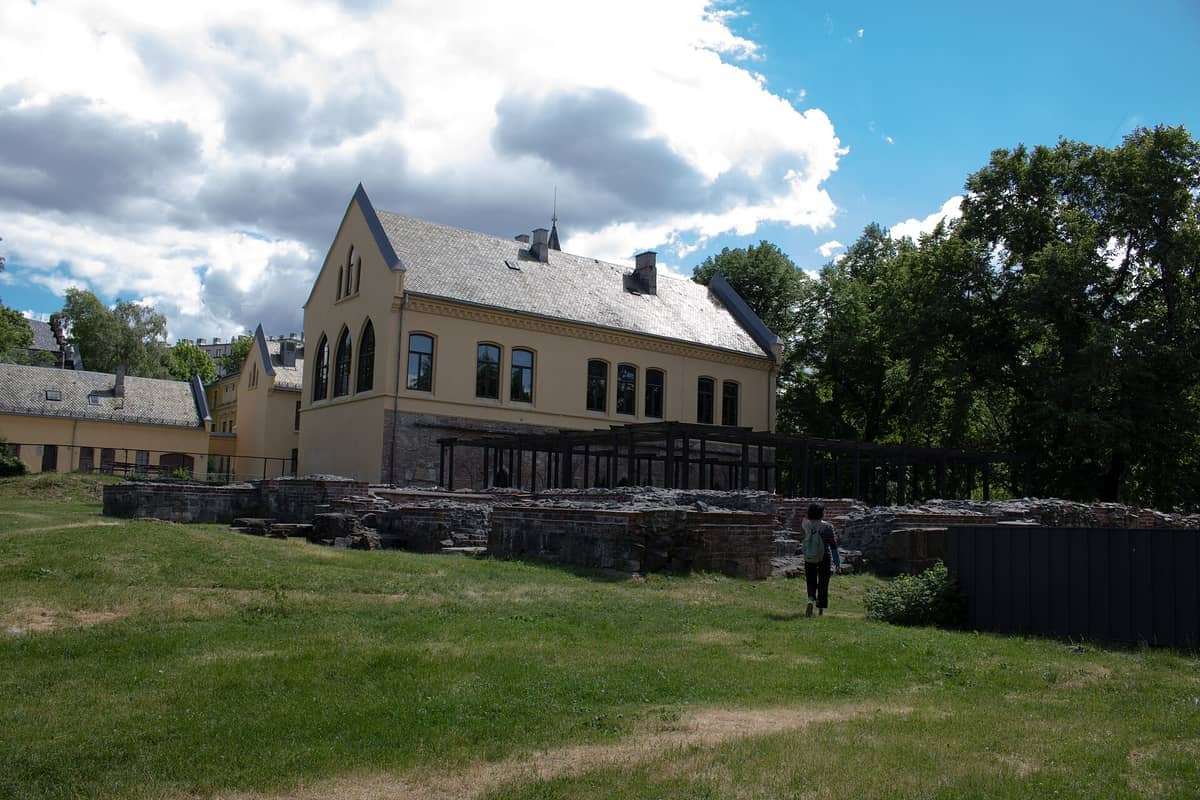
Gamlebyen, which simply means 'the Old Town' in Norwegian, covers the area on Oslo's east side where the medieval city of Oslo was first established around the 11th century. Long before the royal court moved and modern Sentrum took shape, this was the political, religious, and commercial heart of what would become Norway's capital. Today it is a quiet residential neighborhood with a remarkable density of archaeological remains hiding in plain sight: ruined church foundations, a medieval cemetery, and traces of street patterns that predate modern urban planning by several centuries.
The district does not function like a museum with admission gates and guided queues. It is a lived-in neighborhood where medieval ruins sit beside apartment buildings, dog walkers pass stone foundations on their morning circuits, and schoolchildren eat lunch beside remnants of 13th-century churches. That ordinariness is part of what makes it worth visiting.
ℹ️ Good to know
Gamlebyen is a public outdoor area with no opening hours or entry fee. You can walk through at any time of day, though morning and early afternoon offer the best light for photography and the most peaceful atmosphere.
The Historical Weight of the Place
The Oslo that most visitors experience today, centered around Karl Johans gate and the waterfront, is largely a product of the 19th and 20th centuries. But settlement in what is now Gamlebyen dates to the Viking Age, and the city grew significantly under King Harald Hardråde in the 1040s. By the 13th century, Oslo was a functioning medieval city with multiple churches, a bishop's seat, and royal and ecclesiastical institutions concentrated in what is now Gamlebyen, while Akershus Fortress later became the main royal stronghold overlooking the relocated city. Much of that medieval city lay precisely where Gamlebyen stands today.
The Middelalderparken (Medieval Park) within Gamlebyen contains the excavated and preserved ruins of several churches, including St. Mary's Church and St. Clement's Church, together with the former royal estate, which served as key religious and royal sites in medieval Oslo. St. Hallvard, Oslo's patron saint, was martyred near here in the 11th century according to tradition. The ruins were rediscovered and excavated in the 20th century, and what you see today represents genuine remnants of Oslo's first urban phase, not reconstructions.
For deeper context on how Gamlebyen connects to the broader Viking and medieval history of the Norwegian capital, the Viking history in Oslo guide traces how settlement patterns evolved from this eastern quarter westward over the centuries.
Tickets & tours
Live prices and dates from our booking partner. If you book, we may earn a commission at no extra cost to you.
Oslo Fjord sightseeing audio-guided electrical boat tour
From 35 €Instant confirmationFree cancellationFjord cruise with live jazz music
From 64 €Instant confirmationFree cancellationLuggage Storage in Oslo
From 6 €Instant confirmationFree cancellationPicturesque dinner cruise in Oslo
From 137 €Instant confirmationFree cancellation
Walking the District: What You Will Actually See
The core of any visit is the Middelalderparken, a green open space running along the base of the ridge below the old city. The ruins here are well-signed in both Norwegian and English, and the interpretive panels are genuinely informative rather than perfunctory. The foundations of St. Mary's Church are among the largest and most legible: you can trace the outline of the nave, side aisles, and apse, and get a clear sense of the building's scale. A separate section of the park preserves ruins from St. Clement's Church, which dates to the 11th century.
The medieval cemetery adjacent to the ruins is one of the less-discussed but more atmospheric parts of the site. Hundreds of burials have been found in the area over the decades, and while the ground is not visibly marked with graves, the sense of history is palpable if you know what lies beneath. The park's grassy paths are well-maintained, and the space is calm even on weekdays.
Beyond the park itself, walking the streets of Gamlebyen reveals layers of the city's more recent past as well. The neighborhood has a strong multicultural character today, reflecting Oslo's immigration history from the latter half of the 20th century. The junction around Grønland sits just to the north, where halal butchers, Middle Eastern bakeries, and South Asian grocery stores share streets with older Norwegian shopfronts. It is worth walking between the two areas rather than treating the medieval ruins as an isolated stop.
The adjacent Grønland neighborhood has its own distinct energy, and combining a visit to Gamlebyen with time in Grønland makes for a full half-day that covers both medieval history and contemporary Oslo.
How the Experience Changes by Time of Day
Early morning, before 9am, the Middelalderparken is genuinely still. The ruins catch low-angle light well in all seasons, and in summer the long Nordic mornings mean soft golden light from around 5am onward. You are likely to share the space only with joggers and people walking dogs. This is the best time for photographs with no people in frame and no shadows cutting across the stonework at difficult angles.
By mid-morning the park draws families with small children, particularly on weekends in warmer months. The open green space doubles as a play area, which changes the atmosphere from contemplative to relaxed and social. It remains pleasant but less meditative. Late afternoon, especially in autumn when the leaves on the surrounding trees turn, produces warm-toned light that falls well across the stone ruins. Winter mornings after fresh snow are particularly striking: the ruins stand out clearly against white ground and the park is nearly deserted.
💡 Local tip
Visit on a weekday morning in spring or autumn for the best combination of good light, quiet atmosphere, and comfortable temperatures. Summer weekends can feel slightly crowded around the park, though never to the degree of central Oslo's most popular sites.
Practical Walkthrough: Getting There and Getting Around
Gamlebyen sits east of central Oslo and is served by Oslo's public transport network, operated by Ruter. The T-bane (metro) and tram lines with stops at Grønland place you within easy walking distance of the medieval park. The area is also reachable on foot from Oslo Central Station (Oslo S) in about 10 to 15 minutes, which makes it a natural extension of an arrival or departure day if you have time to spare. Verify current route and stop information with Ruter before travel, as schedules are updated periodically.
The terrain around the park is mostly flat with paved and gravel paths. Some sections of the medieval park involve uneven ground near the ruins, and the stone surfaces can be slippery after rain. Mobility-impaired visitors can access large portions of the park but should note that some paths near individual ruins may not be fully accessible. Check current accessibility details with Oslo municipality or Visitoslo.com before planning around this.
There are no cafes or facilities inside the medieval park itself, but the surrounding streets of Grønland offer good options for coffee and food at reasonable prices compared to central Oslo. The area is known for affordable, excellent food from a range of culinary traditions, and stopping for lunch after the ruins is straightforward.
If you are planning a full day in the eastern part of the city, the Akerselva River Walk starts not far north of Grønland and makes a natural pairing for an afternoon on foot.
Is Gamlebyen Worth Your Time?
The honest answer is: it depends on your interests. If medieval archaeology, urban history, and the kind of quiet that comes from standing on ground that has been continuously inhabited for almost a thousand years appeals to you, Gamlebyen is among the most rewarding free experiences Oslo offers. The ruins are real, the interpretation is solid, and the lack of crowds means you can actually think.
If you are primarily interested in polished museum experiences, contemporary architecture, or Oslo's waterfront, Gamlebyen is not the priority. The ruins are modest in scale compared to sites in southern Europe, and visitors expecting a dramatic medieval townscape will find a quiet park in a residential neighborhood instead. That is not a failure of the site; it is simply what it is. The Norway Resistance Museum or the collections at the National Museum offer more curated indoor experiences for those who prefer that format.
For a broader view of what Oslo's historical and cultural attractions offer in combination, the Oslo museums guide helps prioritize based on your interests and available time.
⚠️ What to skip
The medieval park is an outdoor site with no shelter. In heavy rain, the experience is significantly diminished. Check the forecast and reschedule if persistent rain is expected, particularly since the ruins themselves are the main draw and they are less legible in low, grey light.
Insider Tips
- The ruins are lit in winter evenings, and walking through the park after dark in December or January gives an entirely different atmosphere. The city around is quiet, the stone glows under the lights, and you will almost certainly have the space to yourself.
- The Gamlebyen cemetery (Gamlebyen gravlund) slightly north of the medieval park is a historic cemetery that incorporates sections dating back several centuries and contains graves of significant historical figures. It is open to visitors and worth a short detour for those interested in Norwegian history.
- The interpretive signs in the Middelalderparken are detailed and worth reading rather than skimming. They include archaeological cross-sections and historical reconstructions that make the ruins significantly more legible.
- Combine the visit with a stop in Grønland for lunch. The neighborhood's food scene, particularly for Middle Eastern and South Asian cuisine, offers some of the best value eating in Oslo. Avoid the tourist-facing cafes near Grønland T-bane and head one or two streets back for better options.
- If you visit in late afternoon in autumn, the light from the west catches the stone ruins at a low angle and produces excellent photography conditions. The trees surrounding the park turn yellow and orange, framing the medieval stonework effectively.
Who Is Gamlebyen (Old Town) For?
- History and archaeology enthusiasts who want to see where Oslo actually began
- Slow travelers who prefer residential neighborhoods over tourist corridors
- Photographers looking for atmospheric, uncrowded subjects
- Budget travelers: the entire experience is free, and the surrounding neighborhood has inexpensive food
- Visitors combining multiple east-side attractions into a half-day walk
Nearby Attractions
Other things to see while in Grønland & Tøyen:
- Botanical Garden (Botanisk Hage)
Part of the Natural History Museum at the University of Oslo, the Botanical Garden in Tøyen is a free, year-round green space holding over 4,500 plant species from across the globe. Whether you arrive in cherry-blossom spring or frost-sharpened winter, the garden offers something most Oslo attractions cannot: genuine quiet.
- Natural History Museum (Naturhistorisk Museum)
Oslo's Natural History Museum brings together dinosaur skeletons, geological wonders, and a sprawling botanical garden on a single University of Oslo campus. Free garden entry, affordable tickets, and a calm atmosphere make it one of the city's most underrated half-day destinations.
Planning a trip? Discover personalized activities with the Nomado app.