Royal Palace Oslo (Det Kongelige Slott): The Complete Visitor Guide
The Royal Palace is the official residence of the Norwegian monarch and the symbolic heart of central Oslo. Whether you come for a summer guided tour of the state rooms or a quiet morning walk through Slottsparken, it rewards visitors on multiple levels. Here is everything you need to plan your visit well.
Quick Facts
- Location
- Slottsplassen 1, 0010 Oslo (top of Karl Johans gate, Sentrum)
- Getting There
- Nationaltheatret station (T-bane lines 1–4, trams 11/12/13/17/18/19) — 5–10 min walk
- Time Needed
- 30–45 min for park and exterior; 1.5–2 hrs with a guided interior tour
- Cost
- Park and exterior: free. Guided interior tours: paid (NOK, verify current price at royalcourt.no). Advance booking strongly recommended.
- Best for
- History and architecture lovers, ceremonial spectacle seekers, first-time Oslo visitors
- Official website
- www.kongehuset.no
What Is the Royal Palace, and Why Does It Matter?
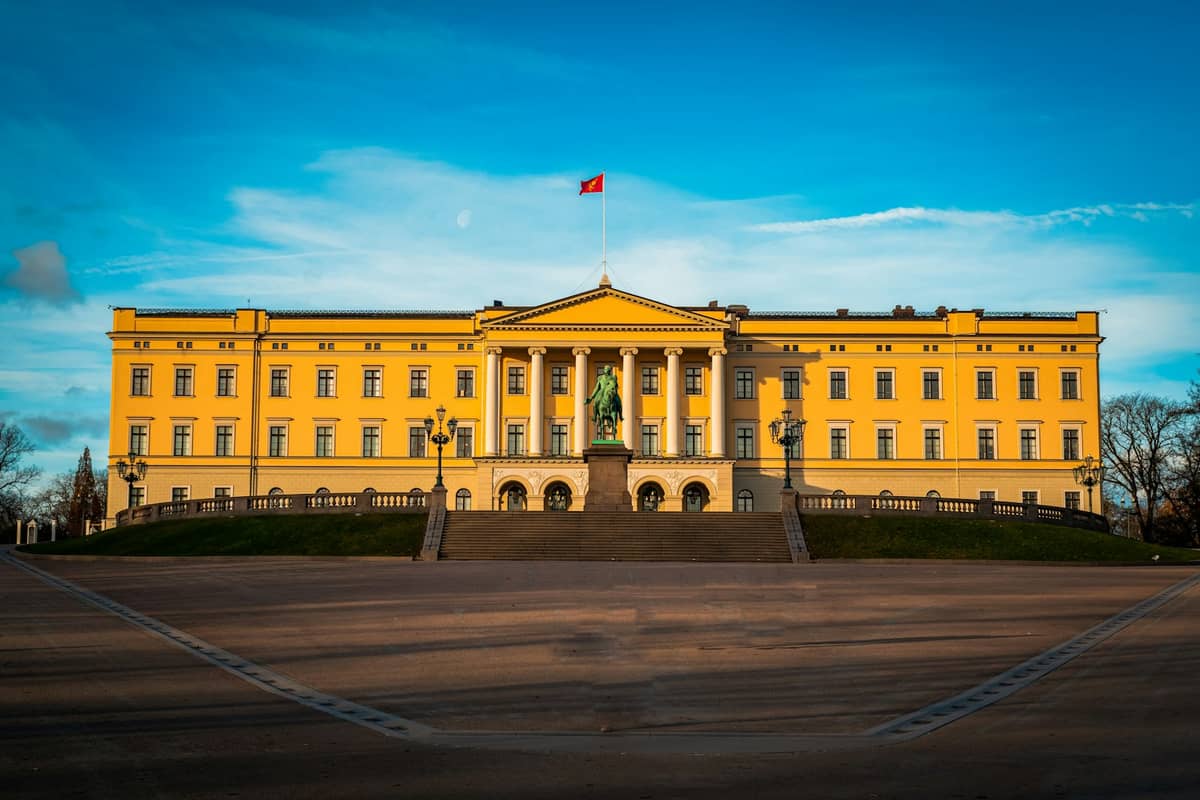
Det kongelige slott (the Royal Palace) is the official residence of the Norwegian monarch, set on a low hill called Bellevue at the western end of Karl Johans gate — Oslo's main ceremonial boulevard. The building is not just a postcard backdrop. It is a functioning royal residence, used for state receptions, diplomatic events, and national ceremonies throughout the year. When the royal standard flies from the flagpole, the king is in residence, a detail that makes the palace feel genuinely alive rather than preserved.
Construction began in 1825 under the direction of architect Hans Linstow, and King Oscar I was the first monarch to take up residence when the building was completed in 1849. That timeline matters: Norway had only re-established its own constitution in 1814, and the palace was built during a period when the country was asserting its distinct national identity within a union with Sweden. The building itself was a statement, not merely a home.
For visitors arriving on foot from Oslo Central Station, the approach along Karl Johans gate builds anticipation deliberately. The street narrows toward Egertorget, passes the National Theatre, and then opens onto Slottsplassen — the broad forecourt where the equestrian statue of King Karl Johan faces down the boulevard toward the city. Few capital cities give you such an uninterrupted ceremonial axis to walk.
The Palace Park (Slottsparken): Free, Year-Round, and Underrated
Most visitors underestimate Slottsparken. The park surrounding the palace is freely accessible year-round, and it functions as one of the more pleasant green spaces in central Oslo — partly because its scale gives it a sense of openness that pocket parks cannot. The grounds cover roughly 220 decares (about 54 acres) and include mature trees, several ponds, and wide gravel paths that loop through the hillside.
Early mornings are the most rewarding time to visit. Before 9 a.m. in summer, the park population is almost entirely joggers, dog walkers, and the occasional school group on a field trip. The palace facade catches the light from the east at that hour, and the forecourt — absent the midday tourist crowd — has an unusual quietness to it. The crunch of gravel, birdsong from the elms and limes along the main allée, and the distant hum of trams on Drammensveien are about all you will hear.
💡 Local tip
Park access is generally open and ungated year-round during daylight hours rather than on strict daily opening and closing times. Check for any temporary restrictions or event-related closures posted at entrances.
In winter, the park takes on a different quality. When snow covers the lawns and the bare tree branches frame the pale yellow neoclassical facade, the scene has a severity that the summer version lacks. Locals cross it on their way to work, collars up, breath visible. It is not a place people linger in January, but it rewards a deliberate five-minute detour on a clear winter day.
Tickets & tours
Live prices and dates from our booking partner. If you book, we may earn a commission at no extra cost to you.
Oslo Fjord sightseeing audio-guided electrical boat tour
From 35 €Instant confirmationFree cancellationFjord cruise with live jazz music
From 64 €Instant confirmationFree cancellationLuggage Storage in Oslo
From 6 €Instant confirmationFree cancellationPicturesque dinner cruise in Oslo
From 137 €Instant confirmationFree cancellation
The Changing of the Guard: When to Show Up
The daily Changing of the Guard at the Royal Palace is one of Oslo's more reliable spectacles, and it requires no ticket and no planning beyond knowing when it happens. The ceremony takes place daily at 13:30 (1:30 pm), but precise timings should still be confirmed with the Royal Court or Oslo tourism portals before your visit in case of seasonal or ceremonial adjustments. The Guards of the Royal Norwegian Guard, dressed in their dark uniforms with white webbing and bearing ceremonial rifles, march up Karl Johans gate from the nearby barracks before the ceremony begins on Slottsplassen.
The ceremony is brief — ten to fifteen minutes — but the acoustics of the forecourt amplify the commands and the rhythmic footwork in a way that carries. Children tend to position themselves at the front of the crowd, which forms naturally along the low fence line. Adults who arrive five minutes early get a reasonable view from the sides. Arrive late and you will be watching the backs of strangers.
ℹ️ Good to know
Confirm the current guard change time directly with the Royal Court (royalcourt.no) or Visit Oslo before your trip — times can shift seasonally or on public holidays.
Interior Guided Tours: What You Actually See
The palace interior is open to the public only in summer. For 2026, the tour season runs from 20 June to 16 August, with tours departing daily between 10:00 and 17:00, three times per hour. Capacity is limited, and tickets sell out on popular dates. Book in advance through the official Royal Court website, which sells tickets via Ticketmaster; only a small number of same-day tickets are available at the entrance.
The guided tour takes you through a sequence of state rooms that are genuinely used for official functions, not rooms that have been converted into display spaces. The State Dining Room is the one that tends to stop people: it seats up to about 200 gala guests, and when you stand inside it mid-tour with twenty other visitors, the formal proportions — the table lengths, the ceiling height, the weight of the silverware on display — communicate something about the expectations placed on state ceremonial life that a photograph cannot.
The neoclassical interiors reflect the design sensibility of the early 19th century, with painted ceilings, silk wall coverings, and a collection of Norwegian and European royal portraits. The guides tend to be thorough on historical context and efficient on crowd management. Tours are conducted in Norwegian and English, and the route is fixed — you follow the guide through specific rooms in sequence and do not explore independently.
⚠️ What to skip
Photography rules inside the palace change periodically. Check the current policy when booking — some rooms may permit photography without flash while others do not.
If the guided tour is the main reason for your trip, build your Oslo itinerary around the tour time rather than the other way around. The palace pairs naturally with a morning walk through Frogner Park beforehand or an afternoon at the National Museum nearby, which holds Norway's largest collection of art, architecture, and design.
Architecture and Historical Context
Hans Linstow designed the Royal Palace in a restrained neoclassical style that was fashionable across European royal architecture in the first half of the 19th century. The pale yellow render, the symmetrical seven-bay facade, and the central projecting portico with columns were all deliberate signals of dignity and permanence. Unlike some European royal palaces built on a scale intended to overwhelm, this one is proportionate — imposing from the forecourt but not theatrical.
The palace sits within a broader architectural conversation that shaped Oslo's Sentrum district. The boulevard leading to it, Karl Johans gate, was itself part of Linstow's urban planning vision, connecting the palace to the city below in a way that mirrors similar axes in other European capitals. Oslo's architectural heritage is readable in this sequence: the parliament building (Stortinget), the National Theatre, and the palace are all visible from points along the same axis, creating a spatial diagram of Norwegian civic and monarchical power.
The equestrian statue of King Karl Johan in the forecourt was installed in 1875, designed by sculptor Brynjulf Bergslien. Karl Johan — originally the French general Jean-Baptiste Bernadotte — founded the current royal dynasty after being elected Crown Prince of Sweden and Norway in 1810. He never learned Norwegian, a fact the guides sometimes mention. The statue faces east, down the boulevard named after him, which gives the whole setup a slightly theatrical quality.
Practical Details: Getting There, Timing, and What to Bring
Getting to the Royal Palace is straightforward from anywhere in central Oslo. Nationaltheatret station — served by all five T-bane lines in practice and several tram routes — is a short walk from the palace forecourt. From Oslo Central Station (Oslo S), the walk up Karl Johans gate takes about 20–25 minutes on flat pavement and is worth doing on foot for the approach.
If you have an Oslo Pass, check the current benefit list — some guided tours are included or discounted. See the Oslo Pass guide for details on what the card covers across the city's main attractions.
Wear comfortable shoes with grip — the forecourt and park paths are wide gravel and compacted stone, not cobblestones, but the slope up from Karl Johans gate to the palace entrance is enough to make smooth-soled shoes a minor inconvenience on wet days. Oslo's weather is variable: bring a light waterproof layer even in July, when afternoon showers arrive with little warning.
For photography, the palace facade faces roughly south-southwest, meaning it catches good light from mid-morning onward in summer. The golden hour before sunset in July, when Oslo light stays long and warm, produces the most flattering exterior shots. At midday in high summer, the forecourt is busy and the light is flat. For the equestrian statue against the palace, a slight angle from the left side of the forecourt gives more depth than shooting straight-on.
💡 Local tip
Constitution Day (17 May) is the single best day to experience the Royal Palace as a living symbol. The royal family appears on the palace balcony to greet a procession of thousands of schoolchildren marching up Karl Johans gate. It is a genuine national celebration, not a staged tourist event.
For full context on Oslo's major national celebrations, including Constitution Day, the Constitution Day guide covers what to expect, where to stand, and how early you need to arrive.
Who Will Enjoy This — and Who Might Not
The Royal Palace works well for visitors who appreciate architectural and historical context, enjoy ceremonial culture, or want a green space at the center of their city walk. It is a natural anchor point for any exploration of central Oslo.
It is less suited to travelers looking primarily for interactive experiences or contemporary culture. The interior tour is structured, guided, and follows a fixed route — if you prefer to explore at your own pace, you will find it mildly constraining. The exterior, while handsome, is not architecturally extravagant: visitors expecting the grandeur of Versailles or Buckingham Palace may find the scale modest. That modesty is, to some eyes, appropriate for Norway. To others, it is underwhelming.
Families with young children will find the park more engaging than the interior tour, which requires sustained attention for 45-60 minutes. For a more hands-on family itinerary, the Oslo with kids guide includes pacing advice and nearby stops that hold children's attention more reliably.
Insider Tips
- Book interior tour tickets as soon as the summer season opens — popular dates in July sell out weeks in advance. The official booking page at royalcourt.no is the most reliable source and updates annually.
- The best free viewpoint of the palace facade is not from the forecourt but from a slight distance at the bottom of the main palace allée inside Slottsparken, looking uphill. This angle shows the building in full, framed by the avenue of trees on either side.
- On 17 May (Constitution Day), arrive at Karl Johans gate well before 10 a.m. if you want a clear sightline to the palace balcony. The pavements fill rapidly and the best positions go early. Noise, flags, and bunads (traditional Norwegian dress) everywhere — plan for a full morning.
- If you are visiting in winter, the palace is at its quietest and most atmospheric in the hour after a fresh snowfall — the park paths are untouched and the yellow facade reads sharply against white ground and grey sky.
- The guided tour departs three times per hour during summer, so if you miss one slot, the wait for the next is short. Use that gap to walk the perimeter of the palace park on the north side, which most visitors skip entirely.
Who Is Royal Palace (Det Kongelige Slott) For?
- First-time visitors to Oslo wanting to understand the city's civic and ceremonial geography
- Architecture enthusiasts interested in early 19th-century Scandinavian neoclassicism
- Travelers visiting on or around 17 May for Constitution Day celebrations
- Anyone who wants a central, free green space for a morning walk before the city wakes up
- History readers with an interest in Norway's post-1814 nation-building period
Nearby Attractions
Other things to see while in Sentrum (City Centre):
- Akershus Castle and Fortress
Akershus Fortress (Akershus slott og festning) is a medieval royal stronghold that has guarded Oslo's harbour since around 1299. The fortress grounds are free to enter year-round, offering sweeping Oslofjord views, cobblestone courtyards, and a castle interior that spans seven centuries of Norwegian history.
- Damstredet & Telthusbakken
Two short streets in central Oslo preserve what the rest of the city lost to fire and modernisation: timber houses from the late 1700s and early 1800s, still inhabited, still cobbled. Free to walk at any hour, Damstredet and Telthusbakken offer a rare glimpse of pre-industrial Oslo just minutes from the parliament building.
- Historical Museum (Historisk Museum)
Housed in a grand early 20th-century building on Tullinløkka in central Oslo, the Historical Museum holds some of Norway's most remarkable ancient objects, from Viking gold jewelry to Egyptian mummies and Arctic indigenous artifacts. It is one of the most substantive indoor experiences the city offers, and it rewards visitors who take their time.
- National Museum (Nasjonalmuseet)
The National Museum (Nasjonalmuseet) is Norway's largest museum for art, architecture, and design, housed in a landmark building on the Oslo waterfront. From Edvard Munch's original Scream to Norwegian design and painting and centuries of decorative arts, it holds the country's most significant cultural collections under one roof.
Planning a trip? Discover personalized activities with the Nomado app.