Frogner Park (Frognerparken): Oslo's Open-Air Sculpture Landmark
Frogner Park is Oslo's most visited green space, combining a peaceful urban park with the world's largest sculpture installation created by a single artist. Free to enter at any hour, it rewards visitors who arrive early, linger at dusk, or return in snow.
Quick Facts
- Location
- Kirkeveien 40, 0268 Oslo (Frogner district)
- Getting There
- Tram 12 to Vigelandsparken stop (200m walk); or Metro to Majorstuen then 10-15 min walk
- Time Needed
- 1.5 to 3 hours; longer if you bring a picnic or visit the Vigeland Museum
- Cost
- Free. No tickets, no reservations. Open 24 hours, year-round.
- Best for
- Sculpture and art lovers, families, photographers, solo walkers
- Official website
- www.frognerparken.com/
What Frogner Park Actually Is
Frognerparken, or Frogner Park, is Oslo's largest public park and the setting for the Vigeland installation, a permanent open-air collection of 212 sculptures by Norwegian artist Gustav Vigeland. The park covers 45 hectares in the western Frogner district, about two kilometers from Oslo's city center. It is owned and maintained by the City of Oslo, entry is permanently free, and the gates never close.
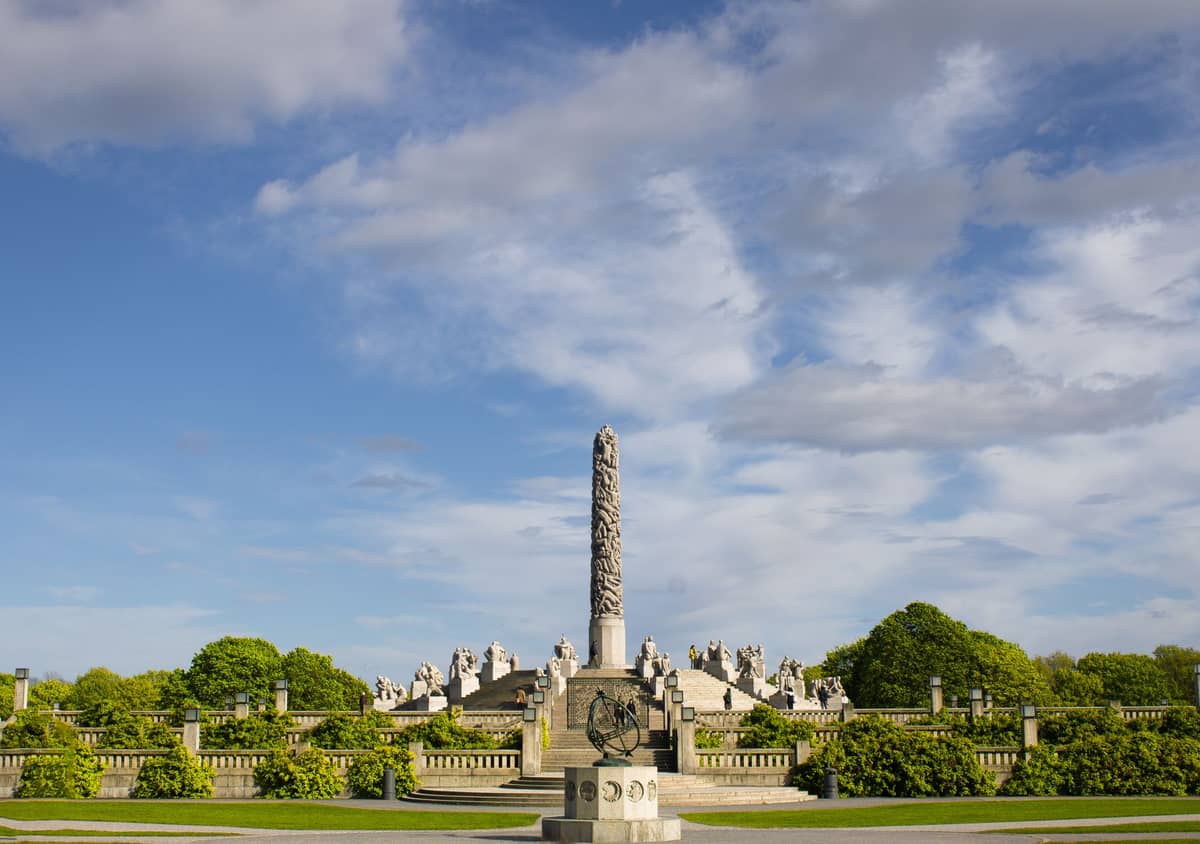
The Vigeland installation is the part most visitors come for. Arranged along a central axis of about 850 meters, it includes a monumental bridge lined with bronze figures, a large fountain surrounded by bronze trees and writhing human forms, and the Monolith plateau, where a 14-meter column of intertwined granite bodies rises from a stepped plinth. Beyond the sculpture zone, the broader park has rose gardens, a historic manor house (Frogner Manor), sports facilities, and long stretches of lawn where Oslo residents come to run, read, or do very little at all.
ℹ️ Good to know
The Vigeland installation and Frogner Park are two overlapping things. The term Vigelandsparken is often used informally to refer to the sculpture area, while Frognerparken is the official name of the larger park that contains it. Both names are used interchangeably by locals.
The Sculptures: What You're Looking At and Why It Matters
Gustav Vigeland (1869–1943) spent over four decades creating the figures that fill this park. He worked in bronze, granite, and wrought iron, and the City of Oslo gave him a studio and housing in exchange for the right to own all his work after his death. That studio, located just south of the park, is now the Vigeland Museum. The deal was unconventional by any standard and produced one of the most concentrated bodies of sculptural work in the world in a single outdoor setting.
The sculptures depict the human life cycle in unflinching, sometimes unsettling detail: infants, lovers, elderly figures, people in conflict, people in ecstasy. There is no religious iconography, no heroic mythology, no idealized proportion in the classical sense. The Angry Boy (Sinnataggen), a small bronze of a furious child mid-tantrum on the main bridge, has become the park's unofficial mascot and is frequently touched by visitors, giving it a polished, golden surface distinct from the weathered green patina of the surrounding figures.
The Monolith is the centerpiece. The column took three stonecutters nearly fourteen years to carve from a single block of granite. Up close, the individual figures, 121 of them according to official count, are easier to distinguish. The viewing platform at the top of the steps surrounding it gives a clear sightline down the entire axis of the installation, which is useful for understanding Vigeland's compositional logic: everything is aligned, symmetrical, and deliberate.
For a deeper understanding of how this work fits into the city's broader artistic legacy, the Oslo architecture guide covers Vigeland's contribution alongside other defining structures in the capital.
Tickets & tours
Live prices and dates from our booking partner. If you book, we may earn a commission at no extra cost to you.
Frognerseteren and Tryvannsstua private tour from Oslo
From 0 €Instant confirmationFree cancellationOslo Fjord sightseeing audio-guided electrical boat tour
From 35 €Instant confirmationFree cancellationFjord cruise with live jazz music
From 64 €Instant confirmationFree cancellationLuggage Storage in Oslo
From 6 €Instant confirmationFree cancellation
How the Park Changes by Time of Day and Season
Early morning, particularly before 9am in summer, is when Frogner Park reveals its quieter character. Joggers trace the outer paths, the fountain basin catches the low light, and the Monolith plateau is usually empty enough to walk around without navigating tour groups. The bronze figures on the bridge cast long shadows across the gravel path below. The air in summer mornings often carries the scent of cut grass and the rose garden nearby.
By mid-morning in July and August, the main axis fills quickly. Organized tour groups tend to arrive between 10am and noon, so the bridge and Monolith area can feel congested. If your priority is unobstructed photography or quiet contemplation, come before 9am or after 6pm. Late afternoon light in summer is particularly good for photographing the bronze figures, as the warm directional sun brings out the surface texture and depth of the casting.
In winter, the park is transformed. Snow on the Monolith plateau reduces visual noise and the sculpture column reads with unusual clarity against a white or grey sky. Frost on the bronze figures is common from November through February. The park is plowed on the main axis but side paths may be icy, so appropriate footwear matters. Visitor numbers drop sharply in winter, which means you can spend extended time at the Monolith alone, something nearly impossible in peak summer.
💡 Local tip
For photographers: the Monolith faces roughly south, so morning light hits the west face and afternoon light hits the east. Overcast winter days provide the most even lighting across the granite surface.
Oslo's overall calendar of outdoor activities, including how Frogner Park fits into different seasons, is covered in the guides on Oslo in summer and Oslo in winter.
Practical Walkthrough: How to Navigate the Park
The most direct entry for first-time visitors is through the main gate on Kirkeveien, marked by four large granite columns. From here, the main axis runs straight ahead: first the bridge (about 100 meters long, lined with 58 bronze sculptures), then the fountain plaza with its large bronze fountain and surrounding mosaic paths, then the Monolith plateau at the elevated far end. This route covers the core of the Vigeland installation in a single walk of roughly 850 meters.
The wrought iron gates at the main entrance are themselves significant: designed by Vigeland, they are detailed with intricate relief work and worth a close look before entering. The rose garden sits to the left of the bridge and is at its best from late June through August. Frogner Manor, the yellow 18th-century building visible to the right as you enter, houses the Oslo City Museum and is worth a separate visit if you have time.
Getting here by public transport is straightforward. Tram 12 stops at Vigelandsparken, about 200 meters from the main gate on a flat, paved sidewalk. From Majorstuen metro station (served by lines 1, 2, 3, 4, and 5), it is about an 8–10 minute walk southwest through the Frogner neighborhood. Street parking exists in the surrounding area but is limited and metered; public transport is the practical choice.
💡 Local tip
Accessible visitors: the main axis from the Kirkeveien gate through the bridge, fountain plaza, and up the gentle ramp to the Monolith is fully paved and wheelchair-accessible. Side gravel paths can be difficult with narrow wheels. Accessible toilets are located near the main entrance.
The Broader Park: Beyond the Sculptures
Frogner Park extends well beyond the Vigeland axis. The western sections of the park are less visited and more locally oriented: open lawns used for sunbathing and informal football in summer, wooded sections with older trees, and the Frogner outdoor swimming pool (Frognerbadet), which is currently closed for long-term renovation and is expected to reopen for the 2028 summer season. The pool facility includes outdoor lanes and is popular with Oslo residents on warm days when in operation.
The park is genuinely used as a neighborhood park by Frogner locals, which gives it a different atmosphere in its quieter sections. On summer weekends, it is common to find families with picnics on the grass, groups of teenagers, elderly residents on benches, and dogs on long leads, all coexisting with international visitors on the main sculpture axis. This mix is part of what makes Frogner Park more interesting than a pure tourist site.
The surrounding Frogner neighborhood itself is one of Oslo's more architecturally coherent residential areas, with late 19th and early 20th century apartment buildings and wide tree-lined streets. The Frogner neighborhood guide covers nearby restaurants, cafes, and what else is worth seeing in the area.
Clear Assessment: Is It Worth Your Time?
Frogner Park is one of the few Oslo attractions that genuinely delivers on its reputation, partly because expectations are easy to calibrate. It is a free park with remarkable sculptures in it. You are not paying for an experience that might disappoint; you are walking into a large urban green space and finding that the art inside it is more serious and stranger than you might expect.
That said, if you arrive at 11am in July with no plan, you will spend your first twenty minutes navigating around tour groups on the bridge and waiting to photograph the Monolith without other visitors in the frame. The sculptures do not lose their power in a crowd, but the experience is significantly better with some timing consideration.
Visitors who find public sculpture underwhelming or who are primarily interested in indoor cultural institutions may want to spend their energy elsewhere. The park has no permanent interpretation panels in English along the route, so understanding Vigeland's thematic intentions requires some advance reading or a visit to the Vigeland Museum nearby.
If your Oslo itinerary is tight, the 3-day Oslo itinerary includes Frogner Park alongside other high-priority stops in a practical sequence. For visitors focused on art and culture, the Oslo museums guide pairs well with a Vigeland Museum visit after the park.
Insider Tips
- The Sinnataggen (Angry Boy) bronze on the bridge is on the right side roughly a third of the way along from the main gate. It is small, easy to miss in a crowd, and has a notably different surface finish from being handled by generations of visitors.
- The Vigeland Museum, located on Nobels gate just south of the park, contains Vigeland's original plaster models and his personal workspace. It is often overlooked but gives essential context for what you see in the park. Entry is separate and priced; check current hours before visiting.
- If you are visiting in late June or July, the rose garden to the left of the bridge peaks around the summer solstice. It is maintained with labeled varieties and is worth the short detour.
- The mosaic paths around the fountain basin use geometric patterns designed by Vigeland. They are best appreciated from the elevated Monolith plateau looking back down toward the bridge, not from ground level.
- The main gate columns and wrought iron entrance gates are often skipped by visitors eager to get to the bridge. Spend a few minutes with the gate details before entering; they show the same figurative language as the larger sculptures in compressed form.
Who Is Frogner Park (Frognerparken) For?
- First-time Oslo visitors who want to understand the city's cultural identity without paying admission
- Photographers willing to arrive early or stay late for good light and manageable crowds
- Families with children, who respond well to the expressive, sometimes comic human figures
- Visitors who want a genuine mix of local park life and international-quality art in one place
- Winter travelers looking for a photogenic outdoor experience with minimal crowds
Nearby Attractions
Other things to see while in Frogner & Majorstuen:
- Vigeland Museum
The Vigeland Museum in Oslo's Frogner district is the former studio and home of sculptor Gustav Vigeland, now housing thousands of his drawings, woodcuts, plaster casts, and finished works. It offers the definitive explanation for what you see across the road in Vigeland Park, and stands as one of the most coherent artist's museums in Scandinavia.
- Vigeland Sculpture Park
Vigeland Sculpture Park is the world's largest sculpture park created by a single artist, Vigeland Sculpture Park is the world’s largest sculpture park created by a single artist, with around 200 sculptures in granite, bronze, and wrought iron within the larger Frogner Park. Entry is free, the gates never close, and the experience shifts dramatically depending on when you visit.
Planning a trip? Discover personalized activities with the Nomado app.