Oslo City Hall (Rådhuset): The Nobel Venue Worth Exploring for Free
Oslo City Hall, known in Norwegian as Oslo rådhus, is one of Scandinavia's most significant civic buildings: a free-entry landmark on the harbor front whose interior walls tell the story of Norway through monumental 20th-century art. It also hosts the Nobel Peace Prize ceremony every December.
Quick Facts
- Location
- Rådhusplassen 1, 0037 Oslo (Sentrum, by the harbor)
- Getting There
- Nationaltheatret station (T-bane/train, 5–10 min walk); Tram to nearby stops such as Kontraskjæret or Aker Brygge
- Time Needed
- 45 minutes to 1.5 hours
- Cost
- Free — no admission charge
- Best for
- Architecture, Norwegian history, Nobel Peace Prize connections
- Official website
- www.oslo.kommune.no/english/oslo-city-hall
What Oslo City Hall Actually Is
Oslo rådhus is the seat of the city's municipal government, but it has outgrown that administrative identity. Most international visitors know it primarily as the venue where the Nobel Peace Prize is awarded each year on December 10, a ceremony broadcast to audiences worldwide. What fewer people realize until they step inside is that the building is also one of Norway's most ambitious public art projects, its walls and ceilings covered in enormous murals painted by the country's leading 20th-century artists.
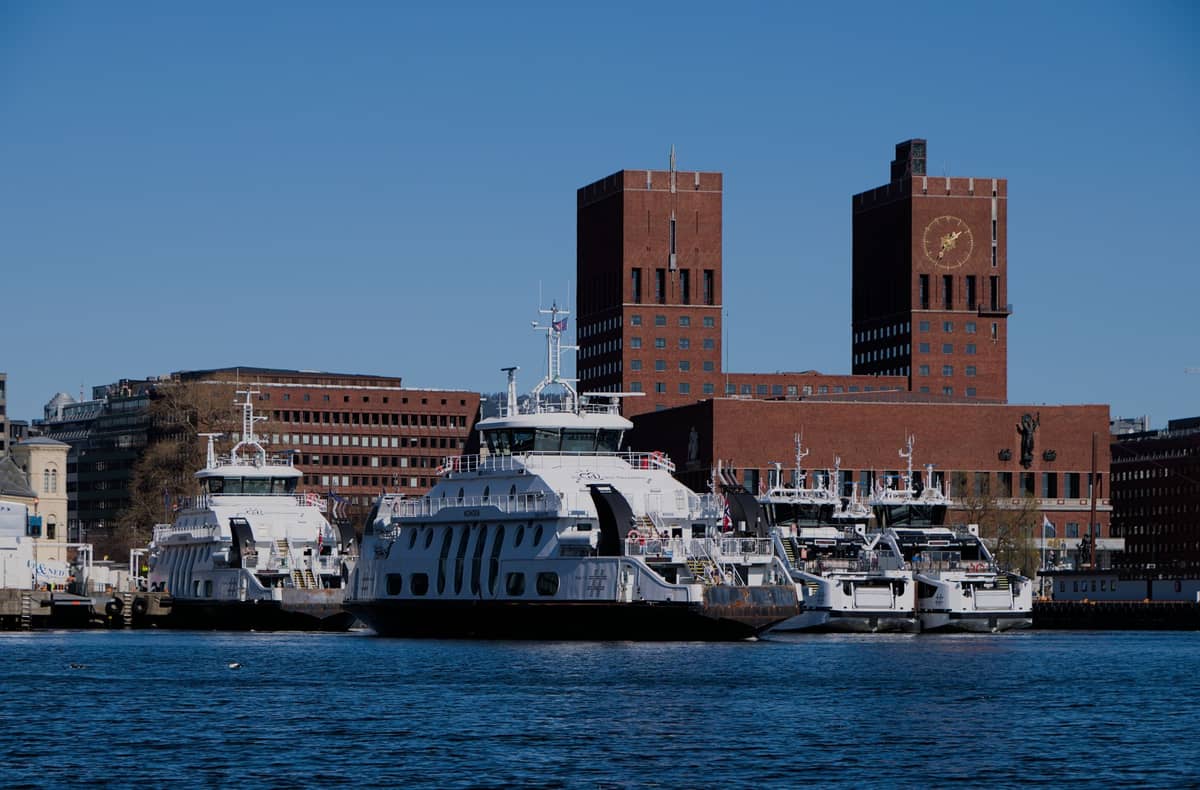
The building sits at the edge of Oslo's inner harbor at Rådhusplassen 1, with its twin brick towers visible from the fjord and from much of central Sentrum. It sits at the gateway between the waterfront areas of Aker Brygge and Tjuvholmen to the west and the main civic spine of the city running north toward the Royal Palace. Arriving on foot from the harbor side gives the best first impression: the towers frame the square, and the building's scale becomes apparent gradually rather than all at once.
ℹ️ Good to know
Oslo City Hall is generally open 09:00–16:00. Entrance is free. Some rooms may be closed during official events or meetings, and the building is closed to visitors on certain listed dates each year. A security check is in place at the entrance.
The Architecture: Red Brick, Norse Symbolism, and a Long Wait
The building was designed by architects Arnstein Arneberg and Magnus Poulsson and took an unusually long time from conception to completion. The project was commissioned in the late 1910s, construction began in 1931, and the building was not inaugurated until 1950, delayed by the German occupation of Norway during the Second World War. That history of interrupted progress is, in some ways, baked into its character.
The exterior is built almost entirely in dark red brick, with two square towers rising to 66 metres. The style draws on Nordic functionalism and a restrained form of monumental classicism, avoiding the ornate decoration of earlier civic buildings in favor of weight and solidity. Sculptural reliefs on the exterior facades depict scenes from Norwegian mythology and daily life, worth examining before you go in. On the harbor-facing facade, reliefs by sculptor Anne Grimdalen and others show figures from Norse legend alongside workers and farmers, a deliberate statement about who the building represents.
The clock tower bells are a daily presence in central Oslo, sounding every hour from 07:00 to midnight. If you are anywhere near the harbor or Akershus Fortress during the hour, you will hear them.
Tickets & tours
Live prices and dates from our booking partner. If you book, we may earn a commission at no extra cost to you.
Oslo Fjord sightseeing audio-guided electrical boat tour
From 35 €Instant confirmationFree cancellationFjord cruise with live jazz music
From 64 €Instant confirmationFree cancellationLuggage Storage in Oslo
From 6 €Instant confirmationFree cancellationPicturesque dinner cruise in Oslo
From 137 €Instant confirmationFree cancellation
Inside: The Murals Are the Main Event
The Main Hall (Rådhussalen) is where the Nobel Peace Prize ceremony takes place each December, and it is the first space most visitors enter. The scale stops people in their tracks: it is a vast civic room with a very tall ceiling, and every major surface carries artwork.
The dominating piece is Henrik Sørensen's enormous oil painting on the west wall, spanning 12 by 13 metres. It depicts Norwegian working life across the seasons, with fishing, forestry, and farming rendered in muted earthy tones that give the hall a serious, almost somber atmosphere. The east wall carries Alf Rolfsen's fresco covering Norwegian history from the Viking age through to the 20th century, organized in horizontal bands that read almost like a comic strip when viewed up close. The detail rewards slow attention: individual faces, tools, ships, and domestic scenes are worked in with precision.
Beyond the Main Hall, visitors can access several other rooms depending on what is open on a given day. The Banquet Hall (Festsalen) has a painted ceiling by Per Krohg, a deep-blue celestial composition that creates a strikingly different atmosphere from the earthy tones of the main space. The City Council Chamber is functional and modernist, less dramatic but interesting for its straightforward civic design. Not every room is accessible on every visit, which can be frustrating, but the Main Hall alone justifies the trip.
💡 Local tip
Bring binoculars or use your phone's zoom camera to study the upper sections of the murals. The detail in Rolfsen's east-wall fresco is considerable, but it sits several metres above eye level.
The Nobel Peace Prize Connection
Since 1990, Oslo City Hall has been the site of the Nobel Peace Prize award ceremony, held annually on December 10, the anniversary of Alfred Nobel's death. The Nobel Committee presents the prize to the laureate in the Main Hall in front of an invited audience of around 1,000 people. The ceremony is televised internationally and is one of the most watched award events in the world.
Visitors at other times of year can stand in the exact spot where laureates from Nelson Mandela to Malala Yousafzai have received their prizes. Small informational displays near the hall explain the prize's history and Oslo's role in it. For a deeper dive into the Nobel connection, the Nobel Peace Center is located directly adjacent to City Hall on the harbor front, and the two together make a natural half-day pairing.
When to Visit and How the Experience Shifts
The City Hall is generally open from 09:00 to 16:00. Crowds are lightest on weekday mornings, particularly before 11:00. By midday in summer, tour groups move through the main hall in rotation and the acoustics amplify the noise considerably. If you want genuine space to stand and study the murals, arrive at opening time.
The exterior plaza, Rådhusplassen, behaves differently depending on the season. In summer it is lined with outdoor seating for cafes and food stalls and fills with people eating, meeting, and watching the harbor. In winter the same square is often windswept and quiet, which actually makes the building's imposing brick mass more impressive. The towers catch low winter light in a way that summer's flat brightness does not replicate.
December visitors during Nobel week will find the area around the building unusually animated, with security measures, official vehicles, and a general sense of ceremony in the air. The Oslo in winter guide covers what to expect during that period and how to plan around the Nobel events if they coincide with your trip.
⚠️ What to skip
Some sections of the building close without advance notice when official meetings or events are scheduled. There is no reliable way to guarantee full access on any given day. Check the City of Oslo website (oslo.kommune.no) before your visit if specific rooms matter to you.
Getting There and Moving Around Nearby
The most convenient public transit approach is to take the T-bane or regional train to Nationaltheatret station, then walk south toward the harbor for around 5 to 10 minutes. Tram services stop at nearby Sentrum stops such as Kontraskjæret or Aker Brygge, which deposit you a short walk from the square in front of the main entrance. From Oslo Central Station (Oslo S), the walk along the waterfront promenade takes about 15–20 minutes and passes the Opera House, the Barcode buildings, and the Aker Brygge marina.
The immediate waterfront around the building connects easily on foot to several other major attractions. The Akershus Fortress is a 10-minute walk east along the harbor. The Astrup Fearnley Museum of Modern Art is a short walk west through Tjuvholmen. Ferry services to the Oslofjord islands depart from piers just east of the City Hall square.
Accessibility: The building has step-free access from the harbor-facing square. Visitors with specific mobility requirements are advised to contact Oslo City Hall administration directly at +47 23 46 12 00 before visiting to confirm current conditions, as large civic buildings can have internal areas with varying access arrangements.
Photography
The exterior is best photographed in the late afternoon when the sun moves to the south and west, casting warm light across the brick towers. The harbor reflection from the water on the south side can add depth to wide-angle shots, though the parked ferries and floating docks sometimes clutter the foreground.
Inside, the lighting in the Main Hall is artificial and somewhat flat. A wide-angle lens captures the scale of the murals but struggles with the contrast between the bright upper windows and the darker lower walls. For detail shots of individual panels in Rolfsen's fresco, a 50mm or short telephoto setting isolates sections more cleanly. Flash photography may be restricted; check on arrival.
Who Should Skip This
Oslo City Hall is not a museum with interactive exhibits or a building that explains itself easily to children. The murals are large and remarkable, but without some background knowledge of Norwegian history and 20th-century Nordic art, they can read as impressive but opaque. If you have very limited time in Oslo and need to choose between this and the National Museum, the latter offers more interpretive support and broader coverage of Norwegian art across all periods.
Visitors whose primary interest is Norwegian folk culture or the Viking age will find more focused content at the Norsk Folkemuseum or the Historical Museum. City Hall rewards travelers who come specifically for monumental civic architecture and Nobel history; it is less rewarding as a casual stopover.
Insider Tips
- The hourly bell chimes from the towers are programmed with different melodies depending on the time of day. Arriving on a full hour, especially around midday, often gives you one of the more elaborate sequences.
- Free guided tours of the building are sometimes available; check the City of Oslo website before your visit as these are not always advertised on third-party travel platforms.
- The plaza benches on the harbor side of Rådhusplassen face the water and the islands beyond, making them a good place to eat a packed lunch while watching the ferry traffic to Bygdøy and the Oslofjord islands.
- If you visit in early December, the Nobel Peace Prize banquet preparations turn the interior into a spectacle of floral arrangements and formal decor that is visible during the last public opening days before the ceremony.
- The bas-relief sculptures on the north-facing exterior (the city-side facade) are often missed because most visitors approach from the harbor. The north entrance panels depict scenes of Oslo's civic and industrial life and are worth a five-minute detour.
Who Is Oslo City Hall (Rådhuset) For?
- Architecture and design travelers interested in Nordic 20th-century civic buildings
- History-focused visitors who want to understand Norway's self-image through public art
- Nobel Peace Prize followers who want to stand in the award ceremony hall
- Budget travelers: one of the most significant free cultural sites in Oslo
- Walkers building a harbor-front itinerary that links Aker Brygge, Akershus Fortress, and the Nobel Peace Center
Nearby Attractions
Other things to see while in Sentrum (City Centre):
- Akershus Castle and Fortress
Akershus Fortress (Akershus slott og festning) is a medieval royal stronghold that has guarded Oslo's harbour since around 1299. The fortress grounds are free to enter year-round, offering sweeping Oslofjord views, cobblestone courtyards, and a castle interior that spans seven centuries of Norwegian history.
- Damstredet & Telthusbakken
Two short streets in central Oslo preserve what the rest of the city lost to fire and modernisation: timber houses from the late 1700s and early 1800s, still inhabited, still cobbled. Free to walk at any hour, Damstredet and Telthusbakken offer a rare glimpse of pre-industrial Oslo just minutes from the parliament building.
- Historical Museum (Historisk Museum)
Housed in a grand early 20th-century building on Tullinløkka in central Oslo, the Historical Museum holds some of Norway's most remarkable ancient objects, from Viking gold jewelry to Egyptian mummies and Arctic indigenous artifacts. It is one of the most substantive indoor experiences the city offers, and it rewards visitors who take their time.
- National Museum (Nasjonalmuseet)
The National Museum (Nasjonalmuseet) is Norway's largest museum for art, architecture, and design, housed in a landmark building on the Oslo waterfront. From Edvard Munch's original Scream to Norwegian design and painting and centuries of decorative arts, it holds the country's most significant cultural collections under one roof.
Planning a trip? Discover personalized activities with the Nomado app.