Astrup Fearnley Museum of Modern Art: Art, Architecture, and the Oslo Waterfront
The Astrup Fearnley Museum of Modern Art is Oslo's most architecturally striking contemporary art venue, housed in a Renzo Piano-designed building on the Tjuvholmen waterfront. With a world-class private collection and a sculpture-lined harborfront setting, it rewards visitors who care about both the art and the space it inhabits.
Quick Facts
- Location
- Strandpromenaden 2, Tjuvholmen, Oslo
- Getting There
- Tram or bus to Aker Brygge/Vika, then a short walk to Tjuvholmen; short walk from Aker Brygge
- Time Needed
- 1.5 to 2.5 hours
- Cost
- Adults NOK 180 / Seniors & Students NOK 100 / Under 20 free / Oslo Pass free
- Best for
- Contemporary art fans, architecture lovers, rainy-day culture seekers
- Official website
- www.afmuseet.no/en
What Is the Astrup Fearnley Museum?
The Astrup Fearnley Museum of Modern Art, known locally as Astrup Fearnley Museet, is Oslo's foremost private institution for international contemporary art. Unlike Norway's state-funded museums, it operates through private patronage rooted in the Astrup Fearnley family's collecting tradition, which means its program takes bigger risks: provocative commissions, living artists, and works that institutional caution tends to avoid.
The collection and rotating exhibitions draw from the top tier of postwar and contemporary work, with pieces by artists including Cindy Sherman, Jeff Koons, Takashi Murakami, and Matthew Barney having featured prominently over the years. The breadth is considerable, running from American neo-expressionism through Japanese pop and into conceptually charged installation art. Not every exhibition will speak to every visitor, but the curatorial ambition is consistently high.
ℹ️ Good to know
The museum is closed on Mondays, except during July and August when it opens Monday 12:00–17:00. On other weekdays it is open 12:00–17:00 (Tuesday, Wednesday, Friday) and 12:00–19:00 on Thursday, with weekend hours 11:00–17:00.
The Building: Renzo Piano on the Oslo Waterfront
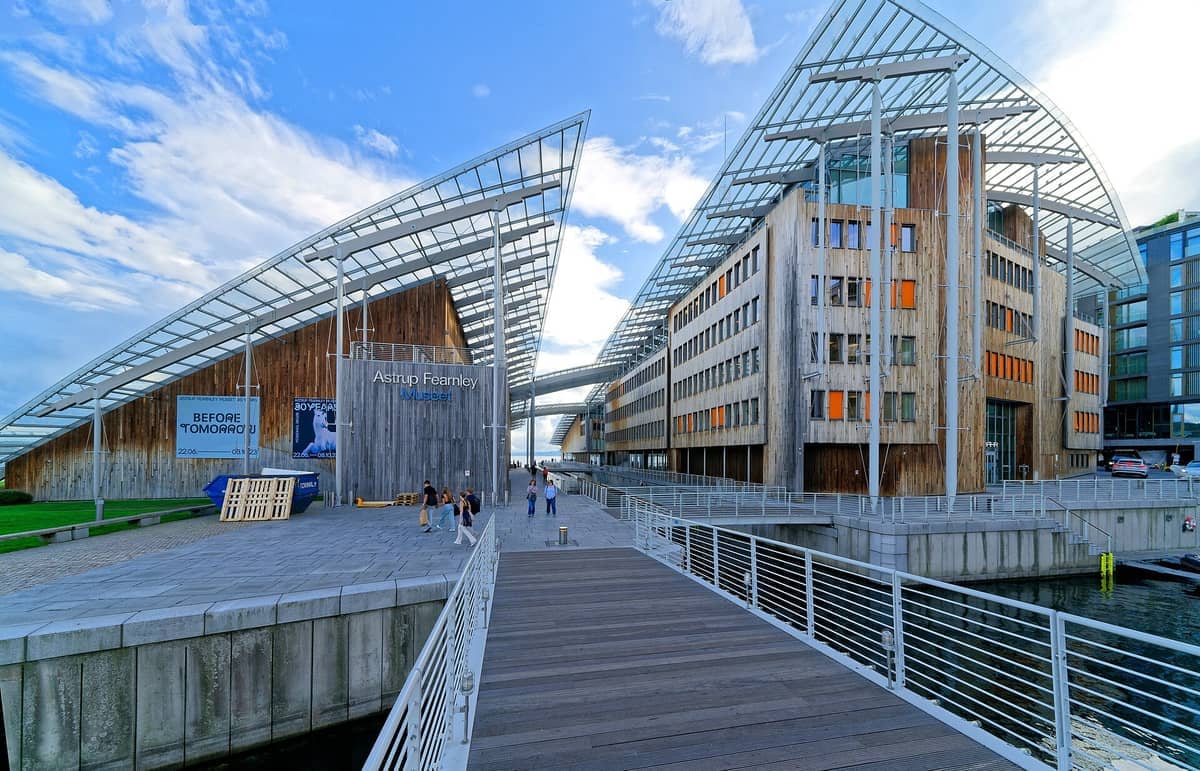
The museum building is, by any honest measure, as interesting as what hangs inside it. Completed in 2012 as part of the broader Tjuvholmen waterfront redevelopment, it was designed by the Renzo Piano Building Workshop, the same studio behind the Centre Pompidou in Paris and the Shard in London. The structure is composed of two linked pavilions under a single sweeping timber-and-glass roof that arcs over the canal between them, letting natural light wash the galleries at angles that shift across the day.
From the waterfront promenade, the building reads as both solid and transparent: dark timber cladding grounds it to the harbor, while the glass roof panels seem to lift the whole structure above the fjord. On clear summer afternoons, sunlight reflected off the water creates a constantly shifting pattern on interior walls, something no artificial lighting can replicate. On overcast winter days, the diffused grey light is softer and arguably better suited to photography and focused looking.
The architecture doesn't overwhelm the art, which is the hardest trick a museum building can pull off. Piano's handling of ceiling height and natural light means even large-scale installations breathe properly. If architecture interests you, consider pairing this visit with a broader walk through Tjuvholmen and Aker Brygge, two neighborhoods that together form one of Oslo's most coherent examples of planned urban waterfront design. Our Oslo architecture guide covers the wider context of the city's contemporary building landscape.
Tickets & tours
Live prices and dates from our booking partner. If you book, we may earn a commission at no extra cost to you.
Oslo Fjord sightseeing audio-guided electrical boat tour
From 35 €Instant confirmationFree cancellationFjord cruise with live jazz music
From 64 €Instant confirmationFree cancellationLuggage Storage in Oslo
From 6 €Instant confirmationFree cancellationPicturesque dinner cruise in Oslo
From 137 €Instant confirmationFree cancellation
The Collection and Exhibition Program
The permanent collection is not always displayed in full, as the museum rotates works to accommodate major temporary exhibitions. At any given visit, you may encounter a large solo show filling most of the space, or a more mixed hang drawing from the collection. The official website publishes current exhibition schedules, and it is worth checking before you go, both to set expectations and to time your visit around shows that interest you.
The building's two pavilions function as distinct zones. The larger main pavilion handles the heavy lifting: big canvases, video installations, sculpture on a significant scale. The smaller pavilion is more intimate, better suited to quieter works that reward prolonged looking. The canal-side corridor connecting them, visible from outside through the glass, is often used for smaller displays or sculpture that benefits from the waterfront light.
Visitors with a serious interest in Norwegian and international art will find the Astrup Fearnley fits naturally into a broader Oslo museum day. The National Museum Oslo covers Norwegian art history from the medieval period to the twentieth century, making the two institutions complementary rather than redundant. For those specifically interested in Edvard Munch, the Munch Museum in Bjorvika provides the deepest possible exploration of Norway's most internationally recognized artist.
Visiting by Time of Day
Arrival at opening time—12:00 Tuesday to Friday, or 11:00 on weekends—means you share the galleries with almost nobody. The morning light through the glass roof is at its most horizontal then, catching the texture of painted surfaces in ways that afternoon flat light does not. For photography of the building exterior from the promenade, early afternoon with the sun moving west produces the most flattering angles.
Weekend afternoons, particularly Saturdays between 13:00 and 15:00, bring the largest crowds. Families with children are common during these windows, which can make concentration difficult in galleries with video or sound-based work. Thursday evenings until 19:00 are notably calm, catching the post-work crowd but avoiding weekend volume. For visitors who think slowly in front of art and dislike the ambient noise of a busy museum, a Thursday evening or a Tuesday-Friday lunchtime opening is the right call.
💡 Local tip
The outdoor sculpture area along the Tjuvholmen waterfront adjacent to the museum is free and open at all hours. Even if you skip the paid galleries, this stretch of the promenade, dotted with commissioned works and overlooking the Oslofjord, is worth the walk.
Practical Information for Your Visit
Getting There
The museum sits at Strandpromenaden 2 on the Tjuvholmen peninsula, approximately a 20-minute walk from Oslo Central Station. Tram line 12 stops at Aker Brygge/Vika, from where Tjuvholmen is a short walk, making this the most direct public transit option. From Aker Brygge, the walk along the waterfront promenade takes about five minutes and is pleasant in any weather.
Tickets and the Oslo Pass
Standard adult admission is NOK 180. Seniors and students pay NOK 100. Children and young people under 20 enter free. Oslo Pass holders enter free, which makes the museum a strong inclusion on any multi-attraction day. During exhibition changeover periods, reduced prices apply: NOK 130 for adults and NOK 80 for students and seniors. Always verify current prices on the official website before visiting, as special programming can affect the standard tariff.
If you are planning multiple paid museum visits in Oslo, the Oslo Pass typically pays for itself after two or three major attractions. The Astrup Fearnley is one of the stronger inclusions given its standard adult price.
Guided Tours and Accessibility
Guided tours run on specific days and carry an additional fee of NOK 50 on top of the regular entrance ticket. Specialty tours including baby-friendly sessions for visitors with infants are offered periodically; the official website lists upcoming tour schedules. The building is fully wheelchair accessible, with step-free entry and lifts serving all gallery floors.
What to Bring and Wear
Oslo's waterfront is exposed. Even in summer, a layer against the wind is worth carrying for the time you spend outside on the promenade before or after the galleries. In winter, the building is warm inside, but the walk along the harbor from tram or from Aker Brygge is cold and can be icy. Visitor information does not highlight a staffed coat check, so dress in easily removable layers when visiting during colder months.
The Surrounding Waterfront: Before and After
The Astrup Fearnley does not exist in isolation. It anchors the eastern end of the Tjuvholmen sculpture park, a free outdoor space with commissioned works from international artists, set along the water between the museum and the broader Aker Brygge district. This outdoor collection extends the museum experience without additional cost and is particularly enjoyable in summer light. A full account of what to expect from this sculpture park appears in our guide to the Tjuvholmen Sculpture Park.
The wider Aker Brygge and Tjuvholmen area has restaurants and cafes at multiple price points. The museum itself has a small café. For a longer lunch or dinner, the redeveloped harborfront stretching toward the Aker Brygge waterfront offers everything from casual fish-and-chips counters to more formal Scandinavian dining.
Clear Assessment: Is It Worth Your Time?
The Astrup Fearnley Museum is one of the genuinely strong contemporary art institutions in northern Europe, not just a respectable local museum. The quality of its collection and the calibre of its temporary shows mean it competes with private museums in larger cities. The building alone justifies the walk out to Tjuvholmen for anyone with an eye for architecture.
That said, visitors expecting a broad survey of art history will be disappointed. This is a contemporary art museum with a specific sensibility: international, often challenging, occasionally confrontational. If large-scale installation art, provocative photography, or conceptually dense work is not your preference, the experience may feel alienating rather than enriching. The museum is also compact relative to Oslo's largest institutions, and two hours is genuinely sufficient for most visitors.
⚠️ What to skip
Exhibition content can be explicit or disturbing. The museum's program has historically included works dealing with sexuality, violence, and mortality without sanitization. If you are visiting with children, check the current exhibition details in advance on the official website.
Insider Tips
- Thursday evenings until 19:00 are the least crowded weekday option and the only time natural light from the west catches the gallery interiors at a low angle. Arrive at 17:30 and you may have entire rooms to yourself.
- The outdoor Tjuvholmen sculpture promenade is free and requires no ticket. Walk the perimeter of the museum building along the canal-facing side to see how Piano handled the transition between building and water, one of the more considered details of the whole complex.
- If a major temporary exhibition has just opened, ticket prices may revert to full rate after a preceding changeover period. Check the website not just for what is showing but when the show opened, to avoid arriving during a higher-priced changeover window.
- The museum café faces the water and gets afternoon sun in summer. Even if you visit on a short timescale, factor in ten minutes on the terrace after the galleries: the view back toward the fjord and the Oslo Opera House in the distance is one of the better urban panoramas in the city.
- Photography is generally permitted in the permanent collection galleries without flash. Rules vary for temporary exhibitions, some of which are contracted with artists who restrict photography entirely. Look for posted notices at the entrance to each gallery rather than assuming either way.
Who Is Astrup Fearnley Museum of Modern Art For?
- Contemporary art enthusiasts who follow international gallery programs and want to see how a private Nordic collection holds up
- Architecture-focused travelers interested in Renzo Piano's approach to light, material, and waterfront integration
- Rainy-day visitors needing a substantive indoor experience that goes beyond the typical tourist circuit
- Oslo Pass holders maximizing value from their card with high-quality free entry
- Couples or solo travelers who want a slower, more contemplative alternative to Oslo's larger, more crowded museums
Nearby Attractions
Other things to see while in Aker Brygge & Tjuvholmen:
- Nobel Peace Center
The Nobel Peace Center (Nobels Fredssenter) is the official museum of the Nobel Peace Prize at Oslo's City Hall Square, presenting the history and laureates of the Nobel Peace Prize through immersive exhibitions., presenting the history and laureates of the Nobel Peace Prize through immersive exhibitions. It is one of the few museums in Oslo that genuinely rewards slow, attentive visitors.
- Tjuvholmen Sculpture Park
Tjuvholmen Sculpture Park sits at the tip of Oslo's most architecturally ambitious waterfront district, offering world-class contemporary sculpture for free, every day of the year. It pairs well with a visit to the Astrup Fearnley Museum next door and a walk along the fjord promenade.
Planning a trip? Discover personalized activities with the Nomado app.