National Museum of Western Art, Tokyo: The Matsukata Collection in a UNESCO Landmark
The National Museum of Western Art sits inside Ueno Park, occupying a rare Le Corbusier building and holding one of Asia's most significant collections of European paintings, prints, and sculpture. Entry to the permanent collection costs ¥500 for adults, and the museum is a 1-minute walk from JR Ueno Station.
Quick Facts
- Location
- 7-7 Ueno-koen, Taito-ku, Tokyo 110-0007, Japan (Ueno Park)
- Getting There
- JR Ueno Station (Park Exit) — 1-minute walk
- Time Needed
- 1.5 to 2.5 hours for permanent collection; add 1 hour for special exhibitions
- Cost
- Permanent collection approx. ¥500 adults; special exhibitions priced separately. Verify current fees at nmwa.go.jp
- Best for
- Art lovers, architecture enthusiasts, rainy-day culture seekers, Ueno Park visitors
- Official website
- www.nmwa.go.jp/en
What the National Museum of Western Art Actually Is
The National Museum of Western Art is Japan's primary public institution dedicated to art produced outside Asia, and it holds a genuinely unusual distinction: The National Museum of Western Art is Japan's primary public institution dedicated to art produced outside Asia, and it holds a genuinely unusual distinction: the main building is the only structure in Asia designed by Le Corbusier to be recognized as a UNESCO World Heritage Site, since 2016. That combination, serious European art in a serious piece of modern architecture, makes this museum worth visiting on two independent grounds.. That combination, serious European art in a serious piece of modern architecture, makes this museum worth visiting on two independent grounds.
The collection traces back to Kojiro Matsukata, a Kobe shipping magnate who amassed The collection traces back to Kojiro Matsukata, a Kobe shipping magnate who amassed thousands of Western artworks in Europe during the early twentieth century. Much of the collection was held in France during World War II and returned to Japan in 1959, forming the founding gift of around 375 works that the museum was built to house. Today the permanent collection has grown to over 6,000 items, spanning medieval altarpieces through Impressionist paintings and early twentieth-century prints. Today the permanent collection has grown to over 6,000 items, spanning medieval altarpieces through Impressionist paintings and early twentieth-century prints.
The museum sits in the northwestern corner of Ueno Park, alongside the Tokyo National Museum, the National Museum of Nature and Science, and the Tokyo Metropolitan Art Museum. It takes under a minute to reach from the Park Exit of JR Ueno Station, which makes it easy to combine with several other institutions in a single day — though doing justice to two major museums in one afternoon is ambitious.
The Building: Le Corbusier's Only Asian Work
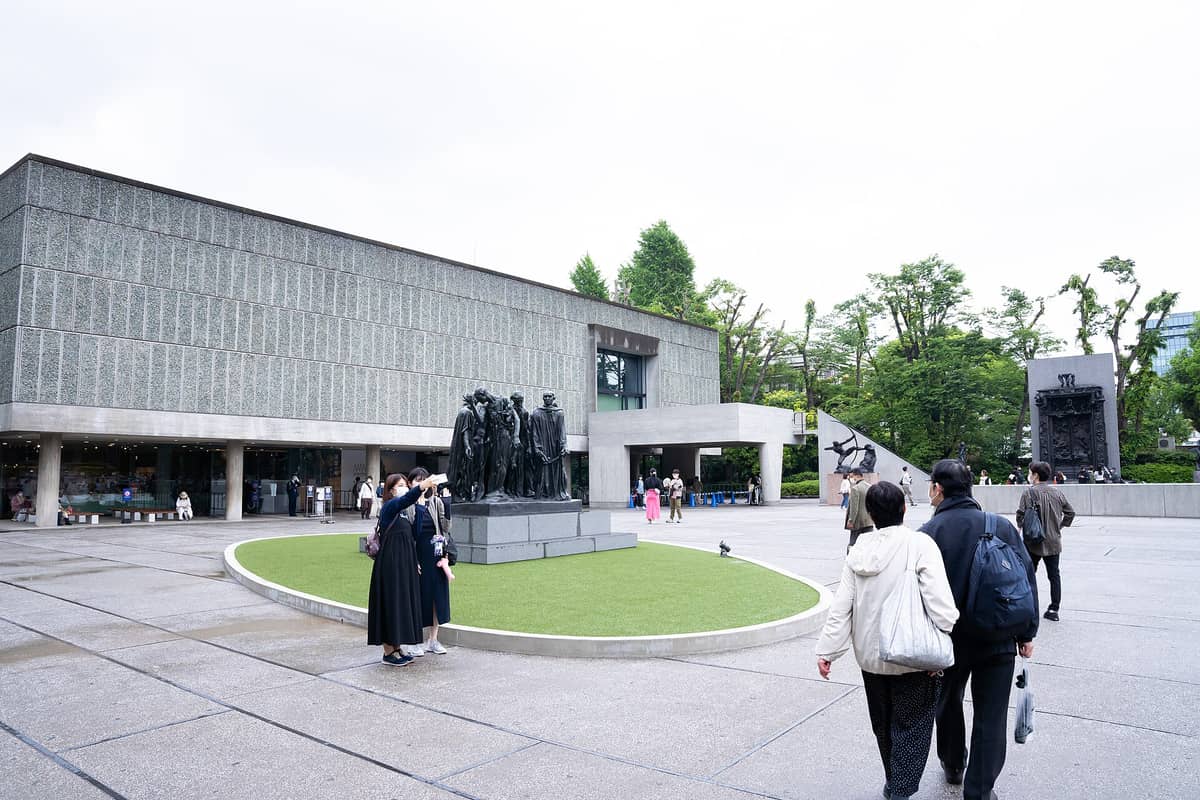
Before you step inside, pause in the forecourt. The Main Building, completed in 1959 to a design by Le Corbusier with execution by his Japanese disciples Junzo Sakakura, Kunio Maekawa, and Takamasa Yoshizaka, Before you step inside, pause in the forecourt. The Main Building, completed in 1959 to a design by Le Corbusier with execution by his Japanese disciples Junzo Sakakura, Kunio Maekawa, and Takamasa Yoshizaka, reflects the architect's ideas about a museum of unlimited growth. The layout was intended to expand outward as the collection grew, with a flat roof supported on pilotis, ribbon windows, and concrete brise-soleil panels filtering the light. It reads as restrained from the outside, almost severe, but that concrete is finely detailed if you look closely. The idea was a spiral layout that could expand outward as the collection grew, with a flat roof supported on pilotis, ribbon windows, and concrete brise-soleil panels filtering the light. It reads as restrained from the outside, almost severe, but that concrete is finely detailed if you look closely.
The forecourt also gives you Auguste Rodin. Several major bronzes are placed in the open air: The Gates of Hell, The Thinker, The Burghers of Calais, and the Monument to Balzac. On a clear morning the shadows cast by the Rodin sculptures against the concrete facade create a visual dialogue that photographers particularly appreciate. This outdoor display is accessible without paying admission, which is worth knowing if you are short on time or budget.
💡 Local tip
The Rodin bronzes in the forecourt are viewable free of charge at any time during park hours. If you only have 20 minutes, spend them here and in the covered walkway before the entrance.
Tickets & tours
Hand-picked options from our booking partner. Prices are indicative; availability and final rates are confirmed when you complete your booking.
Art and soul of the sword samurai experience
From 156 €Instant confirmationFree cancellationTokyo Dining Bar Experience with Darts Throwing Plan
From 8 €Instant confirmationFree cancellationTokyo Dining Darts Bar Experience with Unlimited Darts Plan
From 8 €Instant confirmationFree cancellationManga Art Workshop in a Traditional Tokyo House
From 88 €Instant confirmationFree cancellation
Inside the Permanent Collection
The permanent collection is organized roughly chronologically across the main building's interiors, moving from medieval and Renaissance works through the Baroque, then into nineteenth-century French painting and eventually Impressionism. The lighting inside is carefully controlled, with natural zenithal light entering through the roof skylights in sections of the original Le Corbusier building, giving canvases a quality of illumination that feels different from the fluorescent norm.
Highlights include a substantial group of Rodin sculptures beyond what is displayed outside, paintings by El Greco, Rubens, Tintoretto, and Veronese from the earlier periods, and a particularly strong Impressionist and Post-Impressionist section featuring Monet, Renoir, Cézanne, and Gauguin. The Monet holdings are exceptional by any international standard, including several large-format works. The museum's print and drawing collection is less frequently discussed but extensive, covering Rembrandt etchings through to early twentieth-century German Expressionist woodcuts.
Special exhibitions, Special exhibitions are held in a separate Special Exhibition Wing and typically run for two to three months, bringing major international loans to Tokyo. These exhibitions often draw queues and have higher, separate admission prices. If a special exhibition is running during your visit, check whether it aligns with your interests because the wing entrance is separate from the permanent collection.
ℹ️ Good to know
Opening hours: Tuesday to Sunday, 09:30 to 17:30. Extended hours until 20:00 on Fridays and Saturdays. Last admission 30 minutes before closing. Closed Mondays (and the following Tuesday when Monday is a public holiday), and 28 December to 1 January. Confirm current hours at nmwa.go.jp before visiting, as hours can shift during special exhibitions.
How the Experience Changes by Time of Day
Weekday mornings between opening and about 11:00 are the quietest period. School groups occasionally arrive mid-morning but tend to cluster near the entrance. The Impressionist galleries in particular feel very different with five people in them versus fifty: you can actually stand close to the Monets without competing for space, and the quiet intensifies the concentration the paintings reward.
Weekends and public holidays bring noticeably more visitors, especially if a popular special exhibition is running. The permanent collection galleries remain manageable even then, since most visitors stream directly into the special exhibition wing. Afternoons on Fridays and Saturdays benefit from the extended 20:00 closing time, which draws an evening crowd but also means you can visit after dinner plans shift, or simply linger longer without the pressure of an early close.
Rain is genuinely not a problem here. The museum is compact enough to fill an entire wet afternoon, and the combination of a covered forecourt, a well-stocked shop, and a cafe makes it a considered choice during Tokyo's June to mid-July rainy season or on typhoon-adjacent September days. The building's brutalist aesthetic arguably suits grey skies better than direct sun.
Getting There and Getting Around Inside
From JR Ueno Station, use the Park Exit and walk straight ahead into Ueno Park. The museum entrance is visible within about 60 seconds of leaving the ticket gates. From JR Ueno Station, use the Park Exit and walk straight ahead into Ueno Park. The museum entrance is visible within about 60 seconds of leaving the ticket gates. If you are arriving on the Keisei Line (useful if coming from Narita Airport via the Skyliner), Keisei Ueno Station's Main Exit puts you about 7 minutes on foot from the museum. Tokyo Metro Ginza and Hibiya line users should alight at Ueno Station and follow signs for the park.
Inside the museum, the layout is intuitive once you orient yourself at the entrance map. The permanent collection flows through interconnected galleries with clear signage in both Japanese and English. Audio guides are available for rental at the information desk. The museum is fully wheelchair accessible from the JR Park Exit route, with ramps, elevators, and multipurpose restrooms on the first floor and in the Special Exhibition Wing basement. Wheelchair and stroller loans are available at the information desk. For more detail on accessibility facilities, see the official site. Disabled visitors and one companion are admitted free upon presentation of a disability certificate or Mirairo ID. There is no on-site parking; visitors arriving by car should use the shared Ueno Park parking facilities.
Photography, the Shop, and the Cafe
Photography without flash is permitted in the permanent collection galleries, which is a genuine courtesy not universal among Tokyo's major museums. The exterior of the Le Corbusier building and the Rodin forecourt are excellent photographic subjects. The best exterior light falls on the facade in the morning, and the Rodin bronzes photograph most dramatically in the low-angle sun of late afternoon in autumn and winter. The exterior of the Le Corbusier building and the Rodin forecourt are excellent photographic subjects. The best exterior light falls on the facade in the morning, and the Rodin bronzes photograph most dramatically in the low-angle sun of late afternoon in autumn and winter.
The museum shop is well-curated, stocking scholarly catalogues from past exhibitions alongside prints, postcards, and design objects. It is one of the better museum shops in Ueno Park for anyone interested in European art history. The cafe, accessible without museum admission, serves simple drinks and light food and faces the forecourt.
💡 Local tip
Photography rules can differ for special exhibitions — flash and tripods are typically prohibited and some loan works from overseas may be excluded from photography altogether. Check the signage at the special exhibition entrance.
Who Should Come, and Who Might Not
This museum is well matched to travelers who already have an interest in European art history and want to see it in an architecturally significant setting. It fits naturally into a museum-focused itinerary in Tokyo, particularly combined with the Tokyo National Museum a few minutes away within Ueno Park. Art-curious visitors without a strong prior interest will still find plenty of accessible Impressionist works, and the building itself rewards anyone interested in twentieth-century architecture.
Travelers seeking Japanese art, traditional craft, or cultural context specific to Japan will find the museum's focus too narrow for their purpose. For that, the Tokyo National Museum next door is a far better fit. Families with young children may find the collection less engaging unless the children have a specific interest in art, though the outdoor Rodin sculptures tend to capture attention across age groups. People who dislike contemporary or Brutalist architecture may find the building cold, though the interior galleries are warmer in feel than the facade suggests.
The permanent collection admission at around ¥500 makes this one of the more affordable serious art museums in Tokyo. It sits comfortably within a budget-conscious Tokyo itinerary without feeling like a compromise. The free Rodin forecourt means even a very short or free visit has something to offer.
Insider Tips
- The museum occasionally holds free admission days for specific national observances. Check the official site's news section when planning ahead, as these are announced with a few weeks' notice and fill up on the day.
- If you are visiting Ueno Park for cherry blossoms in late March or early April, the museum is a reliable retreat when the park crowds become overwhelming. Weekday mornings during blossom season are the sweet spot: the park is lively, but the museum interiors stay calm.
- The Friday and Saturday evening hours until 20:00 are underused by tourists, who tend to leave the area by late afternoon. Evening visits to the permanent collection offer a noticeably quieter experience and more comfortable gallery temperatures in summer.
- Pick up the free floor map in English at the entrance desk before touring the permanent collection. The spiral layout of the Le Corbusier building is not immediately intuitive, and the map saves considerable backtracking.
- The Print Gallery within the permanent collection receives less foot traffic than the painting galleries and is consistently quieter. If you want to spend time with individual works without interruption, the graphic arts section is the place to do it.
Who Is National Museum of Western Art For?
- European art enthusiasts visiting Asia who want access to a serious permanent collection
- Architecture lovers with an interest in Le Corbusier and mid-century Modernism
- Rainy-day visitors to Ueno looking for a full-afternoon cultural alternative
- Travelers combining a Ueno Park museum crawl with the Tokyo National Museum
- Budget-conscious visitors who want a significant art experience under ¥500
Nearby Attractions
Other things to see while in Ueno & Akihabara:
- Akihabara Electric Town
Akihabara Electric Town (秋葉原電気街) is the beating heart of Tokyo's electronics and otaku culture. Stretching from Akihabara Station along Chuo-dori and its surrounding alleys, the district packs multi-story electronics megastores, retro game shops, anime merchandise outlets, and maid cafés into a few dense city blocks. Entry is free. The real cost is time and willpower.
- Ameyoko Market
Ameyoko Market (Ameya-Yokocho) stretches between Ueno and Okachimachi stations in central Tokyo, packing fresh seafood, discount clothing, snacks, and cosmetics into roughly 500 meters of covered and open-air stalls. Entry is free, the energy is genuine, and the history runs deep.
- Kanda Myojin Shrine
Kanda Myojin Shrine has stood as Edo's spiritual guardian for nearly 1,300 years, yet sits a seven-minute walk from one of Tokyo's most modern districts. The shrine grounds are free to enter and effectively accessible at all hours, making it an accessible counterpoint to the neon intensity of nearby Akihabara.
- Kyu-Iwasaki-tei Garden
Kyu-Iwasaki-tei Garden preserves the former Tokyo residence of the Iwasaki family, founders of Mitsubishi, in the Ikenohata area of Taito Ward near Ueno. The estate combines a Victorian-style wooden mansion, a connected billiard hall, and a traditional Japanese garden — all for one of the lowest admission prices of any historic site in the city.