Museo del Novecento: Milan's 20th-Century Art Museum on the Duomo Square
Housed inside the Fascist-era Palazzo dell'Arengario directly on Piazza del Duomo, the Museo del Novecento holds around 400 works of Italian 20th-century art; the museum’s broader collection encompasses over 4,000 works in total. Standard full entry costs 10 EUR, and the building's upper floors offer some of the most unusual views of the Milan Cathedral you will find anywhere in the city.
Quick Facts
- Location
- Palazzo dell'Arengario, Piazza Duomo 8, 20123 Milan
- Getting There
- Metro: Duomo (M1/M3); multiple tram lines on Piazza del Duomo
- Time Needed
- 1.5 to 2.5 hours
- Cost
- Full price 10 EUR; reduced 5 EUR; free entry for multiple categories, plus every first Sunday of the month for all visitors and every second Tuesday of the month for visitors up to 25 years old
- Best for
- Italian modern art lovers, architecture fans, travellers wanting Duomo views without cathedral crowds
- Official website
- www.museodelnovecento.org/it/visita
What Is the Museo del Novecento?
The Museo del Novecento is Milan's dedicated museum of 20th-century Italian art, opened on 6 December 2010 inside the Palazzo dell'Arengario, a Rationalist-style building that anchors the southwestern edge of Piazza del Duomo. With around 400 works in the collection, it is one of the most coherent collections of Italian modernism anywhere in the country.
The museum sits directly opposite the Milan Cathedral, which means the setting is as significant as the contents. You are stepping into a building that once served Fascist-era political theatre, now repurposed to house Futurist paintings, Arte Povera installations, and mid-century abstraction. That tension between the building's origins and its current cultural mission is part of what makes a visit here interesting.
💡 Local tip
Free admission is available in specific time windows such as every first Sunday of the month for all visitors and every second Tuesday of the month for visitors up to 25 years old; if the collection rather than a quiet experience is your priority, these are the most economical ways in — but expect more visitors during free windows.
The Building: Palazzo dell'Arengario
The Palazzo dell'Arengario was designed by the architects Piero Portaluppi, Enrico Agostino Griffini, Pier Giulio Magistretti, and Giovanni Muzio between the 1930s and 1950s. The name 'Arengario' refers to a medieval Italian term for a public speaking platform or civic hall, and the building was intended partly as a stage for Mussolini's addresses to crowds in the square. It was never fully completed in its original form, and for decades after World War II it stood underused.
The conversion into a museum was completed by architects Italo Rota and Fabio Fornasari. They added a dramatic spiral ramp that winds through the upper levels, a glazed walkway connecting the Arengario to the adjacent Palazzo Reale, and a circular panoramic terrace at the top. The architects made a clear decision to let original Rationalist details — travertine surfaces, tall windows, geometric reliefs on the facade — coexist with contemporary insertions rather than erasing them.
The building sits at the heart of the Duomo district, flanked by the Galleria Vittorio Emanuele II to the north and Palazzo Reale to the east. Architecturally, it is worth examining the exterior bas-reliefs before you enter: they depict themes of labour and civic life in the grandiose Rationalist visual language of the period.
Tickets & tours
Hand-picked options from our booking partner. Prices are indicative; availability and final rates are confirmed when you complete your booking.
Milan Museo Del Novecento entry ticket with audio guide
From 14 €Instant confirmationFree cancellationAudio guide for the Last Supper in Santa Maria delle Grazie
From 4 €Instant confirmationMuseum of the 900 self-guided audio tour in Milan
From 4 €Instant confirmationNatural History Museum self-guided audio tour in Milan
From 4 €Instant confirmation
The Collection: What You Will See Inside
The permanent collection moves roughly chronologically through Italian art from the late 19th century to the 1980s, though the strongest sections cover the early and mid-20th century. The museum's holdings include significant works from the Futurist movement — Umberto Boccioni's paintings and sculptures are among the highlights, and the curatorial decision to open the collection with a Boccioni sculpture in a double-height space makes a strong first impression.
Beyond Futurism, the rooms address Novecento Italiano (the conservative figurative movement of the interwar years), Abstract art of the 1940s and 1950s, and Arte Povera. There are works by Giorgio de Chirico, Lucio Fontana (his slashed canvases, called 'Concetto Spaziale,' are among the collection's most recognisable pieces), Piero Manzoni, and Alighiero Boetti. International works appear in smaller numbers, contextualising Italian production within broader European movements.
The layout across multiple floors means the visit has a clear physical rhythm: you ascend through decades, with each floor offering different light conditions and ceiling heights. The spiral ramp connecting levels creates moments where you see works from unusual angles — not always flattering for the art, but architecturally memorable. Allow at least 90 minutes to move through the permanent collection without rushing; dedicated visitors or those who read labels carefully should budget closer to 2.5 hours.
ℹ️ Good to know
The museum also hosts temporary exhibitions, which may require a separate or combined ticket. Check the official website before visiting to understand what is currently on and whether the layout has been adjusted to accommodate temporary shows.
The Rooftop Terrace: Views Worth the Climb
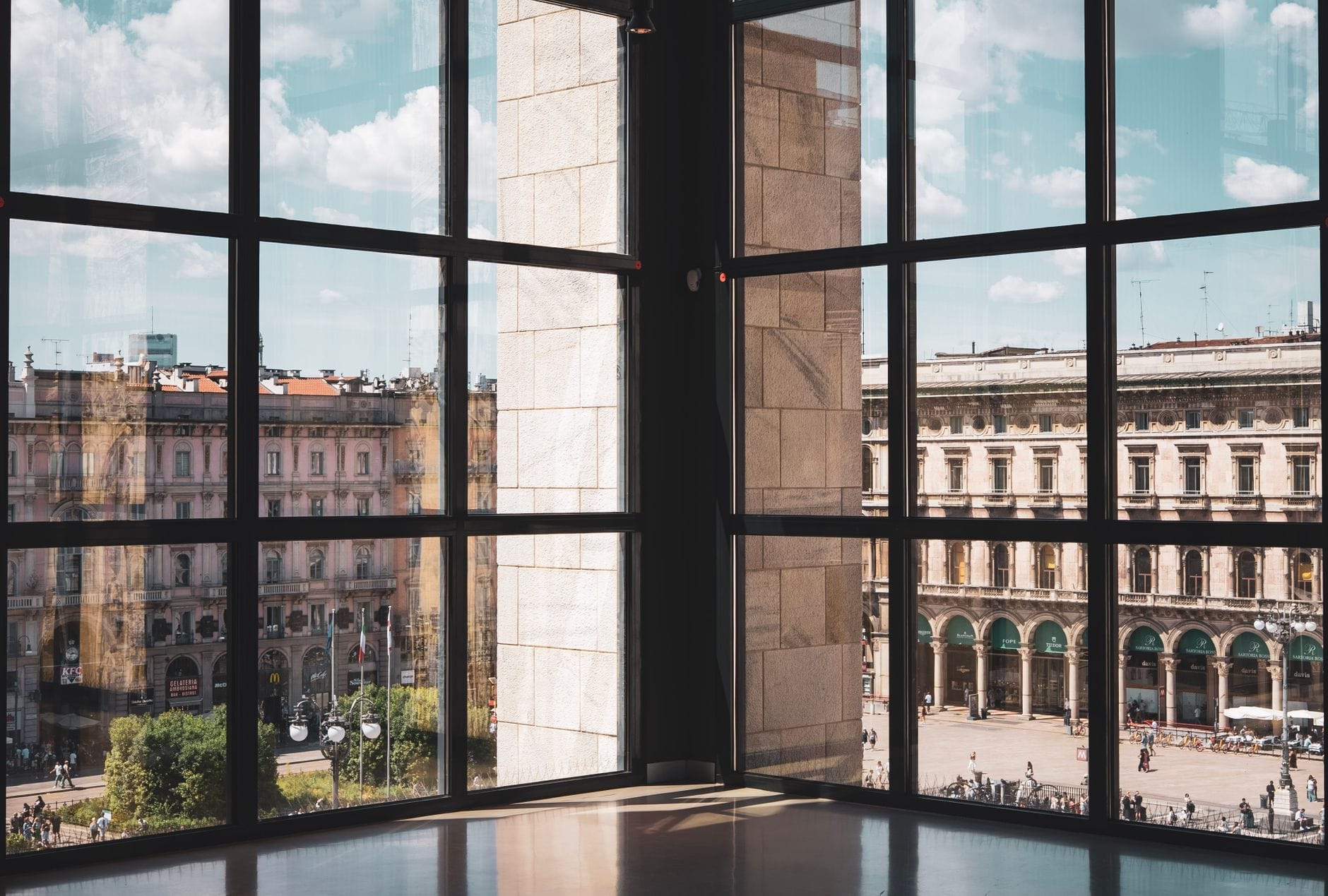
The circular glazed terrace at the top of the Arengario is one of the building's most practical rewards. From here, the view across Piazza del Duomo is nearly unobstructed, and the Cathedral's Gothic facade and spires read differently at this elevation than from street level. The angle also reveals the roofline details of the Galleria Vittorio Emanuele II and the urban spread toward the north. On clear days in spring and autumn, the Alps are visible on the horizon.
The terrace is included in the museum admission, so it is considerably cheaper than the Milan Cathedral rooftop terraces while offering a notably different perspective. The downside is that you are looking at the Cathedral rather than from it, which may or may not suit what you are after. Morning light is generally better for photography here, hitting the Cathedral's marble facade directly. Afternoon light can be strong and flat from the west.
Visiting in Practice: Hours, Crowds, and Timing
The museum is open Monday from 14:30 to 19:30, Tuesday through Friday and Sunday from 10:00 to 19:30, and Thursday and Saturday from 10:00 to 22:30. Last admission is one hour before closing. The extended Thursday and Saturday evening hours are worth noting: the museum at 20:00 on a weekday evening is substantially quieter than at 11:00 on a weekend morning, and certain works — particularly Fontana's canvases — are genuinely more compelling under artificial lighting with fewer people in the room.
Weekday mornings between 10:00 and 12:00 tend to attract school groups, which can make some galleries feel congested and noisy. Afternoons from around 14:00 onward are typically calmer, especially mid-week. Weekend afternoons are busier but manageable if you start from the upper floors — where most visitors head last — and work your way down against the crowd flow.
⚠️ What to skip
The museum is closed on Mondays before 14:30, so a morning visit on Monday is not possible. If you are planning a tight itinerary, note that the reduced Monday hours are a genuine constraint.
Getting here requires no special navigation: Duomo metro station (served by the red M1 and yellow M3 lines) exits directly onto Piazza del Duomo. The museum entrance is on the piazza itself, clearly marked. Tram lines running along Via Orefici and Corso Vittorio Emanuele II also stop within a two-minute walk.
Photography and Practical Notes
Photography without flash is generally permitted in the permanent collection galleries, though individual works may be restricted. The rooftop terrace offers the best photography conditions in the building, and the internal spiral ramp is itself a strong architectural subject. Avoid visiting with a large bag if you can: cloakroom facilities are available, but bag checks can add a few minutes to entry during busy periods.
The museum has a shop on the ground floor with a reasonable selection of Italian art books and design objects. There is a cafe area, though it functions more as a light refreshment stop than a destination in itself. For anyone wanting to extend the visit into a longer cultural afternoon,
the Gallerie d'Italia on Piazza Scala is a logical complement — it covers a different slice of Italian art history and is within easy walking distance. For a fuller picture of what Milan's museum landscape looks like, the best museums in Milan guide outlines how the Novecento fits alongside the city's other major collections.
Is It Worth Your Time?
The Museo del Novecento earns its place on any serious Milan itinerary, but with realistic expectations. The collection is deep rather than broad: it rewards visitors who have some interest in Italian modernism specifically. If your primary interest is Renaissance or Baroque art, the Pinacoteca di Brera or the Pinacoteca Ambrosiana will speak to you more directly.
Visitors with children may find the abstract and conceptual works less engaging for younger audiences than, say, the Museo Nazionale della Scienza e della Tecnologia, which is more interactive. That said, the rooftop terrace tends to appeal to all ages, and the building itself — with its spiral ramp and changing light — holds attention beyond the art alone.
Anyone with a serious interest in 20th-century European art, in Italian cultural history between the wars, or in the architecture of Rationalism will find the visit consistently rewarding. The price point at 10 EUR full price is reasonable for the combination of collection, architecture, and views. At free admission times, it is one of the strongest cultural offers in the city centre.
Insider Tips
- Start on the upper floors and work your way down. Most visitors do the opposite, meaning the top-floor rooms with the best Duomo views and the Fontana canvases are often quieter early in your visit.
- Thursday and Saturday evening openings until 22:30 are underused by tourists. The galleries feel noticeably different after 20:00 — quieter, with warmer artificial lighting that suits works like Fontana's Concetto Spaziale particularly well.
- The glazed walkway connecting the Arengario to Palazzo Reale is worth pausing on: it offers a ground-level visual link between the two buildings and frames the Cathedral facade in an unexpected way.
- If you plan to visit the Cathedral on the same day, consider doing the Novecento first. By mid-morning the Cathedral queues lengthen significantly, while the museum is quieter before 11:00 on weekdays.
- The exterior bas-reliefs on the Arengario's facade are worth a few minutes before you enter. They are a direct visual record of Fascist-era Rationalist aesthetics and provide context for understanding the building's original purpose.
Who Is Museo del Novecento For?
- Art enthusiasts with a specific interest in Italian Futurism, Arte Povera, and mid-century abstraction
- Architecture followers interested in Fascist-era Rationalism and its contemporary adaptive reuse
- Travellers wanting elevated views of the Duomo at a lower cost than the Cathedral rooftop ticket
- Visitors planning an evening cultural itinerary, thanks to the extended Thursday and Saturday hours
- Anyone combining a full day in the Duomo district who wants a quieter indoor counterpoint to the busy piazza
Nearby Attractions
Other things to see while in Duomo District:
- Chiesa di San Bernardino alle Ossa
Tucked into Piazza Santo Stefano a short walk east of the Duomo, the Chiesa di San Bernardino alle Ossa is one of Milan's most arresting and least-crowded historic interiors. Its 17th-century ossuary chapel is lined floor to ceiling with human skulls and bones, crowned by a luminous baroque fresco. Entry is free.
- Duomo di Milano
The Duomo di Milano is one of the largest Gothic cathedrals in the world, nearly six centuries in the making and still the physical and symbolic heart of the city. This guide covers what to expect inside, how to reach the rooftops, when to visit, and the practical details that make the difference between a rushed stop and a memorable experience.
- Museo del Duomo
The Museo del Duomo di Milano, housed inside Palazzo Reale on Piazza del Duomo, holds six centuries of sculpture, stained glass, and architectural models that the cathedral itself can no longer display. It is quieter than the church next door, considerably less crowded than the rooftop terraces, and far more revealing about how one of the world's most complex Gothic buildings actually came to be.
- Galleria Vittorio Emanuele II
Built between 1865 and 1877 and inaugurated in 1867, the Galleria Vittorio Emanuele II connects Piazza del Duomo to Piazza della Scala beneath a soaring 47-metre glass dome. Entry is free and the arcade never closes, making it one of the most accessible landmarks in northern Italy. Whether you stop for an espresso at a historic café or simply pass through on foot, the architecture alone rewards the detour.