Muriwai Gannet Colony: Thousands of Seabirds on Auckland's Wild West Coast
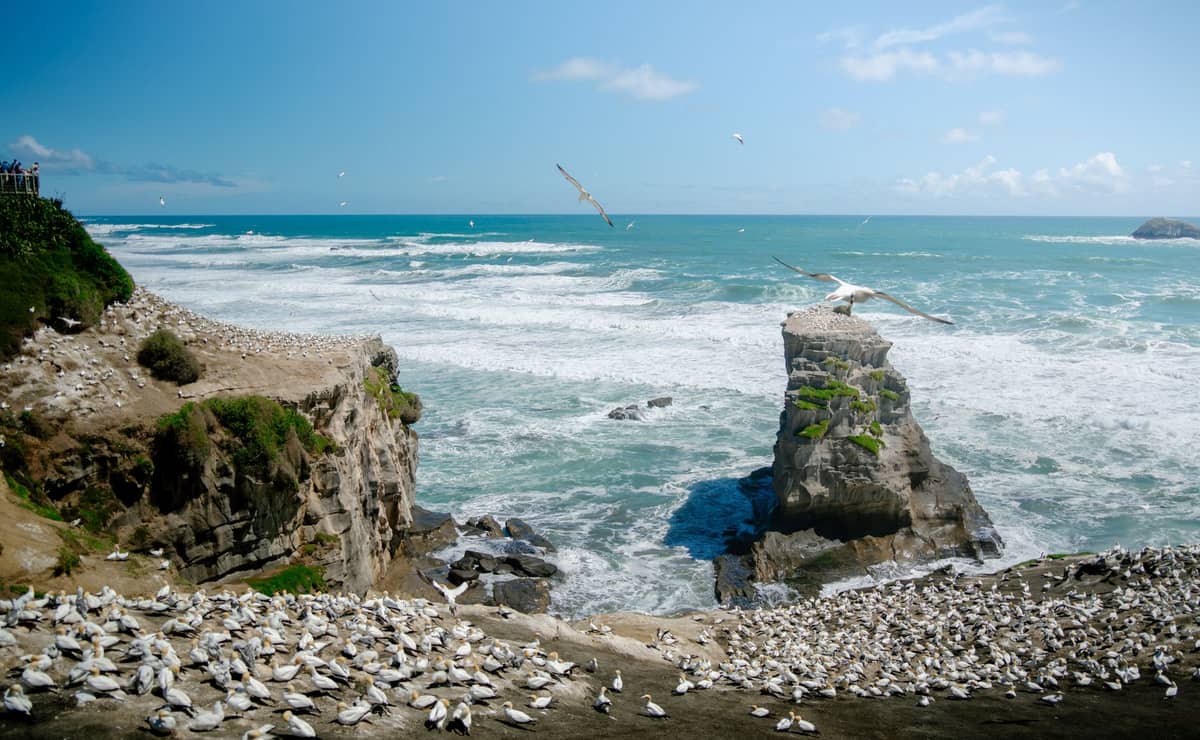
At Ōtakamiro Point on Muriwai Beach, one of New Zealand's most dramatic mainland seabird colonies puts on a seasonal spectacle from August through March. When access is open, thousands of Australasian gannets nest, court, and raise chicks on the cliffs, visible from public viewing platforms above the Tasman Sea.
Quick Facts
- Location
- 458 Motutara Road, Muriwai, Auckland region
- Getting There
- Car recommended via State Highway 16 then Muriwai Road; approx. 40 min from central Auckland
- Time Needed
- 1.5–3 hours including the beach walk
- Cost
- Free entry (no admission fee identified)
- Best for
- Wildlife watching, photography, nature walks, families with older children
- Official website
- regionalparks.aucklandcouncil.govt.nz/muriwai
What Is the Muriwai Gannet Colony?
The Muriwai Gannet Colony, situated on Ōtakamiro Point at the southern end of Muriwai Beach, is The Muriwai Gannet Colony, situated on Ōtakamiro Point at the southern end of Muriwai Beach, is one of three mainland breeding sites for Australasian gannets (Morus serrator) in New Zealand. Many gannet colonies are on offshore islands, which makes Muriwai unusually accessible: when the track is open, visitors can watch a large seabird colony without a boat or entry fee.
The birds arrive around August, pair up with elaborate sky-pointing and bill-touching displays, lay eggs, and raise chicks through to around March, The birds arrive around August, pair up with elaborate sky-pointing and bill-touching displays, lay eggs, and raise chicks through to around March. Juveniles then leave the colony; they migrate to Australian waters and return to breed after several years. At peak season, the colony holds several thousand birds on the cliffs and ledges, with the smell of guano and the constant noise of calling adults carrying well before you reach the viewing platforms. At peak season, the colony holds several thousand birds stacked across dramatic basalt stacks and cliff-top ledges, with the smell of guano and the constant noise of calling adults carrying well before you reach the viewing platforms.
⚠️ What to skip
Access to the colony is currently closed while the Maukatia Gannet Track is upgraded. Check Auckland Council's regional parks website or AucklandNZ before making the trip. Conditions on the access track can also change after heavy rain. Check current status at Auckland Council's regional parks website or the AucklandNZ visitor site before making the trip. Conditions on the access track can also change after heavy rain.
The Experience: What You Actually See and Hear
From the viewing platforms above Ōtakamiro Point, the colony reveals itself in layers. The closest stack is close enough that you can pick out individual nest cups, count the speckled brown juveniles among the brilliant white adults, and watch the precise, almost choreographed greeting rituals between bonded pairs. Gannets are large birds with a wingspan around 1.7 to 2 metres, bright yellow-gold heads, and piercing pale-blue eyes ringed in black. They are not shy.
The noise is the first thing most visitors remark on. The colony produces a continuous, low-frequency roar of calls that is more industrial than musical, layered with the crash of Tasman Sea swells against the basalt below. The smell is sharp and immediate. Neither is unpleasant in the way that people sometimes expect; they simply signal that you are in the presence of something genuinely wild.
Above the nesting stacks, birds circle constantly on the coastal updrafts. When conditions are right, gannets fold their wings and plunge-dive offshore Above the nesting stacks, birds circle constantly on the coastal updrafts. When conditions are right, gannets fold their wings and plunge-dive offshore from heights of up to 30 metres, entering the water with barely a splash. Watching this from the cliff-top platforms, with the black Waitākere Ranges behind you and nothing but open ocean ahead, is one of the more striking free experiences available within an hour of Auckland's city centre., entering the water with barely a splash. Watching this from the cliff-top platforms, with the black Waitākere Ranges behind you and nothing but open ocean ahead, is one of the more striking free experiences available within an hour of Auckland's city centre.
Tickets & tours
Live prices and dates from our booking partner. If you book, we may earn a commission at no extra cost to you.
Muriwai Beach and Gannet Eco Tour with Wine Tasting
From 351 €Instant confirmationFree cancellationLuggage Storage in Auckland
From 5 €Instant confirmationFree cancellationNew Zealand West Coast discovery tour
From 100 €Instant confirmationFree cancellation13,000ft skydiving experience in Auckland
From 195 €Instant confirmationFree cancellation
When to Visit: Season, Time of Day, and Weather
The colony is active from approximately August through March, with the busiest and most visually rewarding period falling between October and February. Early in the season you will see courtship and nest-building; by December the platforms are full of sitting adults and hatching chicks; by late January and February the large, chocolate-brown juveniles dominate the outer edges of the stacks, exercising their wings before departure.
Time of day matters more than most guides acknowledge. Morning visits, particularly in the two hours after sunrise, tend to offer the best light for photography: the sun is behind you as you face the stacks, and the birds are most active with feeding flights and display behaviour. Midday in summer brings harsh overhead light that flattens the detail on the white plumage. Late afternoon can be beautiful in a different way: low golden light and a warmer atmosphere, though the platforms are busier at this time on weekends.
Muriwai sits on the west coast and receives the full force of weather crossing the Tasman Sea. Wind is almost always present; on days with strong westerly or south-westerly winds, the updrafts above the cliffs are extraordinary, and birds hang almost motionless at eye level while you watch from the platforms. A blustery, overcast day is not a reason to skip the colony. Rain, on the other hand, reduces visibility and can make the boardwalk sections of the track slippery, so check the forecast and wear appropriate footwear regardless of season.
💡 Local tip
Binoculars are worth bringing even though the closest stacks are very near the viewing platforms. A pair with 8x or 10x magnification reveals the texture of feathers, the blue-ringed eyes, and the feeding behaviour of chicks in ways that unaided eyes and phone cameras cannot match.
Getting There and Getting Around the Site
The colony is approximately The colony is approximately 40 minutes from central Auckland by car, travelling via State Highway 16 northwest through Kumeu, then turning onto Muriwai Road. The address commonly given is 458 Motutara Road, Muriwai. There is a car park near the beach access, and the Maukatia Gannet Track starts at 1 Waitea Road, which gives access to the colony track. AucklandNZ describes the site as most easily reached by car, and this is accurate: public transport to Muriwai is limited., travelling via State Highway 16 northwest through Kumeu, then turning onto Muriwai Road. The address commonly given is 458 Motutara Road, Muriwai. There is a car park near the beach access, and a second smaller car park at Waitea Road that gives more direct access to the colony track. AucklandNZ describes the site as most easily reached by car, and this is accurate: public transport to Muriwai is limited.
From the Waitea Road access, the route to the colony involves steps and boardwalk sections before reaching a flat viewing area at the northern end of the cliff. The terrain is uneven in places. Visitors with limited mobility should note that step-free access has not been confirmed in available sources; it is worth contacting Auckland Council Regional Parks before travelling. Combine the colony with the wider Muriwai Beach itself, a long, dark-sand west coast surf beach with its own dramatic character, and you have a half-day destination that justifies the drive from the city.
If you are planning a broader west coast day out, the Waitākere Ranges Regional Park lies between Muriwai and Auckland and contains dozens of walking tracks through native bush, including access to the dramatic Kitekite Falls. Combining these into a single day is straightforward with a car.
Ecological and Cultural Context
Australasian gannets are the only species of gannet native to New Zealand and Australia. Australasian gannets are native to New Zealand and Australia. They are long-lived and return to breeding colonies after spending years at sea, making mainland colonies like Muriwai particularly observable over time. The colony at Ōtakamiro Point is managed within Auckland Council's regional parks system and is one of the region's significant wildlife assets. The colony at Ōtakamiro Point is managed as part of Auckland Council's regional parks system and is one of the region's most significant wildlife assets.
The broader Muriwai area sits within the context of the Waitākere Ranges and the Tasman coastline, both of which hold deep significance for local Māori. The region's volcanic and coastal landscapes are part of a wider Auckland story that the Auckland Māori culture guide explores in more detail. The west coast beaches, including Muriwai, are also covered in the Auckland west coast beaches guide if you want to understand the full coastal character of this part of the region.
Photography Practical Notes
The colony is unusually photogenic because the birds are large, the backgrounds are dramatic, and the distance from the viewing platforms to the nearest nesting stack is short enough that even a phone camera with a modest zoom can capture readable images of individual birds. That said, a lens in the 200–400mm equivalent range will make a substantial difference if your priority is detailed animal portraits.
The main photographic challenge is exposure: the birds have brilliant white bodies and dark wingtips, the stacks are dark basalt, and the sea behind can be either silver-grey or deep blue depending on conditions. Morning light from the east resolves this contrast most effectively. For plunge-diving shots off the cliff, you need a fast shutter speed (1/2000s or faster) and some patience. The birds circle repeatedly before committing to a dive, giving you multiple chances to track and time the shot.
Who Might Want to Skip This
The colony visit is not well suited to travellers who need fully accessible terrain, at least until access conditions are confirmed. It also requires a car and an approximately 40-minute drive each way, which makes it a poor fit for visitors on a tight city-centre itinerary with no vehicle. Outside the August-to-March season, the stacks are largely empty and the drive is hard to justify purely for the colony, though the beach and wider park remain worthwhile.
Visitors who prefer compact urban experiences or are already committed to island destinations like Waiheke Island may find the west coast drive adds too much to a single day. Be honest with your itinerary before committing: the colony rewards those who make it a deliberate destination, not an afterthought tacked onto a city afternoon.
Insider Tips
- Arrive at the Waitea Road car park rather than the main Muriwai Beach car park; it puts you directly above the colony track and cuts the walk significantly.
- August and September offer the most dramatic courtship behaviour, including sky-pointing displays and the arrival of birds re-establishing pair bonds. It is less crowded than summer and can be more rewarding for behavioural observation.
- Check the Auckland Council regional parks page the morning of your visit; access closures due to track damage or maintenance are posted there and can save a wasted trip.
- Bring a windproof layer regardless of the forecast. The platforms face directly into the prevailing westerly, and even on a warm Auckland day the cliff-top wind chill can be significant.
- If you want the platforms to yourself, aim for a weekday morning in October or November. Weekend afternoons in January and February bring the largest crowds and the most competition for the best viewing positions.
Who Is Muriwai Gannet Colony For?
- Wildlife and birdwatching enthusiasts wanting a mainland seabird colony without a boat trip
- Nature photographers looking for dramatic coastal backdrops and accessible subjects
- Families with children old enough to handle uneven terrain and a short walk
- Travellers combining a west coast day with Muriwai Beach or the Waitākere Ranges
- Visitors who want a genuinely wild natural experience within reach of Auckland city
Nearby Attractions
Combine your visit with:
- Auckland Botanic Gardens
Spread across 64 hectares in Manurewa, the Auckland Botanic Gardens offer free entry every day of the year, with themed garden collections, 10 hectares of native forest, and a visitor centre on site. It sits south of the city centre and rewards a longer visit than most people initially plan for.
- Auckland Zoo
Auckland Zoo has been part of the city's fabric since 1922, sitting in the Western Springs precinct with a collection that spans native New Zealand wildlife and international species. This guide covers everything from ticket prices and transit options to the best time of day to arrive and which exhibits deliver the most.
- Bastion Point (Takaparawhau)
Takaparawhau, known widely as Bastion Point, is a grassy headland in Ōrākei where Māori history, colonial conflict, and sweeping Waitematā Harbour views converge. It costs nothing to visit, carries centuries of significance, and rewards visitors who take time to understand what they are standing on.
- Bethells Beach (Te Henga)
Bethells Beach, officially Te Henga (Bethells Beach), is a raw, dramatic stretch of black-sand coastline about 45 minutes west of central Auckland. With rolling dunes, a freshwater lagoon, strong surf, and zero phone coverage, it delivers a genuine wilderness experience rare for a city of 1.6 million people.
Planning a trip? Discover personalized activities with the Nomado app.