Auckland's West Coast Beaches: Piha, Muriwai & Beyond
Auckland's west coast delivers something the sheltered harbour beaches simply cannot: raw, wind-scoured black-sand shorelines, serious surf, and dramatic coastal scenery within 45 minutes of the city. This guide covers every major beach, how to get there, when to go, and how to stay safe on some of New Zealand's most powerful surf.
Tickets & tours
Live prices and dates from our booking partner. If you book, we may earn a commission at no extra cost to you.
TL;DR
- Piha and Muriwai are Auckland's two most-visited west coast beaches, both around 45 minutes' drive from the CBD via the Waitākere Ranges.
- Black-sand surf beaches on the west coast are not gentle swimming beaches — rip currents are serious and lifeguard patrols are seasonal. Always swim between the flags. See our full Auckland beaches guide for east coast alternatives.
- Muriwai's gannet colony at Ōtakamiro Point is one of the most accessible in the world, but Muriwai's gannet colony at Ōtakamiro Point is one of the most accessible in the world, but track access changes during upgrade work — check Auckland Council notices before you go. — check Auckland Council notices before you go.
- There is no reliable scheduled public transport to either Piha or Muriwai. You need a rental car, a tour, or a rideshare.
- Karekare and Bethells Beach (Te Henga) are quieter alternatives worth considering if you want to avoid summer crowds. More detail in our Auckland hiking guide which covers the Waitākere Ranges trails connecting these beaches.
Why the West Coast Is Different from Every Other Auckland Beach
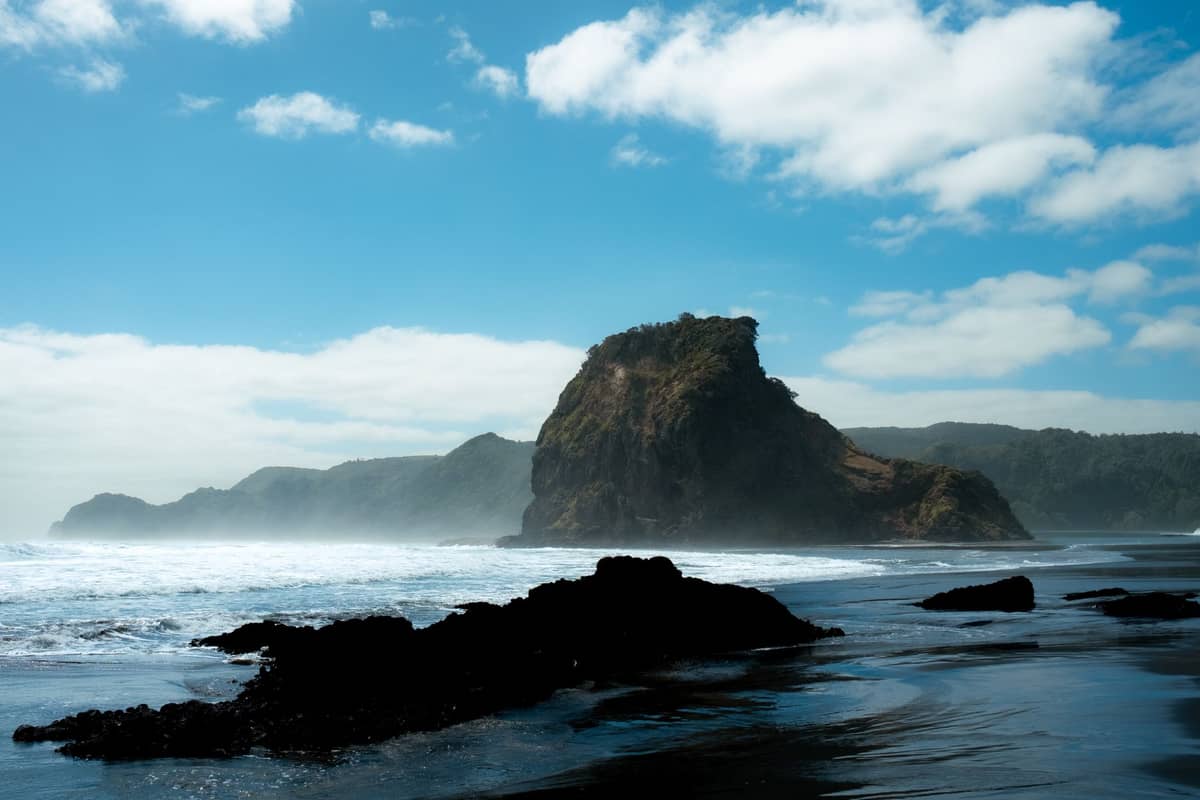
Auckland sits on a narrow isthmus between two harbours, and the contrast between its coastlines is stark. The east-facing beaches along Tāmaki Drive and the Hauraki Gulf are calm, sheltered, and family-friendly. The west coast is the opposite: exposed to the Tasman Sea, the beaches here handle constant swell, carry strong rip currents, and are backed by dense native forest in the Waitākere Ranges.
The black sand itself is the first thing that surprises most visitors. It gets extremely hot in direct summer sun — hot enough to burn bare feet — and it stains towels and light-coloured clothing. Bring old towels and wear footwear to and from the waterline. The black colour comes from the volcanic and ironsand composition of the local geology, the same geological character that defines much of this coastline.
⚠️ What to skip
West coast beaches are not patrolled year-round. Surf Life Saving New Zealand typically operates patrols at Piha and Muriwai on weekends and public holidays during summer (roughly October to April), with daily patrols during peak school holiday periods. Outside these times, there may be no lifeguards present. Always check current patrol status before swimming, and never swim alone.
Piha: The Icon of Auckland's West Coast
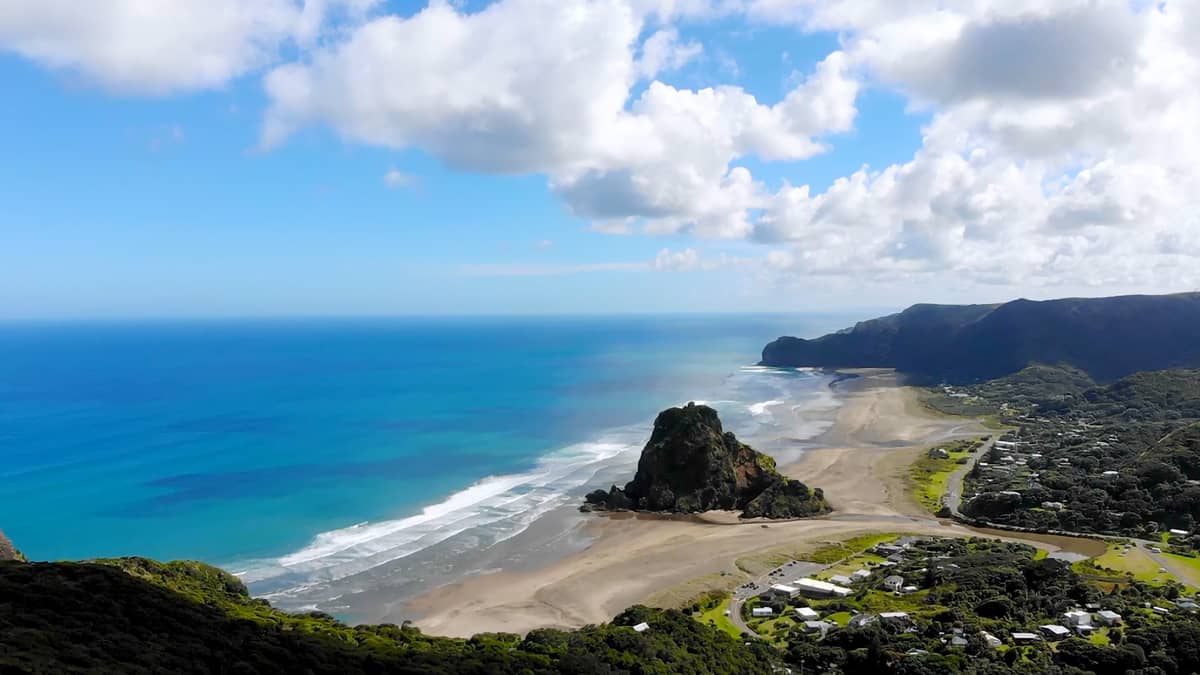
Piha is the beach most Aucklanders mean when they talk about 'going to the west coast'. It sits roughly 45 minutes' drive from central Auckland through the Waitākere Ranges Regional Park, accessed via Scenic Drive and then Piha Road. The route is narrow, winding, and spectacular — dense native bush right to the roadside. Allow extra time on summer weekends when the road slows to a crawl.
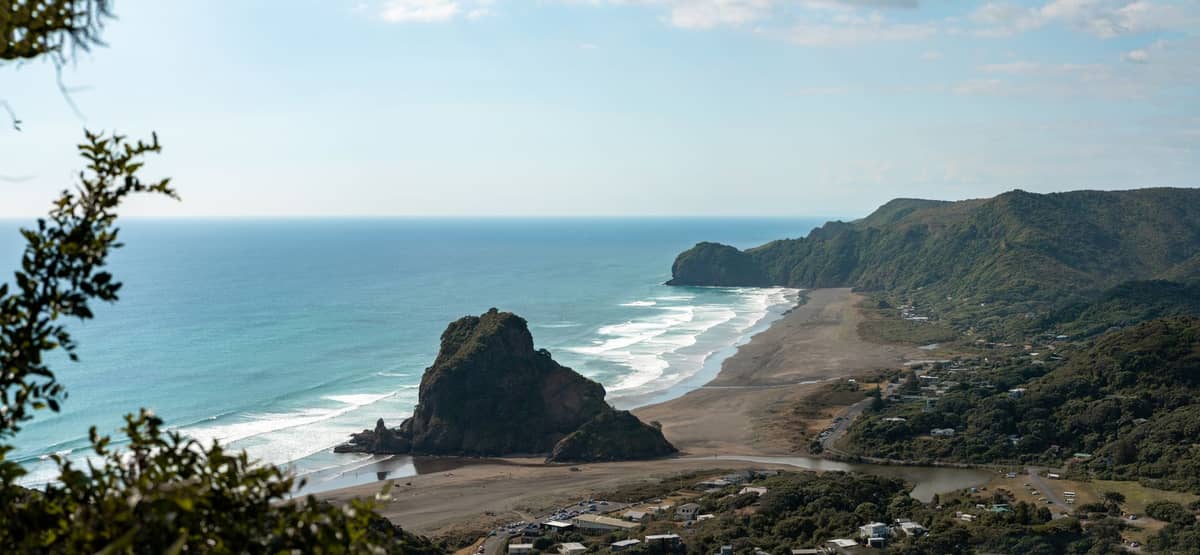
The beach is split into North and South Piha by Lion Rock (Taitomo), a 101-metre basalt outcrop that rises dramatically from the sand. The summit track has been closed since storm damage in 2023; do not attempt to climb it. You can still photograph and walk around the base of the rock from the beach.
South Piha is where the lifeguard patrol operates and where you should swim. North Piha is less patrolled and has more complex rip current patterns. The surf at Piha is legitimate: it attracts experienced surfers from across the region, and the waves can be deceptively powerful even on calmer-looking days. Rip currents are the primary hazard. If you are caught in one, do not try to swim directly back to shore — swim parallel to the beach to exit the rip, then return.
- Best time to visit Piha Weekday mornings in summer (December to February) for lighter crowds. Avoid Saturday afternoons when half of Auckland arrives simultaneously.
- Parking There are car parks at both North and South Piha. They fill quickly on summer weekends — aim to arrive before 10am or after 3pm.
- Food and facilities A small café and a dairy (convenience store) operate near the beach in summer. Outside peak season, options are limited — bring your own food and water.
- Swimming safety Only swim between the flags in the patrolled area on South Piha. The Piha Surf Life Saving Club posts conditions updates during patrol season.
✨ Pro tip
The Kitekite Falls walk starts from Glen Esk Road near Piha and is one of the better short hikes in the Waitākere Ranges. The return trip to the falls takes around 1.5 hours through regenerating bush and crosses the stream several times — wear shoes you don't mind getting wet. It pairs well with a Piha beach visit on the same day.
Muriwai: Gannet Colony, Big Surf, and More Space
Muriwai Regional Park sits north of Piha, accessed via State Highway 16 and then Muriwai Road. The drive from central Auckland takes around 45 to 50 minutes. The beach itself is considerably longer than Piha — stretching for kilometres in either direction — which means it never feels as crowded even during peak season.
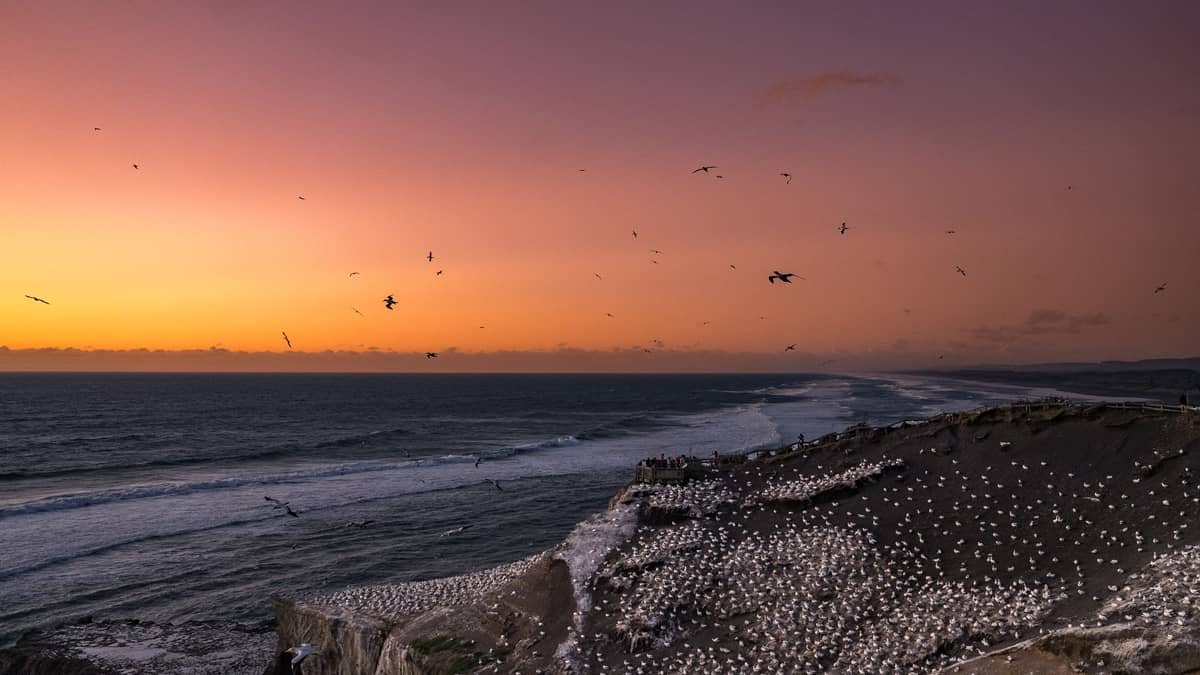
The main attraction that sets Muriwai apart from every other Auckland beach is the Australasian gannet colony at Ōtakamiro Point. Around 1,200 to 1,500 breeding pairs nest here from August through March, and viewing platforms bring you within metres of the nesting birds. Access is via the Maukatia Gannet Track. Importantly, this track has been subject to closures and repair work — the council reopened it in late 2024 after a period of restricted access. Always check the Muriwai gannet colony status on Auckland Council's website before making it the centrepiece of your trip.
Dogs are not permitted on the gannet track. This is a firm rule, not a suggestion — the colony is actively nesting and disturbance rules apply strictly. Vehicle access to the beach itself requires a permit and a roadworthy registered vehicle; you cannot simply drive onto Muriwai Beach without the appropriate documentation.
- Gannet colony access: Maukatia Gannet Track, dogs prohibited, verify track is open before visiting
- Beach driving: requires an Auckland Council beach driving permit and a registered vehicle with a current WOF — not open to all vehicles
- Swimming: lifeguard patrols are seasonal; swim only in the flagged area when patrols are active
- Facilities: café and toilets at the main car park; basic amenities compared to a city beach
- Getting there: drive via SH16 and Muriwai Road; no confirmed regular public bus service directly to the beach
Beyond Piha and Muriwai: Karekare, Bethells, and Whatipu
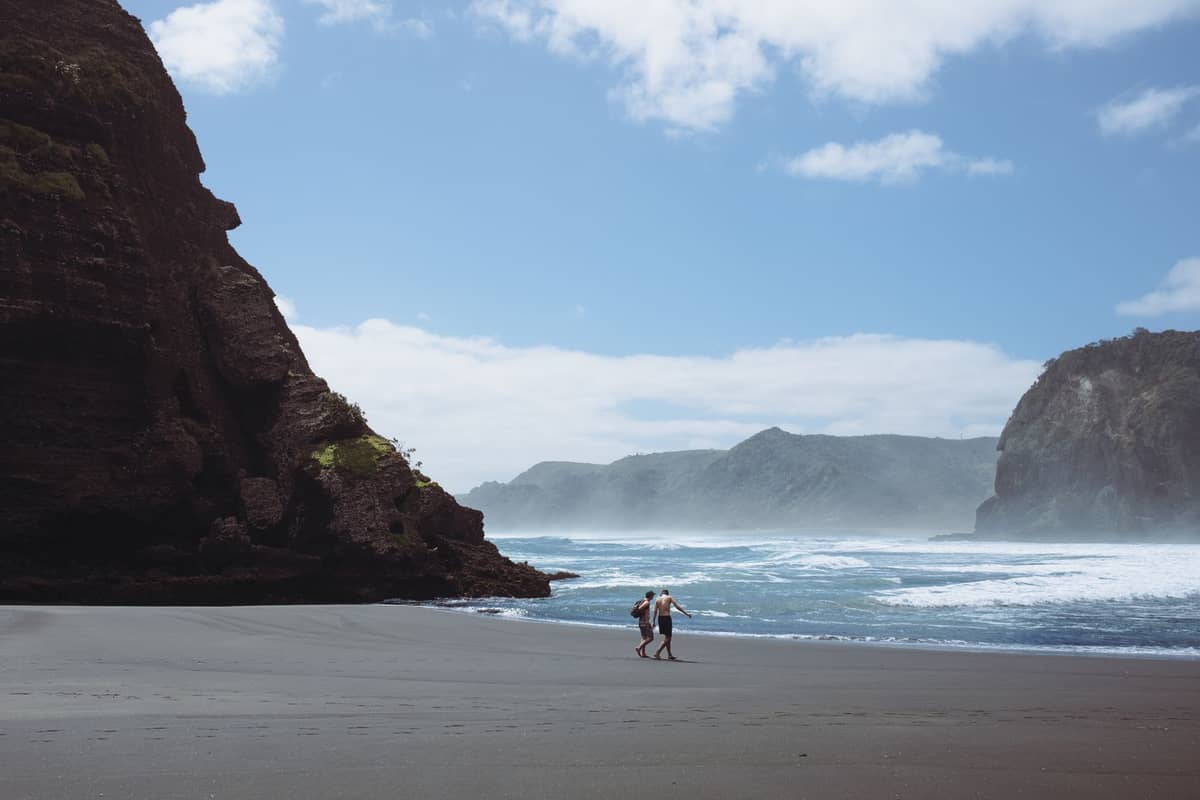
If you want to avoid the crowds that descend on Piha on summer weekends, the west coast has several alternatives. Karekare Beach sits just south of Piha and is reached via a separate road that adds time to the journey. It has no café, no surf school, and far fewer visitors. The setting is striking: a narrow black-sand strip framed by steep bush-covered cliffs. Swimming here is genuinely hazardous and there is typically no lifeguard patrol — treat it as a walk-and-look beach rather than a swim beach unless conditions are clearly safe and you are a confident ocean swimmer.
Bethells Beach (Te Henga) sits to the north between Piha and Muriwai and has a loyal local following. The surrounding dunes are extensive and the lake behind the beach, Lake Wainamu, offers a freshwater swimming option that is considerably safer than the surf. The short walk to the lake takes around 30 minutes. Bethells Beach also has a tea room that operates on weekends — a genuine rarity on this coast.
Whatipu, at the southern end of the Manukau Harbour entrance, is a completely different landscape again: a broad, windswept tidal flat backed by wetlands and caves. Swimming is not the draw here — it is the isolation, the birdlife, and the sense of being genuinely far from the city. The access road is unsealed and can require a vehicle with reasonable clearance after heavy rain.
ℹ️ Good to know
The Waitākere Ranges Regional Park, which covers most of the land behind these west coast beaches, is ecologically significant and contains areas under Kauri Dieback Management controls. Some tracks may require you to clean your footwear at hygiene stations before and after use to prevent the spread of Phytophthora agathidicida (the kauri dieback pathogen). Respect any track closures you encounter — they exist to protect irreplaceable kauri trees.
Getting to Auckland's West Coast Beaches: Practical Logistics
This is where many visitors get caught out: there is no reliable, regular public bus service that takes you directly from central Auckland to Piha or Muriwai. Auckland Transport's network does not cover these beaches in the way it covers suburban destinations. Your realistic options are a rental car, a guided tour, or a rideshare arranged in advance. Taxis from the city centre will be expensive given the distance.
Several tour operators run half-day and full-day west coast beach tours from Auckland, which solve the transport problem and often include commentary on the Waitākere Ranges ecology and Māori history of the area. If you are combining the west coast with broader Auckland sightseeing, check our 3-day Auckland itinerary for how to sequence it efficiently.
- Rental car (recommended) Most flexible option. Piha and Muriwai are around 40-50km from the CBD. A GPS or offline maps are helpful as mobile coverage in the Waitākere Ranges can be patchy.
- Guided tour Half-day tours typically depart morning and return by early afternoon. Full-day tours may combine Piha, Karekare, and sometimes Muriwai in one trip.
- Rideshare Possible but costs will be significant for a return trip. Drivers may be reluctant to do the return journey from Piha, so arrange pickup in advance rather than relying on app availability at the beach.
- Public transport Not a practical option for direct beach access. Verify any planned services with Auckland Transport before relying on this.
When to Go and What to Expect by Season
Summer (December to February) is the obvious choice: daytime temperatures reach 20 to 24°C, lifeguard patrols are active, and the gannet colony at Muriwai is in full breeding activity. The trade-off is crowds, particularly on Auckland Anniversary weekend in late January, which is one of the busiest beach days of the year. For the best time to visit Auckland overall, late November and early March offer good weather with slightly fewer visitors.
Autumn (March to May) is genuinely underrated on the west coast. The surf is often at its most consistent, the crowds thin out sharply after school goes back, and the bush behind the beaches takes on a different quality of light. The gannet colony begins to wind down from late March as birds depart for wintering grounds, so visit before April if that is your priority.
Winter (June to August) is cold, wet, and often stormy on the west coast. That said, the dramatic weather can make for extraordinary photography, and you will have the beaches almost entirely to yourself. There are no lifeguard patrols in winter — do not enter the water. Spring (September to November) sees the gannets return to Muriwai from around August, making early spring a good time to see colony activity before the summer crowds build.
FAQ
Can you swim at Piha Beach?
Yes, but only in the flagged area on South Piha when lifeguards are on patrol, which is typically on weekends and public holidays during summer (October to April), with daily patrols during school holidays. Piha has strong rip currents and is not safe for casual swimming outside patrolled areas or patrolled hours. Check Surf Life Saving NZ's patrol status before you go.
Is there public transport to Piha from Auckland city?
There is no regular direct public bus service between central Auckland and Piha. You need a rental car, a tour, or a rideshare. Some tour operators run half-day trips from the city. Confirm any public transport options with Auckland Transport's journey planner, as services can change.
Is the Muriwai gannet track open?
Track access has changed over time due to maintenance and repair work — it reopened in December 2024, and further upgrade work is ongoing in 2026. Before visiting, check Auckland Council's website or the Auckland Council parks notices for current track status. Dogs are not allowed on the track.
What is the best west coast beach to visit with children?
South Piha during patrolled hours is the safest option on the west coast for families, but even here, young children should stay close to the waterline in shallow water and be supervised constantly. The surf is powerful and rips are present even on calm-looking days. For a genuinely safe swimming experience with kids, the sheltered east coast beaches like Mission Bay or Takapuna are better choices.
How far is Piha from Auckland?
Piha is roughly 45km from central Auckland by road, which translates to around 45 to 60 minutes' drive depending on traffic. The final section via Piha Road through the Waitākere Ranges is narrow and winding. On summer weekends, the road slows considerably — give yourself extra time and aim to arrive before 10am.
Tickets & tours
Live prices and dates from our booking partner. If you book, we may earn a commission at no extra cost to you.
Planning a trip? Discover personalized activities with the Nomado app.