Muriwai Beach: Auckland's Wild West Coast and Gannet Colony
Muriwai Beach is a rugged stretch of black volcanic sand on Auckland's west coast, backed by high dunes and home to one of the world's most accessible Australasian gannet colonies. It is about 45 minutes from central Auckland and best experienced in the morning before coastal winds pick up.
Quick Facts
- Location
- 458 Motutara Road, Muriwai, Auckland region (approx. 45 min drive from central Auckland)
- Getting There
- Private car recommended: take SH16 toward Helensville, then Muriwai Road to the beach car park. No direct rail service.
- Time Needed
- 2–4 hours for beach walk, gannet colony viewing, and dunes. Allow a full half-day if you plan to hike or surf.
- Cost
- Free beach entry. A beach-driving permit is required only for permitted exceptional access; check Auckland Council’s current rules before applying.
- Best for
- Wildlife enthusiasts, surfers, photographers, and anyone wanting a dramatic landscape escape from the city
What Muriwai Beach Actually Is
Muriwai Beach is not a postcard beach. The sand is dark grey-black, the surf is powerful and often unpredictable, and the wind can cut through in any season. That is precisely the point. This long stretch of coast, part of Muriwai Regional Park, sits on Auckland's west coast facing the Tasman Sea. Its Māori name, Muriwai, is reported to mean something close to 'water's end' or 'backwater,' while its traditional name, Te One Rangatira, translates as 'the Chiefly Beach.' Both names reflect the reverence this coastline holds in local history.
The beach stretches from Maukatia northward, backed by tall sand dunes and flanked at its northern end by a headland where one of New Zealand's most remarkable wildlife spectacles plays out year-round. For a city of 1.6 million people, having a functioning, free-entry regional park of this scale and wildness within a single tank of petrol is genuinely unusual.
The Gannet Colony: A Close Encounter with 1,200 Birds
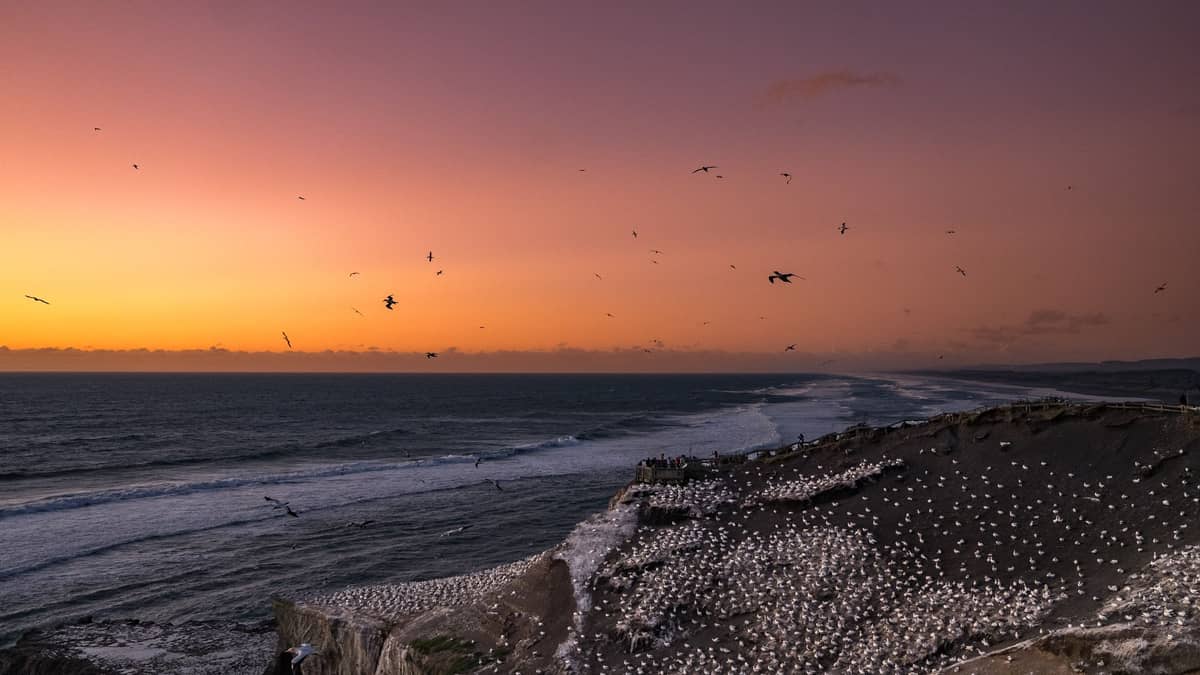
The Australasian gannet colony at Ōtakamiro Point is one of New Zealand's few mainland nesting sites, and it is the primary reason many visitors make the drive. The colony occupies the rocky Otakamiro Point headland, and viewing platforms bring you within a few metres of nesting pairs. At close range, gannets are surprisingly large, with a wingspan that can exceed 1.8 metres. The collective noise of the colony, a constant low roar of calls, wingbeats, and the sharp crack of beaks during greeting rituals, carries on the wind before you even see the birds.
Gannets are present at Muriwai throughout the year, but activity peaks from August through March. From around August, birds return to claim nesting spots. Eggs hatch from October onward, and by late summer (February to March) the cliff edges are crowded with large, downy chicks and attentive adults. The colony disperses somewhat during autumn and winter but does not disappear entirely. If you visit outside the peak season, you will see fewer birds but often have the platforms to yourself.
💡 Local tip
Arrive at the gannet platforms before 10am. Morning light falls directly onto the headland, improving both the viewing experience and photography. By midday, harsh overhead light and increasing visitor numbers make for less rewarding conditions.
The viewing platforms are reached from the Maukatia car park by a short walk to Ōtakamiro Point. Check current access conditions before visiting if mobility is a concern.
For context on other wildlife-rich coastal areas in the region, the Tiritiri Matangi Island sanctuary in the Hauraki Gulf offers a different but equally rewarding wildlife experience, and Goat Island Marine Reserve is Auckland's top destination for snorkelling with marine life.
Tickets & tours
Live prices and dates from our booking partner. If you book, we may earn a commission at no extra cost to you.
Muriwai Beach and Gannet Eco Tour with Wine Tasting
From 351 €Instant confirmationFree cancellationLuggage Storage in Auckland
From 5 €Instant confirmationFree cancellationNew Zealand West Coast discovery tour
From 100 €Instant confirmationFree cancellation13,000ft skydiving experience in Auckland
From 195 €Instant confirmationFree cancellation
The Beach Itself: Dunes, Surf, and Scale
Walk south from the main car park and the beach opens into something that feels almost cinematic. The black sand compacts firmly at the waterline, making it easy to walk, but inland from the surf zone the sand becomes loose and wind-sculpted into low ridges. The dunes behind the beach rise sharply in places, stabilised by marram grass and native spinifex, and block the wind enough to make sheltered sitting spots on calm days.
The surf at Muriwai is strong, consistent, and respected by Auckland's surf community. It is a recognised surf location with lifeguard patrols during summer months, operating between designated flags. Swim only between the flags. The rips along this stretch of coast are powerful and not obvious to unfamiliar eyes. If you are not a confident open-water swimmer, treat Muriwai as a beach to walk and watch, not to swim.
⚠️ What to skip
Muriwai's surf is not suitable for casual swimming. Rip currents are common and can be difficult to spot. Swim only in flagged areas when lifeguards are on patrol, or stay out of the water.
The scale of the beach means you can walk for 30 minutes in either direction from the main access point and see almost no one, even on a moderately busy weekend. The light shifts quickly here. Morning visits in summer offer long, low-angle light across the wet sand with mist sometimes sitting in the dunes. By afternoon the wind typically strengthens from the northwest, and the beach can feel exposed and cold regardless of air temperature.
How the Experience Changes Through the Day
Early morning, roughly 7am to 9am, is the most rewarding time at Muriwai. The car park is near-empty, the gannets are active on the headland, and the quality of light on the black sand and dark cliffs is excellent for photography. Local surfers are in the water early, and watching the surf from the headland while the colony noise drifts across from Otakamiro Point is a genuine sensory experience that is hard to replicate later in the day.
Midday brings families, day-trippers from Auckland, and the strongest winds. The gannet platforms get crowded between about 11am and 2pm during weekends in summer. If you arrive at this time, you will still see the birds clearly, but the atmosphere is more visitor-centre than wilderness encounter. Weekend afternoons in summer also mean the surf breaks are busy with experienced surfers, so the water has its own energy if you enjoy watching.
Late afternoon light returning from the west can be spectacular in autumn (March to May), when the sky behind the headland turns amber and the gannet colony silhouettes against it. This is arguably the best photography window of the day, but it is also the coldest part of the afternoon, especially if cloud moves in. Bring a wind layer regardless of the season.
Practical Guide: Getting There and Planning Your Visit
Muriwai is about 45 minutes by car from central Auckland via State Highway 16. Take SH16 northwest toward Helensville, turn onto Muriwai Road, and follow signs to the beach car park. Organised tours are another way to visit.
If you are combining Muriwai with other west coast destinations, the region's other beaches and the dramatic Waitākere Ranges are all within range for a day trip. The Auckland west coast beaches guide gives a solid overview of what is accessible in a single day's drive, including Piha Beach and Karekare to the south.
A third-party source reports park gates are open 6am to 9pm in summer and 6am to 7:30pm in winter, but this is not confirmed through Auckland Council's official page. Verify locally or call Auckland Council before planning an early-morning or late-evening visit. There is no entry fee to the beach or gannet viewing area. A beach-driving permit is required only for exceptional permitted access, and the permit is free; check Auckland Council’s current rules before applying.
Facilities in the park include toilets; Sand Dunz Beach Cafe is nearby. Check directly for current opening hours before relying on it. The nearest town with reliable food and fuel options is Waimauku, roughly 10 km back toward Auckland on Muriwai Road.
ℹ️ Good to know
Weather on the west coast changes fast. Muriwai can be warm and clear in central Auckland while foggy and cold at the beach, separated by about a 45-minute drive. Check a coastal forecast, not just a city forecast, before heading out.
Hiking and Beyond the Beach
Muriwai Regional Park contains walking tracks beyond the gannet colony circuit. A network of paths climbs through the dunes and coastal bush north of the car park, with views back across the beach and out to sea. These are not heavily signposted, so download the Auckland Council park map before arriving. For more substantial walking in the wider area, the Waitākere Ranges Regional Park to the south contains a much larger trail network, including walks to Kitekite Falls and along the ridge above Piha.
The dunes themselves reward exploration on a calm day. The sand structure changes constantly with coastal wind, and the contrast between the exposed seaward faces and the sheltered, vegetated inland slopes is striking. In some seasons, the dunes support hardy coastal plants that bind the sand and attract small birds. Sturdy footwear is worth wearing if you plan to leave the main paths.
Who Muriwai Is Not For
Visitors expecting a sheltered, calm swimming beach with clear blue water will be disappointed. This is a West Coast beach in New Zealand: the water is cold year-round, the surf is powerful, and there is no reef or headland to tame it. If your priority is swimming or relaxed sunbathing in warm, calm conditions, beaches closer to the city, such as Mission Bay or Takapuna, are better suited.
Muriwai is also not ideal if you are relying entirely on public transport, are visiting only for a quick stop, or expect comprehensive on-site facilities. The café is not reliably open, the roads require a car, and the full experience rewards at least two to three hours rather than a passing visit.
Insider Tips
- Arrive before 9am to have the gannet platforms largely to yourself and to catch the best morning light on the headland.
- Bring a wind-resistant layer even in summer. The beach can be 5 to 8 degrees cooler than central Auckland, and the northwest wind at midday has a sharp edge.
- If you plan to photograph gannets, If you plan to photograph gannets, use the viewing platforms and follow any on-site access guidance for the best available views.
- The black sand heats up quickly on sunny days and can burn bare feet by late morning. Footwear is worth keeping on until you reach the water's edge.
- On weekdays outside school holidays, Muriwai sees a fraction of the weekend crowds. A Tuesday or Wednesday visit in February delivers a near-solitary experience at a beach that draws thousands on Saturdays.
Who Is Muriwai Beach For?
- Wildlife watchers who want close, unmediated access to a large seabird colony without a boat trip
- Surfers and surf-watchers drawn to a consistent west coast break with a strong local surf culture
- Photographers looking for dramatic coastal light, black sand contrasts, and bird behaviour
- Hikers and walkers wanting dune and coastal bush terrain beyond a standard beach walk
- Travellers on a tight budget who want a full half-day experience outside the city at effectively no cost
Nearby Attractions
Combine your visit with:
- Auckland Botanic Gardens
Spread across 64 hectares in Manurewa, the Auckland Botanic Gardens offer free entry every day of the year, with themed garden collections, 10 hectares of native forest, and a visitor centre on site. It sits south of the city centre and rewards a longer visit than most people initially plan for.
- Auckland Zoo
Auckland Zoo has been part of the city's fabric since 1922, sitting in the Western Springs precinct with a collection that spans native New Zealand wildlife and international species. This guide covers everything from ticket prices and transit options to the best time of day to arrive and which exhibits deliver the most.
- Bastion Point (Takaparawhau)
Takaparawhau, known widely as Bastion Point, is a grassy headland in Ōrākei where Māori history, colonial conflict, and sweeping Waitematā Harbour views converge. It costs nothing to visit, carries centuries of significance, and rewards visitors who take time to understand what they are standing on.
- Bethells Beach (Te Henga)
Bethells Beach, officially Te Henga (Bethells Beach), is a raw, dramatic stretch of black-sand coastline about 45 minutes west of central Auckland. With rolling dunes, a freshwater lagoon, strong surf, and zero phone coverage, it delivers a genuine wilderness experience rare for a city of 1.6 million people.
Planning a trip? Discover personalized activities with the Nomado app.