Mid-Levels Escalator: Hong Kong's Commuter Landmark Worth Exploring on Foot
The Central-Mid-Levels Escalator is a 800-metre covered moving walkway system that climbs from Central up through SoHo and the Mid-Levels. It doubles as a commuter lifeline and an accidental sightseeing route through some of Hong Kong's most characterful streets.
Quick Facts
- Location
- Central to Mid-Levels, Hong Kong Island
- Getting There
- MTR Central Station (Exit G or D1) or Sheung Wan Station (Exit B)
- Time Needed
- 30–90 minutes depending on stops
- Cost
- Free
- Best for
- Urban explorers, food lovers, architecture enthusiasts
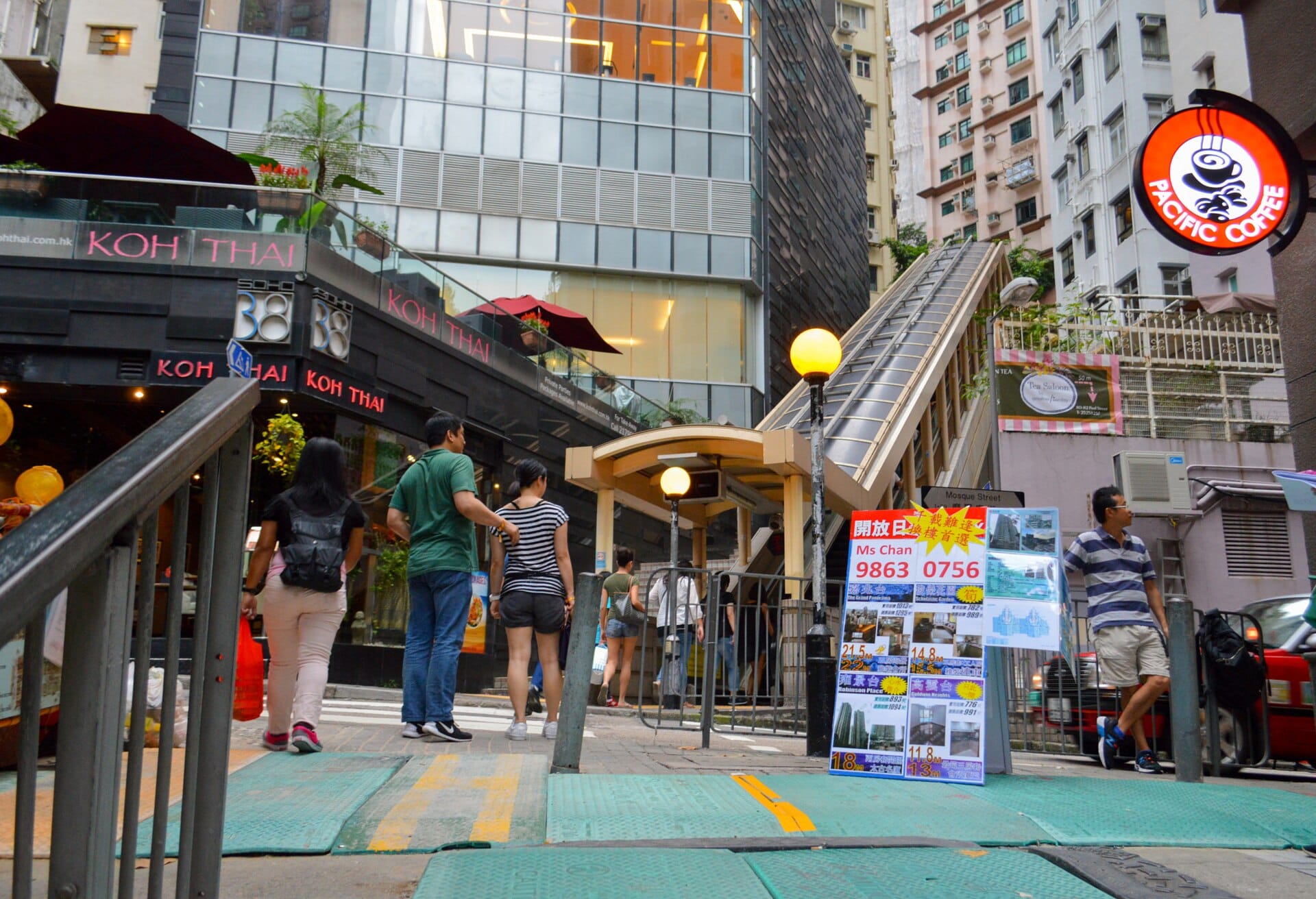
What the Mid-Levels Escalator Actually Is
The Central-Mid-Levels Escalator is the longest outdoor covered escalator system in the world, stretching approximately 800 metres in horizontal distance and climbing around 135 metres in vertical elevation. It is not a single escalator but a series of 18 escalators and 3 moving walkways linked together, running through a covered canopy along a corridor of streets from Central up to Conduit Road in the Mid-Levels.
Opened in 1993, it was built to ease traffic congestion by encouraging residents of the Mid-Levels to commute downhill to work without a car. The system was designed by the Hong Kong government as functional infrastructure, not a tourist attraction. That it became one is a side effect of where it goes: straight through the layered, densely packed streets that give Hong Kong Island its distinctive vertical character.
ℹ️ Good to know
Direction matters: the escalator runs downhill (toward Central) from 6:00am to 10:00am, then reverses to run uphill until midnight. If you arrive at the base expecting to ride up before 10am, you will be walking against the flow.
The Ride Up: What You Pass and What You Notice
The lower entry point sits on Queen's Road Central, close to the junction with Cochrane Street. From street level, the system feels underwhelming: a grey canopy, a moving rubber belt, and the smell of the city. But the experience changes as the elevation increases. Within the first three minutes you are already level with second-floor shopfronts, looking directly into the windows of dim sum restaurants and small offices in a way that feels slightly intrusive and completely fascinating.
At Hollywood Road, the escalator crosses one of Hong Kong Island's most historically significant streets. This is the territory where antique dealers, Taoist temples, and contemporary art galleries occupy adjacent shophouses. The smell shifts here, especially on mornings when incense drifts out from nearby doorways. If you step off and walk east along Hollywood Road, you will reach the Man Mo Temple within a few minutes.
Continuing upward, the system passes through SoHo (short for South of Hollywood Road), which is packed with international restaurants, wine bars, and independent cafés at street level. This stretch is the most photographed section of the escalator, partly because the streets here are narrow and the canopy frames the surrounding architecture tightly. For the full context of the neighbourhood, the Sheung Wan side streets to the west are equally worth diverting into before or after you ride.
Higher still, the residential character intensifies. The streets become quieter, the buildings older and more worn. Laundry hangs from bamboo poles, small convenience stores sell to the same customers every day, and the density of tourist foot traffic drops noticeably. This upper section, between Caine Road and Conduit Road, gives the most honest picture of what the escalator was built for: moving people through a real neighbourhood, not staging one for visitors.
Tickets & tours
Live prices and dates from our booking partner. If you book, we may earn a commission at no extra cost to you.
Hong Kong audio guide with TravelMate app
From 8 €Instant confirmationHong Kong Tour with Peak Tram, harbour cruise and dim sum dinner
From 85 €Instant confirmationFree cancellationHong Kong night tour with Peak Tram and Symphony of Lights
From 63 €Instant confirmationFree cancellationLantau Cable Car and Big Buddha Guided Tour with Lunch in Hong Kong
From 85 €Instant confirmationFree cancellation
Time of Day: How the Experience Shifts
Before 10:00am, the escalator runs downhill, which means residents and office workers are streaming toward Central while visitors who want to ride up must walk. This is actually worth doing deliberately: walking up the stationary escalator steps in the early morning lets you move at your own pace, pause at intersections, and observe the commute without being part of it. The streets smell of fresh tofu, frying oil, and mild traffic exhaust. Hawkers who set up near Cochrane Street in the mornings are gone by midday.
Midday is the least interesting time. The escalator is operational upward, but the SoHo restaurants are mid-service, the streets are crowded with delivery workers, and the light in the narrow stairwell streets is flat. If your only goal is to ride the system for its own sake, midday is fine. If you want to combine it with exploration, skip the lunch rush.
Late afternoon, roughly 4:00pm to 7:00pm, is the most rewarding window. The light drops below the building line and catches the facades at a low angle. SoHo begins its evening transition: bar staff arrange outdoor seating, the smell of garlic and char from restaurant kitchens fills the covered sections, and the foot traffic is a mix of residents heading home and early diners heading out. This is also the best window for photography along the middle sections.
💡 Local tip
For photography: position yourself on one of the pedestrian footbridges that cross perpendicular to the escalator corridor. From there you can frame the moving walkway against the layered street life on either side without being carried along by it.
What to Do Along the Route
The escalator is best treated as a spine, not a destination. The value is in the streets that branch off it. At the Hollywood Road level, step off and walk five minutes west to reach the Man Mo Temple, one of the oldest temples on Hong Kong Island, dedicated to the gods of literature and war. The interior is always heavy with coil incense, and the contrast between the ornate interior and the busy street outside is stark.
At the Staunton Street and Elgin Street level, you are in the heart of SoHo's bar and restaurant corridor. For food options across the city's diverse culinary landscape, the Hong Kong travel guide covers the broader neighbourhood context. If you are visiting for an evening meal, this stretch offers everything from Sichuan hotpot to Portuguese egg tarts within a few hundred metres.
Shelley Street, which runs parallel to the escalator on the eastern side, is worth walking for its cluster of independent boutiques and smaller wine bars that avoid the weekend tourist foot traffic that concentrates on Elgin Street. It is also the more photogenic of the two parallel streets, thanks to the coloured shophouse facades.
At the base of the escalator near Central, Hong Kong Park is a short walk east and makes a logical pairing for the same morning, especially if you want green space after the urban density of the escalator corridor.
Practical Information: Getting There and Moving Around
The base of the escalator system is accessible from MTR Central Station, Exit G or D1, via a short walk up Cochrane Street or Des Voeux Road. From Sheung Wan MTR Station, Exit B leads to a five-minute walk through the market streets of the neighbourhood before you reach the Hollywood Road crossing point, which is effectively a mid-point entry. There is no single ticket gate or checkpoint; you simply step on or off at any of the numerous street-level access points.
The system is covered but not air-conditioned. In Hong Kong's summer months (June through September), the humidity under the canopy can be significant, especially in the slower upper sections where air circulation decreases. Wear light, breathable clothing and carry water. The escalator itself has no seating and no shelter beyond the canopy, so if it rains heavily the side-spray can reach you in exposed sections.
⚠️ What to skip
The escalator is not wheelchair accessible throughout its entire length. While some sections connect to street-level ramps, the full route involves steps at multiple access and exit points. Visitors with mobility limitations should check specific sections before planning the full route.
The top terminus at Conduit Road is served by several bus routes that can return you to Central or take you further into the residential Mid-Levels. Walking back down via the parallel staircase streets such as Peel Street takes roughly 20 to 30 minutes and is a reasonable option in cooler weather, giving you a downhill perspective on the same neighbourhood.
Honest Assessment: Who This Is For and Who Should Skip It
The Mid-Levels Escalator is a functional piece of infrastructure that happens to pass through interesting places. If you treat it as a standalone attraction expecting a spectacular view or an immersive experience, it will disappoint. The ride itself is slow, partially obscured by the canopy, and the views are fragmented. It is not a panoramic experience.
Where it earns its place on an itinerary is as a framework for urban exploration. Travellers who enjoy walking neighbourhoods, observing daily city life, and finding food and drink by wandering will get genuine value from it. If you are focused on Hong Kong's big-ticket sights and have limited time, the escalator probably should not compete with the Victoria Peak or the Star Ferry for a half-day slot.
Visitors who dislike heat, crowds, or slow-paced urban walks will find the escalator underwhelming, particularly during summer weekends when the SoHo sections become congested and the covered canopy traps warm air. It is also not the right choice if you are travelling with young children who need engagement beyond streetscapes.
For context on whether this fits your broader Hong Kong trip, the guide on whether Hong Kong is worth visiting covers how to calibrate expectations for the city's urban attractions generally.
Insider Tips
- Ride up in the evening around 6:30pm and step off at Elgin Street. Walk one block west to Staunton Street, where the bar density is high and the tourist pressure is noticeably lower than on the main strip.
- The section between Mosque Street and Shelley Street has a small public seating ledge on the left side. It is one of the few places on the route to pause, sit at elevation, and watch the street below without being moved along.
- If you want the escalator nearly to yourself, try a weekday morning just after 10:00am when the direction switches uphill. Commuters have already descended and the tourist wave has not yet arrived.
- The escalator corridor runs roughly southwest to northeast. Morning light falls on the western facades of the cross-streets, making the left side (west-facing) better for photography in the first half of the day and the right side better in late afternoon.
- Step off at Hollywood Road and walk two minutes east to the stretch between Peel Street and Lyndhurst Terrace. The shophouse density here is some of the most intact on Hong Kong Island and often overlooked by visitors who stay on the escalator route.
Who Is Mid-levels Escalator For?
- Urban walkers who want to explore a neighbourhood rather than just pass through it
- Food and drink travellers using SoHo as a base for evening dining
- Architecture and street photography enthusiasts interested in Hong Kong's vertical city form
- Travellers with a half-day in Central looking for a free, unhurried activity
- Anyone curious about how a city solves the problem of extreme topography
Nearby Attractions
Other things to see while in Central:
- Hong Kong Park
Hong Kong Park covers eight hectares on the Mid-Levels slope where waterfalls, a walk-through aviary, and terraced gardens occupy former British military barracks. The Edward Youde Aviary houses 90 bird species, Flagstaff House Museum displays Chinese tea ware, and elevated walkways provide skyline views filtered through greenery.
- Peak Tram
Peak Tram rises to 396 meters above sea level from Central to Victoria Peak via a funicular railway operating since 1888. The steep gradient creates dramatic views as the tram ascends through Mid-Levels. However, queues often exceed 90 minutes at peak times, and buses offer faster, cheaper alternatives with comparable scenery.
- IFC Mall
IFC Mall occupies four floors beneath the International Finance Centre towers in Central where 200+ shops sell luxury brands, electronics, and international fashion. Connected directly to Hong Kong Station and the Airport Express, the mall serves business travelers and Hong Kong's upper-income shoppers. Architecture is modern and air-conditioned, atmosphere is polished and expensive.
- Star Ferry
For less than the price of a coffee, the Star Ferry carries you across Victoria Harbour on a route that has run continuously since 1888. The views of Hong Kong Island's skyline from the Kowloon side are among the most photographed in Asia, but the ferry itself, with its wooden benches and swinging chains, is worth the trip on its own terms.
- Victoria Peak
At 552 metres above sea level, Victoria Peak offers one of the most recognisable urban skylines on earth. But the experience varies enormously depending on when you go, how you get there, and how far you walk once you're at the top.
Planning a trip? Discover personalized activities with the Nomado app.