Victoria Peak: What the View Is Really Like (And When to Go)
At 552 metres above sea level, Victoria Peak offers one of the most recognisable urban skylines on earth. But the experience varies enormously depending on when you go, how you get there, and how far you walk once you're at the top.
Quick Facts
- Location
- The Peak, Hong Kong Island, above Central
- Getting There
- Peak Tram from Garden Road Terminal (Central), or Bus 15 from Central Exchange Square
- Time Needed
- 2–4 hours (tram + viewing + loop walk)
- Cost
- Peak Tram return ticket required; Sky Terrace 428 observation deck charges a separate admission fee. The Peak Galleria and outdoor viewing platform are free.
- Best for
- First-time visitors, photographers, hikers, families with older children
What Victoria Peak Actually Is
Victoria Peak, commonly called simply 'The Peak', is the highest point on Hong Kong Island, rising 552 metres above the harbour. It is one of the most visited attractions in Asia, which is both its appeal and its biggest challenge. The panorama of skyscrapers stacked between mountain and water is genuinely extraordinary; the crowds at the main viewing terrace on a Saturday afternoon are equally extraordinary, and not in a good way.
The centrepiece for most visitors is the Peak Tower, a wok-shaped structure designed by British architect Terry Farrell, completed in 1997. Inside is the Sky Terrace 428 observation deck, named for its elevation of 428 metres above sea level. Alongside it sits the Peak Galleria mall, a free outdoor viewing platform, and the upper terminus of the Peak Tram. Understanding how these pieces fit together before you arrive saves considerable confusion on the ground.
ℹ️ Good to know
The Sky Terrace 428 observation deck charges a separate admission fee on top of your tram ticket. The outdoor terrace at the Peak Galleria is free and offers a comparable ground-level view of the skyline, it's less elevated but far less crowded.
The View: What You'll Actually See
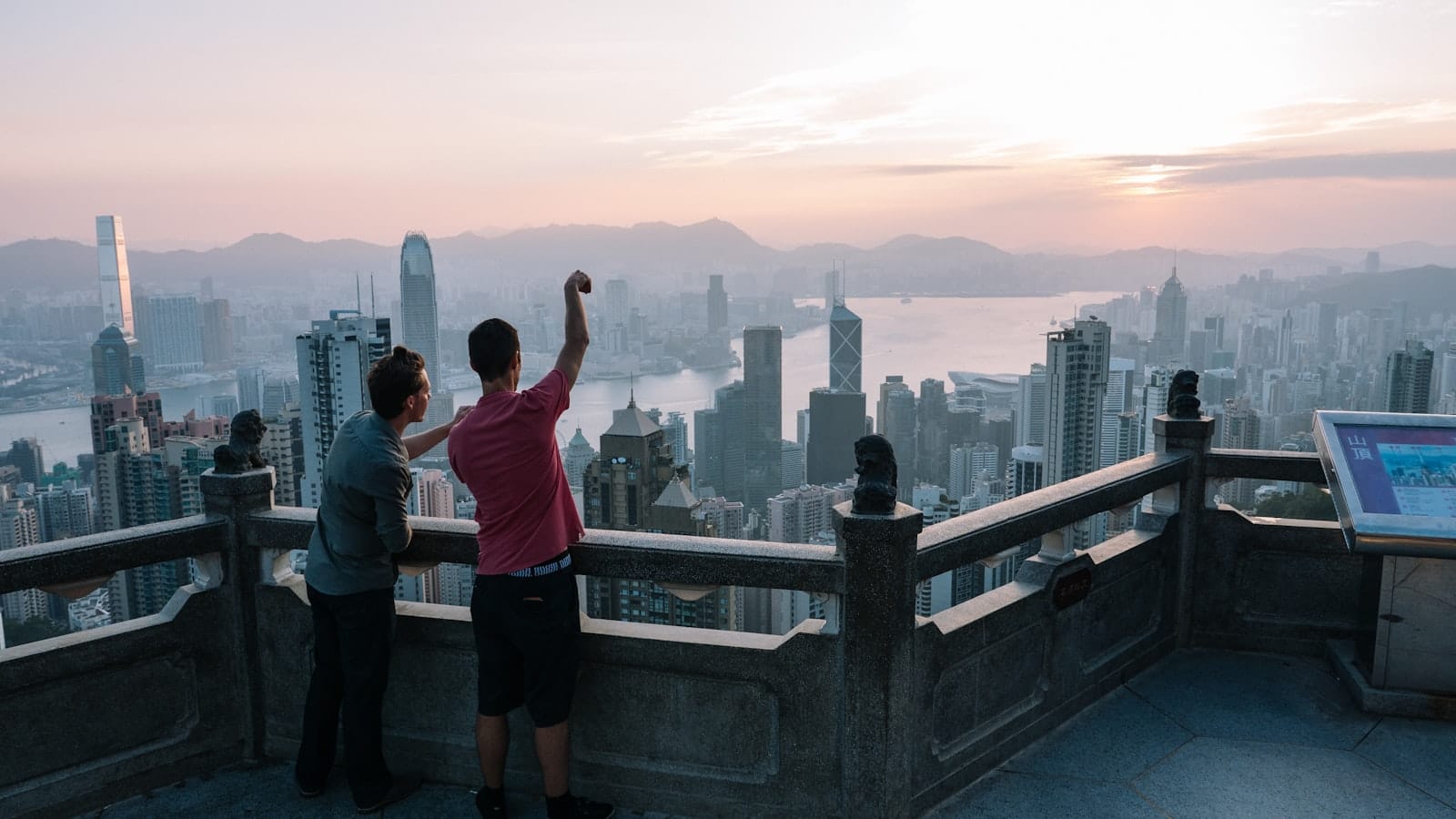
On a clear day, the view from the Peak is a genuine spectacle. The full arc sweeps from Lamma Island in the southwest, across the dense vertical mass of the Central and Wan Chai skyline, over Victoria Harbour, and into the Kowloon Peninsula and beyond. The density of it, skyscrapers in the foreground, container ships on the harbour, mountainous islands in the distance, compresses geography in a way that photographs never quite reproduce.
Hong Kong's air quality directly affects the experience. On hazy days, which are common from November through February and especially in winter when northerly winds carry pollution from the Pearl River Delta, the skyline disappears into a grey wash. Summer afternoons frequently bring low cloud that blankets the Peak entirely. Clear days tend to cluster in autumn (October to early December), when humidity drops and northerly winds scour the sky clean. Even then, mornings can be misty while afternoons clear, check the Hong Kong Observatory's visibility report before you commit to the trip.
⚠️ What to skip
Hong Kong's Peak is frequently shrouded in low cloud, especially in summer and on humid days. A cloud-covered visit means no view at all. Check visibility conditions at the Hong Kong Observatory website (www.hko.gov.hk) before heading up.
Tickets & tours
Live prices and dates from our booking partner. If you book, we may earn a commission at no extra cost to you.
Hong Kong Tour with Peak Tram, harbour cruise and dim sum dinner
From 85 €Instant confirmationFree cancellationHong Kong night tour with Peak Tram and Symphony of Lights
From 63 €Instant confirmationFree cancellationHong Kong Island Orientation with Peak Tram Ride
From 79 €Instant confirmationFree cancellationHong Kong audio guide with TravelMate app
From 8 €Instant confirmation
Morning, Afternoon, or Night: When the Visit Changes Most
Early morning, before 9am, is the most underrated time to visit. The tram queues are manageable, the air is often at its clearest, and the Peak itself has a quieter, greener character. Joggers complete the circular loop walk; the smell of damp vegetation and mist mingles with cool air. It feels less like a tourist attraction and more like a mountain overlooking a city.
Midday on weekends is the low point. Tram queues routinely stretch past 45 minutes, the viewing platforms are shoulder-to-shoulder, and the Peak Tower's interior, where Madame Tussauds and several restaurants are located, functions more like a shopping centre than a viewpoint. If this is when you arrive, take Bus 15 instead of the tram, walk directly to the Lugard Road Lookout (about 10 minutes from the tram terminus on foot), and skip the Sky Terrace entirely.
Night visits are popular for the illuminated skyline, and with reason, the harbour glitters, the IFC tower blinks its LED crown, and the city's density reads more dramatically in contrast with the dark mountain behind. Arrive around sunset and stay for the transition. The tram runs until midnight, so there is no reason to rush down.
For a broader view of Hong Kong's geography at night, pair the Peak with a walk along the Tsim Sha Tsui Promenade the following day, the two viewpoints complement each other across the harbour.
Getting Up: Peak Tram vs. Bus 15
The Peak Tram is the iconic way up, a funicular railway that has operated since 1888, climbing gradients steep enough to make your sense of vertical genuinely tilt. The cars are dramatically raked, so passengers appear to lean backward at impossible angles against the city behind them. It is a short ride (about 8 minutes) but a memorable one. The lower terminus is on Garden Road in Central, a short walk from St. John's Cathedral and Hong Kong Park.
The tram was refurbished and relaunched in 2022 with new wider cars. Tickets must now be purchased in advance online or at the terminal; cash purchase is still possible but adds wait time. If you are already exploring Hong Kong Park nearby, the Garden Road tram terminus is about a 5-minute walk through the park's eastern exit.
Bus 15 from Exchange Square is the locals' alternative. It is slower (about 30–40 minutes with traffic), but it terminates right at the Peak Bus Terminus adjacent to the Peak Tower, bypasses any tram queue, and offers elevated road-level views on the way up through residential Mid-Levels. It costs a fraction of the tram fare. On busy weekend afternoons, this is not a compromise, it is the smarter choice.
💡 Local tip
If you want the tram experience in both directions, book a return ticket online in advance. If the queue at the top looks long on the return, Bus 15 (or the green minibus 1) can get you back down without waiting.
The Peak Circle Walk: What Most Visitors Skip
The single best thing to do at the Peak costs nothing and takes about 45 minutes: the Peak Circle Walk. Lugard Road and Harlech Road form a mostly flat 3.2-kilometre loop around the Peak, offering views in multiple directions that the Sky Terrace, which faces primarily south toward the harbour, cannot match. The north-facing Lugard Road Lookout is the best single viewpoint on the mountain, giving the full Hong Kong Island skyline framed between tree cover.
The path is paved and well-maintained, accessible to most fitness levels. Shade is consistent along the route, which matters on hot days. On the south side of the loop, the view opens to Aberdeen, Lamma Island, and the South China Sea, a completely different perspective from the harbour panorama, and nearly always empty of crowds. Wear comfortable shoes; the surface is smooth but uneven in places.
If you want a longer hike, the Peak connects to several of Hong Kong's mountain trails. The area around The Peak is part of the wider Hong Kong Trail system. For travellers keen to explore beyond the city's vertical skyline, there is far more to Hong Kong's outdoors than most short itineraries suggest.
Practical Details: Accessibility, Photography, and Crowds
Photography at the Peak rewards patience more than equipment. The most reproduced shot, the harbour skyline from the Sky Terrace, is taken through glass panels that pick up reflections during daylight. Night photography through the same panels is more effective. The Lugard Road Lookout is fully open-air and far better for photography at any hour, with no glass between you and the city.
Accessibility: the Peak Tram and Peak Tower are wheelchair accessible. The Sky Terrace has lift access. The Peak Circle Walk has some surface irregularities but is generally manageable. The summit of Victoria Peak itself (552m) requires a steeper trail beyond the circle walk and is not accessible to all.
The Peak sits above the Central district, making it easy to combine with a morning in the financial quarter, a visit to Man Mo Temple in Sheung Wan, or an afternoon along the waterfront before heading up for the evening skyline.
Who This Attraction Is Not For
Return visitors to Hong Kong who have already done the Peak once rarely find it worth repeating, unless conditions align for a perfectly clear day or they are taking guests. The commercial interior of the Peak Tower. Madame Tussauds, souvenir shops, chain restaurants, holds no interest for travellers seeking authentic local experience. If you are on a tight itinerary and the visibility forecast is poor, consider skipping the observation deck entirely and using the time to explore Sheung Wan or cross the harbour to Kowloon instead.
Budget travellers should also note that the tram plus Sky Terrace admission adds up quickly. The free outdoor viewing platform at Peak Galleria and the free Lugard Road Lookout offer strong value alternatives. For broader context on managing costs across a Hong Kong trip, see how expensive Hong Kong actually is for visitors.
Insider Tips
- Skip the Sky Terrace on weekday mornings and walk directly to the Lugard Road Lookout instead, it's free, open-air, and almost always quieter than the paid deck.
- Bus 15 from Central Exchange Square is the fastest route on busy weekend afternoons, bypassing the tram queue entirely. It drops you right at the Peak Tower entrance.
- If you go at night, position yourself on the left side of the tram car (facing uphill) for the best views of the city during the ascent, this side faces the harbour as you climb.
- The south side of the Peak Circle Walk, facing Lamma Island and the South China Sea, is almost always deserted. It takes about 25 minutes from the tram terminus and offers a view most visitors never see.
- Check the Hong Kong Observatory's 'Special Weather Announcements' before heading up, a T1 or T3 typhoon signal means transport to the Peak may be suspended.
Who Is Victoria Peak For?
- First-time visitors to Hong Kong wanting the iconic skyline overview
- Photographers willing to time their visit for clear autumn evenings
- Walkers and mild hikers who will do the Peak Circle Walk
- Families with children old enough to manage the tram ride and a short walk
- Travellers planning their trip around Hong Kong's neighbourhoods who want geographic orientation
Nearby Attractions
Other things to see while in Central:
- Hong Kong Park
Hong Kong Park covers eight hectares on the Mid-Levels slope where waterfalls, a walk-through aviary, and terraced gardens occupy former British military barracks. The Edward Youde Aviary houses 90 bird species, Flagstaff House Museum displays Chinese tea ware, and elevated walkways provide skyline views filtered through greenery.
- Peak Tram
Peak Tram rises to 396 meters above sea level from Central to Victoria Peak via a funicular railway operating since 1888. The steep gradient creates dramatic views as the tram ascends through Mid-Levels. However, queues often exceed 90 minutes at peak times, and buses offer faster, cheaper alternatives with comparable scenery.
- IFC Mall
IFC Mall occupies four floors beneath the International Finance Centre towers in Central where 200+ shops sell luxury brands, electronics, and international fashion. Connected directly to Hong Kong Station and the Airport Express, the mall serves business travelers and Hong Kong's upper-income shoppers. Architecture is modern and air-conditioned, atmosphere is polished and expensive.
- Mid-levels Escalator
The Central-Mid-Levels Escalator is a 800-metre covered moving walkway system that climbs from Central up through SoHo and the Mid-Levels. It doubles as a commuter lifeline and an accidental sightseeing route through some of Hong Kong's most characterful streets.
- Star Ferry
For less than the price of a coffee, the Star Ferry carries you across Victoria Harbour on a route that has run continuously since 1888. The views of Hong Kong Island's skyline from the Kowloon side are among the most photographed in Asia, but the ferry itself, with its wooden benches and swinging chains, is worth the trip on its own terms.
Planning a trip? Discover personalized activities with the Nomado app.