Macau Fisherman's Wharf: The Waterfront Complex Explained
Macau Fisherman's Wharf is a free-entry, 133,000-square-metre leisure complex on the outer harbour of the Macau Peninsula. Part themed streetscape, part hotel zone, part dining strip, it draws curious walkers and families rather than serious sightseers. Here is what you actually get.
Quick Facts
- Location
- Avenida Dr. Sun Yat Sen, Macau Peninsula, next to the Outer Harbour Ferry Terminal
- Getting There
- Short walk from the Outer Harbour Ferry Terminal; accessible by taxi or local bus routes serving the outer harbour area
- Time Needed
- 1 to 2 hours for a leisurely walk; longer if dining or with children
- Cost
- Free entry to the grounds; individual venues charge separately
- Best for
- Families, evening strollers, visitors arriving by ferry with time to spare
- Official website
- www.fishermanswharf.com.mo
What Macau Fisherman's Wharf Actually Is
Macau Fisherman's Wharf (澳門漁人碼頭) is the largest leisure and themed entertainment complex on the Macau Peninsula, spread across 133,000 square metres of reclaimed waterfront land along Avenida Dr. Sun Yat Sen. It sits directly beside the Outer Harbour Ferry Terminal, which means many visitors encounter it the moment they arrive from Hong Kong, often without knowing what it is.
The short version: it is an open-air complex combining themed architectural streetscapes, hotels, restaurants, retail shops, and occasional entertainment venues. Entry to the grounds is completely free, and the outdoor areas are accessible 24 hours a day, while individual businesses within the complex keep their own hours, with most operating roughly from 10:00 to 22:00 or later.
ℹ️ Good to know
Admission to the Fisherman's Wharf grounds is free. Some individual rides or attractions inside may charge separately. Check with specific venues on arrival, as prices are not centrally listed.
The complex is not a historic site, not a museum, and not a casino. It occupies a distinct category in Macau's attraction landscape: large, visually varied, and easy to drop in and out of without any planning. Whether it earns a dedicated slot in a tight itinerary depends almost entirely on what you are looking for.
The Themed Streetscapes: What You See Walking Through
The design concept behind Fisherman's Wharf pulls from several architectural traditions at once. Walk through and you will encounter facades referencing European harbour towns, classical Roman columns, and elements loosely styled on Las Vegas-era entertainment design. It is deliberately theatrical, and the quality of execution is uneven. Some sections feel polished; others have aged in ways that make the original ambition more visible than the result.
The most photographed area is a stretch of buildings designed to evoke a Mediterranean waterfront, with warm-toned plasterwork, arched windows, and ground-floor restaurants opening onto broad pedestrian walkways. In the late afternoon, when the light comes in low from the harbour side, these facades photograph well without much effort. Mornings tend to be flatter, with harsh shadows from the surrounding hotel towers cutting across the decorative details.
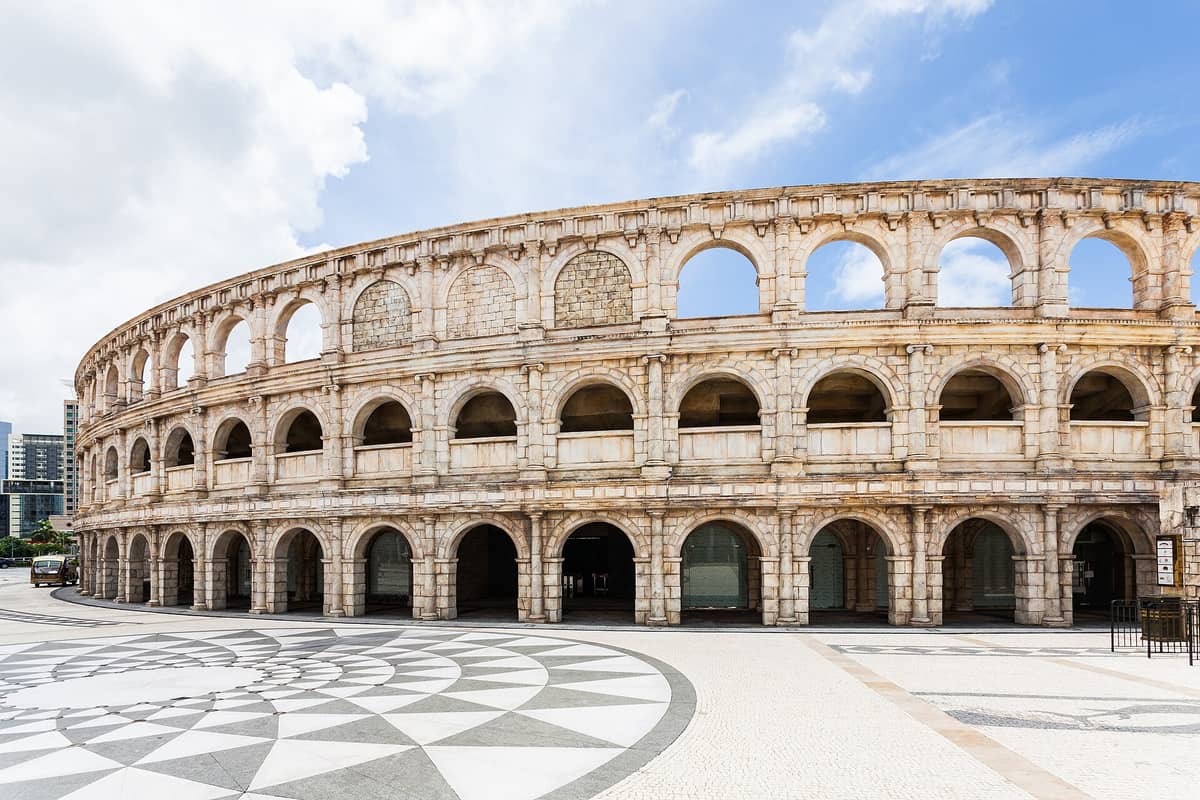
A Roman-inspired amphitheatre structure sits within the complex and serves as an event and performance space. It is worth a quick look for its scale alone, though it is often quiet outside of scheduled events. Check the official site before visiting if you want to catch a performance.
How the Experience Changes by Time of Day
Mornings here are genuinely quiet. The grounds are open, but most food and retail outlets do not open until mid-morning. If you arrive early after a ferry from Hong Kong, you can walk the full length of the promenade with almost no other visitors around. The harbour air is cooler, and the sound of small vessels on the outer harbour carries clearly. It is a reasonable introduction to the waterfront before heading into the denser historic neighbourhoods.
Weekday afternoons bring a moderate crowd, mostly families with children and visitors who have combined a trip to the ferry terminal with a look around. The light is harsh in summer, and there is limited natural shade outside the arcade sections of the complex. If you are visiting between June and September, the midday heat on the open waterfront promenade is significant. Comfortable shoes and sun protection matter more here than at shaded heritage sites.
Evenings from around 18:00 onward are when the complex works best. The illuminated facades reflect off the harbour water, the restaurants fill with a mix of tourists and Macau residents, and the temperature drops to something comfortable for most of the year. Weekend evenings are busier, particularly around the dining areas. This is the version of Fisherman's Wharf that the designers intended.
💡 Local tip
Visit on a weekday evening for the best balance of atmosphere and manageable crowds. Weekend evenings near the restaurants can get congested, especially during public holidays.
Location and Getting There
The complex is positioned on the Macau Peninsula directly adjacent to the Outer Harbour Ferry Terminal on Avenida Dr. Sun Yat Sen. If you are arriving by high-speed ferry from Hong Kong, the site is visible and walkable from the terminal exit without needing any transport. This geographical accident makes it one of the most naturally trafficked spots in Macau, visited by many people who simply walk past on their way to somewhere else.
From the historic centre, the walk from Leal Senado or the Ruins of St. Paul's takes around 20 to 30 minutes on foot, passing through the waterfront boulevard. Taxis are readily available and the fare from central Macau is short. Local bus routes serving the outer harbour area also stop nearby, though specific route numbers should be confirmed with current transport information before travel.
The complex has parking facilities and a Tesla Supercharging station at the Harbourview Hotel within the site, making it accessible by car for those driving from elsewhere on the peninsula. Detailed accessibility information for visitors with mobility requirements is not publicly listed; contact the management at +853 8299 3300 for specific enquiries before visiting.
Eating and Drinking at Fisherman's Wharf
The dining options here range from casual Chinese restaurants to international cuisine, concentrated mainly along the ground floors of the themed building blocks. Quality varies considerably between venues. The more tourist-facing spots can feel overpriced relative to what you get, particularly compared to the street food and dai pai dong culture you find deeper in the Macau Peninsula.
If food is a priority during your trip, the surrounding waterfront area and nearby streets offer better value. For a more curated sense of Macanese food culture, the Macau food guide covers the city's wider eating landscape in detail, including neighbourhoods where the cooking is more consistent and the prices fairer.
That said, the waterfront setting of the outdoor seating areas in the evening is genuinely pleasant for a drink or a slow meal. The restaurants that face the harbour directly benefit from the light and the occasional breeze. If you are already at Fisherman's Wharf in the evening, eating here is a reasonable choice, particularly for visitors who want to avoid navigating unfamiliar streets after dark.
Who Should Visit and Who Should Not
Macau Fisherman's Wharf is worth seeing if you are passing through the outer harbour area anyway, have children in tow who respond well to varied visual environments, or want a low-effort evening walk with harbour views. The free entry removes any barrier, and the 24-hour access means it suits early arrivals and late-night wanderers equally.
Visitors on a short itinerary who are focused on Macau's UNESCO-listed heritage, its extraordinary temple architecture, or its casino culture will find Fisherman's Wharf peripheral. The time would be better spent at the A-Ma Temple, the Fortaleza do Monte, or along the Macau heritage walk which covers the historic core in a single route. Fisherman's Wharf does not belong in the same category as those experiences.
Weather also affects the calculus significantly. In summer, the open waterfront sections are exposed and hot during daylight hours. During typhoon season, which runs from May through November with July through September as the peak period, any plans to visit the outer harbour area should account for potential weather disruptions. The cool, dry months of October through December are the most comfortable for an extended outdoor walk here.
Travellers comparing Fisherman's Wharf with Macau's larger entertainment complexes should know that the scale and spectacle of the integrated casino resorts on the Cotai Strip is in an entirely different league. If that style of architecture and entertainment interests you, the Cotai Strip guide is a more relevant starting point.
Photography Notes
The complex offers a few genuinely interesting photography situations. The contrast between the theatrically European-styled facades and the South China Sea harbour backdrop behind them makes for an unusual composition. Shoot toward the water at golden hour and the warm light catches the decorative plasterwork well.
At night, the illuminated reflections on the harbour surface are worth a few frames. A wide lens and a stable phone or camera handles this without difficulty. The amphitheatre, empty on most weekday evenings, offers an unusual symmetrical subject that most visitors walk past without stopping.
⚠️ What to skip
Macau's typhoon season runs July through September. If the Macau Meteorological and Geophysical Bureau raises a typhoon signal, outdoor waterfront areas including Fisherman's Wharf can be hazardous. Check smg.gov.mo for current weather advisories.
Insider Tips
- The complex is often overlooked as a morning arrival zone. If your ferry from Hong Kong docks before most of Macau wakes up, use the quiet grounds and empty waterfront promenade here to get oriented before heading into the historic centre.
- The Roman-style amphitheatre occasionally hosts live performances and cultural events. Check the official Fisherman's Wharf site before your visit to see if anything is scheduled during your dates.
- Street food stalls and cheaper local eateries are more plentiful a few blocks inland from the Fisherman's Wharf complex. If budget matters, treat the wharf as a backdrop and eat elsewhere.
- The outer harbour promenade adjacent to Fisherman's Wharf offers views back toward the peninsula skyline that include the Grand Lisboa tower. Early evening light on clear autumn days makes this one of the cleaner skyline shots on the peninsula.
- If you are visiting with a rental car or driving within Macau, the parking facilities and Tesla Supercharger at the on-site Harbourview Hotel make this a practical stop for EV drivers combining sightseeing with a charge.
Who Is Macau Fisherman's Wharf For?
- Families with young children who want a relaxed, no-cost outdoor environment with varied scenery
- Ferry arrivals from Hong Kong who want to ease into Macau before navigating the historic centre
- Evening walkers looking for harbour views and waterfront dining without a cover charge
- Photographers interested in the contrast between themed European architecture and a South China Sea backdrop
- Budget-conscious travellers who want to fill an hour without spending anything
Nearby Attractions
Other things to see while in Macau Waterfront & NAPE:
- Grand Prix Museum
The Macao Grand Prix Museum dedicates 16,000 square metres across four floors to the history of one of Asia's oldest and most technically demanding street races. Whether you follow motorsport closely or simply want to understand one of Macau's defining annual events, this is the most focused and well-produced museum on the waterfront.
- Kun Iam Statue (Goddess of Mercy Waterfront Statue)
Rising from a lotus-shaped dome on an artificial islet off Avenida Dr. Sun Yat-Sen, the Kun Iam Statue is one of Macau's most distinctive waterfront landmarks. The Kun Iam Ecumenical Centre inside the base is free to enter and offers a rare moment of calm away from the casino corridors. The outdoor park stays open from early morning until late evening, making it one of the few major sights in Macau that rewards visitors at multiple hours of the day.
- Macau Museum of Art
The Macao Museum of Art is a major museum in Macau dedicated entirely to the visual arts, with seven exhibition areas across four floors and free admission. Located in the NAPE waterfront district inside the Macao Cultural Centre complex, it offers a genuinely calm alternative to the city's more-trafficked historic sites.
- Macau Science Centre
The Macao Science Center is a modern science museum and planetarium on the Macau Peninsula waterfront, housed in a striking cone-shaped building designed by I.M. Pei Architects. With generally low-cost admission to its 13 themed galleries and ticketed planetarium dome shows, it offers a genuinely worthwhile stop, especially for families and anyone looking for a break from the city's casino-heavy entertainment landscape.