Fortaleza do Monte: Macau's Most Commanding Historic Fortress
Fortaleza do Monte, built between 1617 and 1626, rises above the historic centre of Macau with cannon-lined ramparts, sweeping 360-degree views, and the acclaimed Macao Museum within its walls. For the price of a cup of coffee, or nothing at all on free days, this UNESCO-listed site delivers more history per square metre than almost anywhere else in the city.
Quick Facts
- Location
- Praceta do Museu de Macau, No. 112, Macau Peninsula — short uphill walk from the Ruins of St. Paul's
- Getting There
- Walk from the Ruins of St. Paul's via the historic centre
- Time Needed
- 1.5–2.5 hours for fortress grounds and Macao Museum combined
- Cost
- Fortress grounds free. Macao Museum: MOP 15 adults, MOP 8 students; free for under-12s, over-65s, and all visitors on Tuesdays and the 15th of each month
- Best for
- History enthusiasts, photographers seeking city panoramas, and travellers who want context before exploring the wider historic centre
- Official website
- www.macaumuseum.gov.mo
What Fortaleza do Monte Actually Is
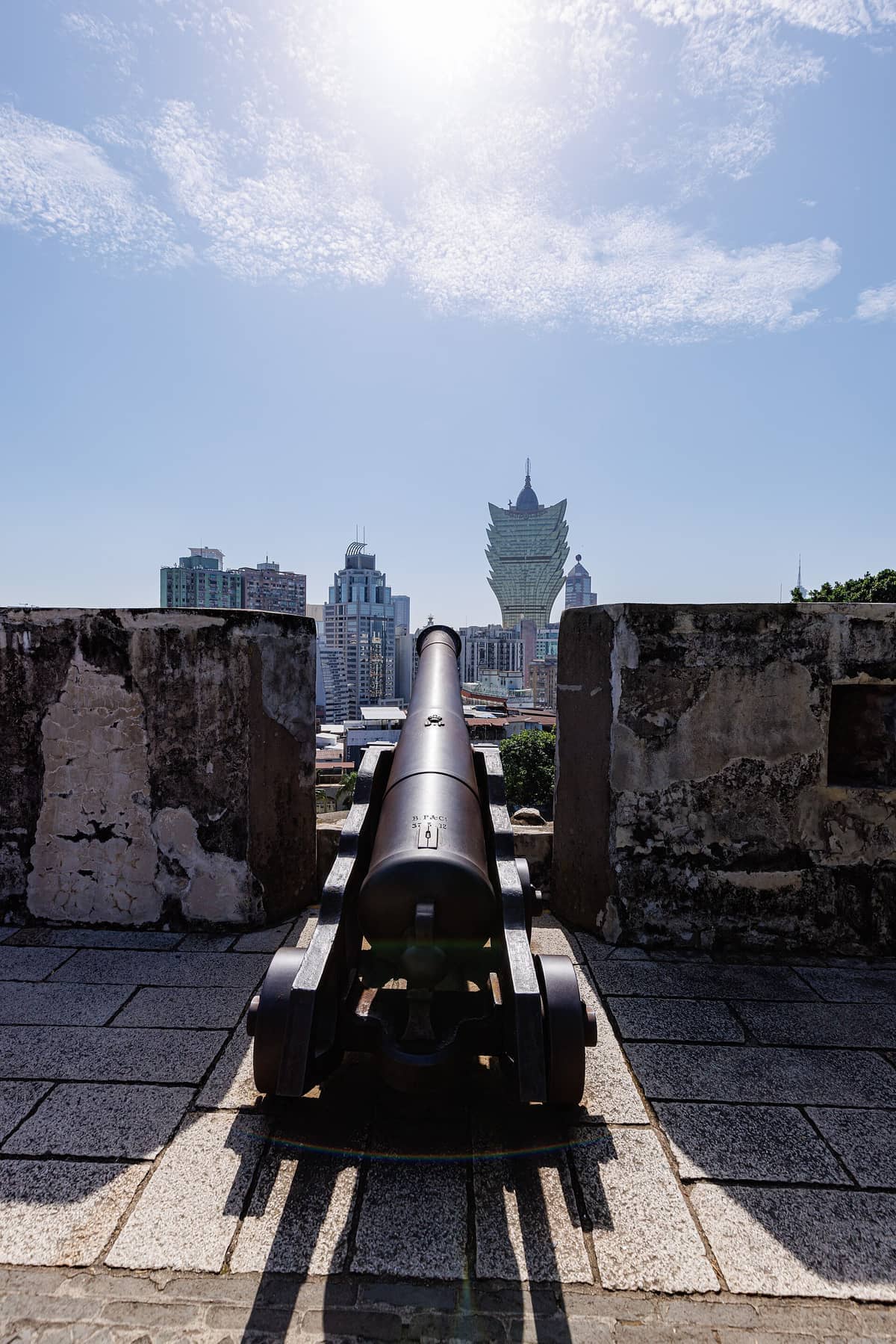
Fortaleza do Monte, known in English as Mount Fortress, is a 17th-century Portuguese military fortification perched on a hill above the historic centre. Guia Hill, not Monte, is the peninsula's highest point. Built between 1617 and 1626 to defend the Portuguese settlement against Dutch and other rival colonial powers, it covers roughly 8,000 square metres in a trapezoid layout, with four projecting bulwarks at its corners that once housed cannon emplacements. Today most of those original bronze cannons remain in place, pointing outward over a city that has changed beyond all recognition since they were last fired in anger.
The fortress is part of the Historic Centre of Macao, a UNESCO World Heritage Site designation covering 30 elements across the peninsula. Within the fortress walls sits the Macao Museum, a three-level permanent exhibition tracing the cultural and social history of Macau from pre-Portuguese settlement through to modern times. The outdoor grounds and the museum are technically separate experiences with separate opening hours, and understanding that distinction matters practically: the ramparts and gardens open at 07:00, while the museum does not open until 10:00.
💡 Local tip
Visit on a Tuesday or on the 15th of any month for free museum admission. Combine this with an early morning walk on the fortress ramparts before the museum opens and before tour groups arrive from the Ruins of St. Paul's below.
The Approach: Getting Up There
The most logical approach is on foot from the Ruins of St. Paul's, Macau's most photographed landmark, which sits at the base of the hill. From the facade of St. Paul's, a path winds upward to the right, gaining elevation through shaded steps and short ramps. The walk takes five to ten minutes depending on pace, and the gradient is noticeable but manageable for most visitors. Wear shoes with grip, particularly after rain, when stone surfaces become slippery.
There is no cable car or escalator access. Visitors with limited mobility should note that the approach from the historic centre involves sustained uphill walking, and the fortress interior also has uneven stone surfaces on the ramparts. The Macao Museum itself is more accessible, with level floors inside the main exhibition building.
On the Ramparts: What You See and When
The top of Fortaleza do Monte gives a panoramic view across the Macau Peninsula in almost every direction. To the north and east, the grand casino towers of the peninsula's gaming district rise incongruously behind the low-rise heritage streets below. To the south and west, on a clear day, you can see across the Inner Harbour toward Zhuhai in mainland China. The sight of centuries-old cannons aimed at a skyline of contemporary towers is one of the more arresting visual contrasts Macau produces.
The quality of the views changes considerably with time of day and season. Early morning, between 07:00 and 09:00, the light is soft and the air relatively clear. The fortress is largely empty at this hour, with only a handful of early-rising locals and the occasional photographer. By mid-morning, particularly on weekends and public holidays, tour groups flow up from the Ruins of St. Paul's and the ramparts can feel crowded. Afternoon light in autumn and winter falls at a useful angle for photographs of the cannons and the historic centre rooftops below.
Summer visits require more planning. Summer visits require more planning. From June through September, the heat and humidity on open stone ramparts is significant. Bring water, wear sun protection, and consider timing the outdoor portion for early morning or late afternoon. Typhoon season runs through this period, and when a typhoon warning signal is raised, the fortress grounds close.
⚠️ What to skip
Photography of the cannon-lined battlements is best in the morning when the sun is behind you (if approaching from the east). By midday in summer, the stone surfaces reflect intense heat and the haze reduces long-distance visibility significantly.
Inside the Macao Museum: What the Exhibition Covers
The Macao Museum occupies three floors of a purpose-built structure embedded within the fortress. The permanent collection is organized chronologically and thematically, beginning with Macau's origins as a settlement before Portuguese arrival and moving through the colonial period, the blending of Chinese and Portuguese cultures, and the social fabric of 20th-century Macau. The displays include ceramics, religious artefacts, historical maps, reconstructed workshop environments, and photographic archives.
The second floor covers the encounters between Chinese and Portuguese cultures with particular nuance, showing how trade, religion, and daily life produced a society that was neither purely Chinese nor purely European. This section resonates more deeply if you have already walked the streets of the historic centre and noticed the linguistic signage (both Chinese characters and Portuguese), the Catholic churches beside Taoist temples, and the pastel-painted government buildings.
The museum exhibition benefits from being visited either before or after exploring the wider heritage area on foot. The Macau heritage walk connects many of the sites referenced in the museum displays, giving physical context to what the exhibitions describe in glass cases. Allow at least an hour inside the museum to move through all three levels at a reasonable pace; rushing through in 30 minutes leaves the third floor, which covers popular traditions and festivals, largely unseen.
The museum is closed on Mondays, except when a Monday falls on a public holiday, in which case it opens and closes instead on the following Tuesday. This is worth checking before visiting, particularly during Chinese New Year and other festive periods when the schedule shifts. The last ticket sale is at 17:30 and the museum closes at 18:00.
Historical Context: Why This Fortress Exists
The Portuguese established Macau as a trading post in the mid-16th century, making it the first and longest-lasting European settlement in East Asia. The fortress was constructed in the early 17th century partly in response to Dutch attempts to seize Macau, most notably during the Dutch attack of 1622, when Dutch forces were repelled partly from this hilltop position. That engagement, which the Portuguese won despite being significantly outnumbered, cemented the fortress's reputation as the linchpin of the city's defenses.
The Jesuits played a central role in the fortress's early history, constructing and managing much of the original military infrastructure alongside their ecclesiastical buildings, including what became the Church of St. Paul, whose facade now stands as the iconic Ruins of St. Paul's directly below the fortress. The proximity of military and religious power on this hilltop was deliberate: the church, the college, and the fortress formed a unified complex controlling the high ground of the settlement.
The cannons visible today on the ramparts are original, not reproductions, which gives the fortress a tactile authenticity that many fortifications lack.
Practical Walkthrough: How to Structure Your Visit
A well-structured visit combines the early fortress grounds experience with the museum. Arrive at or shortly after 07:00 to walk the ramparts before crowds build. Spend 45 to 60 minutes on the battlements, circling the full perimeter to catch all cardinal viewpoints and examining the cannon placements up close. The grounds include a small garden area within the courtyard that provides shade and a quieter atmosphere than the exposed rampart walks.
When the museum opens at 10:00, join the queue early or enter immediately after the opening to avoid the wave of tour groups that typically arrive from 10:30 onward. After the museum, the logical continuation of the day is a walk through the Macau Peninsula's historic centre, visiting the Leal Senado building and St. Dominic's Church on Senado Square, both within walking distance downhill.
There is no cafe or food vendor reliably operating inside the fortress grounds, so carry water and a snack if you plan a morning visit before the nearby streets' restaurants open fully. The surrounding area around the Ruins of St. Paul's has numerous small bakeries and cafes that open from mid-morning, including places selling the egg tart pastries Macau is known for.
ℹ️ Good to know
The fortress grounds (not the museum) are free to enter at all times during opening hours. If you only want the views and cannon-lined ramparts, there is no cost involved. Museum admission is MOP 15 for adults.
Is It Worth Your Time?
Fortaleza do Monte is one of the stronger heritage stops on the Macau Peninsula, and it earns its place in a day's itinerary more reliably than many better-publicized sites nearby. The views are genuinely useful for spatial orientation early in a visit, the museum is well-presented for its price, and the fortress itself has authentic physical presence rather than the sanitized feel of many restored heritage sites.
That said, it is worth being clear about limitations. The fortress does not compare in grandeur to large European citadels. The museum's English-language labeling is functional but not always rich in interpretive depth. And the walk uphill from the Ruins of St. Paul's, while short, is steep enough that visitors with mobility limitations or knee problems should factor this in. If you are working through a one-day Macau itinerary, this site works well as a morning anchor before the crowds descend on the area below.
Visitors primarily interested in casinos, shopping, or nightlife will find little to engage them here. The fortress is not a spectacle in the contemporary sense; it rewards curiosity and patience rather than quick visual gratification. Travellers who skip it in favour of another hour at the casino floor are not missing something irreplaceable, but travellers who care about understanding how Macau came to be what it is today will find it genuinely rewarding.
Insider Tips
- The fortress grounds open at 07:00, a full three hours before the museum. Arriving at opening time gives you the ramparts almost entirely to yourself, with good morning light for photography and noticeably cooler temperatures in summer months.
- Free admission applies to all visitors every Tuesday and on the 15th of each month. If your travel dates allow it, timing your museum visit around these days costs nothing and requires no advance planning.
- The northern rampart offers the clearest sightline toward the Grand Lisboa tower and the casino district skyline. Position yourself here for the most visually striking juxtaposition of colonial-era cannons against modern high-rises.
- The museum's third floor, covering popular traditions and festivals, is a quieter section even when the lower floors are busy with tour groups. The festival reconstructions and costume displays on this floor are among the more vivid parts of the whole collection.
- If you visit on a sunny afternoon in autumn or winter, the low angle of the sun illuminates the stone textures of the rampart walls and cannon barrels in a way that does not occur at midday. This is the single best window for detailed architectural photography of the fortress structure itself.
Who Is Fortaleza do Monte (Mount Fortress) For?
- First-time visitors to Macau who want historical grounding before exploring the wider heritage centre
- Photographers seeking elevated panoramic views of the Macau Peninsula without paying for a skyscraper observation deck
- Budget travellers and families: free entry to the grounds always, free museum entry on Tuesdays and the 15th of every month, and free admission for children under 12 and seniors over 65
- History and architecture enthusiasts drawn to authentic Portuguese colonial military heritage in East Asia
- Early risers who want a calm, crowd-free experience of a major heritage site before the tour-group rush begins
Nearby Attractions
Other things to see while in Macau Peninsula:
- A-Ma Temple (Ma Kok Miu)
A-Ma Temple, known locally as Ma Kok Miu, is the oldest temple in Macau, with origins traced to 1488. Part of the UNESCO-listed Historic Centre of Macao, this atmospheric complex blends Taoist, Buddhist, Confucian, and folk traditions across six distinct halls climbing Barra Hill. Entry is free, and the site remains an active place of worship year-round.
- Camões Grotto and Casa Garden
Tucked into the northwest of the Macau Peninsula, Camões Grotto and Casa Garden form one of the city's most layered heritage sites. The park honors Portugal's greatest poet in a setting of banyan trees and rocky outcrops, while the adjacent 18th-century mansion carries the architectural weight of colonial trade history. Both are free to enter and rarely crowded.
- Dom Pedro V Theatre
The Dom Pedro V Theatre (Teatro Dom Pedro V) is the oldest Western-style performance venue in East Asia, completed in 1860 and — though normally a working venue — temporarily closed for renovation until early October 2026. Its pale green neoclassical facade on Largo de Santo Agostinho is one of the most photogenic and historically layered corners of the Macau Peninsula, and admission is free when it is open to visitors
- Grand Lisboa
Grand Lisboa is the lotus-shaped tower that defines the Macau Peninsula skyline. Operated by SJM, it combines a 24-hour casino, a cluster of high-end restaurants, and a landmark hotel on Avenida de Lisboa. Whether you're here to gamble, dine, or simply photograph one of Asia's most distinctive buildings, this guide tells you exactly what to expect.