St. Dominic's Church: Macau's Most Beautiful Baroque Landmark
Founded in 1587 by Spanish Dominican priests, St. Dominic's Church is one of the finest Baroque buildings in Asia, standing at the edge of Senado Square in the heart of Macau's UNESCO-listed historic core. Entry is free, the interior holds centuries of Catholic art, and the surrounding square makes it a natural anchor for any heritage walk through the peninsula.
Quick Facts
- Location
- Largo de São Domingos, Sé (Cathedral Parish), Macau Peninsula
- Getting There
- Buses 2, 3, 3A, 4, 5, 6A, 10, 18, 26A and others to Avenida de Almeida Ribeiro, then a short walk to Senado Square
- Time Needed
- 30–60 minutes, including the Treasure of Sacred Art museum
- Cost
- Free (church and museum)
- Best for
- Architecture lovers, history seekers, photography, heritage walks
- Official website
- www.macaumuseum.gov.mo/en/visit/treasure-sacred-art
⚠️ What to skip
Temporary closure: As of June 8, 2026, St. Dominic's Church is closed for approximately 120 days of maintenance work, and its Treasure of Sacred Art museum is closed from July 8, 2026, for approximately 90 days. Check local tourism sources or the official museum page before visiting.
What St. Dominic's Church Actually Is
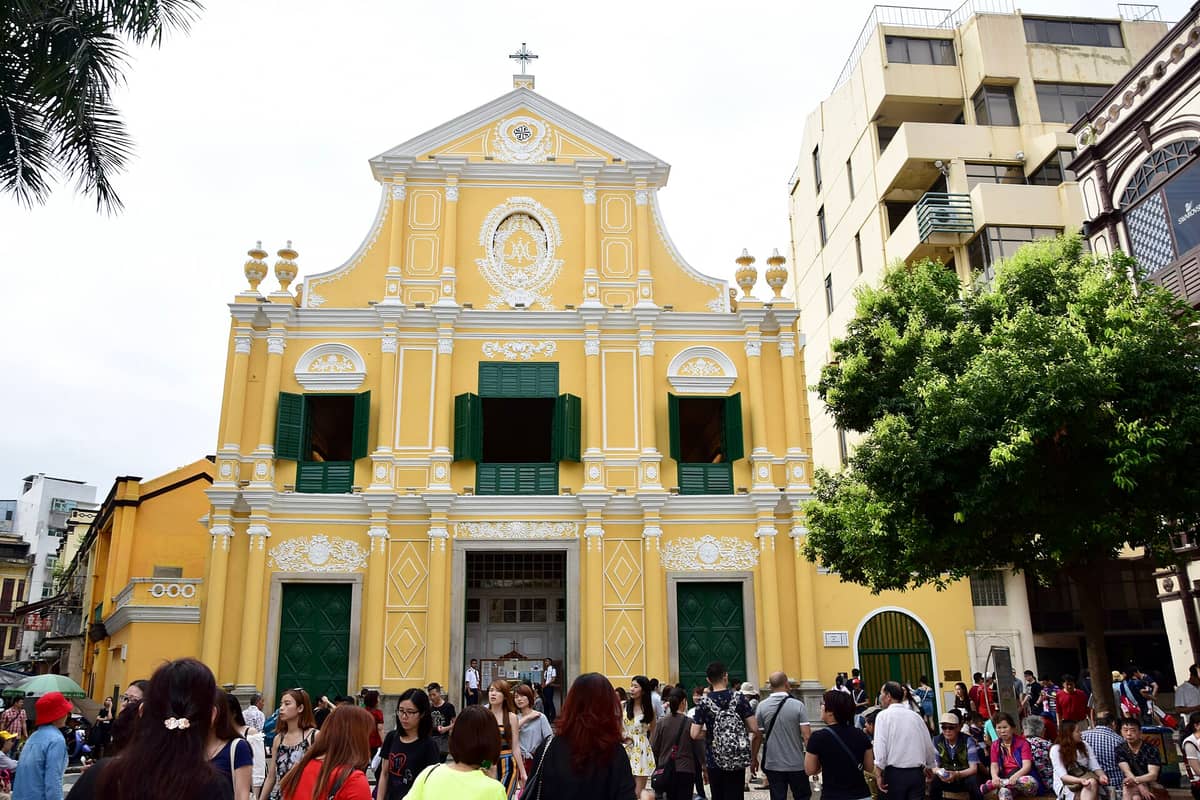
St. Dominic's Church — known in Portuguese as Igreja de São Domingos — is a late 16th-century Baroque Catholic church occupying the northeastern corner of Senado Square in central Macau. It was founded in 1587 by Spanish Dominican priests from the Brotherhood of Our Lady of the Rosary, making it one of the oldest Catholic churches in China. The building you see today reflects layers of reconstruction and renovation over four centuries, but the essential Baroque character of its cream-and-green facade has been preserved with care.
The church is part of the Historic Centre of Macao, a UNESCO World Heritage site inscribed in 2005 as China’s 31st World Heritage site. That designation matters in practical terms: the building is maintained to a higher standard than it might otherwise be, which is visible in the quality of the stonework, the condition of the interior, and the ongoing restoration efforts that periodically close sections for upkeep.
For travelers following the Macau heritage walk, St. Dominic's Church functions as a natural waypoint. It sits roughly 200 meters east of the main square, connected by a short pedestrian lane lined with souvenir stalls and egg tart shops. The church's presence is announced before you see it: the yellow-and-white spire appears above the roofline as you approach from Senado Square.
The Facade and Square: First Impressions
The exterior of St. Dominic's Church is one of the most photographed in Macau, and for good reason. The three-tiered Baroque facade is painted in a pale cream-yellow with green shuttered windows, topped by a bell tower visible from several streets away. The color combination is unusual enough to stop people mid-stride. The proportions are generous without being overwhelming — it reads as a grand building even though it occupies a relatively compact footprint in the dense historic core.
The small square in front, Largo de São Domingos, acts as a buffer between the church and the surrounding lanes. A few stone steps lead up to the main entrance, and the plaza itself tends to collect a rotating mix of visitors pausing to take photographs, tour groups receiving briefings from guides, and the occasional local sitting on the steps. Early morning, before 10 am, the square is considerably quieter — the warm light falls directly on the facade, and the relative calm makes for better photography than midday when the square fills up.
💡 Local tip
For the best exterior photographs, come between 8–10am when light hits the facade and crowds are minimal. The angle from the far left corner of the square captures both the main facade and the bell tower without distortion.
Inside the Church: What to Expect
The interior of St. Dominic's Church is a single nave with side altars, typical of the Portuguese-influenced Baroque churches found across Macau. The ceiling is high and barrel-vaulted, painted in white with pale decorative detailing. The main altar is dedicated to Our Lady of the Rosary, and a statue of the Virgin occupies a prominent position behind the altar table. The side walls hold a series of chapels, each with its own small altar and devotional objects.
The atmosphere inside is notably cooler and quieter than the street outside. The stone walls absorb heat, and even on a humid Macau afternoon the interior offers some relief. Incense is used for ceremonies, and on days when the church has hosted a morning service, a faint trace of it lingers. The acoustic character of the space is distinctive: footsteps echo on the tiled floor, and the hum of traffic outside disappears almost completely once you step through the main doors.
Access to the nave is not always guaranteed. Some visitor reports note that on certain days, or during services, the public is restricted to the entrance area near the main doors. Services take priority over general visiting hours, so if you arrive when a ceremony is underway, expect to wait outside or return later. There is no official signage warning of this in advance.
The Treasure of Sacred Art Museum
Behind the main altar, a staircase leads to the church's former bell tower, which has been converted into a three-story museum called the Treasure of Sacred Art. The museum holds a collection of religious paintings, vestments, statues, silverwork, and liturgical objects drawn from the long history of Catholicism in Macau. Entry is free, which makes it one of the better-value cultural stops on the peninsula.
The display cases are clearly labeled in Chinese, Portuguese, and English, and the curation is straightforward: objects are grouped by type and era, with brief explanatory text. Highlights include processional statues used in major Catholic feast days, embroidered vestments from the 17th and 18th centuries, and a collection of ivory and painted religious figures. The top floor of the tower offers a small window view over the surrounding rooftops, though it is not a formal viewpoint.
The museum is a more rewarding stop than it might appear from the outside. Travelers with a broader interest in Macau's Catholic heritage will find it complements visits to the Ruins of St. Paul's and the St. Joseph's Seminary and Church well. Together, these three sites trace the arc of the Dominican and Jesuit presence in Macau over more than four centuries.
Historical Context: Why This Church Exists Here
Macau's Catholic heritage is inseparable from its history as a Portuguese trading port, established in the mid-16th century as one of the first European footholds in East Asia. Spanish Dominican friars arrived in Macau in 1587, using the city as a base for missionary activity throughout China and Japan. The church they founded was built on land granted for their mission, in what was then a central and symbolically important location.
The church passed through several reconstructions, particularly after fire damage and general deterioration, before reaching its current form. The Baroque style that defines the facade was a deliberate aesthetic choice associated with the Counter-Reformation Catholic Church, which used grandeur and ornamentation to project authority and devotion. In Macau's colonial context, the church also served as a gathering point for the Portuguese-speaking community — a role it has continued to play for over four centuries.
To understand St. Dominic's Church in context, it helps to read about Macau's broader Catholic architectural legacy. The churches of Macau guide covers the full range of ecclesiastical heritage across the peninsula and islands.
Opening Hours, Getting There, and Practical Details
Under normal circumstances (outside maintenance closures), St. Dominic's Church keeps the following schedule: Monday through Wednesday and Friday, 10:00 to 18:00; Saturday, 10:00 to 15:00; Sunday and public holidays, 10:00 to 19:00; closed all day Thursday. Note also that the church closes after 15:00 on the 13th and 25th of each month. These hours are subject to change without notice, so verifying with local tourism sources before visiting is advisable.
The church is located at Largo de São Domingos, in the Cathedral Parish (Sé) of the Macau Peninsula. Getting there by public transport is straightforward: buses 2, 3, 3A, 3X, 4, 5, 6A, 8A, 10, 10A, 18, 18A, 19, 26A, 33, N1B, N2A, and N3 all stop on Avenida de Almeida Ribeiro, from which Senado Square and the church are a short walk. The walk from the Ruins of St. Paul's takes approximately five to eight minutes on foot and passes through narrow lanes with food stalls and local shops.
The church sits on the Macau Peninsula, which concentrates most of the city's UNESCO-listed heritage sites within a walkable area. Combining a visit here with Leal Senado Building and the Holy House of Mercy makes for a coherent half-day heritage circuit without requiring transport between stops.
Accessibility
The church entrance involves a short flight of stone steps, and no detailed official information on wheelchair ramps or lift access has been published by the parish or the Cultural Affairs Bureau. Visitors with mobility requirements should contact local tourism resources in advance. The surrounding Largo de São Domingos plaza is paved and relatively level, though the narrow lanes approaching from Senado Square can be uneven.
Weather and What to Wear
Macau's climate makes timing important for outdoor sightseeing around the church. From October through February, conditions are most comfortable: temperatures range from around 15 to 22 degrees Celsius, humidity drops, and the sky is often clear. The summer months from June through September bring heat above 30 degrees, high humidity, and the risk of typhoons. The interior of the church provides some relief from the heat, but the surrounding square can be exhausting at midday in July or August. Loose, breathable clothing and a hat are advisable in summer; the church interior is also a place of worship, so overly revealing attire is best avoided.
ℹ️ Good to know
October to early December is consistently the most comfortable period for walking the historic centre. The light is good for photography, temperatures are mild, and the typhoon season has passed.
Who Should Skip This Attraction
St. Dominic's Church is a genuine architectural and historical site, not an entertainment attraction. Travelers primarily interested in Macau's casino resorts, the Cotai Strip, or contemporary spectacles will find little here that rewards attention. The building is also quite compact — the interior takes fifteen minutes to walk through at a relaxed pace, and the museum adds another twenty to thirty minutes. Visitors expecting a grand cathedral on the scale of European examples may be underwhelmed by the size, even though the quality of the detail is high.
During maintenance closures, the attraction offers nothing beyond a view of the exterior. The facade is worth a brief stop regardless, but if the museum and interior are closed, there is no reason to linger.
Insider Tips
- The church faces roughly northeast, so morning light falls directly on the facade before 10am — arrive before the official opening time to photograph the exterior without crowds or midday glare.
- Thursday is the weekly closing day for the Treasure of Sacred Art museum, and the church itself may also close or adjust hours around religious activities. Many visitors arriving as part of a group tour do not check this and find the doors shut; confirm the schedule applies to your visit date, especially around public holidays when hours shift.
- The Treasure of Sacred Art museum is often overlooked by visitors who only look at the nave and leave. The third floor of the bell tower contains the most historically significant pieces and takes less than fifteen minutes to reach from the main entrance.
- On the 13th and 25th of each month, the Treasure of Sacred Art museum closes at 15:00 (unless these dates fall on a Sunday), likely connected to parish liturgical observances. If your visit falls on those dates, plan to arrive in the morning.
- The small pedestrian lane connecting Senado Square to the church entrance is one of the better places on the peninsula to buy pineapple cakes and almond biscuits from shops that have been operating for decades — the walk itself is part of the experience.
Who Is St. Dominic's Church For?
- Architecture and history travelers who want to understand Macau's Portuguese colonial legacy beyond the casinos
- Photographers looking for striking Baroque exteriors in good morning light
- Visitors on a budget: both the church and its museum are entirely free
- Travelers combining multiple UNESCO heritage sites in a single half-day walking circuit
- Anyone interested in the history of Catholicism in East Asia and the Dominican missionary presence in Macau
Nearby Attractions
Other things to see while in Macau Peninsula:
- A-Ma Temple (Ma Kok Miu)
A-Ma Temple, known locally as Ma Kok Miu, is the oldest temple in Macau, with origins traced to 1488. Part of the UNESCO-listed Historic Centre of Macao, this atmospheric complex blends Taoist, Buddhist, Confucian, and folk traditions across six distinct halls climbing Barra Hill. Entry is free, and the site remains an active place of worship year-round.
- Camões Grotto and Casa Garden
Tucked into the northwest of the Macau Peninsula, Camões Grotto and Casa Garden form one of the city's most layered heritage sites. The park honors Portugal's greatest poet in a setting of banyan trees and rocky outcrops, while the adjacent 18th-century mansion carries the architectural weight of colonial trade history. Both are free to enter and rarely crowded.
- Dom Pedro V Theatre
The Dom Pedro V Theatre (Teatro Dom Pedro V) is the oldest Western-style performance venue in East Asia, completed in 1860 and — though normally a working venue — temporarily closed for renovation until early October 2026. Its pale green neoclassical facade on Largo de Santo Agostinho is one of the most photogenic and historically layered corners of the Macau Peninsula, and admission is free when it is open to visitors
- Fortaleza do Monte (Mount Fortress)
Fortaleza do Monte, built between 1617 and 1626, rises above the historic centre of Macau with cannon-lined ramparts, sweeping 360-degree views, and the acclaimed Macao Museum within its walls. For the price of a cup of coffee, or nothing at all on free days, this UNESCO-listed site delivers more history per square metre than almost anywhere else in the city.