Holy House of Mercy (Santa Casa da Misericórdia): Macau's Oldest Charitable Institution
Standing just off Senado Square since 1569, the Holy House of Mercy is one of Macau's most significant historical buildings. Its small but carefully curated museum tells the story of Portuguese colonial welfare and the city's early Catholic institutions, all for just MOP 5 for adults.
Quick Facts
- Location
- Travessa da Misericórdia no. 7, near Senado Square, Macau Peninsula
- Getting There
- Walk a few minutes from Avenida de Almeida Ribeiro (San Ma Lo); buses stop on the main road near Senado Square
- Time Needed
- 30-45 minutes
- Cost
- MOP 5 adults; students and seniors 65+ free
- Best for
- History enthusiasts, architecture lovers, and anyone tracing Macau's Portuguese heritage
- Official website
- http://www.scmm.mo/frontend/main/index.php?hl=en
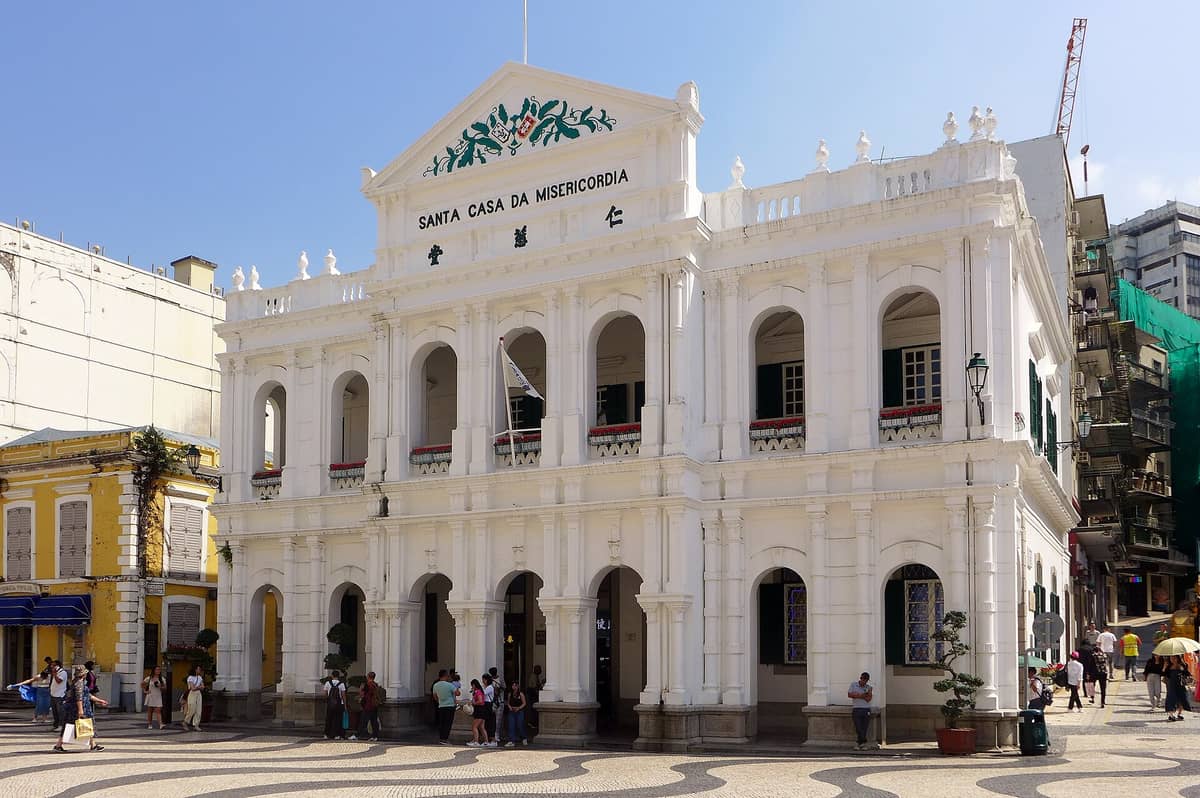
What Is the Holy House of Mercy?
The Holy House of Mercy (Santa Casa da Misericórdia de Macau) is not a church, not a casino, and not a street-food alley. It is one of the oldest continuously operating charitable institutions in Asia, founded in 1569 by Dom Belchior Carneiro, the first Bishop of Macao. That makes it older than most of what visitors queue to see on the Ruins of St. Paul hill above Senado Square. Yet it receives a fraction of the foot traffic.
Modeled on Portugal's charitable brotherhoods of the same name, the institution was established to provide medical care, social welfare, and burial services to Macau's poor, regardless of nationality or faith. The organization still operates welfare services today, but its historic headquarters building on Travessa da Misericórdia now also houses a small museum that opens those centuries to the public.
ℹ️ Good to know
The Holy House of Mercy is a UNESCO World Heritage site, listed as part of the Historic Centre of Macao inscribed in 2005. Admission to the museum is just MOP 5 for adults, making it one of the cheapest heritage experiences in the city.
The Building: Architecture Worth Slowing Down For
The headquarters building presents a restrained, colonnaded neoclassical facade that would look at home in Lisbon or Porto. Pale paintwork, arched ground-floor windows, and a symmetrical roofline distinguish it from the more elaborate baroque gestures of nearby churches. The structure occupies a corner position that gives it a quiet authority: it does not shout for attention, but it rewards anyone who stops to look.
Compared to the ornate facade of Leal Senado across the square, the Holy House of Mercy reads as more austere, more institutional. That restraint is deliberate: this was a place of practical mercy, not civic theater. The interior continues that tone, with corridors, carved wooden details, and period religious art that feels genuinely used rather than merely preserved.
Be aware that the building is multi-storey with internal stairways. No sources confirm step-free or lift access throughout, so visitors with limited mobility should contact the institution before making the trip a central part of their itinerary. The surrounding Senado Square area is paved with the city's characteristic wave-pattern Portuguese stone, which can be uneven and slippery after rain.
Inside the Museum: What You Actually See
The museum occupies the upper floors of the headquarters and is compact enough to absorb in under an hour. Its collection centers on religious art, liturgical objects, historical documents, and painted portraits of past leaders of the brotherhood. The pieces range from 17th-century ivory figures to oil paintings that capture the particular cultural blending of Catholic Portugal and the Chinese Pearl River Delta.
There is a skull relic claimed to belong to Macao's first bishop, Carneiro himself, displayed in a side chapel area. That single object tends to stop visitors in their tracks in a way that no label or interpretive panel could replicate. Whether you find it unsettling or deeply moving will depend on your own disposition, but it is genuinely singular.
The museum's labeling is available in English and Portuguese, and the overall layout is intuitive. Staff are present and generally willing to answer questions, though the level of English varies. This is not a grand, multimedia museum experience. It is a quiet room of objects that accumulates meaning as you move through it.
💡 Local tip
Arrive at opening time (10:00) on a weekday. The museum draws few visitors in the morning, and you may have the rooms largely to yourself.
How It Fits Into a Walk Around Senado Square
The Holy House of Mercy sits at the edge of Senado Square, Macau's principal heritage plaza and the heart of the UNESCO-listed historic zone. Most visitors arrive at the square from Avenida de Almeida Ribeiro (locally known as San Ma Lo) and gravitate immediately toward the fountains, the pink facade of the Leal Senado Building, and then north toward the Ruins of St. Paul. The Holy House of Mercy is directly accessible from the square's western edge, at Travessa da Misericórdia, but it is easy to walk straight past if you do not know to look for it. Part of what makes the Macau heritage walk so rewarding is that the most interesting buildings are not always the ones with the longest queues.
A logical sequence for the area: visit the Holy House of Mercy first, while you have morning energy and the square is quiet, then walk to the St. Dominic's Church a few minutes away, and continue uphill to the Ruins of St. Paul and the Macau Museum. This sequence roughly follows the footfall gradient from quiet to crowded, which tends to make for a more pleasant day.
Time of Day and Crowd Behavior
Senado Square transforms over the course of the day. At 10:00 on a weekday morning, the patterned stone plaza holds street cleaners, a few early walkers, and the occasional pigeon. By 11:30, organized tour groups start arriving in rotation, moving briskly between landmarks. From early afternoon onward, the square fills with visitors from Mainland China, school groups, and weekend crowds that spill along every connecting lane.
Because the Holy House of Mercy museum is not on most tour-group itineraries, its interior remains relatively calm throughout the day, even when the square outside is packed. That makes it a genuinely useful refuge during peak hours: the MOP 5 admission essentially buys you cool, quiet air-conditioned space and a legitimate reason to pause and reflect on what you have already seen outside.
Avoid Monday visits, as the museum is closed. Public holidays also bring closures. If you are visiting during Chinese New Year or other major festivals, verify hours directly with the institution before arriving. The square itself is worth seeing during festival periods, but the museum's schedule does not always align with those dates.
Practical Details for Your Visit
- Opening hours: 10:00-13:00 and 14:30-17:30, Tuesday to Sunday. Closed Monday and public holidays. Confirm current hours before visiting.
- Admission: MOP 5 per adult. Students and seniors aged 65 and over are reportedly admitted free. Check on arrival as prices are subject to change.
- Getting there: Walk 2-3 minutes from the main Senado Square area. Multiple bus routes stop on Avenida de Almeida Ribeiro, the main road feeding the square. No dedicated parking.
- Photography: Photography is generally permitted in the museum, but avoid using flash near the older religious artifacts. Check with staff when you arrive.
- What to wear: Smart casual is appropriate. The building is air-conditioned, so a light layer is useful on hot days.
- Language: Bilingual (English and Portuguese) labeling throughout the museum. Some Cantonese and Mandarin materials may also be available.
- Accessibility: Multiple internal stairways confirmed. Step-free access not confirmed. Contact the institution directly if this is a concern.
⚠️ What to skip
The Holy House of Mercy is closed on Mondays and on public holidays. Check the official website before your visit, especially around Golden Week and Chinese New Year.
Is It Worth Your Time?
For travelers with only a single day in Macau following a tight itinerary, the Holy House of Mercy is not the first thing to prioritize: the Ruins of St. Paul, Senado Square itself, and the A-Ma Temple all deliver a bigger visual impact in less time. But the Holy House of Mercy offers something those sites do not: the chance to understand why Macau's Portuguese colonial presence was not purely political or commercial. This institution existed to care for people, and that purpose has continued without interruption since 1569.
If you have at least two days or are following a more considered Macau churches and heritage guide, the 30-45 minutes here will add meaningful depth to your understanding of the city. The admission cost is negligible. The collection is small but specific. And the building itself is a legitimate piece of Portuguese colonial architecture that deserves its UNESCO listing.
Visitors who find religious history unengaging or who have very limited time will not suffer for skipping it. Those who do visit, however, rarely regret it. It is the kind of place that works best when you are not racing through.
Insider Tips
- The entrance on Travessa da Misericórdia is easy to miss from the main square. Look for the colonnaded facade and follow the small lane sign. The building address is no. 7, and the entrance is clearly marked once you are on the correct street.
- The bishop's skull relic is displayed in a side area of the museum and is not prominently signposted. Take your time moving through the rooms rather than heading directly for the exit, and you will find it.
- If you plan to visit multiple UNESCO heritage sites in the same morning, bring a small map or use an official heritage guide that covers the Historic Centre of Macao.
- The museum's midday closure (13:00-14:30) means that if you arrive in late morning, you may only have time for one visit segment. Arrive by 10:00 to give yourself the full morning slot without rushing.
- The patterned Portuguese stone pavement in the Senado Square area becomes particularly slippery during Macau's rainy season (roughly May to September). Wear shoes with grip if visiting during those months, especially if you plan to walk between multiple heritage sites in one outing.
Who Is Holy House of Mercy (Santa Casa da Misericórdia) For?
- History enthusiasts who want context beyond the visual spectacle of the Ruins of St. Paul
- Travelers on a tight budget: MOP 5 is among the lowest admission fees at any heritage site in Macau
- Architecture lovers interested in Portuguese colonial neoclassical design
- Anyone following the full UNESCO Historic Centre of Macao trail across the Peninsula
- Visitors looking for a quiet, air-conditioned break during peak midday crowds at Senado Square
Nearby Attractions
Other things to see while in Macau Peninsula:
- A-Ma Temple (Ma Kok Miu)
A-Ma Temple, known locally as Ma Kok Miu, is the oldest temple in Macau, with origins traced to 1488. Part of the UNESCO-listed Historic Centre of Macao, this atmospheric complex blends Taoist, Buddhist, Confucian, and folk traditions across six distinct halls climbing Barra Hill. Entry is free, and the site remains an active place of worship year-round.
- Camões Grotto and Casa Garden
Tucked into the northwest of the Macau Peninsula, Camões Grotto and Casa Garden form one of the city's most layered heritage sites. The park honors Portugal's greatest poet in a setting of banyan trees and rocky outcrops, while the adjacent 18th-century mansion carries the architectural weight of colonial trade history. Both are free to enter and rarely crowded.
- Dom Pedro V Theatre
The Dom Pedro V Theatre (Teatro Dom Pedro V) is the oldest Western-style performance venue in East Asia, completed in 1860 and — though normally a working venue — temporarily closed for renovation until early October 2026. Its pale green neoclassical facade on Largo de Santo Agostinho is one of the most photogenic and historically layered corners of the Macau Peninsula, and admission is free when it is open to visitors
- Fortaleza do Monte (Mount Fortress)
Fortaleza do Monte, built between 1617 and 1626, rises above the historic centre of Macau with cannon-lined ramparts, sweeping 360-degree views, and the acclaimed Macao Museum within its walls. For the price of a cup of coffee, or nothing at all on free days, this UNESCO-listed site delivers more history per square metre than almost anywhere else in the city.