Macao Museum: The Complete Guide to Macau's Best History Museum
Housed within the historic Monte Fortress, the Macao Museum tells the story of four centuries of coexistence between Chinese and Portuguese cultures. With three floors of permanent collections, low admission prices, and a location steps from the Ruins of St. Paul's, it rewards anyone curious about how this small territory became one of the world's most layered cities.
Quick Facts
- Location
- Praceta do Museu de Macau, No. 112, Monte Fortress, Macau Peninsula
- Getting There
- Buses 7, 8, 8A, 17, 18, 19 to Ruins of St. Paul's stop, then a short uphill walk to the fortress
- Time Needed
- 1.5 to 2.5 hours for the full collection
- Cost
- MOP 15 adults / MOP 8 students / Free for under-12s, seniors 65+, Macao residents, and all visitors on Tuesdays and the 15th of each month
- Best for
- History lovers, first-time visitors wanting context, families, and anyone who wants shade on a hot afternoon
- Official website
- www.macaumuseum.gov.mo/en
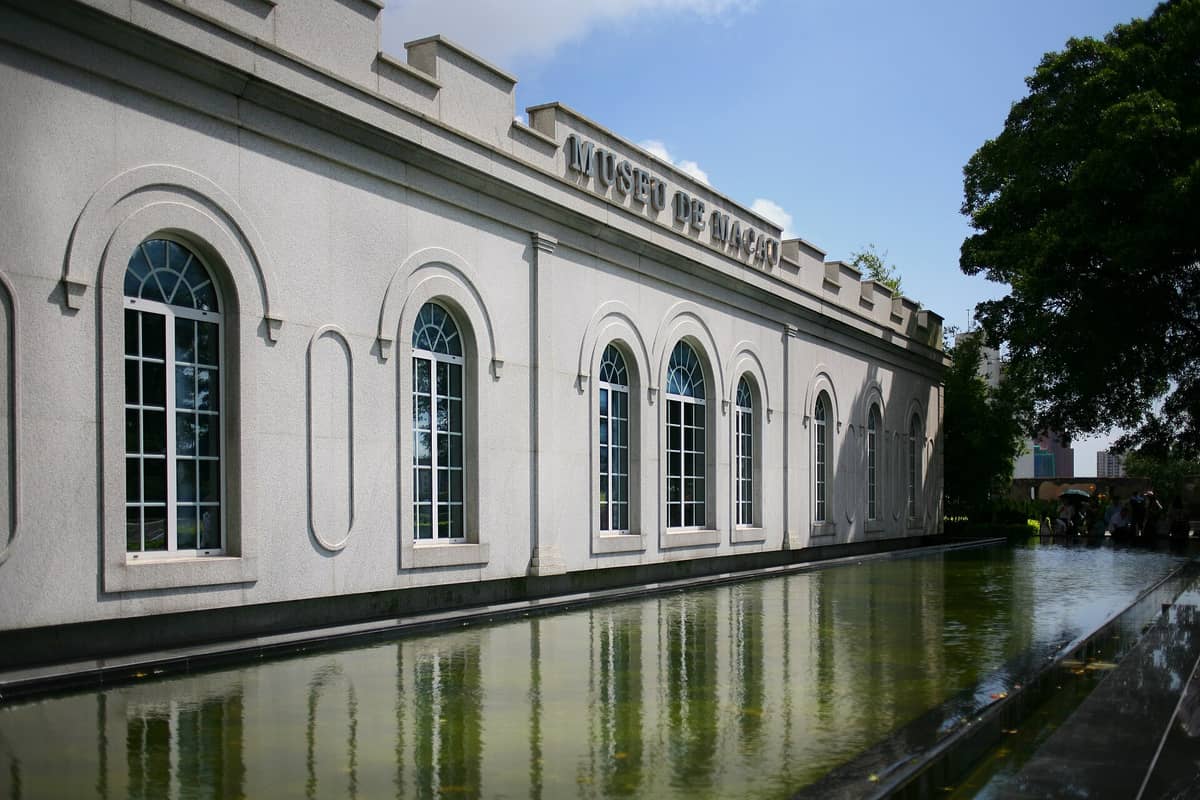
What Is the Macao Museum?
The Macao Museum (officially spelled Macao Museum in English, Museu de Macau in Portuguese, and 澳門博物館 in Chinese) is the territory's primary institution for history and cultural heritage. It occupies the former Meteorological and Geophysical Services building on the summit of Monte Fortress, a site that has been strategically significant since the early seventeenth century. The building itself spans two underground floors and one ground-floor level, which means most of the exhibition space is carved into the hilltop rather than rising above it. From the outside, the effect is understated. Inside, it opens into something considerably more substantial.
The museum sits within a short walk of some of Macau's most recognizable landmarks. The Ruins of St. Paul's are roughly 400 metres downhill, and the Fortaleza do Monte wraps around the museum building itself. If you're following the Macau heritage walk, the museum fits naturally into the middle of the circuit.
💡 Local tip
Admission is free every Tuesday and on the 15th of each month. If your schedule is flexible, timing your visit on one of these days saves the small entrance fee and makes the museum even easier to justify as a spontaneous stop.
Opening Hours and Ticket Prices
The museum is open daily from 10:00 to 18:00, with last entry at 17:30. It is closed on Mondays, except when Monday falls on a public holiday. These hours are generally consistent year-round, though it is worth checking the official website before visiting during major public holidays, as special events occasionally affect access.
Standard adult admission is MOP 15, making it one of the more affordable paid attractions in the territory. Student card holders pay MOP 8. Children aged 12 and under enter free, as do seniors aged 65 and above and holders of a Macao Resident Identity Card. Tourist guide card holders issued by the Macau Government Tourist Office also enter without charge. Commercial groups of ten or more pay MOP 10 per person with seven working days' advance notice.
ℹ️ Good to know
Prices and hours are verified as of late 2025. Admission fees and schedules do change periodically, so confirm current details at macaumuseum.gov.mo before your visit.
Getting There: The Uphill Approach Matters
The museum's location on Monte Fortress is part of the experience, but it does mean arriving on foot involves a noticeable climb. From Senado Square, the walk takes around ten to fifteen minutes at a moderate pace, passing through narrow lanes past egg tart shops and souvenir stalls before the slope becomes more pronounced near the base of the fortress walls. In summer, when temperatures regularly push into the high twenties and humidity is relentless, that final section can feel considerably longer than it looks on a map.
Buses 7, 8, 8A, 17, 18, and 19 all serve stops near the Ruins of St. Paul's, reducing the walking distance considerably. From that stop, follow the crowd upward toward the ruins facade, then bear left along the fortress perimeter toward the museum entrance. The path is well-signed in Chinese, Portuguese, and English. There is no direct parking at the museum, and taxis cannot drop passengers at the entrance itself, so plan for a short walk regardless of how you arrive.
⚠️ What to skip
Visitors with limited mobility should note that the approach from street level involves a sustained uphill gradient. The museum's own accessibility provisions for wheelchair users are not comprehensively documented in publicly available materials. Contact the museum directly before visiting if you need specific access information.
What You'll Find Inside: Three Floors of Cultural History
The permanent collection is organized across three floors and follows a broadly chronological and thematic logic. The first section introduces the early civilizations that shaped the region, covering the Pearl River Delta before Portuguese maritime traders arrived in the early sixteenth century. This section uses artifacts, maps, and scale models to establish the geography and trade networks that made Macau strategically significant. It is not flashy presentation, but the material is genuinely informative.
The second major section is where the collection becomes most distinctive. It traces the encounter between Chinese and Portuguese cultures, documenting how two societies with entirely different calendars, religious traditions, culinary habits, and legal systems gradually developed a shared urban life. There are objects here that you would not see grouped together anywhere else: Chinese ancestral tablets alongside Catholic devotional figures, Portuguese navigational charts alongside Cantonese opera costumes. The juxtaposition is the point, and the curators make it clearly without over-explaining.
The final floor shifts to everyday life in historical Macau, covering crafts, trades, street food culture, and domestic interiors. Reconstructed shopfronts and workshop spaces give this section a more tactile, immersive quality than the floors below. Children tend to engage more here, where there is something to look at beyond glass cases. The smells of the lower floors, a faint mix of cool conditioned air and the slightly institutional scent of archive materials, give way to something livelier in these reconstructed street scenes.
Best Time to Visit: Morning Light and Weekday Calm
The museum is at its quietest on weekday mornings, particularly between 10:00 and midday. By mid-afternoon, especially on weekends, the combination of tour groups from the Ruins of St. Paul's and independent visitors means the narrower corridor sections of the collection can feel congested. The underground floors are well air-conditioned, which is worth factoring into your schedule during the hot months between May and September.
Autumn, specifically October through December, is the most comfortable time to visit Macau overall. Lower humidity and reliable sunshine make the uphill walk to the fortress more pleasant, and you can combine the museum with time on the Monte Fortress ramparts and a walk down to Na Tcha Temple and the surrounding lanes without overheating. See the best time to visit Macau guide for a fuller breakdown of seasonal conditions.
Photography Inside the Museum
Photography is generally permitted throughout the permanent collection for personal use. The lighting in the underground floors is deliberately dim in sections, particularly around more fragile textile and paper exhibits, so a phone camera with a capable low-light mode will outperform a standard point-and-shoot. The reconstructed shopfront section on the upper floor is the most photogenic area for social media purposes, with reasonably good artificial lighting designed to mimic natural street conditions.
Flash photography should be avoided near the historical artifacts, and some temporary exhibition spaces may have individual restrictions. If in doubt, check the signage at the entrance to each room, which is consistently marked.
Is the Macao Museum Worth Your Time?
For a first-time visitor to Macau, the museum provides context that genuinely changes how you read the rest of the city. After two hours inside, the blend of Portuguese baroque architecture and Cantonese street life in the Historic Centre stops looking like an accident of history and starts making sense as the product of four centuries of deliberate coexistence. That reframing is worth something, even if the presentation is more traditional than cutting-edge.
That said, the museum is honest about its limitations by design rather than failure. Signage is provided in Chinese, Portuguese, and English, but the English translations in some of the older sections are functional rather than elegant. Visitors hoping for an immersive, multimedia experience on the scale of major national museums will find the format modest. It is a serious history museum operating on a public institution budget, not a spectacle.
If you are primarily in Macau for the casinos and entertainment, the museum is easy to skip. But if you have any interest in how this unlikely city actually came to be, it earns a place in your itinerary. Pair it with the free things to do in Macau for a cost-effective cultural half-day on the Peninsula.
Insider Tips
- Visit on a Tuesday or the 15th of the month for free entry. The crowds are usually lighter on these days than on weekends regardless of the price.
- Buy your ticket at the lower entrance kiosk rather than searching for a box office at the top. The signage at the base of the climb makes it easy to miss and walk straight past.
- Allow time on the Monte Fortress ramparts before or after the museum. The cannon placements and panoramic views over the Historic Centre take twenty minutes and cost nothing extra.
- The air conditioning is strong enough that a light layer is worth carrying in summer, particularly if you plan to spend time in the underground floors.
- Combine the visit with Na Tcha Temple, which is just below the fortress on the descent back toward Senado Square. The contrast between the temple's active religious life and the museum's archival calm is instructive.
Who Is Macau Museum For?
- First-time visitors to Macau who want historical context before exploring the Historic Centre
- Families with children aged 8 and above, particularly for the reconstructed street and workshop sections
- Travelers interested in the intersection of Chinese and Portuguese colonial history
- Budget travelers looking for a substantive indoor attraction, especially on free-entry days
- Anyone visiting during summer who needs a cool, covered respite in the middle of a sightseeing day
Nearby Attractions
Other things to see while in Macau Peninsula:
- A-Ma Temple (Ma Kok Miu)
A-Ma Temple, known locally as Ma Kok Miu, is the oldest temple in Macau, with origins traced to 1488. Part of the UNESCO-listed Historic Centre of Macao, this atmospheric complex blends Taoist, Buddhist, Confucian, and folk traditions across six distinct halls climbing Barra Hill. Entry is free, and the site remains an active place of worship year-round.
- Camões Grotto and Casa Garden
Tucked into the northwest of the Macau Peninsula, Camões Grotto and Casa Garden form one of the city's most layered heritage sites. The park honors Portugal's greatest poet in a setting of banyan trees and rocky outcrops, while the adjacent 18th-century mansion carries the architectural weight of colonial trade history. Both are free to enter and rarely crowded.
- Dom Pedro V Theatre
The Dom Pedro V Theatre (Teatro Dom Pedro V) is the oldest Western-style performance venue in East Asia, completed in 1860 and — though normally a working venue — temporarily closed for renovation until early October 2026. Its pale green neoclassical facade on Largo de Santo Agostinho is one of the most photogenic and historically layered corners of the Macau Peninsula, and admission is free when it is open to visitors
- Fortaleza do Monte (Mount Fortress)
Fortaleza do Monte, built between 1617 and 1626, rises above the historic centre of Macau with cannon-lined ramparts, sweeping 360-degree views, and the acclaimed Macao Museum within its walls. For the price of a cup of coffee, or nothing at all on free days, this UNESCO-listed site delivers more history per square metre than almost anywhere else in the city.