Ruins of St. Paul's: Macau's Most Recognisable Monument
The Ruins of St. Paul's is the enduring stone façade of a 17th-century Jesuit church, destroyed by fire in 1835 and now one of Asia's most photographed heritage sites. Entry is free, the adjacent Museum of Sacred Art and Crypt is included, and the surrounding lanes are among the best street-food corridors on the Macau Peninsula.
Quick Facts
- Location
- Company of Jesus Square, Santo António, Macau Peninsula
- Getting There
- 10-min walk from Senado Square; taxis drop at Rua de Santo António; many hotel casino shuttles stop nearby
- Time Needed
- 45–90 minutes for façade, museum, and crypt; longer if you explore the surrounding lanes
- Cost
- Free admission; Museum of Sacred Art and Crypt also free
- Best for
- History buffs, photographers, first-time visitors, heritage walkers
- Official website
- www.icm.gov.mo/en/StPaul
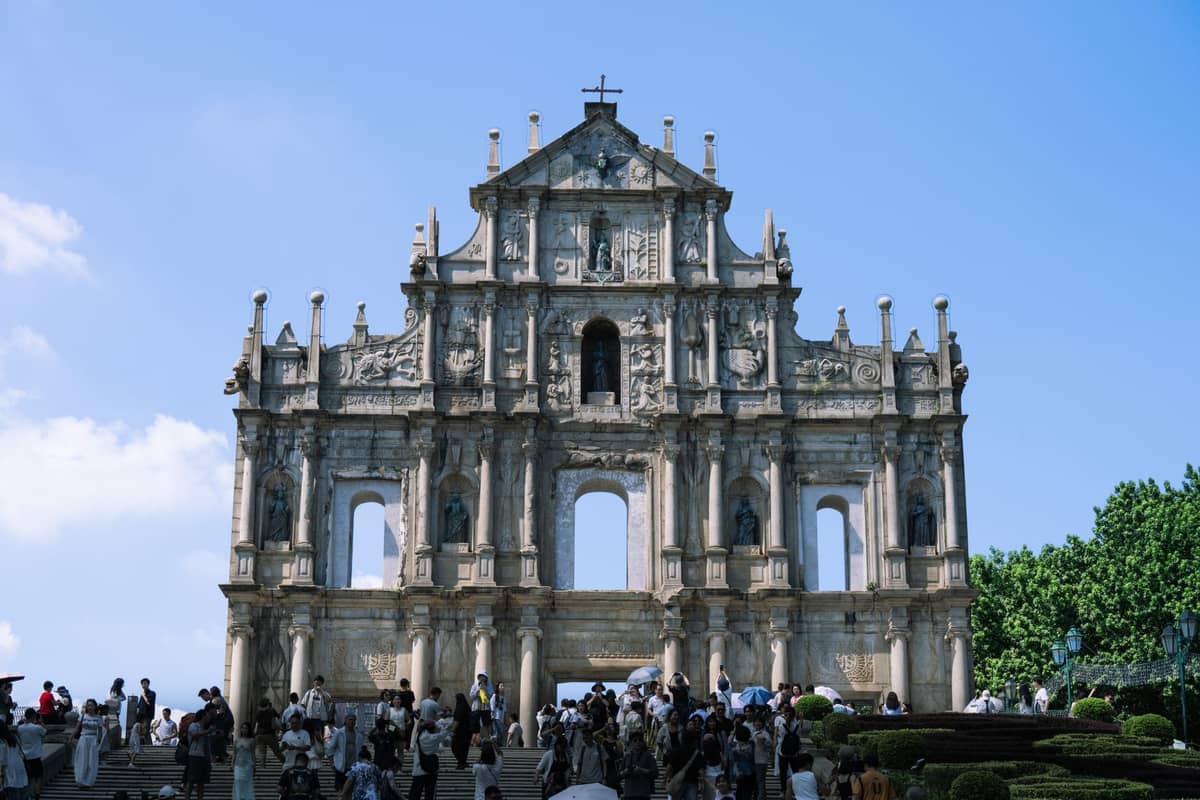
What You're Actually Looking At
The Ruins of St. Paul's is exactly what the name says: the surviving stone façade of the Church of Mater Dei, originally completed in 1640 and attached to one of Asia's earliest Western universities, St. Paul's College. In 1835, a fire that began in the college kitchen swept through the complex and consumed everything combustible. What remained was a 23-metre-wide, 25.5-metre-tall baroque stone front, now standing alone against the sky like a theatrical backdrop with no stage behind it.
Known in Cantonese as 大三巴牌坊 (Daaih Saam Baa Paai Fong), the structure is formally listed as part of the Historic Centre of Macao, a UNESCO World Heritage Site. It is not a reconstructed ruin or a replica. The carved stone you see, with its five tiers of statues, religious symbols, and Portuguese and Chinese inscriptions, is original 17th-century work, completed by Japanese Christian exiles and local craftspeople under Jesuit supervision.
The iconography rewards close attention. The second tier shows the Virgin Mary surrounded by images of a Chinese dragon, a Portuguese galleon, and a hydra. The juxtaposition of Asian and European symbolism was deliberate: the Jesuits understood they were operating at a cultural frontier, and the façade was designed to speak to both worlds simultaneously.
💡 Local tip
Bring binoculars or use your phone's zoom to read the carved details on the upper tiers. The fifth tier bears a dove above a cross flanked by sun, moon, and star motifs — easily missed at ground level.
How the Experience Changes by Time of Day
The outdoor staircase and façade are accessible around the clock as unenclosed public space, but the controlled monument area and Museum of Sacred Art open at 09:00 and close at 18:00, with no admission after 17:30. The museum closes Tuesday afternoons after 14:00, so plan accordingly if that is your only available day.
Early morning, between 09:00 and 10:00, is the most useful window for photography and quiet contemplation. The stone takes on a warm tone in the low eastern light, and the steps in front of the façade are largely empty. Street vendors along the approach lanes are just setting up, and you can smell the charcoal smoke from almond cookie shops before you reach the top of the hill.
By 11:00, coach tour groups begin arriving from ferry terminals and casino hotels. The wide staircase fills quickly. At peak hours in the afternoon, particularly on weekends and public holidays, the crowd density on the steps makes contemplative photography difficult. The sound environment shifts from relative quiet to a continuous murmur of dozens of languages, punctuated by tour guide microphones. This is not necessarily unpleasant, but it is a different experience.
Late afternoon, around 16:30 to 17:00, offers a second lull as day-trippers head back toward ferry terminals. The light becomes golden and falls directly on the face of the façade. If you can tolerate the midday crowds elsewhere and return before closing, this is the most photogenic hour of all.
⚠️ What to skip
On weekends and during major events like Chinese New Year, the approach lanes become extremely congested. Expect slow movement through the vendor corridor on Rua de São Paulo from late morning onward.
The Museum of Sacred Art and Crypt
Most visitors stop at the base of the steps or the top of the staircase for photographs and move on. This misses the most historically substantive part of the site. Behind the façade, accessed through a doorway cut into the base of the structure, is the Museum of Sacred Art, which houses a collection of religious paintings, wooden sculptures, and ritual objects from Macau's Catholic heritage, including works brought from Japan by Jesuit missionaries expelled during the 17th-century persecutions.
The crypt beneath the museum contains the bones of Japanese and Vietnamese Christian martyrs, interred here after their execution in the early 1600s. The display is sombre and thoughtful rather than sensationalised. A silver reliquary containing the remains of Marcello Mastrilli, a Jesuit martyr, is among the more significant objects. This is not a polished international museum with interactive displays; the presentation is modest, the lighting dim, and the labels factual. It suits the material.
Allow 20 to 30 minutes inside. There is no cafe, shop, or seating inside the museum. The space is small and cool, providing genuine relief on hot or humid days.
The Surrounding Streets and How to Use Them
The approach to the Ruins along Rua de São Paulo is one of Macau's most commercially dense pedestrian corridors. Shops sell beef jerky, almond cookies, pork chop buns, egg rolls, and a range of packaged Macanese food products. Free samples are offered constantly. The corridor is worth navigating for the food alone, even if you find the tourist commerce around it formulaic. For a broader context on Macau's street food scene, the Macau street food guide covers the best options across the peninsula.
The lanes immediately north and east of the ruins, including Calçada de São Paulo and the alleyways around Fortaleza do Monte, are quieter and architecturally interesting. The Fortaleza do Monte sits directly behind and above the ruins on a hillside; it is reachable via a short uphill path and offers one of the best elevated views over the façade and surrounding rooftops. Few visitors make this short detour.
For a more structured exploration of the area, the Macau heritage walk covers the Historic Centre in a logical sequence that includes the Ruins, the fort, and Senado Square in a single half-day route.
Historical Context: Why This Monument Matters
St. Paul's College, founded in 1594, was the first Western-style university in East Asia. It operated alongside the adjacent church for over two centuries, training missionaries bound for China, Japan, Korea, and Southeast Asia. The Portuguese enclave of Macau was, in the late 16th and early 17th centuries, one of the most strategically important points of cultural contact between Europe and East Asia. The college and church were central to that project.
The construction of the Church of Mater Dei between 1602 and 1640 brought together craftspeople from multiple cultures under Jesuit direction. Japanese Christians who had fled persecution in Japan following Toyotomi Hideyoshi's 1597 crackdown on Christianity contributed significant labour and craft knowledge. The resulting structure was genuinely syncretic, rather than being a transplanted European church placed in an Asian setting.
After the fire of 1835, the ruins sat largely neglected until the late 20th century, when archaeological excavation and heritage conservation efforts brought the crypt to light and stabilised the façade. The UNESCO listing of the Historic Centre of Macao in 2005 brought international formal recognition. The ruins are now the single most visited attraction in Macau and function as an unofficial symbol of the territory's mixed heritage.
Practical Information
- Monument area and museum: open daily 09:00–18:00, last admission 17:30
- Museum closed Tuesday afternoons after 14:00
- Outdoor façade and staircase: viewable at all hours; main access remains via the long stone staircase
- Admission: free for all areas including the museum and crypt
- Address: Company of Jesus Square, Santo António, Macau Peninsula
- On foot from Senado Square: approximately 5–10 minutes uphill via Rua de São Paulo
- By taxi: ask for 大三巴 (Daaih Saam Baa) or Ruins of St. Paul's
- Nearest bus stops: around Senado Square and Rua de Santo António; multiple routes serve the area from major ferry terminals and casino hotels
ℹ️ Good to know
The long stone staircase leading up to the façade is the primary access route. It is not wheelchair accessible, and there is no lift or ramp directly onto the façade itself; visitors with mobility impairments should be aware of the incline and uneven stone surfaces.
Weather affects the experience significantly. Macau's summers (June to September) are hot and humid, with temperatures frequently reaching the high 20s to low 30s Celsius. The staircase is fully exposed. Autumn, particularly October to November, offers the most comfortable outdoor conditions, with lower humidity and reliably sunny days. For a full breakdown of seasonal considerations, see the best time to visit Macau guide.
Photography Tips
The standard photograph is taken from the base of the staircase, looking up at the façade with the steps in the foreground. This works, and it will always work, but it is what every visitor takes. For something less generic, consider the following.
- Shoot from the top of the staircase looking back down over the square and lanes below: this gives context and crowd dynamics rather than a postcard image
- Use the doorways and archways of adjacent buildings along the approach lanes to frame the façade
- The view from the Fortaleza do Monte directly behind gives an unusual elevated angle showing the façade in relation to the surrounding cityscape
- Blue hour, just after sunset, renders the stone in deep grey-blue tones against a darkening sky — the façade is lit by ground-level spotlights that become visible at dusk
- Overcast days diffuse harsh shadows across the carved relief work and can produce cleaner detail shots than direct sunlight
Insider Tips
- Walk up the narrow lane to the left of the main staircase rather than through the central vendor corridor: it is quieter, shaded, and shows the residential neighbourhood that exists just a few steps from the tourist centre.
- The Fortaleza do Monte, directly above and behind the ruins, is reachable in under five minutes and offers the best overhead perspective of the façade. Most visitors never make this short detour.
- Tuesday afternoons are the one time to avoid the museum specifically, as it closes early. If your visit falls on a Tuesday, prioritise the museum in the morning and the street food lanes after.
- The Na Tcha Temple, a small Taoist shrine, sits immediately adjacent to the ruins on the left side of the approach. It is easy to miss but provides an immediate counterpoint to the Catholic monument — two very different religious traditions within ten metres of each other.
- If you are visiting during a typhoon warning period, check the Macau Meteorological and Geophysical Bureau signal levels before heading out. At higher signal levels, outdoor sites including the ruins may be effectively inaccessible due to safety closures or transportation disruption.
Who Is Ruins of St. Paul's For?
- First-time visitors to Macau who want to understand the territory's Portuguese colonial and Jesuit heritage
- Photographers looking for iconic shots with the option of less-visited angles
- History and architecture enthusiasts willing to slow down and read the iconography
- Visitors combining the ruins with a broader heritage walk through the Historic Centre
- Travellers doing Macau on a budget, since the entire site including the museum is free
Nearby Attractions
Other things to see while in Macau Peninsula:
- A-Ma Temple (Ma Kok Miu)
A-Ma Temple, known locally as Ma Kok Miu, is the oldest temple in Macau, with origins traced to 1488. Part of the UNESCO-listed Historic Centre of Macao, this atmospheric complex blends Taoist, Buddhist, Confucian, and folk traditions across six distinct halls climbing Barra Hill. Entry is free, and the site remains an active place of worship year-round.
- Camões Grotto and Casa Garden
Tucked into the northwest of the Macau Peninsula, Camões Grotto and Casa Garden form one of the city's most layered heritage sites. The park honors Portugal's greatest poet in a setting of banyan trees and rocky outcrops, while the adjacent 18th-century mansion carries the architectural weight of colonial trade history. Both are free to enter and rarely crowded.
- Dom Pedro V Theatre
The Dom Pedro V Theatre (Teatro Dom Pedro V) is the oldest Western-style performance venue in East Asia, completed in 1860 and — though normally a working venue — temporarily closed for renovation until early October 2026. Its pale green neoclassical facade on Largo de Santo Agostinho is one of the most photogenic and historically layered corners of the Macau Peninsula, and admission is free when it is open to visitors
- Fortaleza do Monte (Mount Fortress)
Fortaleza do Monte, built between 1617 and 1626, rises above the historic centre of Macau with cannon-lined ramparts, sweeping 360-degree views, and the acclaimed Macao Museum within its walls. For the price of a cup of coffee, or nothing at all on free days, this UNESCO-listed site delivers more history per square metre than almost anywhere else in the city.