Dom Pedro V Theatre: Macau's Living Monument to Colonial Culture
The Dom Pedro V Theatre (Teatro Dom Pedro V) is the oldest Western-style performance venue in East Asia, completed in 1860 and — though normally a working venue — temporarily closed for renovation until early October 2026. Its pale green neoclassical facade on Largo de Santo Agostinho is one of the most photogenic and historically layered corners of the Macau Peninsula, and admission is free when it is open to visitors
Quick Facts
- Location
- Largo de Santo Agostinho 11, Macau Peninsula
- Getting There
- Bus No. 18, or a 5-minute walk from Senado Square
- Time Needed
- 30–60 minutes for interior; allow extra time to explore the square
- Cost
- Free admission when open
- Best for
- Architecture lovers, history buffs, photography, quiet sightseeing
- Official website
- www.wh.mo/theatre/en
What the Dom Pedro V Theatre Actually Is
The Dom Pedro V Theatre is not a ruin, not a converted museum, and not a replica. It is a working performance hall that has been welcoming audiences since 1860, though at present it is temporarily closed for internal renovation works scheduled to be completed by early October 2026, making it the oldest Western-style theatre in East Asia. That fact alone distinguishes it from most of the historic architecture you will encounter in Macau, where preservation often means roping something off and selling tickets to look at it.
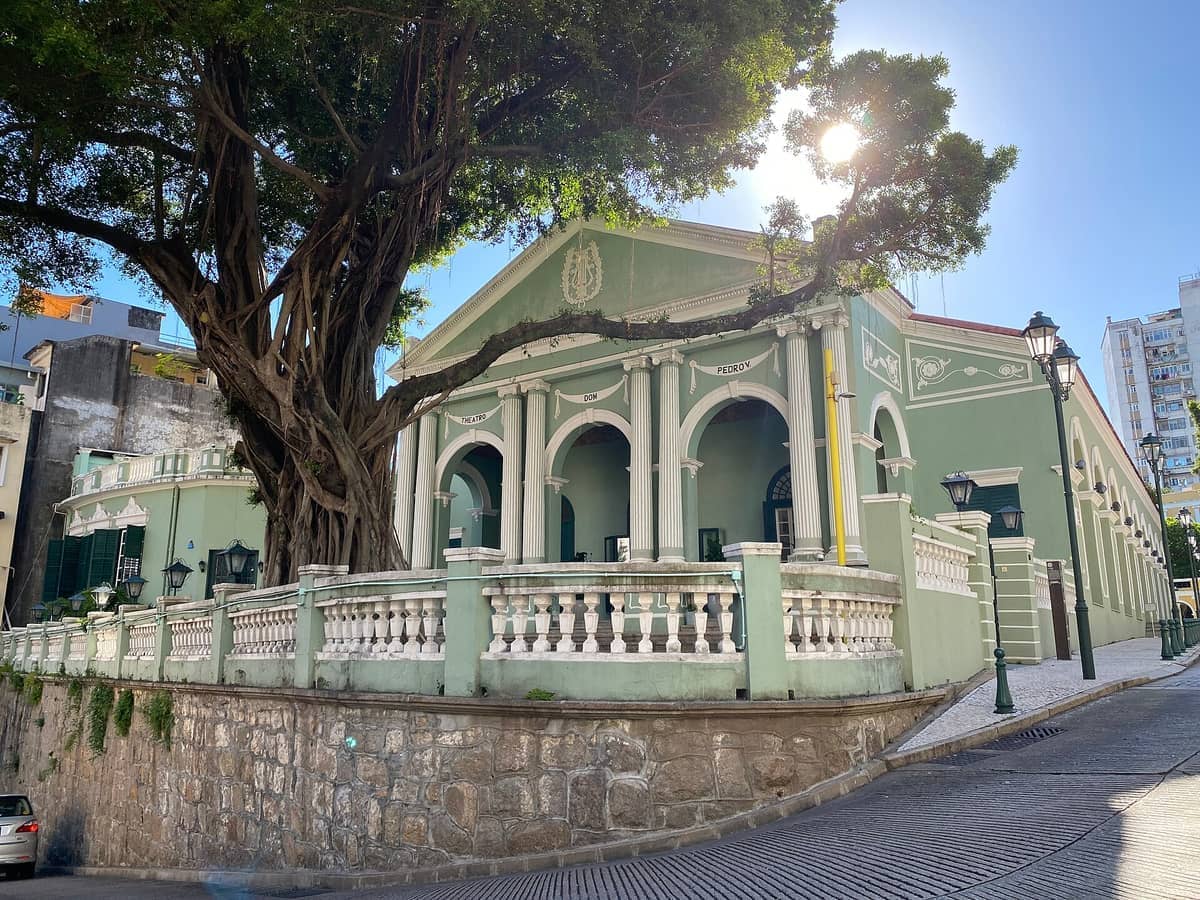
The building stands at Largo de Santo Agostinho, a small, quietly dignified square on the Macau Peninsula framed by a cluster of colonial-era structures. The theatre's neoclassical facade is pale green with white detailing — a color combination so characteristic of Macau's Portuguese-influenced architecture that it almost reads as a deliberate design motif across the city. The portico that gives the facade its formal, colonnaded appearance was added in 1873, thirteen years after the main structure was completed, and it significantly sharpened the building's street presence.
The theatre sits within Macau's UNESCO-designated Historic Centre, which means it belongs to a broader constellation of monuments within walking distance. The Leal Senado building and St. Dominic's Church are both reachable in under ten minutes on foot, making this square a natural waypoint on any heritage walk through the peninsula.
The Architecture Up Close
The building measures 41.5 metres long and 22 metres wide, with a roof ridge at 12 metres and eaves sitting at 7.5 metres. Those proportions give it a solidity and depth that photographs rarely convey. Standing directly in front of the portico, the columns and arched openings frame views of the square behind you in a way that feels almost theatrical itself — which, given the building's purpose, is appropriate.
The interior holds 276 seats in the main performance hall. The space is intimate by modern standards: the kind of venue where every seat is close to the stage and sound travels without amplification. The decor reflects periodic restoration efforts that have kept the structure functional without stripping out its historical character. The wooden elements, the curved balcony lines, and the proportional restraint of the hall make it one of the more beautiful small theatres you are likely to encounter in the region.
💡 Local tip
Check the official website (wh.mo/theatre/en/) before visiting to see if a performance is scheduled during your trip. Attending even a short recital here adds a dimension to the visit that a daytime walk-through simply cannot replicate.
Historical Context: Why This Building Exists Here
Macau was a Portuguese trading post from the mid-16th century and remained under Portuguese administration until 1999, when sovereignty was transferred to the People's Republic of China under the 'one country, two systems' framework. For roughly four centuries, Macau was one of the most significant points of cultural contact between Europe and Asia — and the theatre is a physical product of that encounter.
When the theatre was completed in 1860, it served the Portuguese colonial community as a social and cultural anchor: a place for European-style opera, drama, and musical performance in a city that was geographically isolated from Lisbon by months of sea travel. It was named after King Dom Pedro V of Portugal, who reigned from 1853 to 1861. The construction of a theatre of this ambition in a city of this size and remoteness says something about how seriously the colonial community took the maintenance of European cultural identity.
This cultural layering is part of what makes the Macau Peninsula so rewarding to explore systematically. The theatre sits only a short walk from the Mandarin House, a wealthy Chinese merchant's residence from roughly the same era, which illustrates how different the lived experiences of the city's two dominant communities were — even when they occupied the same small peninsula.
Visiting: What to Expect at Different Times of Day
The theatre normally opens at 10:00 and closes at 18:00, and is closed on Tuesdays; however, it is currently temporarily closed for internal renovation works until early October 2026. On public holidays it has typically remained open, which is worth knowing if you are visiting around Chinese New Year or other festival periods once it reopens.
Early morning, before 10:00, is actually one of the better times to photograph the facade. Largo de Santo Agostinho receives soft morning light and has minimal foot traffic at that hour. Locals cross the square on the way to work, occasionally a delivery is made to one of the nearby buildings, and the relative quiet makes the square feel like it belongs to a different, slower city than the casino strip visible from higher ground. Once the doors are open in normal operation, the interior is worth entering even if no performance is scheduled — the hall itself is open for visitors to see, although access is currently paused during renovation.
Midday brings more tourist traffic, particularly tour groups working their way through the UNESCO sites. The square can feel crowded between roughly 11:00 and 14:00. Late afternoon, from around 15:30 onward, tends to thin out again. The golden hour light on the pale green facade is genuinely striking, particularly if you position yourself slightly to the side to catch the columns in relief.
ℹ️ Good to know
Weather matters here more than at some indoor-heavy attractions. The open square in front of the theatre offers little shade, so visiting in summer (June to September) means arriving early or late to avoid the peak heat and humidity. Autumn — particularly October and November — offers the most comfortable conditions for spending time in the square and exploring the surrounding streets.
The Square and Its Surroundings
Largo de Santo Agostinho is one of the more composed urban spaces on the peninsula. In addition to the theatre, the square is flanked by the Church of Santo Agostinho (an Augustinian church with its own notable history) and the Sir Robert Ho Tung Library, a former private mansion turned public reading room with a garden courtyard.
The Sir Robert Ho Tung Library is free to enter and worth a few minutes even if you have no intention of reading. Its rear garden is one of the quieter green spaces in the historic core, and the building itself — a blend of Western and Chinese architectural elements — reflects the same hybrid cultural identity as the theatre. Treating the square as a single destination rather than stopping only at the theatre makes for a more complete experience.
From the square, it is a short walk to the Ruins of St. Paul and the Na Tcha Temple — the route takes you through some of the most historically dense streets in Macau. If you are planning a full day on the peninsula, the Macau heritage walk guide maps a logical sequence that includes all of these sites.
Photography Notes
The facade is the primary subject for most visitors. The pale green and white palette photographs well in overcast light, which is common in Macau for much of the year, but warm directional light in the early morning or late afternoon adds texture to the columns and cornice details. A wide angle is useful for capturing the full portico without backing into the center of the square, which can be difficult when tour groups are present.
Interior photography is generally permitted when performances are not in session, but confirm on arrival; note that during the current renovation closure interior access is not available. The warm wood tones of the hall interior and the curved balcony create depth that rewards a slightly longer exposure in the available light, rather than flash.
⚠️ What to skip
If you are visiting specifically to photograph the interior, Tuesday closures, any scheduled rehearsals or technical setups, and the current renovation works can limit access even during normal opening hours. Check the official site for performance and reopening schedules in advance.
Who Should Skip This
Travelers whose primary interest is Macau's casino scene or large-scale entertainment will find the Dom Pedro V Theatre low on spectacle by comparison. It is a modest building of significant historical weight, not a dramatic landmark visible from a distance. If your time in Macau is genuinely limited to a few hours focused on the main highlights, the Ruins of St. Paul and Senado Square will likely take precedence. The theatre rewards visitors who slow down and engage with it rather than those ticking boxes on a compressed itinerary.
Visitors with mobility limitations should be aware that the square itself involves some uneven stone paving typical of Macau's historic districts, and that there is no confirmed official accessibility information for the interior. If accessibility is a concern, contact the venue directly before visiting.
Insider Tips
- Check the official performance calendar at wh.mo/theatre/en/ before your visit, particularly once the current renovation works are completed. The theatre hosts concerts, recitals, and cultural events that are open to the public, sometimes at very low cost or free. Attending a live performance in a 276-seat neoclassical hall from 1860 is a significantly different experience from a daytime tour.
- Arrive at Largo de Santo Agostinho before 10:00 to photograph the facade without crowds. The Sir Robert Ho Tung Library garden next door is a good place to wait quietly until the theatre opens.
- The square is significantly quieter on weekday mornings compared to weekends. If you are visiting during a public holiday, expect more foot traffic but also a livelier atmosphere in the surrounding streets.
- Combine the theatre with the Mandarin House and the Lou Kau Mansion on the same morning walk. All three are free, all are within ten minutes of each other on foot, and together they illustrate the Portuguese and Chinese sides of Macau's 19th-century social history more effectively than any single site alone.
- The pale green facade looks its best when lit by indirect or overcast light. Harsh midday sun flattens the columns and bleaches the color. Plan photography for before 10:30 or after 16:00 if you want the most texture and warmth in your shots.
Who Is Dom Pedro V Theatre For?
- Architecture and design enthusiasts who appreciate neoclassical European buildings in unexpected geographic contexts
- History travelers building a picture of Macau's Portuguese colonial era beyond the more famous Ruins of St. Paul
- Photographers seeking a quieter, more composed facade shot than the crowded main heritage sites
- Culture-focused visitors who want to attend a live performance in a genuinely historic, intimate venue
- Slow travelers who prefer depth over volume and enjoy spending time in a single well-layered neighborhood
Nearby Attractions
Other things to see while in Macau Peninsula:
- A-Ma Temple (Ma Kok Miu)
A-Ma Temple, known locally as Ma Kok Miu, is the oldest temple in Macau, with origins traced to 1488. Part of the UNESCO-listed Historic Centre of Macao, this atmospheric complex blends Taoist, Buddhist, Confucian, and folk traditions across six distinct halls climbing Barra Hill. Entry is free, and the site remains an active place of worship year-round.
- Camões Grotto and Casa Garden
Tucked into the northwest of the Macau Peninsula, Camões Grotto and Casa Garden form one of the city's most layered heritage sites. The park honors Portugal's greatest poet in a setting of banyan trees and rocky outcrops, while the adjacent 18th-century mansion carries the architectural weight of colonial trade history. Both are free to enter and rarely crowded.
- Fortaleza do Monte (Mount Fortress)
Fortaleza do Monte, built between 1617 and 1626, rises above the historic centre of Macau with cannon-lined ramparts, sweeping 360-degree views, and the acclaimed Macao Museum within its walls. For the price of a cup of coffee, or nothing at all on free days, this UNESCO-listed site delivers more history per square metre than almost anywhere else in the city.
- Grand Lisboa
Grand Lisboa is the lotus-shaped tower that defines the Macau Peninsula skyline. Operated by SJM, it combines a 24-hour casino, a cluster of high-end restaurants, and a landmark hotel on Avenida de Lisboa. Whether you're here to gamble, dine, or simply photograph one of Asia's most distinctive buildings, this guide tells you exactly what to expect.