Na Tcha Temple: Macau's Smallest UNESCO Site with the Biggest Story
Built in 1888 and wedged against the ancient stone wall of St. Paul's College, Na Tcha Temple is one of the most photographed yet least understood spots in Macau. Free to enter, historically rich, and genuinely compact, it tells a story of plague, faith, and cultural survival in just a few square metres.
Quick Facts
- Location
- No. 6 Pátio do Espinho, next to the Ruins of St. Paul's College, Macau Peninsula
- Getting There
- Walk from Senado Square (approx. 10 min uphill) or take a bus toward the Ruins of St. Paul's area
- Time Needed
- 15–30 minutes for the temple and exhibition room combined
- Cost
- Free admission (temple and Na Tcha Exhibition Room)
- Best for
- History lovers, heritage walkers, photography, and anyone curious about Macau's layered identity
- Official website
- www.macaotourism.gov.mo/en/sightseeing/temples/na-tcha-temple
What Makes Na Tcha Temple Worth Stopping For
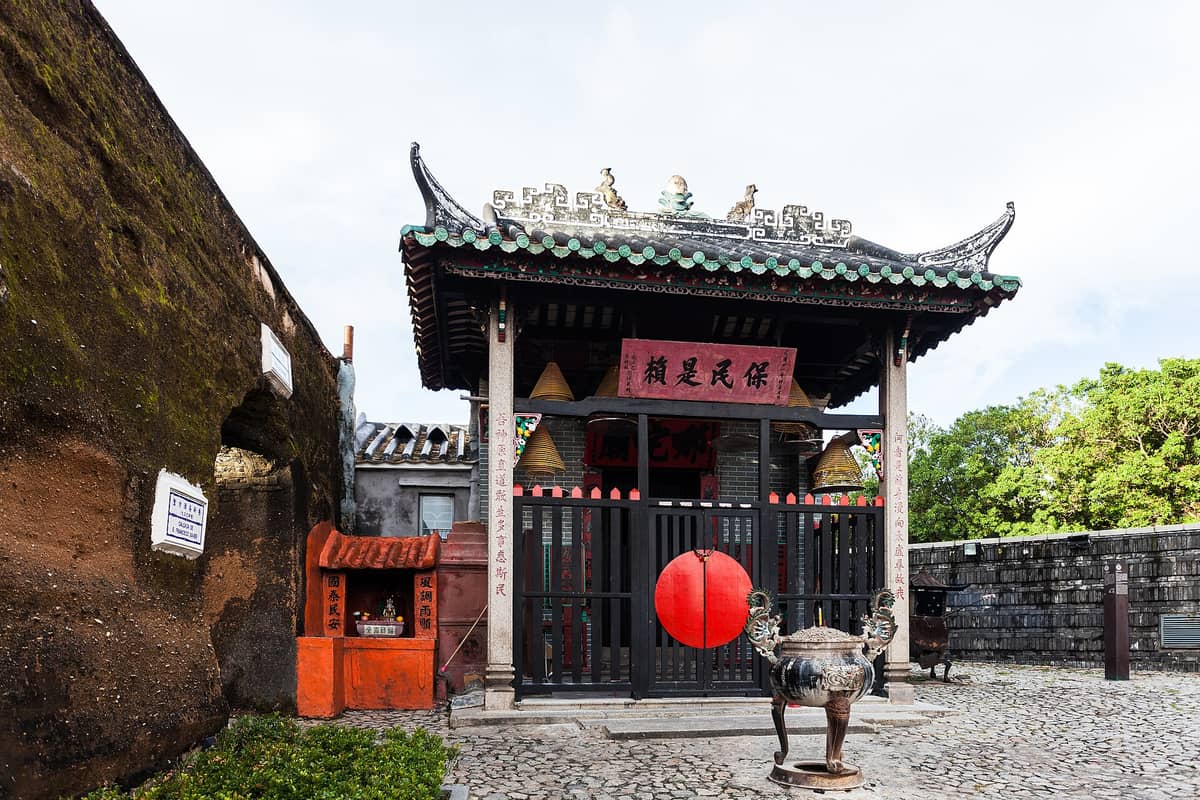
Na Tcha Temple sits so close to the towering stone facade of the Ruins of St. Paul's that first-time visitors routinely walk past it without noticing. That is part of what makes it remarkable. This small Taoist shrine, built in 1888 and dedicated to Na Tcha, a child deity associated with protection and good fortune, is one of the monuments that together form Macau's UNESCO-listed Historic Centre. It is not grand. It is not imposing. But the story it carries and the visual contrast it creates, pressed against a Catholic ruin from the 17th century, make it one of the more thought-provoking stops on any heritage walk through the peninsula.
Entry is free, hours are predictable, and the experience takes under half an hour if you include the adjacent Na Tcha Exhibition Room. For travellers who treat Macau as a casino destination with a quick detour to St. Paul's, this temple is the kind of detail that reframes the whole place.
💡 Local tip
The Na Tcha Exhibition Room (free, open 10am–6pm, closed Wednesdays) is limited to 20 visitors at a time. If you arrive mid-morning on a weekend and find a short wait, it usually moves quickly.
The History Behind the Shrine
The temple was constructed in 1888 during a severe plague outbreak that swept through Macau. Local residents built the shrine to Na Tcha in the hope that the deity's protective powers would bring the epidemic to an end. The choice of location was deliberate: it stands directly beside the old boundary wall of St. Paul's College, part of the former Jesuit complex whose famous stone facade survived after the church burned down in 1835. Placing a Taoist temple against the remnant of a Jesuit institution encapsulates something essential about Macau's identity, namely, that Chinese and Portuguese cultures did not simply coexist here; they built on top of each other, literally.
Na Tcha is worshipped across southern China and among Cantonese diaspora communities worldwide. Often depicted as a young boy warrior carrying a red sash and a spear, the deity is believed to protect children and repel evil. The temple's construction during a public health crisis reflects the way religious practice in this part of China has always been tied to immediate, practical concerns. For a broader look at how temples function as living community spaces across Macau, the guide to Macau's temples provides useful context.
What the Temple Actually Looks Like
Na Tcha Temple is genuinely small, roughly the size of a large living room. The exterior is painted in the warm ochre and green tones typical of southern Chinese religious architecture, with a curved roof edged in ceramic tiles and small decorative figurines along the ridge. Red lanterns hang at the entrance, and the smell of incense coils out from inside even when the flow of visitors is light.
Step inside and the interior is dimly lit, with a central altar holding a gilded effigy of Na Tcha, surrounded by offerings of fruit, flowers, and paper goods. Thin sticks of incense burn in a heavy brass urn. The smoke gives the air a faintly woody, resinous scent that clings briefly to clothing. There are plaques, inscriptions in Chinese characters, and small devotional objects placed by worshippers. This is still an active place of worship, not a museum exhibit dressed up as one.
The old boundary wall of St. Paul's College runs directly behind and beside the temple, its rough-hewn granite blocks a strong visual contrast to the colourful ceramic roof of the shrine. That wall is part of the Historic Centre's heritage fabric, and standing at the junction of the two, you can see the entire breadth of Macau's layered past in a single glance.
How the Experience Changes by Time of Day
Early mornings, from opening at 8am until around 9:30am, are when the temple functions most purely as a religious site. Local worshippers come to pray, light incense, and leave offerings before the tourist traffic begins. The alley outside is quieter, the air cooler, and the smells of incense and fresh flowers are stronger without the competing scents of nearby food stalls. If you are primarily interested in the atmosphere of the place as a working temple, this is the window to aim for.
By mid-morning, the Ruins of St. Paul's above fills with visitors, and the foot traffic past Na Tcha Temple increases sharply. Many people photograph the exterior while barely pausing to enter. The space inside remains calm by contrast, since the small footprint and limited visitor capacity keep it from ever feeling crowded. Afternoons can feel warmer and more rushed, particularly in summer when temperatures climb into the low 30s°C and the narrow lane offers little shade.
The temple closes at 5pm, which means it catches the late-afternoon light well in autumn and winter, when the sun drops low and the ochre exterior glows. October through December, when humidity is lower and temperatures sit in the low-to-mid 20s°C, is the most comfortable time of year to visit this part of Macau on foot.
⚠️ What to skip
In typhoon season (roughly July–September), the area around St. Paul's can be disrupted by weather closures and warnings. Check the Macau Meteorological and Geophysical Bureau before planning outdoor heritage walks during these months.
The Na Tcha Exhibition Room
Adjacent to the temple is the Na Tcha Exhibition Room, managed by the Cultural Affairs Bureau (ICB). It is open from 10am to 6pm daily except Wednesdays, with no admission after 5:30pm. Entry is free. The exhibition focuses on the worship of Na Tcha in Macau, including traditional costumes, ceremonial items, and materials documenting the temple's history and the plague-era context in which it was built.
The exhibition room has a visitor capacity of 20 people at one time, which is enforced by staff at the entrance. The combination of the temple and the room together gives a much fuller picture of Na Tcha worship than the temple alone.
Photography and Practical Notes
Na Tcha Temple photographs well from across the narrow lane, where you can frame the temple's colourful facade against the grey granite of the old college wall. The contrast in colour, texture, and architectural language is striking. Early morning light falls well on the entrance if you position yourself to the south-east of the building. A wide or standard lens works better than telephoto in this tight space.
Inside, the lighting is low and warm. Photography is generally permitted, but visitors should be mindful that worshippers may be present. Avoid photographing people in prayer without clear permission. The incense smoke can scatter light in an interesting way if your camera handles low-light conditions well.
Na Tcha Temple sits on the walking route between Senado Square at the base of the hill and the Ruins of St. Paul's at the top. Walking this route is how most visitors arrive, and it takes about 10 minutes at a moderate pace. Detailed walking routes through this part of Macau's historic core are covered in the Macau heritage walk guide, which sequences the nearby monuments efficiently.
ℹ️ Good to know
The temple may be difficult for wheelchair users due to the stepped, narrow lane context of the heritage area. Visitors with mobility limitations should factor this in when planning.
Fitting Na Tcha Into Your Macau Visit
Because Na Tcha Temple is located immediately beside the Ruins of St. Paul's, it adds virtually no detour to any itinerary that already includes that landmark. The logical sequence is to approach from Senado Square, pass the temple on your way up the lane, visit the ruins, and then stop into the exhibition room on your way back down. The whole cluster, including the ruins and the exhibition room, fits easily into 45–60 minutes.
Visitors with more time can extend the walk to include the Fortaleza do Monte immediately to the east, which houses the Macau Museum and offers panoramic views over the peninsula. This pairing of Portuguese military architecture and Chinese religious history captures the dual character of the Historic Centre more completely than any single site alone.
If you are building a full day around Macau's heritage sites, the one-day Macau itinerary sequences Na Tcha and its neighbours alongside other key stops on the peninsula, including Senado Square and the colonial streetscape between them.
Insider Tips
- Arrive before 9am to see local worshippers lighting incense and making offerings. The atmosphere is noticeably different from the tourist hours that follow — quieter, more purposeful, and more honest as a representation of how the temple actually functions.
- The old boundary wall of St. Paul's College running alongside the temple is part of Macau's heritage landscape. Look for the worn stonework and the way the wall integrates with the temple's side elevation — it is one of the clearest physical illustrations of Macau's layered history.
- The exhibition room's 20-person capacity limit means you may wait briefly during peak times, but the staff rotate visitors efficiently. It is worth the wait: the ceremonial costumes and incense burners on display give context that the temple interior alone does not.
- If you are visiting in autumn or winter, the low-angle afternoon light between 3pm and 4:30pm catches the ochre-painted facade beautifully before the temple closes at 5pm. This is one of the better photography windows in the historic district.
- The alley leading to the temple has several stalls selling almond biscuits, pork jerky, and egg rolls — local snacks worth trying. Buying from the smaller family-run stalls rather than the larger chain shops closer to Senado Square is both more interesting and usually cheaper.
Who Is Na Tcha Temple For?
- History and heritage enthusiasts who want to understand Macau beyond its casino identity
- Photographers looking to capture the visual tension between Chinese and Portuguese colonial architecture
- Travellers on a tight budget: the temple and exhibition room are both free
- Anyone already visiting the Ruins of St. Paul's who has an extra 15–20 minutes
- Visitors interested in Taoist religious practice and southern Chinese folk traditions
Nearby Attractions
Other things to see while in Macau Peninsula:
- A-Ma Temple (Ma Kok Miu)
A-Ma Temple, known locally as Ma Kok Miu, is the oldest temple in Macau, with origins traced to 1488. Part of the UNESCO-listed Historic Centre of Macao, this atmospheric complex blends Taoist, Buddhist, Confucian, and folk traditions across six distinct halls climbing Barra Hill. Entry is free, and the site remains an active place of worship year-round.
- Camões Grotto and Casa Garden
Tucked into the northwest of the Macau Peninsula, Camões Grotto and Casa Garden form one of the city's most layered heritage sites. The park honors Portugal's greatest poet in a setting of banyan trees and rocky outcrops, while the adjacent 18th-century mansion carries the architectural weight of colonial trade history. Both are free to enter and rarely crowded.
- Dom Pedro V Theatre
The Dom Pedro V Theatre (Teatro Dom Pedro V) is the oldest Western-style performance venue in East Asia, completed in 1860 and — though normally a working venue — temporarily closed for renovation until early October 2026. Its pale green neoclassical facade on Largo de Santo Agostinho is one of the most photogenic and historically layered corners of the Macau Peninsula, and admission is free when it is open to visitors
- Fortaleza do Monte (Mount Fortress)
Fortaleza do Monte, built between 1617 and 1626, rises above the historic centre of Macau with cannon-lined ramparts, sweeping 360-degree views, and the acclaimed Macao Museum within its walls. For the price of a cup of coffee, or nothing at all on free days, this UNESCO-listed site delivers more history per square metre than almost anywhere else in the city.