A-Ma Temple (Ma Kok Miu): Macau's Oldest Temple and Living Place of Worship
A-Ma Temple, known locally as Ma Kok Miu, is the oldest temple in Macau, with origins traced to 1488. Part of the UNESCO-listed Historic Centre of Macao, this atmospheric complex blends Taoist, Buddhist, Confucian, and folk traditions across six distinct halls climbing Barra Hill. Entry is free, and the site remains an active place of worship year-round.
Quick Facts
- Location
- Largo da Barra (Barra Square), Rua de São Tiago da Barra, São Lourenço, Macau Peninsula
- Getting There
- Bus routes 1, 2, 5, 6B, 7, 10, 10A, 11, 18, 21A to stop A-Ma Temple; taxi from Senado Square approx. MOP 25–35
- Time Needed
- 45–90 minutes for the full complex; longer if combined with the heritage walk from Senado Square
- Cost
- Free admission; incense bundles available for approximately MOP 10–20 (donation-based)
- Best for
- History lovers, culture travelers, photographers, and anyone curious about Macau before the casinos arrived
- Official website
- www.macaotourism.gov.mo/en/sightseeing/temples/a-ma-temple
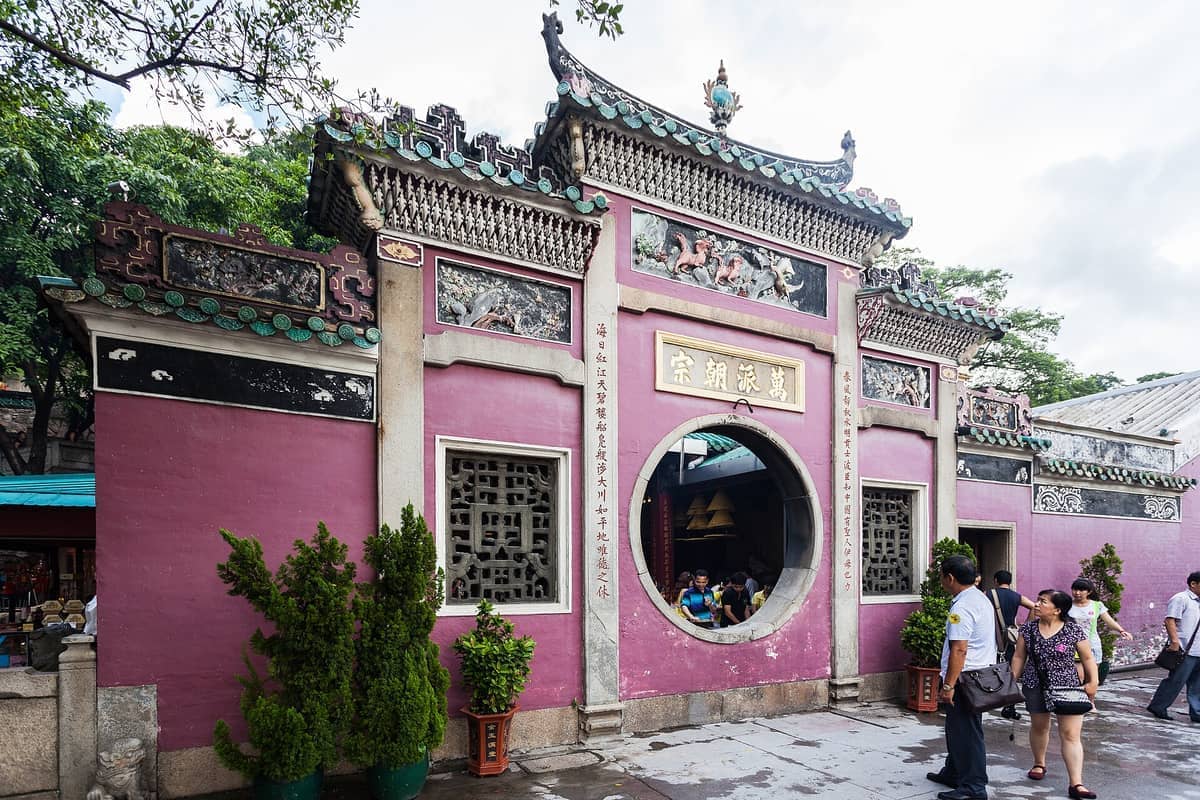
Why A-Ma Temple Deserves Your Attention
A-Ma Temple sits at the southwestern tip of the Macau Peninsula, tucked against the lower slopes of Barra Hill and facing the Inner Harbour. This is the oldest temple in Macau, with a founding tradition dating to 1488, which means it predates the arrival of the Portuguese by several decades. When the first Portuguese sailors landed here in the early 16th century, they asked locals the name of the place. They were pointing at the temple of A-Ma, the sea goddess. Their answer gave Macau its name.
That origin story, whether taken as pure fact or embellished tradition, tells you something important about this site. It sits at the very beginning of Macau's recorded history as a crossroads between Chinese and European worlds. Today, it is a component of the UNESCO-listed Historic Centre of Macao, and it remains a functioning religious complex where worshippers arrive daily with incense and prayers, not just tourists with cameras.
💡 Local tip
Opening hours are commonly listed as 08:00–18:00 daily, though the Macao Government Tourism Office cites 07:00–18:00 on some pages. To be safe, arrive after 08:00 and plan to leave before 17:30.
The Complex: Six Structures, One Hill
A-Ma Temple is not a single building. It is a cluster of six distinct structures arranged up the hillside: the Gate Pavilion, Memorial Arch, Prayer Hall, Hall of Benevolence, Hall of Kuan Yin, and the Zhengjiao Chanlin Buddhist pavilion at the top. The complex integrates Taoist, Buddhist, Confucian, and Cantonese folk religious traditions within a single site, which is unusual even by Chinese temple standards. Each hall is dedicated to different deities, and each has its own incense burners, offerings, and ritual atmosphere.
You enter through the Gate Pavilion at Barra Square, where the smell of incense coil smoke hits you almost immediately. The main prayer hall at the lower level is dedicated to A-Ma (also known as Mazu), the goddess of seafarers. The walls carry stone carvings of sailing junks, worn smooth in places from centuries of humidity and touch. Red lanterns hang in clusters overhead. At this level, the space is relatively open and accessible, and most visitors spend five to ten minutes here before realising there is more above.
The route upward is along stone steps and narrow paths cut into the granite hillside. Incense smoke drifts through the trees as you climb. The upper halls are quieter and more contemplative, and the Zhengjiao Chanlin pavilion at the summit has a distinctly different character from the busier lower sections, with Buddhist iconography replacing the sea goddess imagery below. The total vertical climb is modest, but the uneven stone surfaces mean comfortable footwear matters.
⚠️ What to skip
The upper halls require climbing several flights of uneven stone steps. Visitors with limited mobility can experience the lower courtyard and Prayer Hall fully, but the upper sections including the Hall of Kuan Yin and Zhengjiao Chanlin are not wheelchair accessible.
How the Experience Changes by Time of Day
Early morning, from opening until around 09:30, is when the temple functions most clearly as a place of worship rather than a tourist attraction. Local devotees arrive to light incense, bow before the altars, and leave offerings of fruit and pastries. The air is thick with smoke, the sound of prayer bells carries across the lower courtyard, and you get a genuine sense of how this place has operated for centuries. The light at this hour also filters through the incense haze in ways that are genuinely photogenic.
By mid-morning, tour groups from the cruise terminal and casino hotels arrive, and the lower courtyard fills quickly. The atmosphere shifts. It is still worth visiting, but the contemplative quality fades. Afternoons, particularly between 13:00 and 15:00, can see the crowds thin somewhat as group itineraries move on, and the light on the hillside changes to a flatter, warmer tone. If early morning is not possible, late afternoon before 16:30 is the next best window.
On major festival days, especially around Chinese New Year and the Festival of A-Ma (typically the 23rd day of the third lunar month), the temple draws enormous crowds and becomes a spectacle of ceremony and devotion. The incense smoke is so dense it becomes atmospheric rather than irritating, firecrackers sound in the streets outside, and the queues to reach the main altar stretch through the courtyard. If you are visiting Macau during this period, the temple is extraordinary, but arrive before 09:00 or accept that you will be navigating significant crowds.
Historical and Cultural Context
The founding date of 1488 places A-Ma Temple in the late Ming Dynasty, a period of significant maritime trade activity in the Pearl River Delta. Mazu, the sea goddess to whom the temple is primarily dedicated, was and remains a central figure in the religious life of coastal communities across southern China, Taiwan, and Southeast Asia. Fishermen and sailors sought her protection before voyages, and the Inner Harbour location of the temple is no accident: it faces the water directly.
The temple's syncretic character, blending folk deity worship with Buddhist and Taoist elements under one roof, reflects how religious practice evolved in coastal Chinese communities where rigorous theological boundaries mattered less than practical devotion. This makes it a useful companion to Macau's other temples when understanding the broader religious landscape of the peninsula. The Kun Iam Temple to the north of the peninsula offers a contrast: that site is more purely Buddhist in character and considerably grander in scale, while A-Ma Temple retains the feel of a community shrine that simply never stopped being used.
The site became part of the UNESCO Historic Centre of Macao designation, which covers 22 principal buildings and public spaces across the peninsula. A-Ma Temple represents the Chinese religious architecture strand of that heritage, while nearby European-influenced sites represent Portuguese colonial-era construction. Together they form the argument for Macau's status as a unique cultural crossroads.
Getting There and the Heritage Walk Option
The simplest approach is by public bus on routes 1, 2, 5, 6B, 7, 10, 10A, 11, 18, or 21A, alighting at stop M201 A-Ma Temple on Rua de São Tiago da Barra. By taxi, tell the driver 'Ma Kok Miu' (媽閣廟); from Senado Square, the fare is typically MOP 25–35. For orientation on the broader road network, the guide to getting around Macau covers bus routes, taxis, and the LRT system in detail.
The more rewarding option for most visitors is walking from Senado Square, a route of roughly 20 minutes that passes through some of the best of the peninsula's heritage core. The path takes you past the Mandarin's House, the Moorish Barracks, and Lilau Square before reaching the temple at Barra Square. Each of these sites can be visited en route, and the full walk with stops makes for a half-day itinerary on its own.
ℹ️ Good to know
The heritage walk south from Senado Square to A-Ma Temple is one of the most concentrated stretches of historic architecture on the peninsula. Walking it rather than taking a taxi adds context that makes the temple itself more meaningful when you arrive.
Photography and Practical Preparation
Photography is generally permitted throughout the temple complex. The incense coils hanging from the ceiling of the lower hall create a layered, smoky atmosphere that works well with wide-angle framing. The stone carvings of sailing junks on the interior walls are a specific detail worth looking for: they are easy to miss in the dim light but historically significant. Use a slightly higher ISO setting if shooting indoors rather than flash, which can disturb worshippers and flattens the atmosphere.
Wear shoes with grip. The stone paths and steps become slick when wet, and Macau's subtropical climate means rain is possible year-round. Summers (June through September) bring heat and high humidity that make the climb up the hillside uncomfortable; factor in water and light clothing. Autumn, specifically October through December, offers the most comfortable conditions: mild temperatures, lower humidity, and clear light. During winter months the temperature is pleasant for walking but dress in layers as mornings can be cool.
Dress respectfully when visiting. This is a functioning temple with active worshippers present throughout the day. Shoulders and knees covered is the appropriate standard, and speaking at a reasonable volume in the inner halls shows basic consideration. There are no official dress-code enforcers at the entrance, but the social norms are clear once you are inside.
Is A-Ma Temple Overhyped?
It depends on what you expect. A-Ma Temple is not as visually dramatic as some of southern China's grand religious complexes. It is compact, the buildings are modest in scale, and the most impressive thing about it is arguably not what you see but what you understand once you know the history. Visitors who arrive expecting a spectacular temple complex may be mildly underwhelmed. Those who arrive knowing they are standing in a place that has been in continuous use for over five centuries, that connects Macau's name and identity to a fishermen's sea goddess, and that survived Portuguese colonisation, wartime disruption, and casino-era development completely intact, tend to find it quietly powerful. It pairs well with the Ruins of St. Paul's as a study in contrast: European Catholic architecture in ruins, Chinese folk temple still standing and in daily use.
Visitors who want entertainment, interactivity, or large visual spectacle should manage expectations. The temple is a place of quiet, slow discovery. Those who prefer their sightseeing air-conditioned, fast-paced, or heavily interpreted with English-language displays will likely find 20–30 minutes sufficient. But for anyone with a genuine interest in Macau's pre-colonial identity, religious history, or the texture of a working Chinese temple, an hour here is time well spent.
Insider Tips
- Arrive before 09:00 to see the temple functioning as a place of worship. Local devotees outnumber tourists at this hour, and the incense smoke and prayer bells create an atmosphere that mid-morning group arrivals entirely dispel.
- Look for the stone-carved sailing junks on the interior walls of the main prayer hall. They are easy to miss in the dim light but are among the most historically specific details in the entire complex, linking the temple directly to Macau's maritime trading past.
- If you want to light incense as a mark of respect, small bundles are available inside for around MOP 10–20, given as a donation rather than a set fee. Observe how other worshippers handle the incense before approaching the burners.
- The Zhengjiao Chanlin pavilion at the top of the complex is often nearly empty even when the lower courtyard is crowded. Make the climb: the quieter atmosphere and the view back down through the incense haze and trees is the most photogenic angle in the complex.
- The walk from Barra Square back toward Senado Square is uphill on the return leg. If the climb is a concern, take a bus or taxi out and walk only one direction, arriving on foot from Senado Square so the incline works in your favour.
Who Is A-Ma Temple (Ma Kok Miu) For?
- History and heritage travelers who want to understand Macau before the casino era
- Photographers looking for incense smoke, lantern light, and layered architectural detail
- Visitors following the peninsula's UNESCO heritage walk
- Travelers interested in Chinese folk religion and temple architecture
- Anyone spending more than one day in Macau who wants context beyond the casino strip
Nearby Attractions
Other things to see while in Macau Peninsula:
- Camões Grotto and Casa Garden
Tucked into the northwest of the Macau Peninsula, Camões Grotto and Casa Garden form one of the city's most layered heritage sites. The park honors Portugal's greatest poet in a setting of banyan trees and rocky outcrops, while the adjacent 18th-century mansion carries the architectural weight of colonial trade history. Both are free to enter and rarely crowded.
- Dom Pedro V Theatre
The Dom Pedro V Theatre (Teatro Dom Pedro V) is the oldest Western-style performance venue in East Asia, completed in 1860 and — though normally a working venue — temporarily closed for renovation until early October 2026. Its pale green neoclassical facade on Largo de Santo Agostinho is one of the most photogenic and historically layered corners of the Macau Peninsula, and admission is free when it is open to visitors
- Fortaleza do Monte (Mount Fortress)
Fortaleza do Monte, built between 1617 and 1626, rises above the historic centre of Macau with cannon-lined ramparts, sweeping 360-degree views, and the acclaimed Macao Museum within its walls. For the price of a cup of coffee, or nothing at all on free days, this UNESCO-listed site delivers more history per square metre than almost anywhere else in the city.
- Grand Lisboa
Grand Lisboa is the lotus-shaped tower that defines the Macau Peninsula skyline. Operated by SJM, it combines a 24-hour casino, a cluster of high-end restaurants, and a landmark hotel on Avenida de Lisboa. Whether you're here to gamble, dine, or simply photograph one of Asia's most distinctive buildings, this guide tells you exactly what to expect.