Kun Iam Temple: Macau's Ancient Goddess of Mercy Shrine
The present Kun Iam Temple complex dates to 1627, with origins in the 13th century, and is one of Macau's most important religious sites. This free-entry Buddhist complex on the Macau Peninsula draws both devout worshippers and curious visitors with its layered courtyards, incense-filled halls, and centuries of living tradition.
Quick Facts
- Location
- 2 Avenida do Coronel Mesquita, Macau Peninsula
- Getting There
- Multiple bus routes (2A, 7, 8, 8A, 12, 16, 18A, 19, 22, 25, 28C, 56) stop near Avenida do Coronel Mesquita
- Time Needed
- 45–90 minutes
- Cost
- Free admission
- Best for
- History lovers, cultural explorers, photography, quiet reflection
- Official website
- www.macaotourism.gov.mo/en/sightseeing/temples/kun-iam-tong
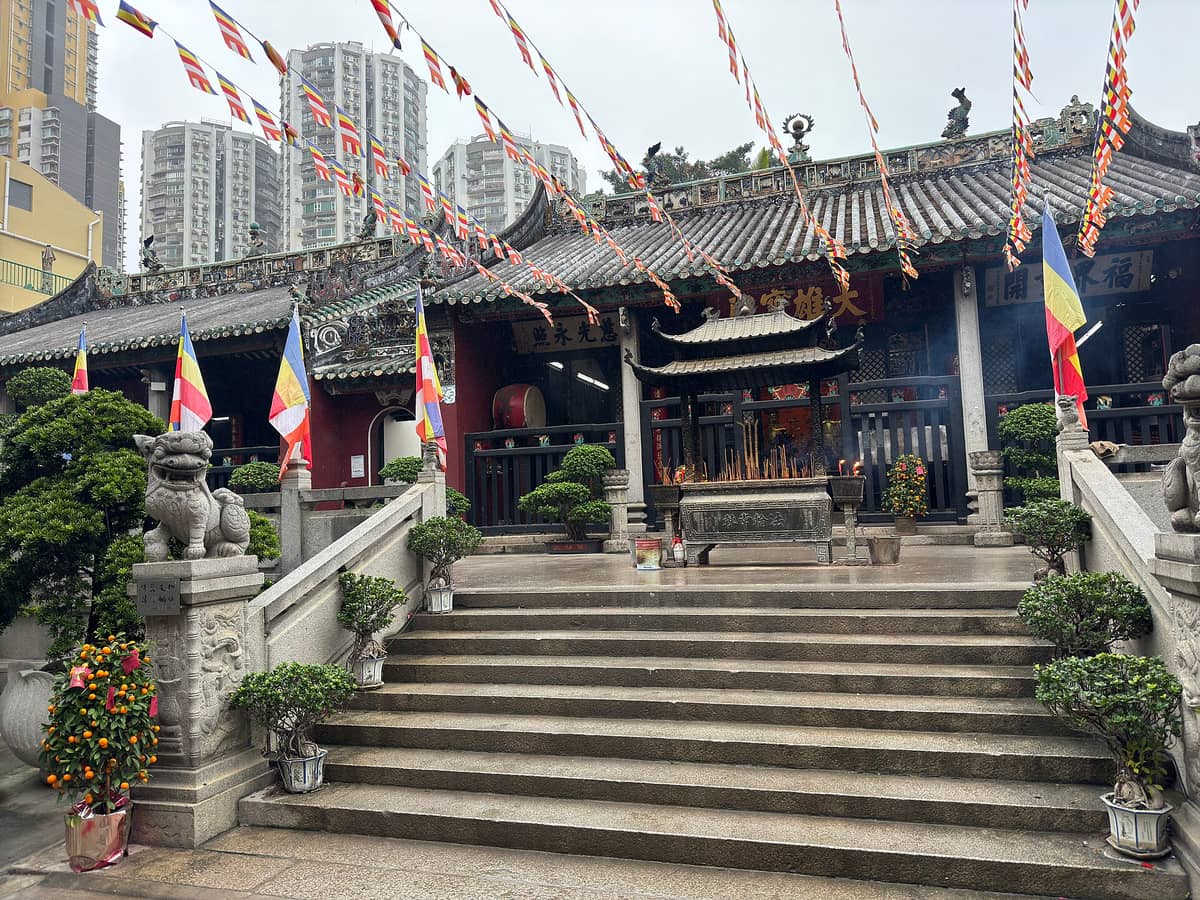
What Is Kun Iam Temple?
Kun Iam Temple, locally known as 觀音堂 (Kun Iam Tong), is one of the oldest and most spiritually significant religious sites in Macau. Located at No. 2 Avenida do Coronel Mesquita on the Macau Peninsula, the complex is dedicated to Kun Iam, the Bodhisattva of Mercy, revered across Chinese Buddhist tradition. The site traces its origins to the 13th century, though the present structures date from 1627, making this one of the oldest standing temple complexes in the city.
Unlike some heritage sites in Macau that have transitioned into museums or monuments, Kun Iam Temple remains a fully active place of worship. Incense burns continuously. Devotees arrive throughout the day to pray, place offerings, and seek guidance through kau cim fortune sticks. The temple belongs to daily Macau life in a way that no restoration project can replicate.
ℹ️ Good to know
Kun Iam Temple is open daily, approximately 07:30–17:00. Entry is free. Confirm current hours locally before visiting, as religious schedules can occasionally affect access to specific halls.
The Architecture and Layout
The complex is built along a traditional Chinese axial plan, drawing visitors through a sequence of three main halls, each set progressively deeper into the compound and rising slightly in elevation. The entrance gate, framed by stone pillars and classical roof ridges, gives little hint of how much space lies beyond it. Step through and the atmosphere changes immediately: the street noise of Avenida do Coronel Mesquita fades, replaced by the low crackle of burning incense coils and the occasional clang of a bronze bell.
The first courtyard contains large ceremonial incense burners, their surfaces blackened and warm to the touch. Walls are lined with ceramic tile murals depicting scenes from Chinese mythology and Buddhist cosmology. The middle hall houses the principal altar to Kun Iam herself, presented in white, seated on a lotus throne. Behind her image, the third hall is dedicated to additional deities and ancestral tablets, and it is here that the atmosphere feels most intimate and personal.
Gardens connect parts of the complex, planted with old banyan trees and potted plants that soften the stone surfaces. Look for the round stone table in one of the rear gardens: according to local accounts, this was the location where American and Chinese officials signed the Sino-American Treaty of Wangxia in 1844, making this quiet courtyard an unlikely site of diplomatic history.
How the Temple Changes Through the Day
Early morning is the most compelling time to visit. Between 07:30 and 09:30, the light is low and golden, filtering through the smoke of freshly lit incense. The worshippers present at this hour are almost entirely local: elderly women in plain clothes, small business owners seeking good fortune for the day, families fulfilling vows. The pace is unhurried. The sound of kau cim sticks rattling in bamboo cups provides a soft, rhythmic backdrop.
By mid-morning, visitors and guided tour groups begin to arrive. The courtyards stay walkable and never feel overcrowded in the way that Macau's more famous heritage sites can, but the devotional atmosphere becomes harder to absorb once tour commentary enters the space. Photography at this hour is easier, with better diffused light and more movement to capture. The incense smoke, caught in angled morning beams, photographs well from the first courtyard looking toward the main hall.
Afternoons are quieter than you might expect. Heat keeps casual visitors away in summer months, and the shadows deepen inside the halls, creating a more dramatic but less photographically forgiving environment. The last hour before closing, around 16:30–17:00, brings a second wave of local worshippers completing rituals after work or errands. If you have flexibility, the bookend hours of the day reward patience.
💡 Local tip
Visit between 07:30 and 09:00 for the most authentic devotional atmosphere and the best light for photography. Summer afternoons (June–September) can be intensely hot and humid in the open courtyards; bring water and light, breathable clothing.
Cultural and Historical Context
Kun Iam, also romanized as Guanyin in Mandarin, is one of the most widely venerated figures in Chinese Buddhism. She represents compassion and mercy, and her temples are among the most attended religious sites across Macau, Hong Kong, and southern China. Kun Iam Temple shares its spiritual significance with other active places of worship on the Peninsula, including the A-Ma Temple near the Inner Harbour, which is dedicated to the sea goddess Mazu. Together these sites illustrate the layered religious character of Macau that predates Portuguese colonization.
The 1627 construction date places Kun Iam Temple in the early decades of Portuguese Macau, when the settlement was already developing its distinctive hybrid identity. The temple complex survived the colonial period intact and was never converted or displaced, a fact that speaks to the negotiated coexistence that defined the city's history. That 1844 treaty signing in the rear garden is often cited as a footnote, but it is genuinely significant: one of the earliest formal diplomatic agreements between China and the United States was conducted not in a grand hall but in a Buddhist temple garden in what was then a small trading settlement.
For travelers interested in Macau's wider religious landscape, the Macau temples guide provides useful context on how these sites fit into the peninsula's neighborhoods and daily life.
Practical Walkthrough: What to Expect
The entrance on Avenida do Coronel Mesquita is marked by a traditional gate. There is no ticket booth, no security check, and no formal queue: you simply walk in. The complex is free to enter and no reservation is needed. Multiple bus routes service stops on this road, so access from central Macau or the hotel districts is straightforward without a taxi.
Inside, navigation is intuitive. The central axis takes you through the three halls in sequence. Side paths lead into courtyard gardens. There are no roped-off areas blocking general visitors from the main shrines, though it is expected that you behave respectfully around active altars: avoid pointing at figures, speak quietly, and do not touch offerings. Photography of the architecture and interiors is generally accepted, but be discreet around worshippers in prayer.
Dress modestly. Bare shoulders and very short shorts are not appropriate for an active place of worship. The complex is not large: a thorough visit, including time in the gardens and all three halls, takes between 45 and 90 minutes. There are no cafes or souvenir shops inside the temple itself, though the surrounding street has small shops selling religious goods and snacks.
⚠️ What to skip
Accessibility note: The complex includes multiple courtyards and halls connected by stone steps. Specific step-free access information is not published in official listings. Visitors with significant mobility limitations should inquire in advance via the Macao Government Tourism Office or visit at a quiet time when staff may be available to assist.
Getting There and Around
Kun Iam Temple sits on Avenida do Coronel Mesquita, well served by Macau's public bus network. Routes 2A, 7, 8, 8A, 12, 16, 18A, 19, 22, 25, 28C, and 56 all have stops near the temple. Buses are inexpensive and run frequently during daylight hours. For full details on navigating the Peninsula by public transport, the getting around Macau guide covers fares, routes, and practical tips.
Taxis are readily available across the Peninsula and are a reasonable option if you are coming from a casino hotel or the ferry terminals. The temple is roughly in the central-northern part of the Peninsula, making it a logical stop on a walking route that might also include other heritage sites in the area. From the temple, the Ruins of St. Paul's and Senado Square are reachable by taxi or bus in under ten minutes.
If you are combining Kun Iam Temple with a broader heritage walk, consider pairing it with the Lou Lim Ieoc Garden nearby, or incorporating it into a half-day loop through the Peninsula's historic sites. The Macau heritage walk guide maps out logical routes across these neighborhoods.
Weather and Seasonal Considerations
The open courtyards at Kun Iam Temple offer no shade cover from the sun. In summer, between June and September, temperatures in Macau regularly reach the high 20s to low 30s Celsius with high humidity. The courtyards can feel oppressively hot by mid-morning. If you visit during these months, go early or in the late afternoon, carry water, and wear light, breathable clothing.
October through December is the most comfortable period for outdoor sightseeing in Macau: temperatures drop to the low-to-mid 20s, humidity falls, and rainfall is minimal. This is also when the temple gardens look their best, with clearer skies and better light for photography. During Lunar New Year and major Buddhist festivals, the temple becomes significantly more crowded, with large quantities of incense burning and longer queues at the main altars. The atmosphere during these periods is extraordinary but the crowds are real.
Insider Tips
- The stone table in the rear garden where the 1844 Sino-American Treaty of Wangxia was signed is easy to miss. Walk past the third hall and into the back garden to find it: a simple round stone table with curved stone benches, unremarkable in appearance but quietly historic.
- If you want to observe kau cim fortune-telling in practice, watch rather than participate unless you have a genuine interest: the process involves shaking a bamboo cup of numbered sticks until one falls out, then collecting a corresponding fortune slip from the temple attendant. It is an active ritual, not a tourist performance.
- The incense coils suspended from the ceilings of some halls can make the air dense and eye-watering on busy mornings. If you are sensitive to smoke, plan for a shorter visit or position yourself near the courtyard openings.
- Bus routes serving Avenida do Coronel Mesquita are numerous, but stop names on bus displays may appear in Chinese characters only. Note your stop in advance or use a navigation app set to the temple's address to know when to exit.
- Visiting during the late afternoon on a weekday gives you the temple largely to yourself, with local worshippers filtering in from around 16:00. This is one of the few times the complex feels genuinely quiet, and the cooler light suits photography of the ceramic murals along the courtyard walls.
Who Is Kun Iam Temple For?
- Travelers interested in living Chinese Buddhist tradition beyond a museum context
- History enthusiasts: the 1627 structure and 1844 treaty connection make this a layered site
- Photographers looking for atmospheric incense smoke, ceramic tilework, and carved stonework
- Visitors who want a meaningful heritage experience without ticket queues or admission fees
- Anyone building a half-day heritage walk across the Macau Peninsula
Nearby Attractions
Other things to see while in Macau Peninsula:
- A-Ma Temple (Ma Kok Miu)
A-Ma Temple, known locally as Ma Kok Miu, is the oldest temple in Macau, with origins traced to 1488. Part of the UNESCO-listed Historic Centre of Macao, this atmospheric complex blends Taoist, Buddhist, Confucian, and folk traditions across six distinct halls climbing Barra Hill. Entry is free, and the site remains an active place of worship year-round.
- Camões Grotto and Casa Garden
Tucked into the northwest of the Macau Peninsula, Camões Grotto and Casa Garden form one of the city's most layered heritage sites. The park honors Portugal's greatest poet in a setting of banyan trees and rocky outcrops, while the adjacent 18th-century mansion carries the architectural weight of colonial trade history. Both are free to enter and rarely crowded.
- Dom Pedro V Theatre
The Dom Pedro V Theatre (Teatro Dom Pedro V) is the oldest Western-style performance venue in East Asia, completed in 1860 and — though normally a working venue — temporarily closed for renovation until early October 2026. Its pale green neoclassical facade on Largo de Santo Agostinho is one of the most photogenic and historically layered corners of the Macau Peninsula, and admission is free when it is open to visitors
- Fortaleza do Monte (Mount Fortress)
Fortaleza do Monte, built between 1617 and 1626, rises above the historic centre of Macau with cannon-lined ramparts, sweeping 360-degree views, and the acclaimed Macao Museum within its walls. For the price of a cup of coffee, or nothing at all on free days, this UNESCO-listed site delivers more history per square metre than almost anywhere else in the city.