Lou Lim Ieoc Garden: Macau's Classical Chinese Retreat
Tucked into the northern Macau Peninsula, Lou Lim Ieoc Garden is a Suzhou-style classical garden of lotus ponds, bamboo groves, winding bridges, and stone grottoes. Entry is free, the atmosphere is genuinely tranquil, and it offers a calm contrast to the busy Macau Peninsula surrounding it.
Quick Facts
- Location
- No. 10 Estrada de Adolfo Loureiro, northern Macau Peninsula
- Getting There
- Bus routes 2, 2A, 4, 5, 9, 9A, 12, 16, 22, 25, 25B, 28C — all stop nearby
- Time Needed
- 45 minutes to 1.5 hours
- Cost
- Free entry, no ticket required
- Best for
- Morning strolls, photography, escaping the casino crowds
What Lou Lim Ieoc Garden Actually Is
Lou Lim Ieoc Garden, known in Portuguese as Jardim de Lou Lim Ioc, is a classical Chinese garden built in the Suzhou style on the northern Macau Peninsula. Like Suzhou's famous gardens, it uses carefully shaped water, stone, and vegetation to evoke a landscape far larger than it physically is.
The garden is managed as a public park and entry is completely free. There are no ticket booths, no queues, and no timed entry slots. You simply walk in from Estrada de Adolfo Loureiro and the city noise drops away within a few steps. For a destination famous for its mega-casinos and rooftop spectacles, this kind of unmediated, unhurried space is genuinely rare.
If you are building an itinerary around Macau's historic core, the garden pairs naturally with the Guia Fortress and Lighthouse, which sits on a forested hill nearby and offers an entirely different but complementary sense of the Peninsula's older, quieter character.
💡 Local tip
The garden opens at 06:00 daily and closes at 21:00. Arriving within the first hour means near-solitude, cooler air in summer, and the best light for photography. By mid-morning on weekends, local families and tour groups begin arriving in number.
The Layout: What You Will Find Inside
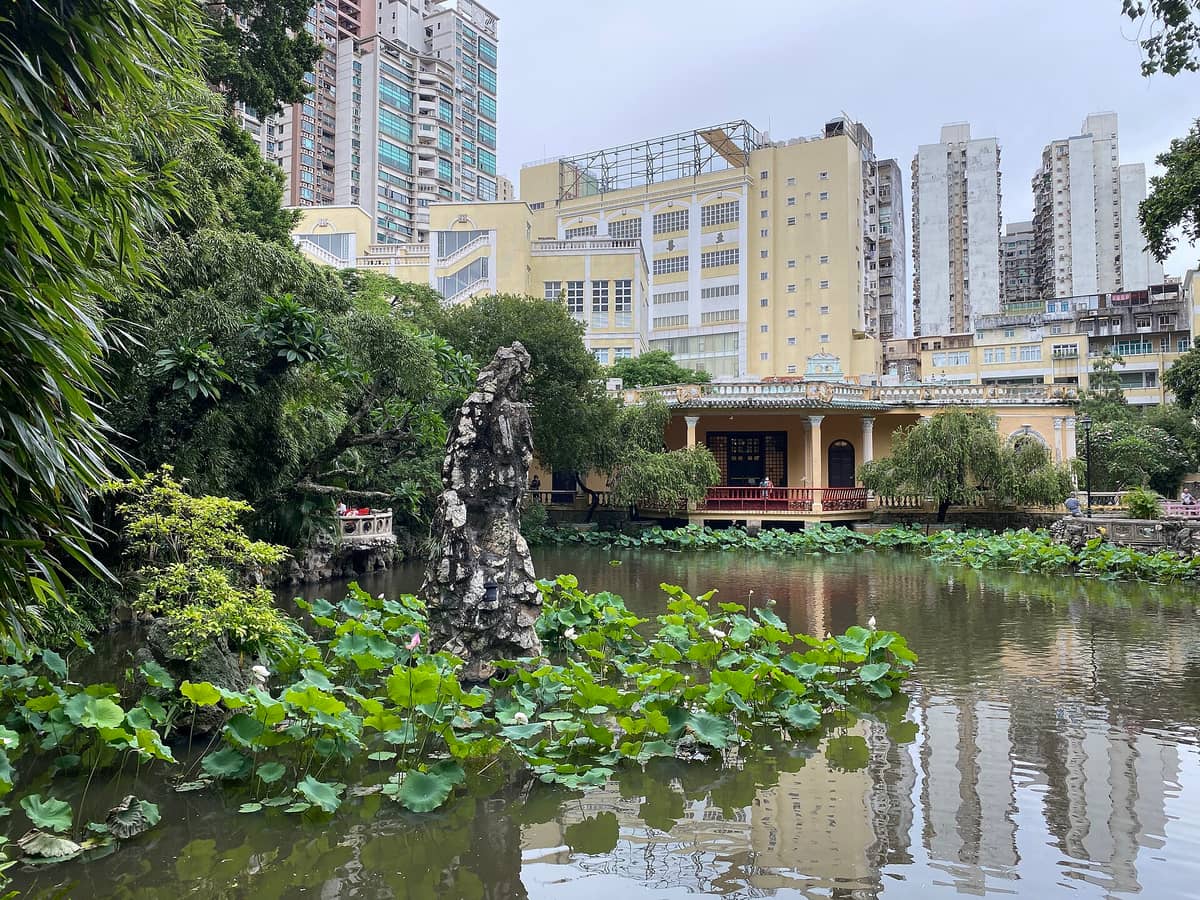
The centrepiece of the garden is its lotus pond, a wide, still body of water bordered by weeping willows and overhanging trees. In summer, the lotus blooms in pale pink and white, sitting on broad flat leaves that catch the morning light. In autumn and winter, the pond takes on a more austere quality: the stems stand bare, the water darkens, and the whole scene shifts from lush to contemplative.
Crossing the pond is the garden's most-photographed feature: a nine-turn zigzag bridge built low over the water surface. The angular path is a deliberate design choice rooted in classical Chinese garden philosophy, the turns slow your pace and force you to view the pond from multiple angles rather than passing through it in a straight line. The bridge's dark woodwork reflects well in calm water, and early-morning photographers often position themselves at the first or last bend for symmetrical compositions.
Surrounding the pond are bamboo groves, stone grottoes, covered walkways, and a series of small pavilions. The bamboo stands are dense enough to create genuine shade and, in a light breeze, produce a dry rustling sound that carries across the otherwise quiet garden. The grottoes are built from irregular porous stone in the tradition of Taihu Lake rock, a hallmark of Suzhou-style gardens where rockwork is used to suggest mountains in miniature.
The pavilions are spaced throughout the garden at intervals that feel considered rather than random. Some face the water directly; others are positioned at the edge of bamboo clearings. Benches inside them are often occupied by older local residents playing cards or simply resting, which tells you something meaningful about who actually uses this space on a daily basis.
How the Garden Changes Through the Day
Early morning is objectively the best time to visit. From around 06:00 to 08:00, the garden is used primarily by local residents doing morning exercises, slow walks, or practicing tai chi near the bamboo groves. The light at this hour comes in low and diffused, the temperature is manageable even in summer, and the sounds are limited to birdsong, bamboo movement, and the occasional distant bus.
By mid-morning the character shifts. Groups begin arriving, particularly on weekends and public holidays. The garden is not large enough to absorb a heavy crowd comfortably, and the narrow bridge over the pond can become a bottleneck when tour groups pass through simultaneously. The experience between 10:00 and 14:00 on a busy weekend is noticeably different from the early hours.
Late afternoon, roughly from 16:00 onward, brings a second quieter window. Families with children tend to arrive at this hour, and the garden takes on a softer, more domestic atmosphere. The light in autumn and winter at this time of day is warm and low, casting long shadows across the pond surface. Summer afternoons are less comfortable due to humidity and heat, and the garden offers limited shade outside the pavilions and bamboo groves.
⚠️ What to skip
In July and August, afternoon humidity in Macau regularly exceeds 80%. The garden has minimal air-conditioned spaces. If you are visiting in summer, commit to early morning. Carrying water is advisable year-round.
Cultural and Historical Context
The garden takes its name from the Lou family, a wealthy Macanese Chinese merchant family who originally developed this private estate. The Suzhou-style design reflects both the cultural aspirations of elite Chinese merchant families in the region and the longstanding influence of classical garden aesthetics from the Yangtze Delta, The garden takes its name from the Lou family, a wealthy Macanese Chinese merchant family who originally developed this private estate. The Suzhou-style design reflects both the cultural aspirations of elite Chinese merchant families in the region and the longstanding influence of classical garden aesthetics from the Yangtze Delta.
Macau's position as a point of cultural convergence between Chinese, Portuguese, and broader colonial influences is visible throughout the Peninsula, but Lou Lim Ieoc Garden is specifically a monument to Chinese aesthetic tradition rather than to that hybrid culture. It does not contain Portuguese architectural elements. Its language is entirely that of classical Chinese garden design: the balance of yin and yang expressed through water and stone, open and enclosed, movement and stillness.
For broader context on Macau's heritage sites and the interplay between Chinese and Portuguese influences across the Peninsula, the Macau heritage walk guide provides a useful framework for understanding how the garden fits into the wider historic landscape.
The garden is today administered as a public park under the Macau SAR government and is open to everyone free of charge. It is located within Macau's UNESCO-listed Historic Centre, though the garden itself is not individually listed.
Getting There and Practical Details
The garden is located at No. 10 Estrada de Adolfo Loureiro on the northern Macau Peninsula. By public bus, routes 2, 2A, 5, 9, 9A, 12, 16, 22, 25, 25B, and 28C all have stops within reasonable walking distance. Macau's bus network is dense and inexpensive, making this the most straightforward way to arrive without a hotel shuttle or taxi.
The garden is officially open daily from 06:00 to 21:00. For most practical purposes, a daytime or early-evening visit carries no risk of finding it closed.
Accessibility: at least one major travel guide lists the garden as having disabled access. The main pathways are described as park-style walkways without significant stair barriers at the entrance, though specific details on ramp gradients and surface conditions are not consistently documented. Visitors with specific mobility requirements should confirm conditions locally before visiting.
ℹ️ Good to know
There is no on-site café or refreshment stall inside the garden. Pick up water or drinks from a convenience store on Estrada de Adolfo Loureiro before entering.
Photography in the Garden
The nine-turn bridge over the lotus pond is the primary focal point for photography. For unobstructed shots, arrive before 08:00 on weekdays. The bridge is low enough over the water that a smartphone held near waist height can capture strong reflections. In the lotus season (roughly June through August), early morning produces the best light and calmest water.
The bamboo groves respond well to backlighting, particularly in the late afternoon when the sun drops low enough to filter through the stems at an angle. The stone grottoes are best photographed on overcast days when harsh shadows do not fragment the irregular rock surfaces. Autumn and winter mornings sometimes produce thin ground mist over the pond, which adds texture to wide shots of the water and surrounding trees.
Photographers who want to combine garden photography with wider urban landscape work on the Peninsula should also consider Penha Hill and Church, which offers elevated views and a quieter atmosphere at similar times of day.
Who Should Manage Their Expectations
Lou Lim Ieoc Garden is a compact urban park. It is not a sprawling estate and does not take more than an hour to explore at a leisurely pace. Visitors expecting the scale of the great Suzhou gardens in mainland China may find it modest. The garden has been maintained and restored rather than left in an original historical state, so it does not carry the same atmospheric weight as gardens that have accumulated centuries of patina without intervention.
Travelers who come to Macau primarily for casino resorts, nightlife, or the large integrated entertainment complexes of Cotai will likely find the garden underwhelming given their priorities. It is a space that rewards a slow pace and genuine interest in classical garden design. Those looking for adrenaline, spectacle, or extensive dining options should redirect their time.
If your interests lean toward the natural and the scenic rather than the urban, Macau's outer islands also offer options worth comparing: Seac Pai Van Park on Coloane is larger, greener, and considerably less visited by tourists.
Insider Tips
- Weekday mornings before 09:00 offer the closest thing to solitude this garden can offer. Weekend mornings shift the dynamic considerably, with local families and tour groups arriving from around 09:30.
- The lotus pond is at its most photogenic in late June and July when blooms are fullest, but visiting in this period means tolerating Macau's peak humidity. Bring a small towel, not just water.
- The pavilions inside the garden are genuinely usable as rest stops, not just decorative. Sitting inside one for ten minutes gives you a completely different view of how locals interact with the space compared to tourist visitors.
- If you are visiting multiple Peninsula heritage sites in one day, the garden works best as an opening stop before the city warms up and crowds build around the more famous sites further south.
- The stone grottoes toward the interior of the garden are often overlooked by visitors who follow the obvious path to the bridge. The rockwork is detailed and worth spending five minutes examining up close.
Who Is Lou Lim Ieoc Garden For?
- Travelers who want genuine calm between busy heritage or casino sites
- Photographers looking for classical Chinese garden compositions without mainland China crowds
- Early risers who can arrive at 06:00 and have the lotus pond largely to themselves
- Anyone interested in classical Chinese garden design and Suzhou aesthetic traditions
- Budget travelers: free entry, central Peninsula location, easy bus access
Nearby Attractions
Other things to see while in Macau Peninsula:
- A-Ma Temple (Ma Kok Miu)
A-Ma Temple, known locally as Ma Kok Miu, is the oldest temple in Macau, with origins traced to 1488. Part of the UNESCO-listed Historic Centre of Macao, this atmospheric complex blends Taoist, Buddhist, Confucian, and folk traditions across six distinct halls climbing Barra Hill. Entry is free, and the site remains an active place of worship year-round.
- Camões Grotto and Casa Garden
Tucked into the northwest of the Macau Peninsula, Camões Grotto and Casa Garden form one of the city's most layered heritage sites. The park honors Portugal's greatest poet in a setting of banyan trees and rocky outcrops, while the adjacent 18th-century mansion carries the architectural weight of colonial trade history. Both are free to enter and rarely crowded.
- Dom Pedro V Theatre
The Dom Pedro V Theatre (Teatro Dom Pedro V) is the oldest Western-style performance venue in East Asia, completed in 1860 and — though normally a working venue — temporarily closed for renovation until early October 2026. Its pale green neoclassical facade on Largo de Santo Agostinho is one of the most photogenic and historically layered corners of the Macau Peninsula, and admission is free when it is open to visitors
- Fortaleza do Monte (Mount Fortress)
Fortaleza do Monte, built between 1617 and 1626, rises above the historic centre of Macau with cannon-lined ramparts, sweeping 360-degree views, and the acclaimed Macao Museum within its walls. For the price of a cup of coffee, or nothing at all on free days, this UNESCO-listed site delivers more history per square metre than almost anywhere else in the city.