Guia Fortress and Lighthouse: Macau's Highest Viewpoint and Oldest Beacon
Perched on Guia Hill, Guia Fortress is a 17th-century military complex that holds the oldest modern lighthouse on the Chinese coast, a beautifully preserved chapel with rare frescoes, and some of the best unobstructed views across the city. Entry is free, and the site is part of Macau's UNESCO World Heritage Historic Centre.
Quick Facts
- Location
- Guia Hill (Colina da Guia), Estrada do Engenheiro Trigo, Macau Peninsula
- Getting There
- Bus routes 6A, 17, 28C, 28, and H1 — stop near Rampa da Guia; cable car from Flora Garden
- Time Needed
- 1 to 1.5 hours for the full complex; 30 minutes if just visiting the viewpoint
- Cost
- Free admission to the fortress, chapel, and park
- Best for
- Panoramic views, colonial history, photography, and escaping the casino crowds
What Is Guia Fortress?
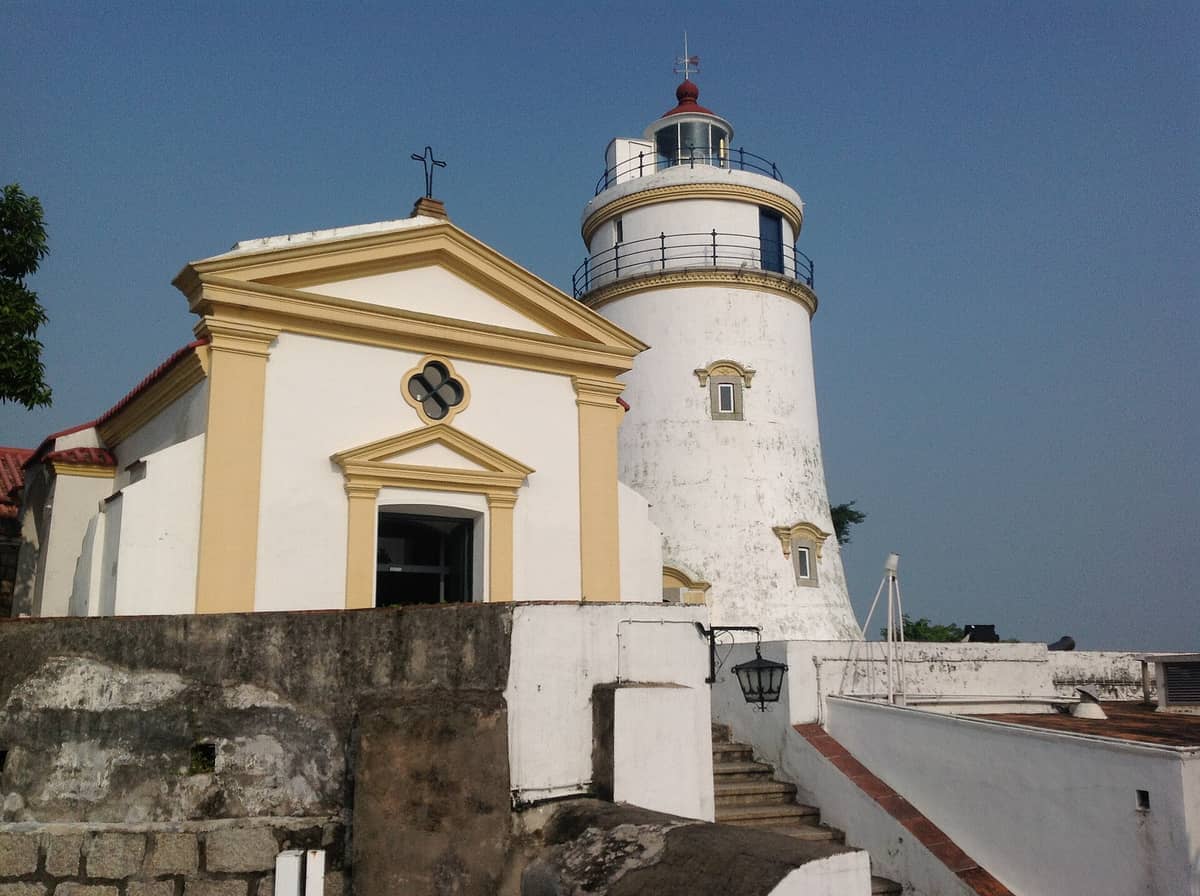
Guia Fortress, Chapel of Our Lady of the Snows and Lighthouse sits on Guia Hill, the highest point on the Macau Peninsula at roughly 90 metres above sea level. The complex was built by the Portuguese between 1622 and 1638 as a military stronghold designed to defend the colony's northern approaches. What makes it unusual, even by the standards of Macau's dense historic portfolio, is that three distinct structures from different centuries share one hilltop: a 17th-century fortress, a chapel of the same era with frescoes that survived more than three hundred years, and a white lighthouse completed in 1865 that became the first modern lighthouse on the Chinese coast.
The entire site forms part of the core zone of the UNESCO World Heritage Historic Centre of Macao, inscribed in 2005. Unlike many heritage sites in the city centre that are ringed by souvenir stalls and pedestrian queues, Guia sits apart — approached through green parkland, noticeably quieter, and oriented outward toward the skyline rather than inward toward a crowd.
💡 Local tip
The fortress complex is open daily from 09:00 to 18:00 (last admission 17:30). The chapel has shorter hours: 10:00 to 17:00. Entry to all areas is free. Arrive before 10:00 if you want the hilltop views without other visitors.
Getting Up the Hill: Cable Car, Path, or Bus
The most atmospheric approach is on foot through Guia Park, a green corridor that cuts away from the urban grid and feels like stepping into a different city. The walk from the park entrance to the fortress takes around 15 to 20 minutes on a well-maintained path shaded by trees. On weekday mornings, this route is shared mainly by elderly residents doing their morning exercise — a markedly different atmosphere from the tourist-dense streets around the Ruins of St. Paul.
A cable car operates between Flora Garden and the hilltop and is the quickest option, though it involves steps at both ends and is not suitable for wheelchairs or pushchairs. Bus routes 6A, 17, 28C, 28, and H1 stop near Rampa da Guia, the road that winds up to the complex. Taxis can drop you at the hilltop road directly.
⚠️ What to skip
The site has no wheelchair access to the lighthouse or upper ramparts, and the paths involve inclines and uneven stone surfaces. Visitors with mobility limitations should assess the terrain carefully. The cable car also has steps at each terminal.
The Fortress and Its Views
From the outer walls of the fortress, the view spans an unusually wide arc: the dense residential blocks of the Macau Peninsula in one direction, the Pearl River estuary in another, and on clear days the towers of Zhuhai visible across the border. To the south, the casino towers of Cotai — The Venetian's replica curves, the Parisian's Eiffel Tower — form a strange but undeniably compelling contrast to the 17th-century stonework in the foreground.
Morning light, particularly in the cooler months of October through February, turns the limestone walls a warm gold and keeps the air clear enough for long-distance photography. By early afternoon in summer, heat haze reduces visibility and the humidity becomes uncomfortable. The best time to visit Macau for outdoor sightseeing is broadly autumn, and this applies at Guia more than most places given how exposed the hilltop is to both sun and wind.
The fortress walls themselves are solid and largely intact, with cannon emplacements that look out over the city. The scale is modest compared to Fortaleza do Monte, which dominates the hill above Senado Square, but the Guia complex compensates with the coherence of its three structures and the relative calm of the surroundings.
The Chapel: Rare Frescoes and Quiet Devotion
The Chapel of Our Lady of the Snows, dating from around 1622, is the cultural centrepiece of the complex. Its interior contains frescoes that blend Catholic iconography with Chinese artistic elements — a visual document of the cultural exchange that defined early colonial Macau. The discovery and subsequent restoration of these frescoes in the 1990s revealed layers of painting that had been whitewashed over during different periods, which is partly why the chapel's condition feels so unlikely: the imagery survived by accident as much as by care.
The chapel is small, with limited capacity, and the frescoes require close attention to read properly. Lighting inside is dim and respectful of the paintings' sensitivity to light. Visitors who take a few minutes to study the walls rather than simply photographing them and moving on will notice details that a quick glance misses: the faces, the layering of Western religious forms with Chinese decorative motifs, the patches where earlier images were painted over and later uncovered. Chapel hours are 10:00 to 17:00 daily.
The Lighthouse: Oldest on the Chinese Coast
The white cylindrical lighthouse completed in 1865 is the most visually distinctive element of the Guia skyline. It remains operational today, still functioning as a navigational aid, and holds the distinction of being the oldest modern lighthouse on the Chinese coast — a fact that is easy to underestimate when standing in front of what looks like a relatively modest structure. The lighthouse's significance is less in its size and more in its placement: the first fixed navigational light in this entire coastal zone, predating the major colonial-era lighthouses of the region.
The interior of the lighthouse is not open to regular visitors. You can photograph the exterior from close range, and the white tower against a blue sky or an overcast morning is a reliable composition. Some sources note occasional special openings on commemorative dates such as World Metrology Day, but this is not a fixed schedule and should be confirmed with the Cultural Affairs Bureau of Macao SAR before planning around it.
ℹ️ Good to know
The lighthouse interior is closed to the public during normal operation. Do not plan your visit around accessing it. The exterior, the chapel, and the fortress walls are the main draws.
How the Experience Changes Through the Day
Early morning, before 09:30, the cable car is not yet running and the only people on the hill are those who have walked up. The air smells of damp stone and the surrounding trees, and the city below is still finding its rhythm. This is the best window for photography: flat, directional light from the east catches the fortress walls, and the absence of crowds means you can frame shots without negotiating around other visitors.
By mid-morning the site becomes noticeably more populated, with tour groups arriving from around 10:00 onwards. The chapel also opens at this hour, which draws visitors specifically to the frescoes. Between 11:00 and 14:00 the hilltop receives direct sun with limited shade near the outer walls; if you are visiting in summer, this is the stretch to avoid or plan around with water and sun protection. The park paths leading up are shaded throughout the day.
Late afternoon, from around 15:30, the crowd thins again. The light becomes warmer and lower, softening the limestone and backlighting the lighthouse well for photography. The complex closes at 18:00 with last admission at 17:30, so a late afternoon visit allows for a relaxed exploration without rushing. Sunset from the outer walls, when the sky is clear, is one of the more quietly rewarding moments available on the Macau Peninsula.
Who Might Want to Skip This
Visitors with very limited time and a single day in Macau may find it difficult to justify the detour, particularly if they are prioritising the Ruins of St. Paul, Senado Square, and the nearby Fortaleza do Monte. The Guia complex rewards those who are interested in detail — the frescoes, the history of the lighthouse, the view. If your priority is a quick photo and a tick on a checklist, the walk up may feel like a long investment for a small return. Families with young children should also note that the paths involve inclines and the site is not rated as child-friendly for the lighthouse section specifically.
The site also has no food or drink facilities at the hilltop itself. If you are visiting during warmer months, bring water. The nearest cafes and restaurants are in the streets below near Flora Garden.
Insider Tips
- The cable car from Flora Garden closes earlier than the fortress itself — check its operating hours before planning your descent. If you walk down, the park paths through Guia Hill are pleasant in the late afternoon and take around 15 minutes to reach street level.
- The frescoes in the chapel are easily missed if you spend only a few seconds inside. Stand near the back wall and let your eyes adjust to the lower light before moving closer. Look for the sections where the Chinese decorative style is most visible alongside Catholic imagery — these are typically on the lateral walls.
- For photographers, the best two compositions are: the lighthouse framed against the sky from the eastern wall of the fortress in morning light, and the panoramic view south toward Cotai from the upper terrace in late afternoon. Neither requires special equipment, but a wide-angle lens makes the city view more dramatic.
- Guia Hill is part of a larger green corridor on the Macau Peninsula. Combining a visit with a walk through the surrounding Guia Park adds almost no time to your itinerary and gives a rare sense of Macau's topography away from the dense urban core.
- If you are interested in Macau's military and colonial architecture more broadly, pairing Guia with Fortaleza do Monte makes a logical half-day. The two fortresses were both built in the early 17th century as part of the same defensive network and offer complementary perspectives on Portuguese colonial strategy.
Who Is Guia Fortress and Guia Lighthouse For?
- History and heritage travellers who want to go beyond Senado Square into the layered military and religious past of colonial Macau
- Photographers looking for panoramic city views and architectural subjects outside the most crowded tourist zones
- Independent travellers on a tight budget — the entire site is free and the walk up through Guia Park costs nothing
- Anyone visiting Macau for more than one day who wants to understand the physical geography and layout of the peninsula from above
- Visitors with an interest in religious art, particularly the rare syncretic frescoes inside the Chapel of Our Lady of the Snows
Nearby Attractions
Other things to see while in Macau Peninsula:
- A-Ma Temple (Ma Kok Miu)
A-Ma Temple, known locally as Ma Kok Miu, is the oldest temple in Macau, with origins traced to 1488. Part of the UNESCO-listed Historic Centre of Macao, this atmospheric complex blends Taoist, Buddhist, Confucian, and folk traditions across six distinct halls climbing Barra Hill. Entry is free, and the site remains an active place of worship year-round.
- Camões Grotto and Casa Garden
Tucked into the northwest of the Macau Peninsula, Camões Grotto and Casa Garden form one of the city's most layered heritage sites. The park honors Portugal's greatest poet in a setting of banyan trees and rocky outcrops, while the adjacent 18th-century mansion carries the architectural weight of colonial trade history. Both are free to enter and rarely crowded.
- Dom Pedro V Theatre
The Dom Pedro V Theatre (Teatro Dom Pedro V) is the oldest Western-style performance venue in East Asia, completed in 1860 and — though normally a working venue — temporarily closed for renovation until early October 2026. Its pale green neoclassical facade on Largo de Santo Agostinho is one of the most photogenic and historically layered corners of the Macau Peninsula, and admission is free when it is open to visitors
- Fortaleza do Monte (Mount Fortress)
Fortaleza do Monte, built between 1617 and 1626, rises above the historic centre of Macau with cannon-lined ramparts, sweeping 360-degree views, and the acclaimed Macao Museum within its walls. For the price of a cup of coffee, or nothing at all on free days, this UNESCO-listed site delivers more history per square metre than almost anywhere else in the city.