Camões Grotto and Casa Garden: Macau's Quiet Corner of Portuguese History
Tucked into the northwest of the Macau Peninsula, Camões Grotto and Casa Garden form one of the city's most layered heritage sites. The park honors Portugal's greatest poet in a setting of banyan trees and rocky outcrops, while the adjacent 18th-century mansion carries the architectural weight of colonial trade history. Both are free to enter and rarely crowded.
Quick Facts
- Location
- Praça de Luís de Camões, northwest Macau Peninsula
- Getting There
- Bus routes 8A, 18, 18A, 18B, 19, or 26 to Camões Garden stop
- Time Needed
- 45–90 minutes for both sites
- Cost
- Free (park and Casa Garden gallery)
- Best for
- History lovers, architecture fans, quiet morning walks
- Official website
- www.wh.mo/en/site/detail/23
What You're Actually Visiting
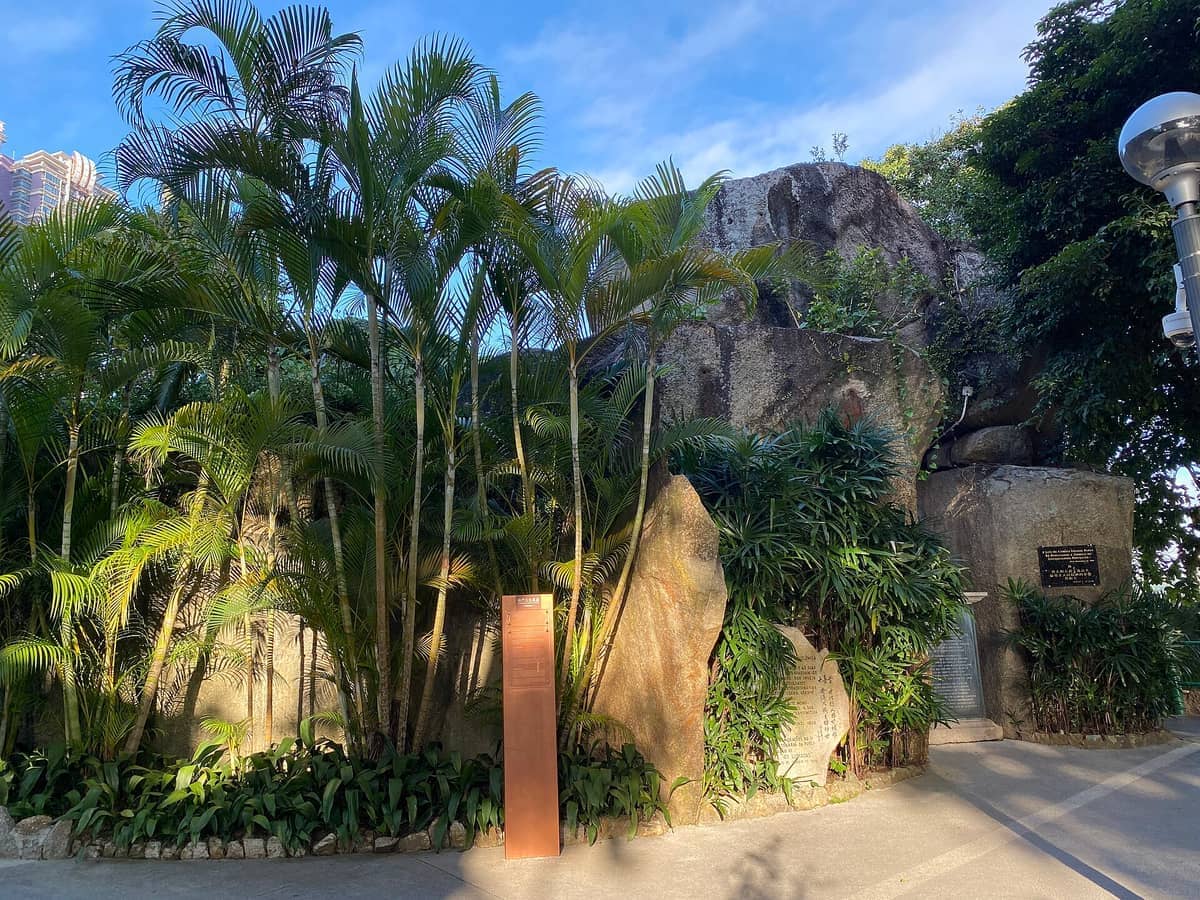
Camões Grotto and Casa Garden are two distinct but physically adjoining attractions on the northwestern edge of the Macau Peninsula, linked by a shared history of Portuguese presence and a shared atmosphere of unhurried calm. The Camões Garden (Jardim de Camões in Portuguese) is a public park built around a rocky hillside grotto featuring a stone bust of Luís de Camões, the 16th-century poet considered the literary father of the Portuguese language. Casa Garden, immediately adjacent, is an 18th-century European-style mansion that once served as the Macau headquarters of the British East India Company and now operates as the headquarters of the Orient Foundation.
Together, they represent one of the more complete encounters with Macau's colonial-era character available on the Peninsula. Unlike the Ruins of St. Paul's, which attract large crowds, this area tends to draw a calmer mix of local residents doing morning tai chi, students reading under the banyan trees, and history-curious visitors who have moved beyond the standard tourist circuit.
💡 Local tip
Visit between 07:00 and 09:00 on weekday mornings to see the garden at its most atmospheric — elderly residents practice tai chi near the grotto while the light filters through dense banyan canopy overhead.
The Grotto and the Garden: A Walk Through the Park
The garden is organized on a hillside, which means the experience changes depending on which direction you enter from. Enter from Praça de Luís de Camões and you move upward along paved paths shaded by mature trees, including large banyan trees whose aerial roots create a textured canopy low enough to feel enveloping rather than merely decorative. The soundscape inside is noticeably muted from the street outside, a combination of foliage density and the park's position away from major traffic corridors.
The grotto itself is carved into exposed rock near the upper section of the park. A marble bust of Luís de Camões sits within a niche, weathered but clearly maintained, surrounded by stone and greenery. The scene carries weight if you know the context: Camões is traditionally associated with this location, with local accounts suggesting he may have spent time here during his years in Asia, though historians note this connection is more legend than documented fact. The grotto functions as a kind of literary monument in a city where Portuguese culture has left deep architectural and linguistic imprints.
Paths continue beyond the grotto to higher viewpoints offering partial views across the surrounding neighborhood and toward the harbor. The terrain involves some steps and inclines, so visitors with limited mobility should be aware that the upper sections and rocky grotto area are not fully accessible by wheelchair. The main lower paths are paved and more manageable.
Casa Garden: The Merchant Mansion Next Door
Casa Garden, the mansion adjacent to the park, is part of the UNESCO-listed Historic Centre of Macao. Its most significant historical chapter came during the late 18th and early 19th centuries, when it served as the Macau base of the British East India Company, one of the dominant commercial forces in Asian trade during that era. The building reflects European neoclassical influence adapted to a subtropical coastal environment, with thick walls, shuttered windows, and a rear garden that connects visually to the public park.
Today, the Orient Foundation operates from the building and periodically opens the gallery spaces to the public for exhibitions on art, culture, and Macanese heritage. Admission to the building and gallery is free, though exhibition schedules vary. The building is reported as closed on Mondays, and hours are generally listed as approximately 10:00 to 19:00, but these details should be confirmed with the Orient Foundation or local tourism offices before visiting, as they can shift depending on exhibition programming.
⚠️ What to skip
Casa Garden's interior hours and exhibition schedule change with programming. Confirm current opening times via the Orient Foundation website at wh.mo before planning your visit.
The exterior of the mansion is worth pausing at even when the interior is closed. The facade, the surrounding garden walls, and the spatial relationship between the building and the park behind it illustrate how the European merchant class shaped Macau's urban form during the colonial period: private, walled, yet adjacently woven into civic space.
Historical Context: Camões, the East India Company, and Macau's Colonial Layers
Macau's position at the mouth of the Pearl River Delta made it the primary European trading post in East Asia for over 400 years. Portugal administered Macau from the mid-16th century until 1999, leaving a distinct architectural, culinary, and institutional legacy that still defines the city's UNESCO-listed historic core. Camões Garden is considered one of the oldest public parks in Macau, and the Camões connection, however partly mythologized, reflects how Portuguese cultural identity was embedded into the landscape of the city long before modern tourism infrastructure arrived.
Casa Garden's East India Company history adds a different national layer: British merchants used Macau as a staging point for trade with China, particularly during the 18th century, before Hong Kong was established as a British colony in 1841. Visiting this site alongside other Peninsula landmarks like the Leal Senado Building or the Mandarin House gives a more complete picture of how multiple colonial powers moved through this small, strategically positioned territory.
How the Experience Changes by Time of Day
Early mornings (before 09:00) belong to the neighborhood. Local residents use the garden for exercise, meditation, and quiet reading, and the atmosphere has none of the tourist-site energy you encounter elsewhere on the Peninsula. The light at this hour comes through the canopy in diffused patches, which also makes it the best window for photography of the grotto and the old tree trunks.
By midday, especially on weekends, the park sees more visitors, though it never reaches the crowd density of the Ruins of St. Paul's area. The stone paths can become warm underfoot in summer, and the shade coverage, while generous, doesn't eliminate the humidity that defines Macau from May through September. Autumn and winter visits (October through February) are more comfortable for extended exploration, with temperatures typically between 15 and 25 degrees Celsius and lower humidity.
Late afternoon light hits the upper sections of the garden well, casting long shadows across the rocky terrain near the grotto. The garden is open until around 22:00, with some sources citing later closing times up to about 23:30, and evening visits have their own quality: the park is lit at night, and the relative quiet of the surrounding streets makes the grotto feel genuinely removed from the city.
Getting There and Practical Notes
The garden sits in the northwest of the Macau Peninsula, reachable on foot from the historic core via Rua de Coelho do Amaral toward Praça de Luís de Camões. The walk from the area near Ruins of St. Paul's takes roughly 10 to 15 minutes on foot through residential and commercial streets. By bus, routes 8A, 17, and 26 all serve the vicinity.
The Old Protestant Cemetery is immediately adjacent to the garden on its eastern edge, making it a natural addition to any visit. The cemetery, dating to the early 19th century, contains graves of European merchants, artists, and diplomats, including the painter George Chinnery, and can be walked through in about 15 minutes.
For visitors planning a structured walking route through the Peninsula's heritage sites, this area pairs well with a broader Macau heritage walk that covers the northwestern neighborhoods along with the more visited central sites. The contrast between the quieter northwest and the denser tourist circuit around Senado Square is itself part of what makes Macau interesting to explore on foot.
ℹ️ Good to know
Camões Garden is free to enter and open daily, roughly 06:00 to 22:00, with some sources citing slightly later closing times. Casa Garden gallery admission is also free but confirm hours before visiting. Bus routes 8A, 18, 18A, 18B, 19, and 26 stop nearby. Taxis are widely available throughout the Peninsula.
Photography Tips
The grotto is best photographed in the early morning when soft light filters through the tree canopy from the east. At midday, harsh shadows make the carved rock surfaces difficult to render well. A wide-angle lens captures the relationship between the stone bust and the surrounding vegetation, while a longer focal length from the path below can compress the layered textures of rock, foliage, and the bust itself.
The Casa Garden facade, with its European neoclassical lines set against tropical vegetation and the neighboring park wall, photographs well in late afternoon light. Avoid weekends if you want clean exterior shots of the mansion without foot traffic in the foreground.
Is It Worth Your Time?
Camões Grotto and Casa Garden are not the most dramatic attractions on the Macau Peninsula. If your itinerary is short — say, a single afternoon as part of a day trip from Hong Kong — you may choose to prioritize the Fortaleza do Monte or St. Dominic's Church for their stronger visual impact. But for visitors with even a modest interest in Macau beyond its gaming identity, or for those on a longer stay, this site offers something the central tourist circuit does not: the texture of a neighborhood that still functions as a neighborhood, wrapped around genuinely significant historical architecture.
Visitors specifically interested in the breadth of Macau's ecclesiastical and colonial heritage will find that this area complements the wider network of Macau's historic churches and mansions across the Peninsula. And since both the garden and Casa Garden are free to enter, the cost of being wrong about your interest level is zero.
Insider Tips
- The Old Protestant Cemetery, directly adjacent to the eastern edge of the garden, is included in the same visit without any additional walking and is rarely mentioned in itineraries despite being historically significant. Allow 15 minutes for it.
- The upper viewpoints in the garden are almost never mentioned in travel content, but they offer clear sightlines over the surrounding low-rise neighborhood toward the harbor — worth the short climb.
- If you want to see the Casa Garden interior, visit on a Tuesday through Sunday when it is more likely to be open, and arrive before 18:30 to allow time before the typical 19:00 closing. Monday closures are commonly reported.
- The park is genuinely pleasant in light rain, which is worth knowing given Macau's wet season (May to September). The banyan canopy provides significant overhead cover, and the grotto takes on a different, more atmospheric quality when the stone is wet.
- Combine this visit with the nearby Lou Kau Mansion if you are interested in contrasting European colonial architecture with traditional Macanese Chinese merchant house design — both are free and within walking distance on the Peninsula.
Who Is Camões Grotto and Casa Garden For?
- Travelers seeking a quieter alternative to the crowded central heritage sites
- History and architecture enthusiasts interested in Macau's Portuguese and colonial-era layers
- Early risers who want to experience local neighborhood life before the tourist day begins
- Photographers looking for atmospheric garden and heritage building subjects without large crowds
- Budget travelers: both sites are completely free to enter
Nearby Attractions
Other things to see while in Macau Peninsula:
- A-Ma Temple (Ma Kok Miu)
A-Ma Temple, known locally as Ma Kok Miu, is the oldest temple in Macau, with origins traced to 1488. Part of the UNESCO-listed Historic Centre of Macao, this atmospheric complex blends Taoist, Buddhist, Confucian, and folk traditions across six distinct halls climbing Barra Hill. Entry is free, and the site remains an active place of worship year-round.
- Dom Pedro V Theatre
The Dom Pedro V Theatre (Teatro Dom Pedro V) is the oldest Western-style performance venue in East Asia, completed in 1860 and — though normally a working venue — temporarily closed for renovation until early October 2026. Its pale green neoclassical facade on Largo de Santo Agostinho is one of the most photogenic and historically layered corners of the Macau Peninsula, and admission is free when it is open to visitors
- Fortaleza do Monte (Mount Fortress)
Fortaleza do Monte, built between 1617 and 1626, rises above the historic centre of Macau with cannon-lined ramparts, sweeping 360-degree views, and the acclaimed Macao Museum within its walls. For the price of a cup of coffee, or nothing at all on free days, this UNESCO-listed site delivers more history per square metre than almost anywhere else in the city.
- Grand Lisboa
Grand Lisboa is the lotus-shaped tower that defines the Macau Peninsula skyline. Operated by SJM, it combines a 24-hour casino, a cluster of high-end restaurants, and a landmark hotel on Avenida de Lisboa. Whether you're here to gamble, dine, or simply photograph one of Asia's most distinctive buildings, this guide tells you exactly what to expect.