Leal Senado Building: Macau's Colonial Heart in Stone and Tile
The Leal Senado Building is the most architecturally polished Portuguese colonial structure in Macau, sitting at the head of the UNESCO-listed Senado Square. Free to enter and open 09:00–21:00 daily, it offers a rare combination of living civic history, a quiet garden courtyard, and a rotating art gallery — all within a two-minute walk of the city's most photographed street.
Quick Facts
- Location
- 163 Avenida de Almeida Ribeiro, Macau Peninsula (Senado Square)
- Getting There
- Bus routes 3, 3A, 4, 8A, 10, 10A, 11, 18, 19 to Av. de Almeida Ribeiro (San Ma Lo)
- Time Needed
- 30–60 minutes for the building; combine with Senado Square for a 2-hour visit
- Cost
- Free entry. Building open daily 09:00–21:00; gallery open 09:00–21:00 only when there is an exhibition.
- Best for
- History lovers, architecture fans, first-time visitors to Macau's historic centre
- Official website
- www.wh.mo/en/site/detail/11
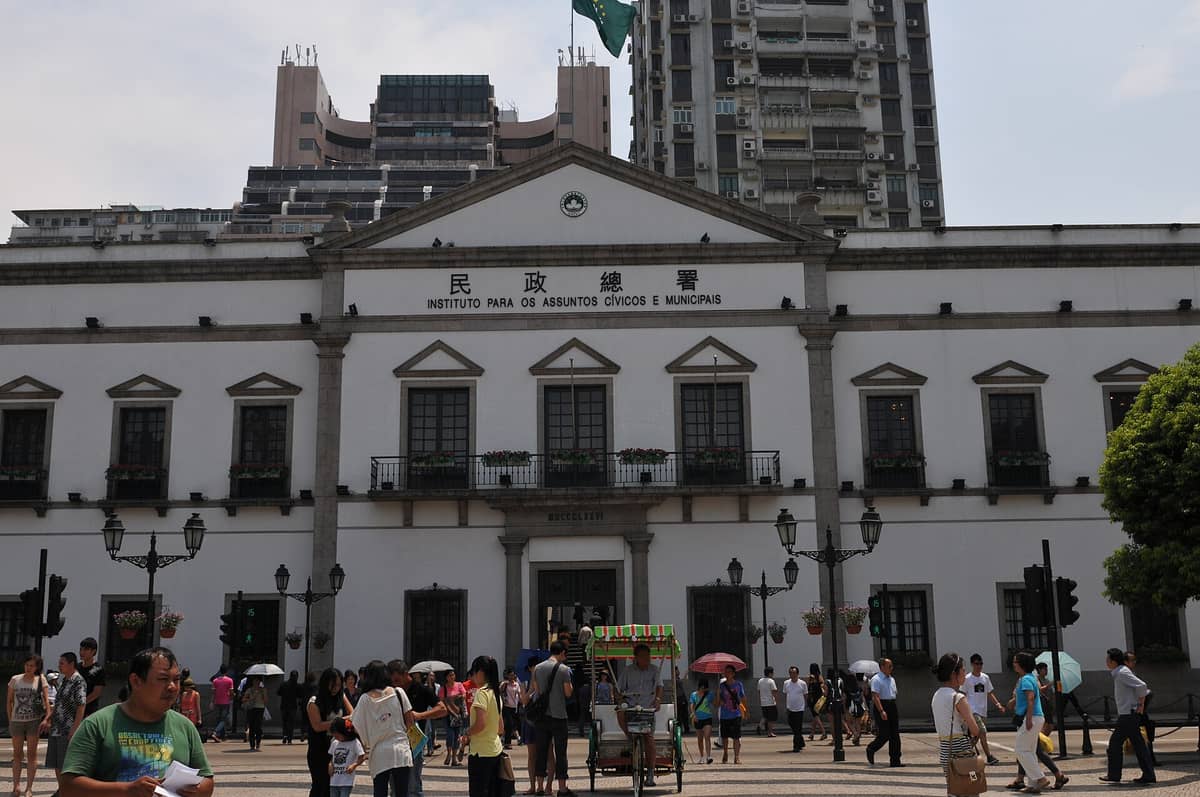
What Is the Leal Senado Building?
The Leal Senado Building stands at the northern end of Senado Square as the most complete expression of Portuguese civic architecture in the entire Pearl River Delta. Its cream-yellow neoclassical facade, blue-and-white azulejo tile panels, and wrought-iron balconies make it immediately recognizable — and immediately distinct from everything around it. Whether you arrive mid-morning with tour groups moving through the Ruins of St. Paul or slip in on a quiet weekday afternoon, the building holds its composure as a working public institution with genuine historical weight.
Its full official designation is the Headquarters Building of the Municipal Affairs Bureau (Former Leal Senado Building), known in Chinese as 民政總署大樓. The name 'Leal Senado' — meaning 'Loyal Senate' — was granted by the Portuguese Crown in recognition of Macau's refusal to submit to Spanish rule during the Iberian Union period of the late 16th century. That title, and the pride attached to it, is now embedded in every tour guide script and information panel inside.
ℹ️ Good to know
The building is part of the UNESCO-listed Historic Centre of Macao (inscribed 2005) and functions as an active government headquarters. Public access to the courtyard, gallery, and select interior areas is free during opening hours (09:00–21:00 daily; the gallery is only open when there is an exhibition).
Four Centuries of Civic History
The origins of the senate here stretch back to 1583, when the Portuguese established the first municipal council in China under their administration — predating many of the colonial institutions that would define the region for the next four centuries. The current building dates to 1784, reconstructed in its present form as the formal seat of the Portuguese Macau municipal council. That means the structure you are walking into today is over 240 years old, though careful maintenance and restoration have kept it looking considerably more sprightly.
After the 1999 handover of sovereignty to the People's Republic of China, the building transitioned from its colonial role into the headquarters of Macau's Institute of Civic and Municipal Affairs, and later the Municipal Affairs Bureau (IAM). The continuity is quietly remarkable: a building that once administered a Portuguese territory now administers the same streets and squares under a different flag, with the original library, council chamber, and garden still intact and accessible to any visitor who walks through the front gate.
What You Actually See Inside
The entrance off Senado Square opens into a formal reception hall with black-and-white marble floors and high ceilings that immediately lower the ambient temperature — useful on a hot afternoon when the square outside bakes in full sun. The sense of stepping from one climate zone into another is almost theatrical. From here, a staircase leads upward with dark wood banisters and carved stonework, the kind of craftsmanship that takes a moment to register before you start noticing the detail.
The library on the upper floor is one of the building's most quietly arresting spaces. Lined with dark wooden shelving and holding a collection of books in Portuguese, Chinese, and other languages, it feels more like a private scholar's room than a public archive. Portraits and crests line the walls. The room is not always fully accessible to visitors — its availability depends on current administrative schedules — but even a glimpse through a doorway gives a sense of the intellectual seriousness the Portuguese colonial administration cultivated here.
The inner courtyard garden is a genuine surprise for first-time visitors. Enclosed by the building's wings, it is planted with tropical shrubs and features a central fountain, with azulejo tile panels on the surrounding walls depicting scenes from Portuguese history and mythology. The contrast between the formal public facade and this quieter, almost domestic interior space is one of the building's most interesting architectural qualities. On weekday mornings, the courtyard tends to be nearly empty — just a handful of people eating packed lunches or checking their phones.
💡 Local tip
The courtyard garden is consistently quieter than the main entrance hall. If you want to photograph the azulejo tile panels without other visitors in the frame, aim for a weekday between 10:00 and 11:30, before tour groups arrive from the nearby Ruins of St. Paul.
The IAM Gallery: Art Inside a Heritage Site
The IAM Gallery operates within the Leal Senado Building and runs rotating exhibitions covering local art, photography, cultural heritage, and occasionally international shows. Entry to the gallery is also free, but the space is only open when an active exhibition is running — which is most of the time, though there can be gaps between shows. If contemporary or historical visual art is part of what you are looking for, it is worth checking current listings before your visit rather than assuming an exhibition will be in place.
The gallery spaces themselves benefit from high ceilings and good natural light. The combination of colonial architecture with modern curatorial installations creates an interesting tension — not always resolved elegantly, but always interesting. Exhibitions tend toward the accessible rather than the challenging, which suits the mixed audience of tourists, students, and local residents who pass through.
How the Experience Changes Through the Day
In the early morning, the Leal Senado Building shares the quiet that settles over Senado Square before the shops open. The light is softer, the limestone facade catching the morning sun without the harsh midday glare that makes photography difficult later in the day. A handful of locals cut through the square on their way to work. The building feels like what it is: a working institution in a city going about its business.
By mid-morning, the crowds arrive. Tour buses deposit groups at the edge of the square, and the flow of visitors through the building's entrance becomes constant. The interior can feel congested in the main hall and on the staircase, though the courtyard garden absorbs visitors more comfortably. Between 14:00 and 16:00, there is often a secondary lull when the square empties slightly as visitors seek shade or air conditioning in nearby cafes. Late afternoon, from around 17:00, brings a different crowd: local families, after-work strollers, and travellers making a second pass through the historic centre as the day cools.
Evening visits, possible until 21:00, offer something genuinely different. The building's facade is lit from below after dark, and the square in front of it takes on a more social character — street food sellers set up nearby, and the whole area feels less like a museum zone and more like a living neighbourhood. If you are spending more than one day in Macau, pairing an evening visit here with a walk through the St. Dominic's Church area makes for a relaxed itinerary that avoids the daytime peaks entirely.
Getting There and Practical Logistics
The building sits on Avenida de Almeida Ribeiro (locally called San Ma Lo), the main commercial artery of the Macau Peninsula. Numerous bus routes stop directly on this street, including routes 3, 3A, 4, 8A, 10, 10A, 11, 18, 19, 21A, 26A, and 33. The stop name to look for is Av. de Almeida Ribeiro or San Ma Lo. For a broader overview of how to move around the peninsula, the getting around Macau guide covers bus, taxi, and ferry options in detail.
From the Inner Harbour ferry terminals, the walk takes under fifteen minutes through the old commercial streets. From the Ruins of St. Paul, it is a five-minute walk downhill through the historic lanes. Major hotel and casino properties on the peninsula run shuttle buses to the ferry terminals and border gates, from which the building is easily reachable by bus or taxi.
Accessibility information for visitors with mobility needs is not comprehensively detailed in official heritage listings. The building is a functioning government office with multiple levels and historical architecture that may present barriers. Travellers with specific accessibility requirements should contact the Municipal Affairs Bureau directly before visiting.
⚠️ What to skip
The Leal Senado Building is a working government headquarters. Some interior rooms may be closed without notice depending on administrative schedules. The gallery is only open when an active exhibition is running. Verify current exhibition status before visiting if that is the primary draw.
Photography and What to Bring
The building's facade is one of the most-photographed structures in Macau, but the interior rewards closer attention. The tile panels in the courtyard require a wide-angle lens if you want to capture full sections without distortion. The library interior, when accessible, is dim enough that a fast lens or camera with good low-light performance makes a noticeable difference. Flash photography is generally discouraged inside heritage buildings.
For the exterior, the best shooting position is from the centre of Senado Square looking north. The patterned cobblestone forecourt (a traditional Portuguese calçada design) leads the eye naturally toward the facade. This view is also one of the classic views in Macau that photographers seek out, so arriving early or late in the day gives you a better chance of capturing it without a crowd in the foreground.
Macau's subtropical climate means that visiting between June and September brings genuine heat and humidity. Light, breathable clothing is sensible, and the building's cool interior provides welcome relief. There are no strict dress code requirements for entry, though as a functioning civic building, casual beach attire would be out of place.
Who This Is For
The Leal Senado Building is not a full museum with hours of curated content. If you are expecting the kind of deep-dive historical experience offered by the Macau Museum on Fortaleza do Monte, you will find this visit brief by comparison. The building is more atmosphere than exhibition — the value lies in the architecture itself, the courtyard, and the chance to stand inside a structure that has been at the centre of Macau's governance for over two centuries. Travellers who engage with places like this tend to get significantly more from it than those who treat it as a checkbox.
Visitors primarily interested in Macau's casino resorts or the Cotai Strip scene will likely find this a brief detour rather than a highlight. That is fine — the building is centrally located and easily combined with the rest of the Macau heritage walk rather than treated as a standalone destination. For anyone spending a full day in the historic centre, it is a natural part of the circuit and requires no dedicated trip.
Insider Tips
- The courtyard garden is almost always calmer than the front entrance hall, even when Senado Square is crowded. Walk straight through the main entrance and past the staircase to reach it.
- The building stays open until 21:00, later than most comparable heritage sites in Macau. An evening visit in the cooler months (October to February) is particularly pleasant — the lit facade reflects off the wet cobblestones of Senado Square after light rain.
- The IAM Gallery sometimes hosts free opening receptions for new exhibitions, typically on weekday evenings. These are open to the public and worth attending if you happen to be in Macau when one is scheduled — check the Municipal Affairs Bureau's announcements.
- The azulejo tile panels in the courtyard depict specific scenes from Portuguese maritime history and mythology. Identifying the individual narratives — Vasco da Gama, the Age of Discovery — adds a layer of meaning that most visitors walking past them quickly miss.
- Combine this visit with the nearby Holy House of Mercy (Santa Casa da Misericórdia) on the opposite side of Senado Square for a complete picture of how Portuguese civic and religious institutions organized themselves in colonial Macau.
Who Is Leal Senado Building For?
- First-time visitors to Macau wanting to understand the city's Portuguese colonial legacy in a single building
- Architecture and design enthusiasts interested in Portuguese neoclassical and azulejo tile traditions
- Travellers following the UNESCO Historic Centre of Macao on foot
- Photography-focused visitors looking for the classic Senado Square facade shot and a quieter interior alternative
- Budget and free-attraction seekers — the building, courtyard, and gallery all cost nothing to enter
Nearby Attractions
Other things to see while in Macau Peninsula:
- A-Ma Temple (Ma Kok Miu)
A-Ma Temple, known locally as Ma Kok Miu, is the oldest temple in Macau, with origins traced to 1488. Part of the UNESCO-listed Historic Centre of Macao, this atmospheric complex blends Taoist, Buddhist, Confucian, and folk traditions across six distinct halls climbing Barra Hill. Entry is free, and the site remains an active place of worship year-round.
- Camões Grotto and Casa Garden
Tucked into the northwest of the Macau Peninsula, Camões Grotto and Casa Garden form one of the city's most layered heritage sites. The park honors Portugal's greatest poet in a setting of banyan trees and rocky outcrops, while the adjacent 18th-century mansion carries the architectural weight of colonial trade history. Both are free to enter and rarely crowded.
- Dom Pedro V Theatre
The Dom Pedro V Theatre (Teatro Dom Pedro V) is the oldest Western-style performance venue in East Asia, completed in 1860 and — though normally a working venue — temporarily closed for renovation until early October 2026. Its pale green neoclassical facade on Largo de Santo Agostinho is one of the most photogenic and historically layered corners of the Macau Peninsula, and admission is free when it is open to visitors
- Fortaleza do Monte (Mount Fortress)
Fortaleza do Monte, built between 1617 and 1626, rises above the historic centre of Macau with cannon-lined ramparts, sweeping 360-degree views, and the acclaimed Macao Museum within its walls. For the price of a cup of coffee, or nothing at all on free days, this UNESCO-listed site delivers more history per square metre than almost anywhere else in the city.