Moorish Barracks, Macau: The Indo-Portuguese Landmark Worth a Detour
Built in 1874 for Indian soldiers from Goa and later converted into a government office, the Moorish Barracks is one of Macau's most architecturally distinctive buildings within the UNESCO-listed Historic Centre of Macao. Its Mughal-influenced facade, raised granite platform, and colonnaded verandah stand in quiet contrast to the surrounding streets near A-Ma Temple. Admission is free, and the verandah is generally open to visitors during posted hours.
Quick Facts
- Location
- Calçada da Barra, Macau Peninsula, near A-Ma Temple
- Getting There
- Bus routes 1, 2, 5, 10, 11, 18, 18B, 21A, 26, 28B (alight at A-Ma Temple, short uphill walk)
- Time Needed
- 20–40 minutes for exterior and verandah
- Cost
- Free (verandah access)
- Best for
- Architecture enthusiasts, heritage walkers, photographers
- Official website
- www.culturalheritage.mo/en/plans/21010/32044
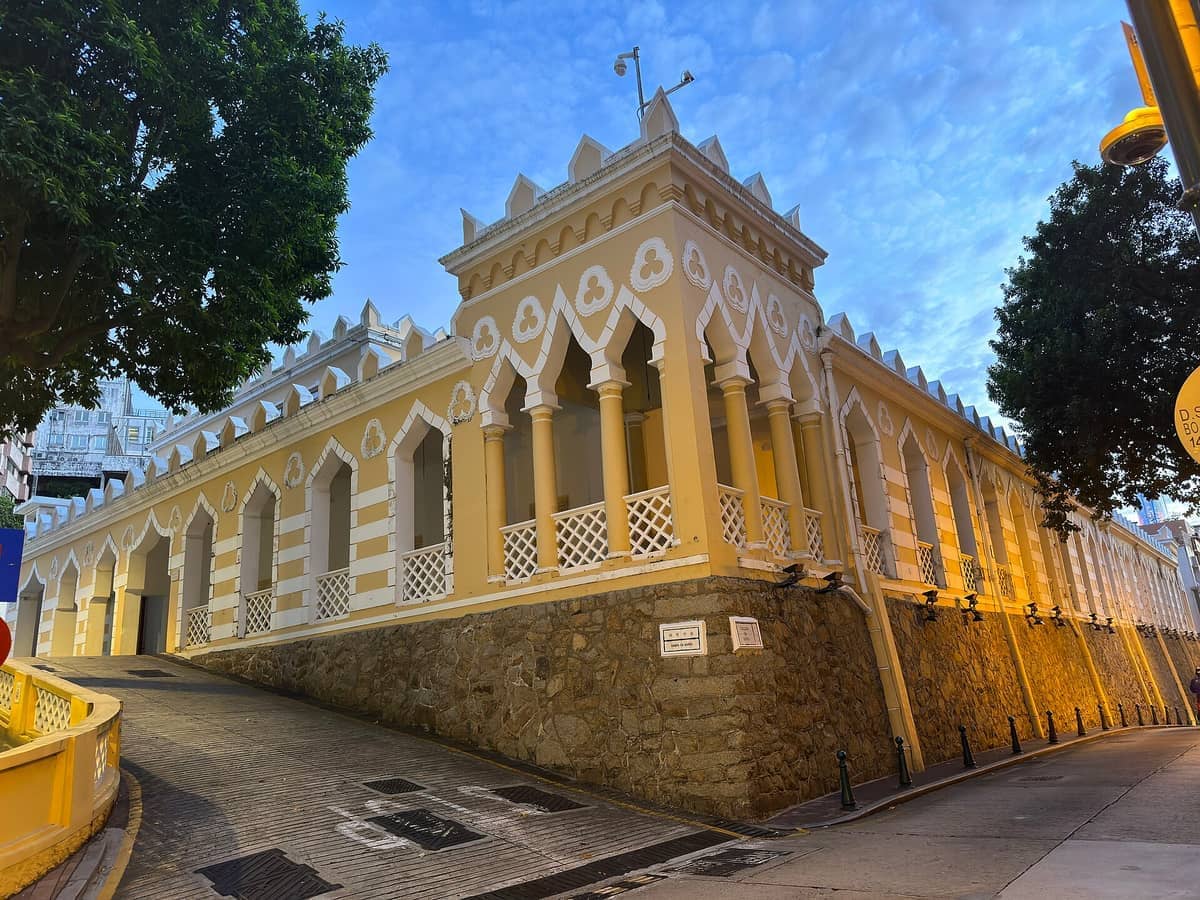
What Is the Moorish Barracks?
The Moorish Barracks, officially known in English as the Headquarters Building of the Marine and Water Bureau (Former Moorish Barracks) and in Portuguese as Quartel dos Mouros, is one of the more quietly compelling buildings in Macau's UNESCO World Heritage portfolio. Constructed in 1874, the building was originally commissioned to house an Indian regiment recruited from Goa, then a Portuguese colony. The "Moorish" in the name is a period misnomer: the soldiers were primarily Hindu and Muslim Goans, not Moors, but the label stuck through to the modern era. In 1905, the Portuguese administration repurposed the building as the local Harbour Authority, and it has functioned as a government office since, most recently housing the Marine and Water Bureau.
This dual identity, military garrison turned maritime bureaucracy, gives the building a layered significance that goes well beyond its photogenic exterior. It is a physical record of Macau's colonial labour arrangements, its trade with the Indian subcontinent, and the gradual reconfiguration of the Inner Harbour waterfront over more than a century.
ℹ️ Good to know
The verandah is open to the public from 9:00 am to 6:00 pm at no charge. The interior of the building is an active government office and is not accessible to visitors.
The Architecture: What Makes It Visually Distinctive
Standing at street level on Calçada da Barra, the Moorish Barracks commands attention through scale and restraint rather than ornamentation. The structure is built from brick and stone, elevated on a raised granite platform, and fronted by a two-storey colonnaded verandah that wraps the building in rhythmic arched openings. The arches themselves show Mughal influence, with a pointed profile that breaks from the otherwise neo-classical European framework of Macau's civic architecture. The combination is not common anywhere else in the territory.
The exterior walls carry a warm ochre-yellow pigment typical of the Iberian-influenced palette found across Macau's historic core, but the building's proportions feel different from the churches and civic plazas elsewhere in the World Heritage zone. It sits lower and broader, with a horizontal emphasis that suits its original barracks function. The granite detailing at the base is well-preserved and worth examining at close range: the stone is cut clean and aged with the patina of a century and a half of subtropical humidity.
If the Moorish Barracks inspires broader curiosity about Macau's Portuguese-colonial architecture, the Mandarin House and the Dom Pedro V Theatre each offer different facets of the same era, within walking distance of the wider Barra district.
How the Experience Changes by Time of Day
Early morning, before 10:00 am, is the best time to visit for photography. The southern orientation of the facade catches soft morning light across the arched verandah columns without harsh shadow, and foot traffic on Calçada da Barra is minimal at that hour. The street sounds this early are almost entirely local: the clatter of deliveries to nearby businesses, the distant hum of ferries on the Inner Harbour below, and the occasional bark from a dog in one of the residential lanes behind the building.
By midday in summer, the building becomes a practical problem for lingering. Macau's subtropical heat from June through September regularly pushes temperatures into the low-to-mid 30s Celsius with high humidity. The verandah provides some shade, but there is no air-conditioning accessible to visitors, no seating in the public area, and the surrounding streets offer little tree cover. A brief stop is comfortable; a long contemplative visit is not. Come before 10:00 am or after 4:00 pm in summer.
In the autumn months, October through December, the light and temperature align well for a more relaxed visit. The air drops to a comfortable 22–26°C, the sky tends toward clear blue, and the yellow-ochre facade photographs best under afternoon light from the west. This is also when the surrounding streets near A-Ma Temple feel most walkable, making the Moorish Barracks a natural first or last stop on a heritage circuit of the Barra area.
💡 Local tip
Typhoon season runs May through November, with July through September as the peak period. Macau's signal system can close sites with little notice. If you see a Typhoon Signal No. 3 or above posted, outdoor visits to the area should be postponed.
Getting There and Navigating the Area
The Moorish Barracks sits on Calçada da Barra, on the southern tip of the Macau Peninsula, in the same cluster of heritage sites as A-Ma Temple. Multiple public bus routes serve the area, including routes 1, 2, 5, 10, 11, 18, 18B, 21A, 26, and 28B, though exact route details and fares should be verified against current timetables before your visit. Alight at the A-Ma Temple stop and walk uphill for a short distance along the lane. The building is signposted as part of the UNESCO World Heritage zone.
Taxis are widely available across Macau and represent the most straightforward option if you are unfamiliar with the bus network. A short ride from the Ruins of St. Paul's or Senado Square takes roughly 10–15 minutes depending on traffic. The guide to getting around Macau covers public transport options, casino shuttle services, and taxi tips in more detail.
Accessibility information for the building is limited in official sources. The site is set on elevated terrain with some incline approaching from the bus stop, and the heritage area involves uneven stone paving. Visitors with mobility constraints should factor this in when planning. No detailed wheelchair-accessibility information is available from the current official heritage listings.
Placing It in Context: The Barra Heritage Circuit
The Moorish Barracks is most rewarding when treated as part of a half-day walk through the Barra district rather than a standalone destination. The immediate neighbourhood contains several of Macau's most significant heritage sites in close proximity. A-Ma Temple, just below on the waterfront, is one of the oldest temples in the territory and a working place of worship that predates Portuguese settlement. The contrast between the temple's incense-thick courtyards and the formal colonial geometry of the barracks, separated by barely 200 metres, is precisely the kind of layered cultural collision that makes Macau interesting.
Walking uphill from the barracks in the other direction takes you toward Barra Hill and the broader peninsula, where residential lanes and small local restaurants fill the space between heritage monuments. The neighbourhood is substantially less crowded than the Ruins of St. Paul's corridor and rewards slower movement: the smells shift from incense near the temple to cooking oil from neighbourhood kitchens, and the sounds change from tourist groups to the low chatter of local residents going about their afternoon.
Macau's heritage walk as a broader concept, connecting the Inner Harbour area with sites across the peninsula, is documented in the Macau heritage walk guide, which can help you sequence the Moorish Barracks into a logical route.
Photography Notes
The facade is the primary photographic subject, and it works best with a wide-angle lens or a phone camera in landscape orientation from the street directly in front. There is a low retaining wall on the opposite side of the narrow lane that provides a useful vantage point for full-frame shots of the verandah. The colonnaded arches compress well from a slightly elevated angle and reward patience: wait for a clear gap in foot traffic or for the warm late-afternoon sun to catch the yellow plasterwork.
The granite platform at the building's base provides strong textural foreground interest for closer architectural shots. Avoid midday in summer entirely for photography: high sun creates flat, washed-out light on the pale facade and heavy shadow under the arches. Overcast days in spring are not ideal either, as the ochre tones need direct light to read clearly. Morning and late afternoon in autumn and winter are the most reliable conditions.
Who This Is For and Who It Is Not
The Moorish Barracks is not a museum, does not have interpretive displays accessible to the public, and cannot be explored inside. What you have is an architecturally singular exterior and verandah, a UNESCO World Heritage context, and a quiet street that tells a story through juxtaposition and texture rather than through curated exhibits. Visitors who need interactive content, guided explanations, or interior access will find the experience limited.
For travellers with a genuine interest in colonial architecture, the building delivers something that very few places in Asia can: an intact, unrestored, and functionally continuous building from 1874 that remains in active public use. The fact that it still operates as a government office is part of what makes it interesting. It has not been turned into a boutique hotel or a heritage centre. It remains, quietly, what it became in 1905.
⚠️ What to skip
If your time in Macau is very limited, the Moorish Barracks works best as a 20-minute addition to a visit to A-Ma Temple rather than a primary destination. It rewards those who are already in the area, not a long journey from the other side of the peninsula on its own.
Insider Tips
- Visit on a weekday morning: the building is an active government office, and the surrounding area is notably quieter on weekday mornings before tour groups arrive from the ferry terminals.
- Pair the visit with A-Ma Temple immediately below. The contrast between the temple's red lanterns and incense smoke and the barracks' crisp colonial geometry is visually striking and tells you more about Macau's history than either site does alone.
- The narrow lane directly in front of the building offers the best unobstructed view of the full facade, but it gets tight when tour groups pass through. Position yourself early or wait for the lane to clear before shooting.
- Wear comfortable, flat-soled shoes. The approach from the A-Ma Temple bus stop involves uneven cobblestone paving and a gentle but sustained incline. Sandals or flip-flops make the walk awkward.
- Check the Macau Meteorological and Geophysical Bureau's typhoon signal board if visiting between May and November, especially July to September. Signal No. 3 or above effectively closes the heritage circuit in this area.
Who Is Moorish Barracks For?
- Architecture and design enthusiasts looking for Indo-Portuguese colonial detail that does not appear elsewhere in Macau
- Heritage walkers building a half-day circuit of the Barra and Inner Harbour district
- Photographers working in the early morning or late afternoon autumn light
- Travellers who have already seen the main UNESCO sites and want to go deeper into the less-visited southern peninsula
- Anyone combining a visit to A-Ma Temple with nearby heritage sites at no extra cost or significant time commitment
Nearby Attractions
Other things to see while in Macau Peninsula:
- A-Ma Temple (Ma Kok Miu)
A-Ma Temple, known locally as Ma Kok Miu, is the oldest temple in Macau, with origins traced to 1488. Part of the UNESCO-listed Historic Centre of Macao, this atmospheric complex blends Taoist, Buddhist, Confucian, and folk traditions across six distinct halls climbing Barra Hill. Entry is free, and the site remains an active place of worship year-round.
- Camões Grotto and Casa Garden
Tucked into the northwest of the Macau Peninsula, Camões Grotto and Casa Garden form one of the city's most layered heritage sites. The park honors Portugal's greatest poet in a setting of banyan trees and rocky outcrops, while the adjacent 18th-century mansion carries the architectural weight of colonial trade history. Both are free to enter and rarely crowded.
- Dom Pedro V Theatre
The Dom Pedro V Theatre (Teatro Dom Pedro V) is the oldest Western-style performance venue in East Asia, completed in 1860 and — though normally a working venue — temporarily closed for renovation until early October 2026. Its pale green neoclassical facade on Largo de Santo Agostinho is one of the most photogenic and historically layered corners of the Macau Peninsula, and admission is free when it is open to visitors
- Fortaleza do Monte (Mount Fortress)
Fortaleza do Monte, built between 1617 and 1626, rises above the historic centre of Macau with cannon-lined ramparts, sweeping 360-degree views, and the acclaimed Macao Museum within its walls. For the price of a cup of coffee, or nothing at all on free days, this UNESCO-listed site delivers more history per square metre than almost anywhere else in the city.