Sir Robert Ho Tung Library: Macau's Most Atmospheric Reading Room
Set in a colonial-era mansion on St. Augustine's Square, the Sir Robert Ho Tung Library is one of Macau's most quietly rewarding attractions. It is part of the UNESCO-listed Historic Centre, free to enter, and far less crowded than the nearby Ruins of St. Paul's.
Quick Facts
- Location
- Largo de Santo Agostinho N.º 3, Macau
- Getting There
- Bus to Avenida de Almeida Ribeiro (San Ma Lo), then a short uphill walk to St. Augustine's Square
- Time Needed
- 30–60 minutes
- Cost
- Free admission
- Best for
- History lovers, architecture enthusiasts, and anyone wanting a calm break from the tourist circuit
- Official website
- www.library.gov.mo
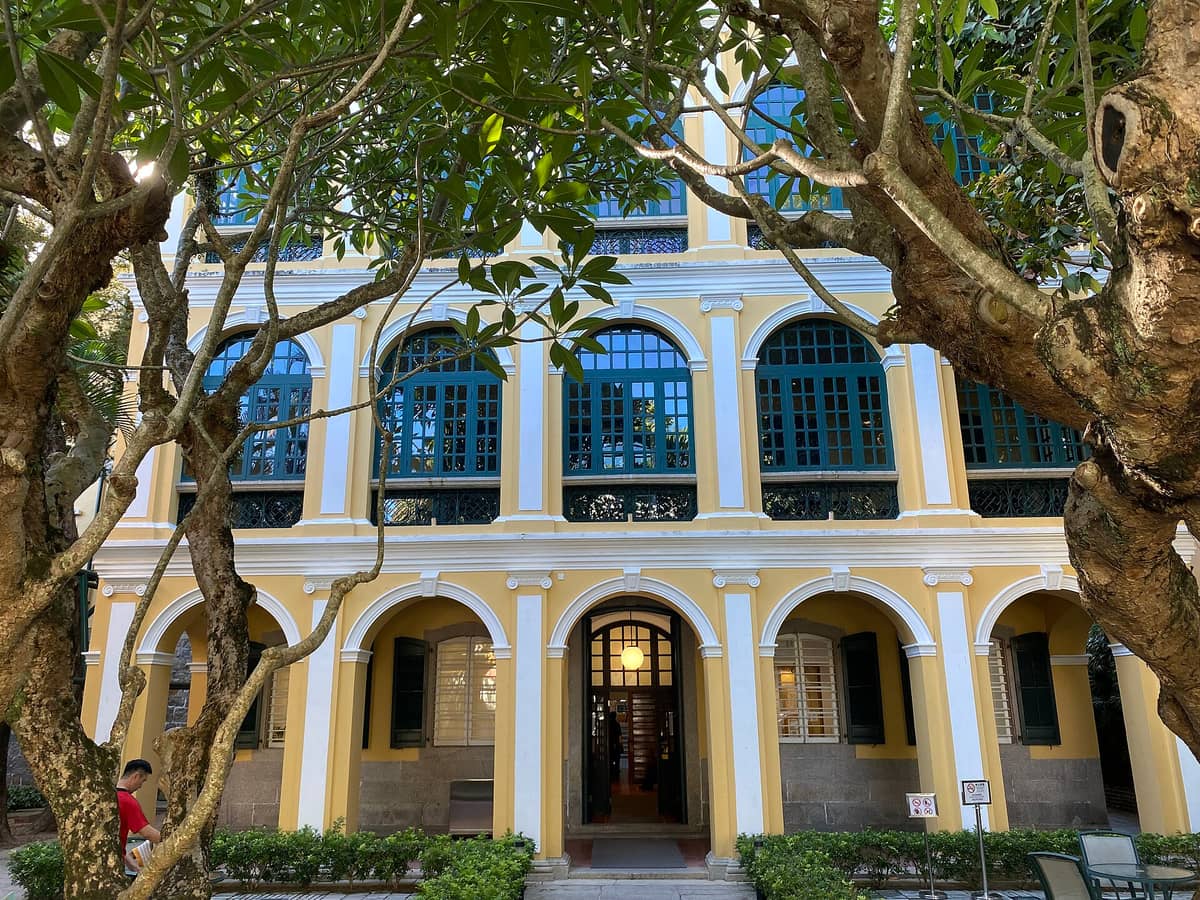
What Is the Sir Robert Ho Tung Library?
The Sir Robert Ho Tung Library is a functioning public library housed inside a pre-1894 colonial mansion on St. Augustine's Square, in the heart of Macau's Historic Centre. It sits within the UNESCO World Heritage Site inscribed in 2005 as the Historic Centre of Macao, and it earns its place on that list not as a ruin or a museum reproduction but as a living institution that residents actually use. Admission is free.
The building was originally constructed as a private residence for Dona Carolina Antónia da Cunha before 1894. In 1918, Hong Kong businessman Sir Robert Ho Tung acquired it as his private retreat in Macau. When he died, he bequeathed the property to the Macao government. It opened as a public library in 1958 and has operated continuously since. That arc, from aristocratic villa to Hong Kong tycoon's escape to public reading room, gives the building a layered character that most purpose-built attractions simply cannot replicate.
💡 Local tip
Opening hours: Monday 14:00–20:00, Tuesday to Sunday 08:00–20:00. The library closes on public holidays and closes at 14:00 on Chinese New Year's Eve. Verify hours before visiting on or near public holidays.
The Building and Garden: What You Actually See
The approach from St. Augustine's Square involves a short uphill climb, which means you arrive slightly breathless and the garden reveals itself as a reward. The walled courtyard garden is the first thing that stops most visitors. Banyan trees spread wide overhead, their root systems pushing against old stone, and the ambient noise of the street drops away almost immediately. On weekday mornings the garden is often empty enough that you can hear birdsong, which in central Macau is not a small thing.
The main building reads as a Portuguese colonial structure with Chinese architectural elements worked in around the doors and eaves. The facade is painted in a warm yellow-cream tone that catches afternoon light well, making late afternoon one of the better times to photograph the exterior. Inside, the library has been modernized enough to function practically, but the bones of the mansion remain: high ceilings, heavy wooden staircases, and rooms that open onto each other with the logic of a private home rather than a purpose-built institution.
The collection is primarily in Chinese and Portuguese. English-language holdings are limited, which is worth knowing in advance. The value for most visitors is not in checking out books but in the experience of being inside a working library in a UNESCO World Heritage building that looks and feels exactly like what it is: a house with a long memory.
How the Experience Changes by Time of Day
Tuesday to Sunday, the library opens at 08:00, and the early morning slot is the most peaceful window in which to visit. Local students and older residents arrive first, using the reading rooms with the casual ease of people who come regularly. The garden, at this hour, is in partial shade and noticeably cooler than the street outside, which matters considerably if you are visiting between May and September.
By mid-morning, a trickle of tourists begins. St. Augustine's Square is not on every itinerary, and the library attracts fewer visitors than the Ruins of St. Paul's or Senado Square, so it never becomes genuinely crowded. Even at midday in high season the atmosphere remains composed. Midafternoon brings soft, warm light through the windows of the upper reading rooms. If you are planning to photograph the interior, windows on the upper floor catch diffuse afternoon light that works well without flash.
Monday afternoons, when the library opens at 14:00 rather than 08:00, tend to be quiet. The reduced hours mean some visitor groups have already moved on to other sites, and the reading rooms feel especially calm in the hour after opening.
Getting There and Navigating the Area
The library is in the southern section of the Macau Peninsula, roughly a 10–15 minute walk from the Ruins of St. Paul's and about 5 minutes on foot from the Avenida de Almeida Ribeiro bus corridor, which multiple routes serve. The walk from the main road climbs noticeably through narrow lanes typical of the historic centre, so wear comfortable shoes. The square itself is signposted, and the library's yellow facade is visible once you enter the square.
St. Augustine's Square also puts you within easy walking distance of several other World Heritage structures. The Dom Pedro V Theatre stands directly on the same square, and the Mandarin House is a few minutes further south. If you are following the Macau heritage walk, the library fits naturally into any southern peninsula loop.
⚠️ What to skip
The historic building involves slopes, uneven stone surfaces, and staircases. No dedicated wheelchair access is confirmed in official listings. Visitors with significant mobility limitations should factor this in when planning.
Photography Tips and Practical Details
Photography in the garden is generally unproblematic. Inside the reading rooms, be discreet: this is a working library where people are studying, and flash photography or intrusive positioning near readers is inconsiderate. The upper floors offer interior shots with good natural light in the afternoon. The staircase, which retains original woodwork, is a frequently photographed detail.
The garden photographs best in morning shade (08:00–10:00) or in the golden hour before the 20:00 closing. The yellow facade works well in full afternoon sun. A wide-angle lens is useful for the garden given the tree canopy; the interior rooms are small enough that a standard focal length is preferable.
There are no bag lockers or cloakrooms. The library is air-conditioned, which, during a humid Macau summer, makes it a genuinely pleasant stop as much for comfort as for culture. Bring water; there is no cafe on the premises.
Is It Worth Your Time?
For a traveler with a single day in Macau, the Sir Robert Ho Tung Library competes with a lot of higher-profile sites. If you are working through a tight itinerary focused on the casino hotels or major landmarks, it is possible to skip this one without regret. But if you are interested in Macau as a place with genuine historical depth rather than just a gaming destination, the library earns 30–45 minutes of your time without difficulty. It is one of the few places in central Macau where the Portuguese colonial period and Chinese domestic life read as a genuinely integrated history rather than a curated display.
The fact that it is still used as a library, that students sit here doing homework and retirees read newspapers in the reading rooms, adds something that most preserved heritage buildings lack: the sense that the place is still meant for people. That is worth something.
Travelers who find that Macau's tourist core feels overly commercial will appreciate this corner of the peninsula. Paired with a walk through the square and a stop at the nearby St. Joseph's Seminary and Church, this area gives a more considered picture of the city than the main souvenir drag around the Ruins of St. Paul's.
Weather and Seasonal Considerations
Macau's subtropical climate means summer visits (June to September) involve heat and high humidity. The uphill walk to St. Augustine's Square is short but steep enough to feel it in July. The air-conditioned interior offers genuine relief, which makes this a smarter afternoon stop in summer than an outdoor attraction. Autumn, roughly October to December, is the most comfortable period for the walk and the garden, with lower humidity and pleasant temperatures in the low-to-mid 20s Celsius.
During typhoon season (July to September), check the Macau Meteorological and Geophysical Bureau's signal status before heading out. The library would typically close if a significant typhoon signal is raised, as would most public facilities. In winter (December to February), temperatures occasionally dip toward 10–12°C in the early mornings; the garden feels exposed at those hours, but the interior is comfortable.
Insider Tips
- Monday is the only day the library opens at 14:00 rather than 08:00. If you plan to visit on a Monday, use the morning for other nearby sites and save the library for the afternoon.
- The garden is at its coolest and quietest between 08:00 and 09:30 on weekday mornings. If you are in Macau for more than a day and want the space to yourself, this is the window.
- The upper reading room windows face west, making afternoon the best time for interior photography without artificial light. Midday light from above can be harsh; late afternoon is softer and warmer in tone.
- St. Augustine's Square is a logical rest stop between the Mandarin House (south) and the Ruins of St. Paul's (north). Building your route around this square rather than treating the library as a detour makes the walk feel cohesive.
- The library closes on public holidays year-round. Chinese New Year in particular sees early closures across the historic centre. Check the official Macao Public Library site before visiting during festival periods.
Who Is Sir Robert Ho Tung Library For?
- History and heritage travelers who want to understand Macau beyond its casino economy
- Architecture enthusiasts interested in Portuguese colonial and Sino-Portuguese hybrid buildings
- Photographers looking for interior and garden shots away from tourist crowds
- Travelers seeking a cool, quiet respite during a hot summer day in central Macau
- Itinerary builders doing a self-guided heritage walk through the southern Macau Peninsula
Nearby Attractions
Other things to see while in Macau Peninsula:
- A-Ma Temple (Ma Kok Miu)
A-Ma Temple, known locally as Ma Kok Miu, is the oldest temple in Macau, with origins traced to 1488. Part of the UNESCO-listed Historic Centre of Macao, this atmospheric complex blends Taoist, Buddhist, Confucian, and folk traditions across six distinct halls climbing Barra Hill. Entry is free, and the site remains an active place of worship year-round.
- Camões Grotto and Casa Garden
Tucked into the northwest of the Macau Peninsula, Camões Grotto and Casa Garden form one of the city's most layered heritage sites. The park honors Portugal's greatest poet in a setting of banyan trees and rocky outcrops, while the adjacent 18th-century mansion carries the architectural weight of colonial trade history. Both are free to enter and rarely crowded.
- Dom Pedro V Theatre
The Dom Pedro V Theatre (Teatro Dom Pedro V) is the oldest Western-style performance venue in East Asia, completed in 1860 and — though normally a working venue — temporarily closed for renovation until early October 2026. Its pale green neoclassical facade on Largo de Santo Agostinho is one of the most photogenic and historically layered corners of the Macau Peninsula, and admission is free when it is open to visitors
- Fortaleza do Monte (Mount Fortress)
Fortaleza do Monte, built between 1617 and 1626, rises above the historic centre of Macau with cannon-lined ramparts, sweeping 360-degree views, and the acclaimed Macao Museum within its walls. For the price of a cup of coffee, or nothing at all on free days, this UNESCO-listed site delivers more history per square metre than almost anywhere else in the city.