St. Joseph's Seminary and Church: Macau's Quiet Baroque Jewel
Tucked into the São Lourenço district, St. Joseph's Seminary and Church is one of Macau's finest examples of Baroque Catholic architecture. Free to enter and far less crowded than the Ruins of St. Paul's, it pairs a contemplative church interior with a sacred art museum that has been closed to the public since September 2025.
Quick Facts
- Location
- Rua do Seminário, São Lourenço district, Macau Peninsula
- Getting There
- 10-minute walk from Senado Square; local buses serve the surrounding streets
- Time Needed
- 45 minutes to 1.5 hours (church + museum)
- Cost
- Free admission to the church; the Treasure of Sacred Art museum, which previously offered free entry, has been closed to the public since 2025
- Best for
- Architecture enthusiasts, history seekers, visitors wanting a calm alternative to busier heritage sites
What St. Joseph's Seminary and Church Actually Is
St. Joseph's Seminary and Church — known in Portuguese as Igreja de S. José — is a historic Catholic complex on Rua do Seminário in the São Lourenço district of the Macau Peninsula. The complex consists of three distinct elements: the church itself, an attached seminary building, and the Treasure of Sacred Art of St. Joseph's Seminary, a small museum housing religious artefacts gathered from Macau's churches and religious institutions. The church and its forecourt and staircase are formally recognized as a heritage site by the Macao Government Cultural Affairs Bureau.
Two things are worth stating clearly from the outset. First, the seminary building is not open to the public — only the church interior and museum are accessible to visitors. Second, both are free to enter. In a city where many headline experiences come with a price tag, this combination of architectural quality and zero admission cost makes St. Joseph's stand out for the budget-conscious traveler.
ℹ️ Good to know
Opening hours: Church open daily 10:00–17:00. The Treasure of Sacred Art museum previously kept the same hours but has been closed to the public since 17 September 2025. Access to the church is via a forecourt and staircase — visitors with limited mobility should be aware that there is no step-free route into the church.
The Architecture: Why This Church Looks the Way It Does
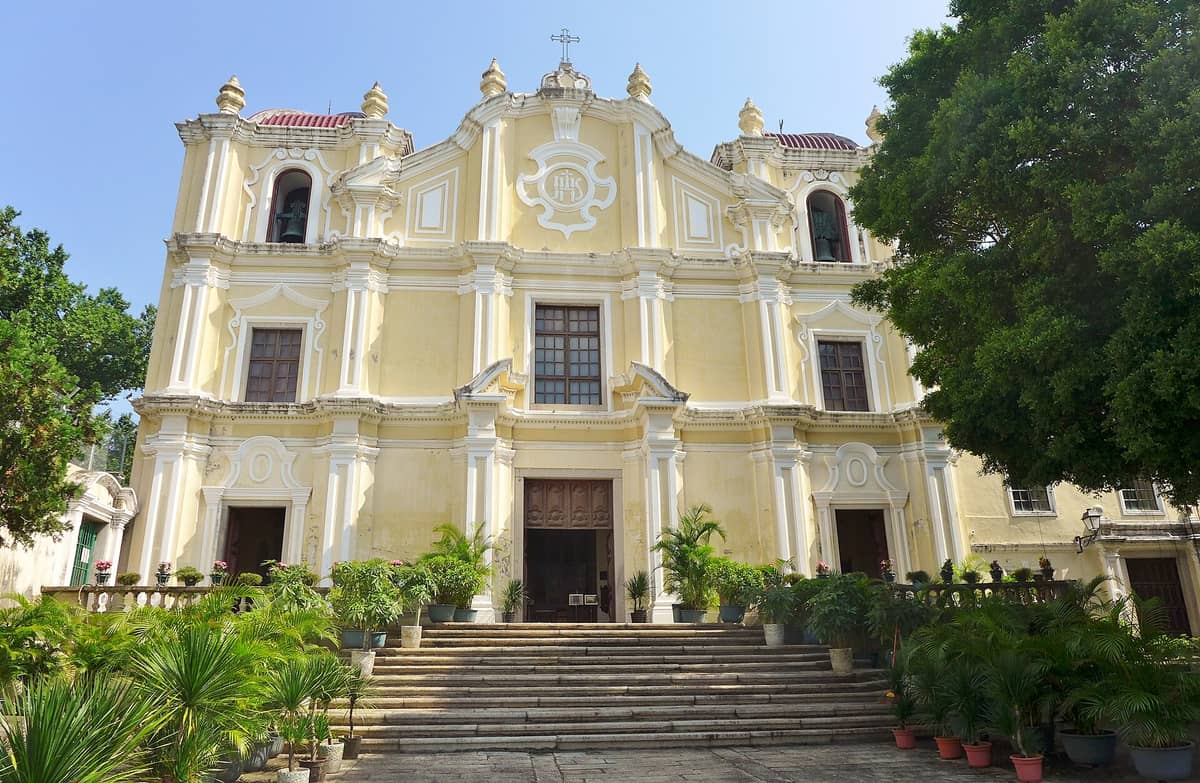
The facade of St. Joseph's Church is one of the most intact and coherent examples of Baroque ecclesiastical architecture in the entire Pearl River Delta region. Unlike the Ruins of St. Paul's — which survives as a dramatic stone front without a roof or interior — St. Joseph's is fully standing and functionally whole. The curved gable, layered pilasters, and symmetrical composition of the exterior follow the Jesuit Baroque tradition that spread from Rome through Portugal and then into its overseas territories during the 17th and 18th centuries.
Standing at the base of the staircase and looking up at the facade, you see the hierarchy of Baroque design working exactly as intended: the eye is drawn upward through increasingly refined detail toward a central lantern. The dome — visible from various angles in the surrounding streets — is one of the distinctive skyline markers of the Macau Peninsula. Inside, the nave is cool, dim, and quiet, with gilded altarpieces and painted ceilings that reward slow attention. The scale is human rather than overwhelming — this was never meant to be a cathedral, but a seminary church, designed to anchor the spiritual life of students and clergy.
Macau's Catholic architectural heritage is unusually concentrated. If you're moving through the historic centre, St. Joseph's pairs naturally with St. Dominic's Church and the Ruins of St. Paul's for a coherent picture of how different Catholic orders — Jesuits, Dominicans — shaped Macau's built environment over three centuries. Read more about this in our guide to Macau's historic churches.
The Church at Different Times of Day
Morning light, particularly between 10:00 and 11:30, enters the church through the upper windows at an angle that brings warmth to the gilded altarpieces without flattening the shadows in the nave. This is generally the best time for photography inside, and the church is at its most peaceful — street noise from Rua do Seminário filters in only faintly, and visitor numbers are low.
Midday brings more visitors, particularly tour groups making their way between landmarks. The church handles these waves quietly — the interior is small enough that even a group of fifteen people makes the space feel full, so if you arrive and find a group inside, waiting ten minutes on the forecourt steps is usually enough to reclaim the atmosphere. The stone steps themselves are worth pausing on: worn smooth by foot traffic over centuries, they frame a view back into the surrounding neighborhood that feels genuinely removed from the casino-and-souvenir-shop character of the busier heritage corridors.
By mid-afternoon, the quality of natural light inside the nave diminishes. The exterior facade, however, photographs well in afternoon shadow, with the carved stone detail showing greater contrast than it does under direct midday sun. The church closes at 17:00, so there is no opportunity to experience it in evening light.
💡 Local tip
Tip: Visit on a Tuesday or Thursday morning for the lowest foot traffic. Note that the Treasure of Sacred Art museum has been closed to the public since September 2025, though the church itself remains open.
The Treasure of Sacred Art Museum
Attached to the church complex was the Treasure of Sacred Art of St. Joseph's Seminary, a small collection of religious objects — vestments, reliquaries, devotional paintings, silverwork, and ecclesiastical furnishings — gathered from Macau's Catholic institutions. The museum was administered by the Macau Museum network and was free to enter until its closure to the public in 2025.
The collection is modest in scale but high in quality. Many of the objects on display were crafted in the 17th and 18th centuries, when Macau served as the primary hub for Jesuit missionary activity across East Asia. Some items reflect the cultural blending that characterized Macau's position as a trading port: European liturgical forms executed with Chinese materials or decorative motifs. This is not a large or exhausting museum — thirty minutes is enough to see everything carefully.
Signage is available in English, Portuguese, and Chinese. The display space is air-conditioned, which makes it a practical mid-afternoon refuge if you are exploring the area on foot during the warmer months, when temperatures regularly reach the high 20s to low 30s Celsius.
Getting There and the Surrounding Area
St. Joseph's Seminary and Church sits in the São Lourenço district, about a ten-minute walk from Senado Square — the geographic center of Macau's historic tourist zone. The walk itself is worthwhile: the route passes through narrower, quieter streets than those surrounding the more crowded landmarks, offering a better sense of everyday Macau Peninsula life. If you are following the Macau heritage walk, St. Joseph's falls naturally within that circuit.
Several public bus routes pass through the surrounding streets, though the exact line numbers and stops are subject to change — check the Macao SAR Government transport website before relying on specific routes. For most visitors based in the central Peninsula, walking from Senado Square or from the Leal Senado Building is the most straightforward approach. The neighborhood also puts you within a few minutes' walk of the Mandarin House and Penha Hill and Church, making it easy to combine these sites into a single afternoon.
⚠️ What to skip
Accessibility note: Entry to the church requires climbing a staircase from the forecourt. There is no step-free access route. Visitors who use wheelchairs or have significant difficulty with stairs will not be able to enter the church interior.
Who This Is For, and Who Might Be Disappointed
St. Joseph's Seminary and Church rewards visitors who are genuinely interested in architecture, Catholic heritage, or the history of European contact with East Asia. The combination of a complete Baroque interior — intact roof, functioning altarpieces, original structural details — with a focused sacred art collection makes this a more substantive experience than the famous St. Paul's ruins, which are visually dramatic but offer only a facade.
That said, visitors looking for sensory variety or family-friendly interactivity will find it limited. The church is a place of quiet contemplation, and the museum is a conventional display format. Children who are not already interested in religious history or old objects are unlikely to find much here to hold their attention beyond the initial impression of the facade. Similarly, if your Macau itinerary is dominated by casino resorts and contemporary entertainment, this site sits at a considerable remove from that world — which, depending on your perspective, is either its greatest strength or a reason to skip it.
Weather matters. In summer (June through September), the walk from Senado Square passes through streets with limited shade, and the midday heat in Macau can be aggressive. Wear light, breathable clothing, carry water, and factor in the humidity when planning the timing of your visit. The church interior and museum are cooler than the street, but the staircase approach is exposed.
Insider Tips
- The forecourt staircase, not just the facade, is worth examining closely — the stone bannisters and lantern posts show fine detail that most visitors walk past without stopping.
- If you visit the museum on a quiet day, the attendant staff are often knowledgeable about specific objects in the collection and will engage if you ask questions — this is not guaranteed, but the museum's small scale makes it more likely than at larger institutions.
- The dome of St. Joseph's Church is visible from several streets to the south of the complex. Walking around the block before entering gives you a better understanding of the building's massing and its relationship to the surrounding urban fabric.
- Combine this visit with Penha Hill — a ten-minute walk uphill from St. Joseph's — for a view over the Peninsula that most visitors miss entirely. The two sites form a natural pair.
- Photography inside the church is generally permitted for personal use, but avoid using flash near the altarpieces. The morning light through the upper windows creates the best natural conditions without it.
Who Is St. Joseph's Seminary and Church For?
- Architecture and design enthusiasts interested in Baroque ecclesiastical building
- Travelers exploring Macau's UNESCO-listed historic centre on foot
- Visitors who want a quieter, less-crowded heritage experience than the Ruins of St. Paul's
- History of religion and East-West cultural exchange
- Budget travelers: the church is free to enter; the museum, which used to be free, is currently closed to the public
Nearby Attractions
Other things to see while in Macau Peninsula:
- A-Ma Temple (Ma Kok Miu)
A-Ma Temple, known locally as Ma Kok Miu, is the oldest temple in Macau, with origins traced to 1488. Part of the UNESCO-listed Historic Centre of Macao, this atmospheric complex blends Taoist, Buddhist, Confucian, and folk traditions across six distinct halls climbing Barra Hill. Entry is free, and the site remains an active place of worship year-round.
- Camões Grotto and Casa Garden
Tucked into the northwest of the Macau Peninsula, Camões Grotto and Casa Garden form one of the city's most layered heritage sites. The park honors Portugal's greatest poet in a setting of banyan trees and rocky outcrops, while the adjacent 18th-century mansion carries the architectural weight of colonial trade history. Both are free to enter and rarely crowded.
- Dom Pedro V Theatre
The Dom Pedro V Theatre (Teatro Dom Pedro V) is the oldest Western-style performance venue in East Asia, completed in 1860 and — though normally a working venue — temporarily closed for renovation until early October 2026. Its pale green neoclassical facade on Largo de Santo Agostinho is one of the most photogenic and historically layered corners of the Macau Peninsula, and admission is free when it is open to visitors
- Fortaleza do Monte (Mount Fortress)
Fortaleza do Monte, built between 1617 and 1626, rises above the historic centre of Macau with cannon-lined ramparts, sweeping 360-degree views, and the acclaimed Macao Museum within its walls. For the price of a cup of coffee, or nothing at all on free days, this UNESCO-listed site delivers more history per square metre than almost anywhere else in the city.