Macao Science Center: What to Expect Before You Visit
The Macao Science Center is a modern science museum and planetarium on the Macau Peninsula waterfront, housed in a striking cone-shaped building designed by I.M. Pei Architects. With generally low-cost admission to its 13 themed galleries and ticketed planetarium dome shows, it offers a genuinely worthwhile stop, especially for families and anyone looking for a break from the city's casino-heavy entertainment landscape.
Quick Facts
- Location
- Avenida Dr. Sun Yat-Sen, Macau Peninsula, Macao
- Getting There
- Public buses along Avenida Dr. Sun Yat-Sen; short taxi ride from Outer Harbour Ferry Terminal or Fisherman's Wharf
- Time Needed
- 1.5 to 3 hours depending on planetarium show schedule
- Cost
- Exhibition Center: paid admission except on designated free-admission days. Planetarium: ticketed (verify current prices at msc.org.mo). Closed Thursdays.
- Best for
- Families with children, rainy-day visits, science and architecture enthusiasts
- Official website
- www.msc.org.mo/en
The Building Before You Even Walk In
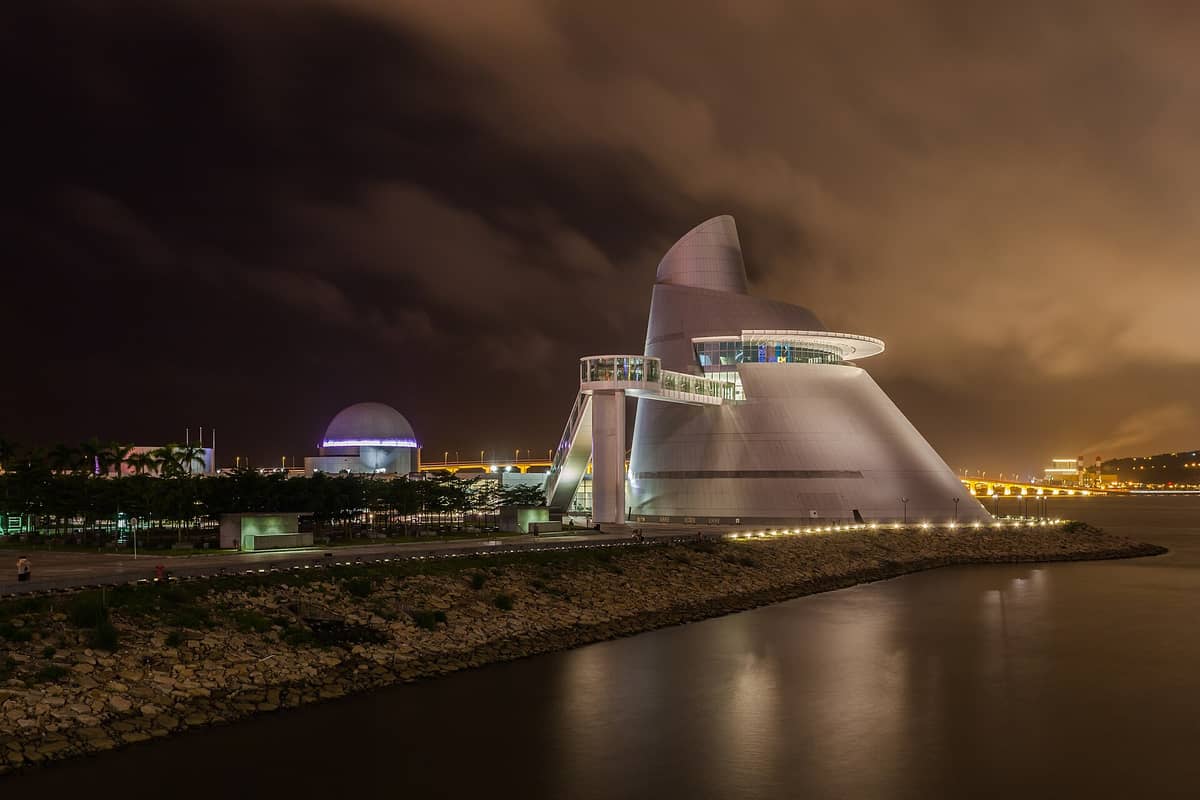
The Macao Science Center announces itself from a distance. Its main exhibition cone, a faceted silver form that tilts out over the waterfront promenade on Avenida Dr. Sun Yat-Sen, was designed by I.M. Pei Architects, the practice behind the Louvre Pyramid in Paris. It is one of the few contemporary buildings in Macau that holds its own visually against the city's older Portuguese colonial architecture and its newer casino mega-structures. The cone's exterior is covered in angled geometric panels that catch the light differently at different hours: in the morning, the surface is a flat, matte silver; by mid-afternoon, it throws reflected light across the adjacent promenade; at dusk, when the center closes and the waterfront quietens, the whole structure takes on a darker metallic quality against the Pearl River.
The building complex contains three main components: the Exhibition Center (the main cone), the Planetarium (a smaller dome adjacent to the cone), and a Convention Center. As a visitor, you will primarily interact with the first two. The waterfront setting is a genuine asset. The promenade out front offers unobstructed views toward Taipa and the casino towers of the Cotai Strip in one direction, and toward the older harbor in the other. If you arrive early, it is worth spending five minutes outside before going in.
💡 Local tip
Arrive by 10:00 when the center opens, especially if you want a planetarium show. Show slots fill up, particularly on weekends and during school holidays. Ticket sales stop 30 minutes before the 17:30 cutoff for ticketing.
Inside the Exhibition Center: 14 Galleries
The Exhibition Center has a standard paid admission (typically around MOP 50 for adults, with designated free-admission days — verify current prices at msc.org.mo). The interior is organized across multiple floors within the cone, with 14 themed galleries covering subjects from astronomy and robotics to environmental science and a dedicated Data Science Gallery. The layout follows the cone's circular footprint, so you naturally spiral upward through the exhibits rather than navigating a conventional rectangular floor plan. This works well in practice: it prevents the disorientation common in large science museums and means even children moving at an unpredictable pace tend to stay within sight.
The interactive quality of the exhibits is generally solid by regional standards. There are hands-on physics demonstrations, motion-sensor displays, and digital interactives that hold up reasonably well, though some exhibits show age and the technology has not all been refreshed at the same pace. The robotics and digital science sections tend to be the most engaging for adults. Younger children gravitate toward the physical experiment stations where they can test concepts like leverage, sound waves, and magnetism with actual equipment rather than just screens.
Signage throughout is in Chinese (Traditional and Simplified) and English, which is more than adequate for most international visitors. The center is noticeably quieter on weekday mornings, when school groups are less common, and this is the better time for adults or anyone who finds crowded interactive spaces frustrating. By weekend afternoons, particularly on Saturdays, the lower gallery floors fill with families and the noise level rises considerably.
The Planetarium: The Main Reason to Time Your Visit
The Planetarium is housed in the smaller dome structure attached to the main cone. It runs dome projection shows on a schedule that varies by season and programming, so checking the current timetable on the official website before your visit is essential rather than optional. Shows are typically ticketed separately from the Exhibition Center, and on certain special days Macao ID card holders receive a limited number of free tickets per showing.
The dome itself is genuinely impressive. The full-dome digital projection creates the kind of immersive overhead experience that flatscreen science content cannot replicate, and for visitors coming with children, this is frequently the part of the visit they remember most clearly. Shows cover topics like the solar system, cosmic phenomena, and Earth science, and run in Cantonese or Mandarin with some English-language options depending on the schedule. Verify language options when booking.
ℹ️ Good to know
The center is closed every Thursday and on Lunar New Year's Eve. On public holidays it remains open, which can mean higher-than-normal visitor numbers. If visiting during Chinese New Year, check the official calendar in advance.
How the Experience Changes by Time of Day
Early morning, around 10:00 to 11:30, offers the most relaxed experience in the Exhibition Center. The galleries are uncrowded, the air conditioning is effective before the building fills with body heat, and the interactive stations are all available without waiting. The waterfront promenade outside is also at its most peaceful at this hour, before the midday tour groups arrive from the ferry terminals and hotel shuttles.
Midday visits during school terms can coincide with organized school tours, which occupy large portions of the lower floors and create unavoidable bottlenecks at popular exhibits. If you arrive between 11:00 and 14:00 on a weekday during school term and find a group in progress, it is worth heading directly to the upper floors and working your way down once the group moves on. Weekend afternoons are the busiest period overall.
The late afternoon window, from around 15:30 to 17:30, is often underrated. Foot traffic drops as families with young children leave for dinner, the light through the building's upper apertures shifts to a warmer angle, and the waterfront outside becomes a pleasant place to decompress after the exhibition. This is also a reasonable time for photography of the exterior, when the sun is lower and the building's geometric panels catch directional light rather than flat midday glare.
Getting There and Practical Logistics
The Macao Science Center sits on Avenida Dr. Sun Yat-Sen on the eastern NAPE / Outer Harbour waterfront of the Macau Peninsula waterfront, close to the Macau Cultural Centre, the Outer Harbour Ferry Terminal, and Fisherman's Wharf. Public buses run along this waterfront avenue and connect the area to the historic center, where attractions like the Ruins of St. Paul's and Senado Square are located.
Taxis are readily available throughout the Peninsula and are an affordable option for direct travel. Many major casino hotels run complimentary shuttles to the ferry terminals, and these drop passengers within walking distance of the Science Center. If you are combining the visit with a stop at Macau Fisherman's Wharf, which is a short walk along the promenade, the two can be combined in a single afternoon without needing additional transport.
Accessibility is well considered. The main circulation routes throughout the building use ramps and elevators rather than relying on stairs, and accessible toilets are available. Free wheelchair rental is available at the main lobby ticket office. The external promenade is flat and paved, making approach from the street level straightforward for visitors with mobility requirements.
On the question of weather: Macau's subtropical climate means summer visits (June through September) involve walking between an air-conditioned interior and humid outdoor heat. The Science Center's indoor focus makes it particularly practical during hot or rainy periods, which is worth keeping in mind when planning around the city's typhoon season. If a typhoon signal is raised during your visit, the center will close in line with local safety protocols.
Who Will Get the Most From This
For families traveling with children between roughly four and fourteen years old, the Macao Science Center is one of the most straightforward and rewarding stops on the Peninsula. The interactive format keeps younger visitors engaged in a way that historic churches and colonial architecture simply don't. It pairs particularly well with a walk through the Macau Museum if you want to balance education with cultural context.
Adults visiting without children will find the building architecture and the planetarium the most compelling elements. The exhibition content, while competent, is calibrated toward younger visitors and general audiences rather than specialist interest. If your primary focus is history, culture, or Macau's Portuguese heritage, the Maritime Museum or the Macau heritage walk through the historic center will likely hold your attention longer.
Solo travelers on a tight schedule who are prioritizing Macau's UNESCO-listed historic core may find the Science Center a lower priority, particularly if the planetarium schedule doesn't align with their timing. The building is worth a glance from the outside even if you don't go in, given its architectural distinction on the waterfront.
⚠️ What to skip
The center is closed every Thursday. This is a firm closure, not seasonal. Checking the official site for Lunar New Year closures is also recommended if you are visiting around that period, as dates shift annually.
Photography Notes
The exterior of the Macao Science Center is one of the more photogenic modern structures in Macau, and the waterfront promenade provides enough physical distance to capture the full cone in a single frame without distortion. Wide-angle compositions that include the adjacent dome and waterfront in the foreground work particularly well. Interior photography of the exhibits is generally permitted in the Exhibition Center, though rules can vary by specific gallery and temporary exhibition. Flash photography near interactive digital displays is typically discouraged.
For those compiling a broader visual record of Macau's architectural landscape, the waterfront area between the Science Center and the Cultural Centre offers a coherent sequence of contemporary public buildings that contrasts effectively with the colonial-era facades of the Peninsula's interior streets. For more context on Macau's best observation points and skyline views, the best views in Macau guide covers additional vantage points across the city.
Insider Tips
- Planetarium show slots are limited and not always available in English. Check the current schedule and language options on the official website (msc.org.mo) before you visit, not on arrival.
- The building's upper floors inside the Exhibition Center are consistently less crowded than the ground and first floors. If you arrive during a busy period, start at the top and work down rather than following the default entry flow.
- The waterfront promenade directly outside the Science Center connects all the way to Fisherman's Wharf without crossing a road. It is a quieter and more interesting route than the main avenue, especially on weekday mornings.
- Free wheelchair rental is available at the main lobby ticket office, but supply is limited. Contact the center in advance if this is essential to your visit.
- Ticket sales close at 17:30, 30 minutes before the 18:00 closing time. If you arrive after 17:30 hoping for a full visit, you will be turned away from purchasing tickets for some areas.
Who Is Macau Science Centre For?
- Families with children aged 4 to 14 looking for hands-on, interactive indoor activities
- Visitors seeking indoor attractions on the Macau Peninsula
- Architecture enthusiasts interested in I.M. Pei's later civic work
- Travelers planning a rainy-day or hot-afternoon itinerary away from casinos
- Anyone combining a waterfront walk with Fisherman's Wharf and the Cultural Centre area
Nearby Attractions
Other things to see while in Macau Waterfront & NAPE:
- Grand Prix Museum
The Macao Grand Prix Museum dedicates 16,000 square metres across four floors to the history of one of Asia's oldest and most technically demanding street races. Whether you follow motorsport closely or simply want to understand one of Macau's defining annual events, this is the most focused and well-produced museum on the waterfront.
- Kun Iam Statue (Goddess of Mercy Waterfront Statue)
Rising from a lotus-shaped dome on an artificial islet off Avenida Dr. Sun Yat-Sen, the Kun Iam Statue is one of Macau's most distinctive waterfront landmarks. The Kun Iam Ecumenical Centre inside the base is free to enter and offers a rare moment of calm away from the casino corridors. The outdoor park stays open from early morning until late evening, making it one of the few major sights in Macau that rewards visitors at multiple hours of the day.
- Macau Fisherman's Wharf
Macau Fisherman's Wharf is a free-entry, 133,000-square-metre leisure complex on the outer harbour of the Macau Peninsula. Part themed streetscape, part hotel zone, part dining strip, it draws curious walkers and families rather than serious sightseers. Here is what you actually get.
- Macau Museum of Art
The Macao Museum of Art is a major museum in Macau dedicated entirely to the visual arts, with seven exhibition areas across four floors and free admission. Located in the NAPE waterfront district inside the Macao Cultural Centre complex, it offers a genuinely calm alternative to the city's more-trafficked historic sites.