LaLaurie Mansion: New Orleans' Most Notorious Address on Royal Street
Standing at the corner of Royal and Governor Nicholls Streets, LaLaurie Mansion is a three-story Federal-style structure with a history that cuts to the darkest core of antebellum New Orleans. It is not open to the public, but its exterior draws visitors daily, and its story demands to be understood on its own terms, not just through ghost-tour mythology.
Quick Facts
- Location
- 1140 Royal Street (corner of Governor Nicholls St.), French Quarter, New Orleans, LA
- Getting There
- Walk from Jackson Square (~10 min); Rampart/St. Claude streetcar to nearby stop. No on-site parking.
- Time Needed
- 15–30 minutes for exterior viewing; 1–2 hours if joining a guided walking tour
- Cost
- Free (exterior only). Interior is not accessible — it is a private residence.
- Best for
- History enthusiasts, ghost tour participants, those studying the history of slavery in the American South
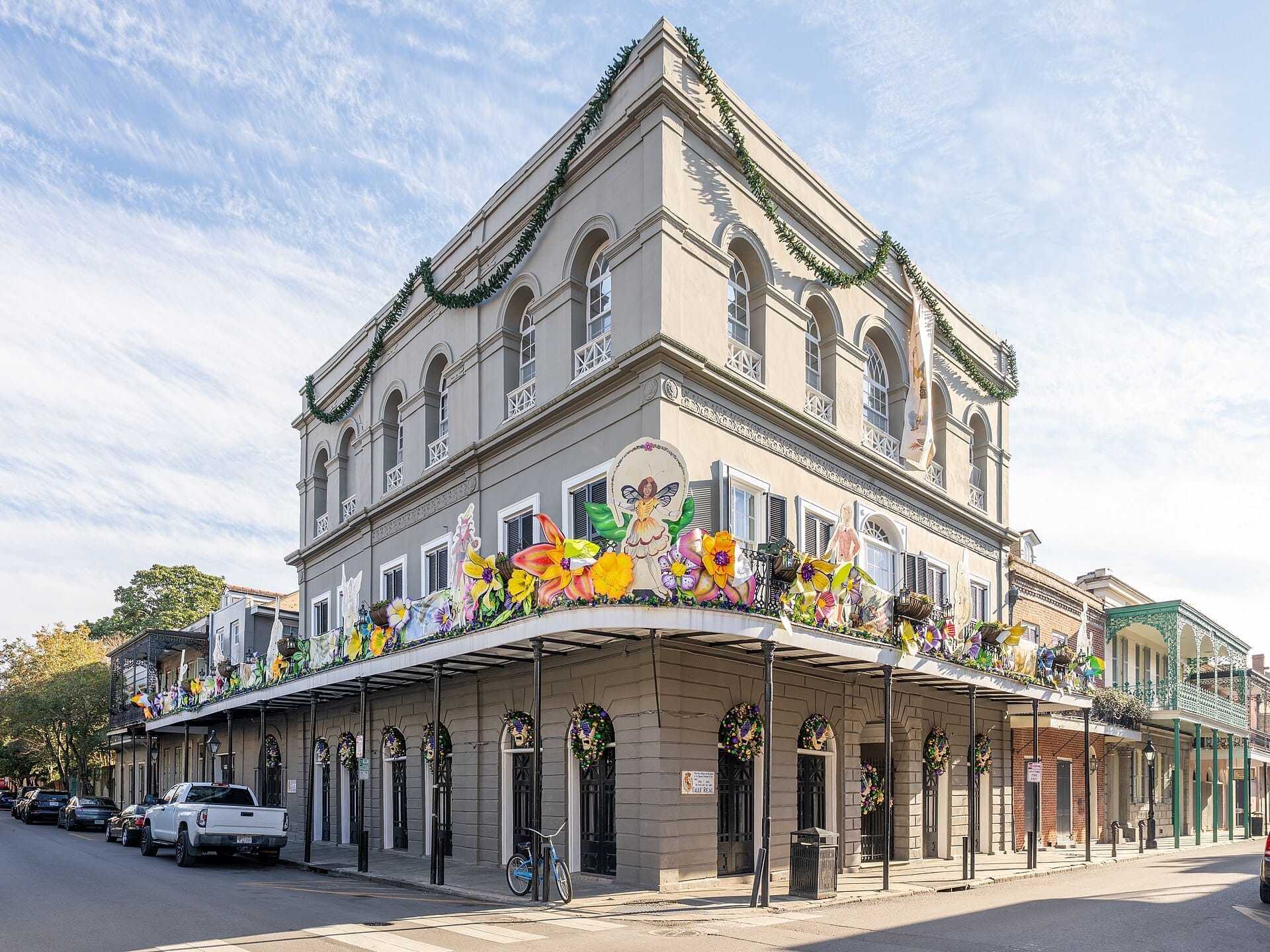
What You're Actually Looking At
LaLaurie Mansion stands three stories tall on the corner of Royal and Governor Nicholls Streets, its pale facade rising above the ironwork balconies that line the rest of the block. The building has a formal, almost austere presence compared to the exuberant Creole townhouses nearby. There is no signage, no ticket booth, no indication of what happened here. Most visitors stop on the sidewalk, look up, take a photograph, and move on. The building does not perform its history for you.
The structure you see today is not quite the same one that stood in 1834. The original two-story, exposed-brick Federal-style house was partially destroyed by fire and mob action in April of that year, then rebuilt and expanded through the 19th century to include a third floor and rear additions. A renovation in the 1970s altered some interior elements. The mansion served, across its history, as a music conservatory in the 1880s and as a school for Black girls in the late 19th century — layers of use that are rarely mentioned in the ghost-tour circuit but are worth holding in mind.
ℹ️ Good to know
LaLaurie Mansion is a private residence. There is no interior access, no tours of the inside, and no tickets to purchase. Anyone offering 'interior access' is not legitimate. Exterior viewing is free at any hour.
The History Behind the Address
Delphine LaLaurie and her husband Dr. Louis LaLaurie acquired the property in 1831, completing the original house around 1832. Delphine was a prominent figure in New Orleans Creole society, known for hosting elaborate dinners. What was happening in the upper floors and outbuildings was something else entirely.
On April 10, 1834, a fire broke out in the kitchen. When firefighters and bystanders entered the property, they discovered enslaved people who had been subjected to extreme abuse and confinement. The discovery triggered a mob response: the LaLauries fled New Orleans, reportedly to France, and much of the house was destroyed by the crowd. Delphine LaLaurie never returned to Louisiana and died in France on December 7, 1849.
The historical record has been complicated by sensationalism over the years. Some accounts, particularly those circulating on ghost tours, have embellished the events beyond what contemporaneous sources confirm. The core facts — documented by New Orleans newspapers in April 1834 — are disturbing enough without embellishment. This was not an isolated eccentricity; it was a product of the legal and social structures of antebellum Louisiana, where the ownership of human beings was codified and protected by law.
For deeper context on this period, the New Orleans history guide covers the city's colonial and antebellum layers with more nuance than most tour scripts allow. If you want to understand the broader geography of slavery in Louisiana, consider adding Whitney Plantation to your itinerary — it is one of the few sites in the region explicitly devoted to the experience of the enslaved, not the enslavers.
Tickets & tours
Hand-picked options from our booking partner. Prices are indicative; availability and final rates are confirmed when you complete your booking.
Houmas House estate and gardens guided mansion tour
From 0 €Instant confirmationSpooky kid-friendly family ghost tour
From 32 €Instant confirmationFree cancellationWalking the Devil's Empire tour with HELLVISION™ in New Orleans
From 32 €Instant confirmationFree cancellationThe New Orleans haunted cemetery city bus tour
From 43 €Instant confirmationFree cancellation
What It Feels Like to Visit
Royal Street in the French Quarter is a relatively quieter corridor compared to Bourbon Street two blocks over. In the morning, before the tour groups coalesce, the block near 1140 has the particular calm of a residential street: shutters half-open, someone walking a dog, the distant sound of a delivery truck on Bourbon. The mansion's facade in morning light looks almost stately, the kind of address you might admire for its proportions without knowing anything about it.
By mid-afternoon, small clusters of visitors are almost always present on the sidewalk outside. Some are there as part of ghost-tour stops, others have simply arrived via Google Maps. The foot traffic on Royal Street picks up as the day goes on, and by late afternoon you may find yourself sharing the sidewalk with a dozen people, all looking at the same second-floor windows. There is no queue, no rope barrier, nothing to manage the experience. You simply stand on a public sidewalk and look at a building.
At night, and especially during ghost tour hours (which typically begin after dark), the block takes on a noticeably different atmosphere. Tour guides often gather their groups outside the mansion, recounting events in low, deliberate voices. The ironwork shadows on the facade, the relative dimness of the street lighting on this block, and the acoustics of the narrow corridor all contribute to the effect. If you want to understand why New Orleans ghost tourism has made this address its centerpiece, standing here after 9 p.m. gives you that answer.
The Ghost Tour Question
LaLaurie Mansion is almost certainly the most-referenced stop on any New Orleans ghost tour. That popularity has a cost: the stories attached to the house have been layered, amplified, and in some cases fabricated beyond the historical record. If you are joining one of the city's walking ghost tours, treat the LaLaurie segment as entertainment with a historical core, not as documentary.
The New Orleans ghost tours guide breaks down which operators take a more historically grounded approach and which lean harder into theatrical storytelling. Both have value, but knowing which you are signing up for helps set expectations.
⚠️ What to skip
Sensationalized accounts of the LaLaurie Mansion frequently exaggerate or fabricate specific details beyond what 1834 newspaper sources document. If historical accuracy matters to you, cross-reference what you hear on tours against primary sources before repeating the stories.
Practical Details for Your Visit
Getting to LaLaurie Mansion is straightforward. From Jackson Square, it is roughly a 10-minute walk northeast along Royal Street. The Rampart/St. Claude streetcar line has stops in the vicinity, though most visitors in the French Quarter find walking the most practical option. Uber and Lyft both operate in the area, and there is no reason to drive — parking in this part of the French Quarter is extremely limited.
The sidewalks on Royal Street are generally accessible for wheelchairs and strollers, though the French Quarter's brick-paved sections can be uneven in places. Viewing the exterior of the mansion requires no steps, no barriers, and no physical exertion beyond the walk to get there. There are no interior facilities, restrooms, or visitor services of any kind, because this is a private home.
If you are building a broader French Quarter itinerary, the mansion fits naturally into a walking route that includes Royal Street and the neighborhood's historic residential blocks. You can extend that walk toward St. Louis Cemetery to continue exploring the city's layered relationship with death, memory, and preservation.
Photography is unrestricted from the public sidewalk. The best light for shooting the facade is in the morning (eastern exposure catches the early sun) or in the blue-hour window just after sunset. At midday, the building sits in flat, harsh light that flattens its architectural detail. A wide angle captures the full three-story height; a longer lens picks up the ironwork balcony details from across the street.
Who Should Skip This
If you are expecting an interactive museum experience, a guided interior tour, or any kind of formal interpretive programming, this is not the right stop. LaLaurie Mansion is, in the most literal sense, just a building you look at from outside. Visitors who arrive expecting the gothic spectacle of popular culture depictions (including the American Horror Story season set here) may find the reality underwhelming: it is a well-maintained historic mansion on a pleasant street.
Travelers who find the history of slavery and abuse distressing should consider whether this visit serves them. The history here is genuinely dark, and while the building itself offers no graphic content, the research and reading that gives the visit meaning can be difficult to sit with. That difficulty is arguably the point, but it is worth knowing in advance.
Insider Tips
- Visit on a weekday morning before 10 a.m. if you want the street largely to yourself. By early afternoon, tour groups begin congregating on the sidewalk outside, and the quiet that makes the building's presence feel most affecting is gone.
- The building is best understood as a physical document of a specific moment in New Orleans history — not a haunted house. Reading about the April 1834 fire and the events that preceded it before you arrive will transform what is otherwise just a facade into something genuinely meaningful.
- Royal Street on this block also has some of the Quarter's better antique and art galleries. Pairing the LaLaurie stop with a slower walk down Royal Street makes the visit feel less like a single-purpose detour and more like an exploration of what the French Quarter actually looks like away from Bourbon Street.
- If you are doing a night ghost tour that stops here, position yourself to the side of the tour group rather than at the back. Tour guides typically face the building while speaking, and being at an angle gives you a better view of both the guide and the facade.
- Nicolas Cage owned the property briefly in the mid-2000s before losing it to foreclosure in 2009. This detail comes up on virtually every ghost tour, but it is worth knowing beforehand so you can evaluate whether the guide is adding substance or just filling time.
Who Is LaLaurie Mansion For?
- History travelers interested in the antebellum South and the institution of slavery in Louisiana
- Ghost tour participants looking to understand the city's most iconic stop before joining a night walk
- Architecture enthusiasts interested in Federal-style structures and 19th-century French Quarter residential design
- Visitors pairing a Royal Street gallery walk with the neighborhood's deeper historical layers
- Travelers researching New Orleans' Creole social history and the elite class structures of the 1830s
Nearby Attractions
Other things to see while in French Quarter:
- Bourbon Street
Rue Bourbon is one of America's most recognizable streets, stretching 13 blocks through the French Quarter from Canal Street to Esplanade Avenue. The nightlife reputation is well-earned, but the street has genuine historical depth and a quieter, more complex daytime character that most visitors never see.
- The Cabildo
Standing on the edge of Jackson Square since 1799, The Cabildo is the building where the Louisiana Purchase transfer was formally completed in 1803, reshaping a continent. Today it houses the Louisiana State Museum's flagship collection on state history, from colonial rule to Reconstruction, making it the most historically consequential building in New Orleans.
- Café du Monde
Open since 1862, Café du Monde on Decatur Street is the oldest coffee stand in New Orleans and one of the most recognizable spots in the French Quarter. The menu is deliberately simple: beignets dusted in powdered sugar and café au lait made with chicory. What makes or breaks the visit is knowing when to go and what to expect.
- Court of Two Sisters
The Court of Two Sisters on Royal Street is one of New Orleans' most enduring dining institutions, serving a daily jazz brunch buffet in a courtyard that has been gathering people since the 18th century. The combination of live jazz, Creole cuisine, and centuries-old architecture makes it unlike anything else in the city.