Sa Llotja, Palma: Inside the Gothic Masterpiece of the Mediterranean
Sa Llotja (La Lonja de Palma) is one of the finest examples of Gothic civil architecture in the western Mediterranean, built between 1426 and 1452 by master architect Guillem Sagrera. Set on Palma's historic seafront, this former merchant exchange now hosts free exhibitions beneath its extraordinary spiraling columns and vaulted ceiling.
Quick Facts
- Location
- Plaça de la Llotja, Palma de Mallorca old town, near the seafront promenade
- Getting There
- 15-minute walk from Palma city centre; walkable from the Cathedral and Parc de la Mar along the waterfront
- Time Needed
- 30 to 60 minutes for the interior; allow extra time to explore the surrounding square
- Cost
- Free entry (exhibitions inside may vary; check current schedule)
- Best for
- Architecture lovers, history enthusiasts, photography, and anyone exploring Palma's old town on foot
What Is Sa Llotja and Why Does It Matter?
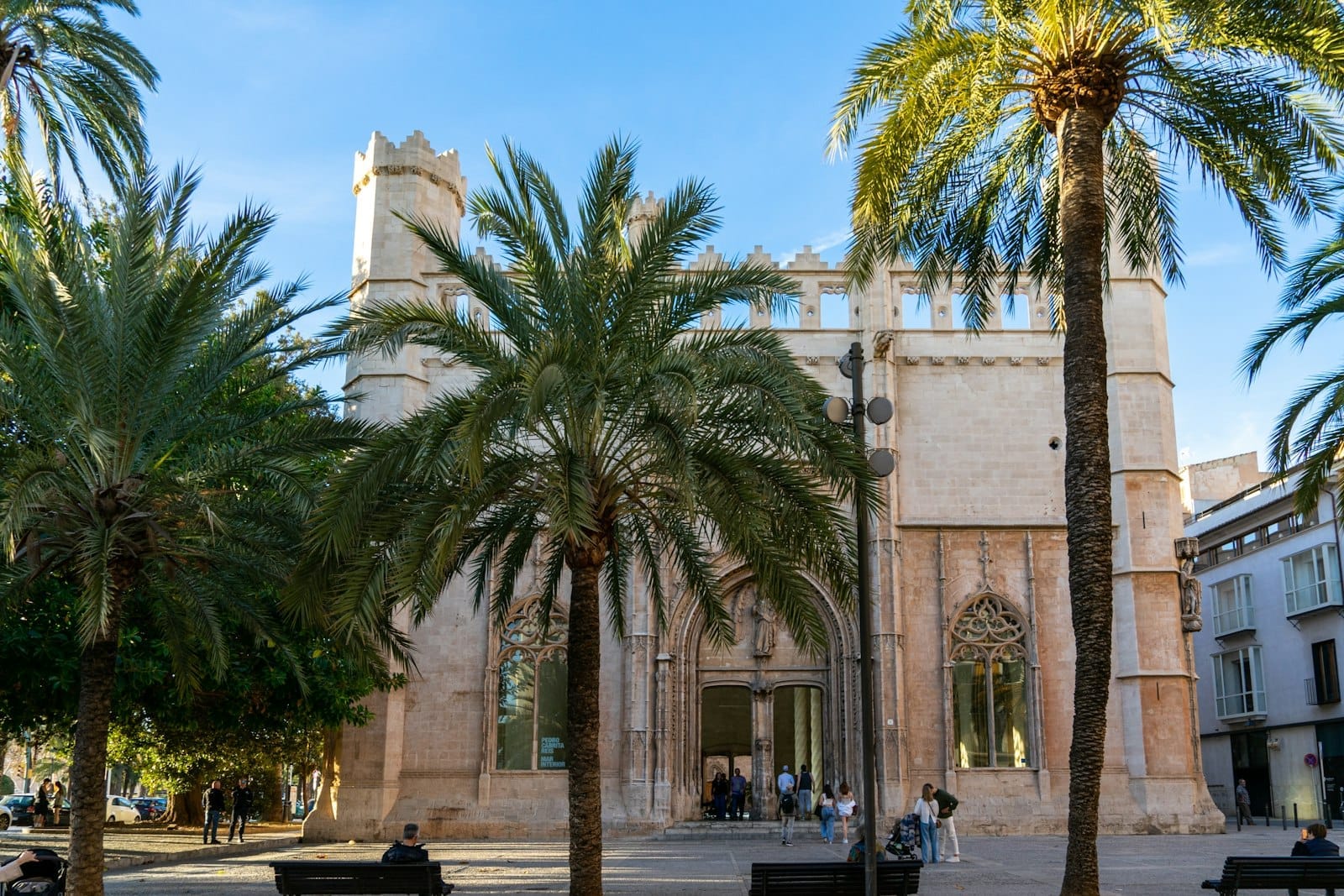
Sa Llotja, known in Spanish as La Lonja de Palma, is a 15th-century Gothic civil building that served as the headquarters of Palma's Merchants' Guild and maritime trade exchange. It stands on the Plaça de la Llotja, a short walk from the seafront, and is widely considered one of the finest surviving examples of Gothic civil architecture anywhere in Europe, not just in Spain.
The building was constructed between 1426 and 1452 under the direction of Guillem Sagrera, a Mallorcan architect of extraordinary skill who later worked on the Castel Nuovo in Naples. The exterior is built from honey-colored Santanyí limestone, which shifts from pale gold in morning light to deep amber at sunset. Four octagonal towers anchor the corners, and the roofline is punctuated by delicate pinnacles and a carved stone angel above the main entrance, a symbol that once presided over the commercial oaths taken inside.
Today Sa Llotja functions as an exhibition space managed by the Balearic Islands government. Entry is free, and the interior hosts rotating cultural and art exhibitions throughout the year. Even when an exhibition is in place, the architecture itself is the main attraction.
💡 Local tip
Opening hours change seasonally. From May to October, Sa Llotja opens 10:30–13:30 and 16:00–22:00. From November to April, afternoon hours close at 18:00. It is closed on Mondays (with a few exceptions for public holidays) and on January 1, November 1, and December 25. Always check current listings before visiting, as the building closes between exhibitions.
The Interior: Six Columns That Change How You Think About Gothic
Step through the heavy wooden doors and you enter a single, undivided hall of remarkable clarity. Six slender helicoidal columns rise from the floor and twist upward like braided rope before fanning out into the vaulted ceiling above. There are no dark corners, no oppressive weight of stone. The effect is the opposite of the heavy Gothic interiors you might expect: the space feels open, almost weightless.
Natural light enters through tall, narrow windows fitted with delicate stone tracery. In the morning, shafts of sunlight cross the floor diagonally and catch the texture of the columns. By late afternoon the light is warmer and more diffuse, and the limestone walls glow. Either hour is worth experiencing, but the late afternoon slot, especially in summer when the building stays open until 22:00, is particularly atmospheric.
The floor is largely bare, which means the columns and ceiling command all your attention. Visitors often tilt their heads back and stand still for a long moment. The acoustics are remarkable too: voices carry softly across the hall, and during quieter hours you can hear the faint sounds of the square outside filtering through the stone.
Tickets & tours
Hand-picked options from our booking partner. Prices are indicative; availability and final rates are confirmed when you complete your booking.
Banana Boat Experience in Mallorca
From 14 €Instant confirmationFree cancellationPalma de Mallorca 30-minute Jet Ski Tour with Visit to the Cathedral
From 99 €Instant confirmationFree cancellationSnorkel Tour in Mallorca
From 40 €Instant confirmationFree cancellationPalma de Mallorca: Small-Group Tour & Fast-Track Cathedral
From 59 €Instant confirmationFree cancellation
Historical Context: From Merchants to Exhibitions
When construction began in 1426, Palma was a major port city in the western Mediterranean. The Col·legi de Mercaders, the city's merchants' guild, needed a building that projected both civic authority and commercial reliability. Guillem Sagrera delivered exactly that. The building was completed in 1452, and for centuries it operated as the place where contracts were signed, oaths were sworn, and disputes among traders were settled.
The stone angel above the main door was not decorative sentiment. In the context of medieval commerce, it was a witness: those who transacted business inside were understood to be doing so under divine oversight. The building's combination of sacred symbolism and civil function is typical of Catalan Gothic architecture from this period, though Sagrera's execution here is considered exceptional even within that tradition.
Sa Llotja sits within a broader concentration of historic architecture. The Palma Cathedral, La Seu is a 15-minute walk along the waterfront, and the Palace of La Almudaina stands between the two. Together, these three buildings form the core of medieval Palma's architectural legacy, and they are close enough to visit in a single morning.
The Surrounding Square and Neighborhood
The Plaça de la Llotja itself is worth pausing in. The square is edged by a low stone wall and opens toward the sea, with the waterfront promenade a short walk beyond. In the early morning, the square is quiet and the limestone surfaces of the building are cool and sharp in the light. By late morning, tour groups arrive and the surrounding streets fill with foot traffic. If you want the exterior to yourself for photographs, arrive before 10:00.
The neighborhood around Sa Llotja, sometimes called the La Llotja-Born district, is one of Palma's most agreeable areas to walk. To the east, the Passeig del Born leads into the heart of the old city. To the west, the promenade follows the waterfront. The streets immediately behind Sa Llotja contain several good small restaurants and wine bars that open in the evening, making the building a natural anchor point for a sunset walk.
If you are exploring Palma's old town on foot, Sa Llotja fits naturally into a half-day itinerary that also takes in the Passeig del Born and the Parc de la Mar. The distances are short and the walking is flat along the waterfront.
Practical Walkthrough: What to Expect on the Day
Sa Llotja does not require advance booking. You simply walk in during opening hours. The entrance is through a pair of heavy wooden doors set into the main facade. There is no turnstile, no ticket desk, and no audio guide. What you see is the building itself, and whatever exhibition is currently installed.
The interior is a single ground-floor hall with no upper floors open to the public on a standard visit. Group bookings can arrange access to the recently restored roof terrace, but this is not available for individual visitors without prior arrangement. The ground-level floor is smooth stone, and the space is wide open, so there are no narrow passages or stairs to navigate. Accessibility for wheelchair users depends on the condition of the entrance threshold; the interior itself presents no obstacles.
Photography is generally permitted inside the building, though individual exhibitions may have restrictions on flash or tripods. The natural light inside is usually sufficient for handheld shots, especially in the afternoon when the windows on the western side admit warm light directly onto the columns.
⚠️ What to skip
Sa Llotja closes between exhibitions, sometimes for several weeks. This is not always clearly advertised in advance. If visiting specifically to see the interior, check current listings on the Balearic government cultural website or local event platforms before making it a centerpiece of your day.
Honest Assessment: Is It Worth Your Time?
For anyone with an interest in medieval architecture, Sa Llotja is genuinely exceptional and one of the most rewarding thirty minutes you can spend in Palma. The helicoidal columns are unlike anything in the city, and the spatial quality of the hall is something photographs do not fully convey. It is also free, which makes it one of the most accessible cultural experiences on the island.
That said, if architecture is not a particular interest, Sa Llotja may feel underwhelming compared to the spectacle of the Cathedral or the scale of the old city walls. It is a single room. The exhibitions vary in quality and relevance. Travelers who find the built environment less engaging than landscape or food will probably enjoy the time more by heading to the Mercat de l'Olivar or spending an hour on the waterfront instead.
Visitors who should skip the interior entirely: those with very limited time in Palma who have already seen the Cathedral and need to choose between secondary stops. The exterior of Sa Llotja is worth seeing regardless; it takes five minutes and costs nothing. The interior rewards anyone who can give it their full attention.
If you are planning your time carefully, the guide to things to do in Mallorca has useful context for prioritizing across the whole island.
Insider Tips
- Visit in the late afternoon during summer (the building stays open until 22:00 from May to October). The low sun comes through the western windows at an angle that makes the helicoidal columns cast dramatic shadows across the floor — far more interesting than the flat midday light.
- The exterior angel above the main door is easy to walk past without noticing. Step back to the center of the square and look up at the roofline to take in the full ensemble of pinnacles, towers, and carved stone details.
- The square in front of Sa Llotja is one of the calmer spots in the old town in the early evening. The tourist foot traffic eases, the light is good for photographs, and the small bars nearby start filling with locals rather than day-trippers.
- Sa Llotja closes between exhibitions, sometimes for several weeks at a time. If you are traveling specifically to see the interior, confirm it is open before building your itinerary around it.
- The Santanyí limestone used in the construction is the same warm golden stone you will see throughout Palma's historic core. Look closely at the exterior surface and you can see the fine-grained texture that makes it ideal for the delicate carved tracery around the windows.
Who Is La Llotja For?
- Architecture and medieval history enthusiasts who want to see Gothic civil design at its highest point
- Photographers looking for interior column and vault compositions, or exterior golden-hour shots
- Travelers doing a self-guided walking tour of Palma's historic waterfront district
- Visitors seeking a free, indoor cultural stop that takes under an hour
- Anyone interested in the maritime and mercantile history of the western Mediterranean
Nearby Attractions
Other things to see while in Palma de Mallorca:
- Arab Baths (Banys Àrabs)
The Banys Àrabs are the only intact remnant of Palma's Islamic past, dating to the 10th or 11th century. Compact but genuinely atmospheric, this ancient hammam in the heart of the old city takes less than an hour to visit and rewards anyone with even a passing interest in history.
- Bellver Castle
Perched on a pine-covered hill 3 km west of Palma's city centre, Bellver Castle is one of Europe's rare circular Gothic fortresses. Built under King Jaume II and completed around 1311, it has served as a royal residence, a prison, and now houses the Palma Municipal History Museum. The views over Palma Bay alone justify the climb.
- Bishop's Garden (Jardí del Bisbe)
Tucked behind the towering walls of Palma Cathedral, the Jardí del Bisbe is a small formal garden on the grounds of the Episcopal Palace. Free to enter and often overlooked by visitors rushing between La Seu and the seafront, it offers citrus groves, herb beds, an ornamental pond, and a rare ground-level view of the cathedral's famous rose window.
- Es Baluard Museum of Modern & Contemporary Art
Es Baluard Museu d'Art Contemporani de Palma occupies a Renaissance bastion on the old city walls, combining 800-plus works of modern and contemporary art with sweeping views over Palma Bay. It is one of the most architecturally striking museum settings in the Balearic Islands, and far less crowded than the cathedral a few minutes' walk away.