Hampton Court Palace: The Complete Guide to London's Most Spectacular Royal Retreat
Hampton Court Palace stands on the banks of the River Thames in East Molesey, Surrey, roughly 30 minutes by train from central London. With Tudor kitchens, baroque state apartments, a famous hedge maze, and 60 acres of formal gardens, it offers more depth than almost any other royal site in England. This guide covers everything you need to plan a visit well.
Quick Facts
- Location
- Hampton Court Palace, East Molesey, Surrey, KT8 9AU — approximately 12 miles southwest of central London, on the north bank of the River Thames
- Getting There
- Hampton Court railway station (direct from London Waterloo, approx. 35 min) — about a 5-minute walk from the palace gates. No London Underground station at Hampton Court.
- Time Needed
- 4–6 hours for a thorough visit; the gardens alone can absorb 2 hours
- Cost
- Adults £29.00, Children 5–15 £14.50, Under-5s free. Tickets should be pre-booked online. Members of Historic Royal Palaces enter free.
- Best for
- History enthusiasts, families, architecture lovers, garden visitors, and anyone wanting a full-day escape from central London
- Official website
- www.hrp.org.uk/hampton-court-palace
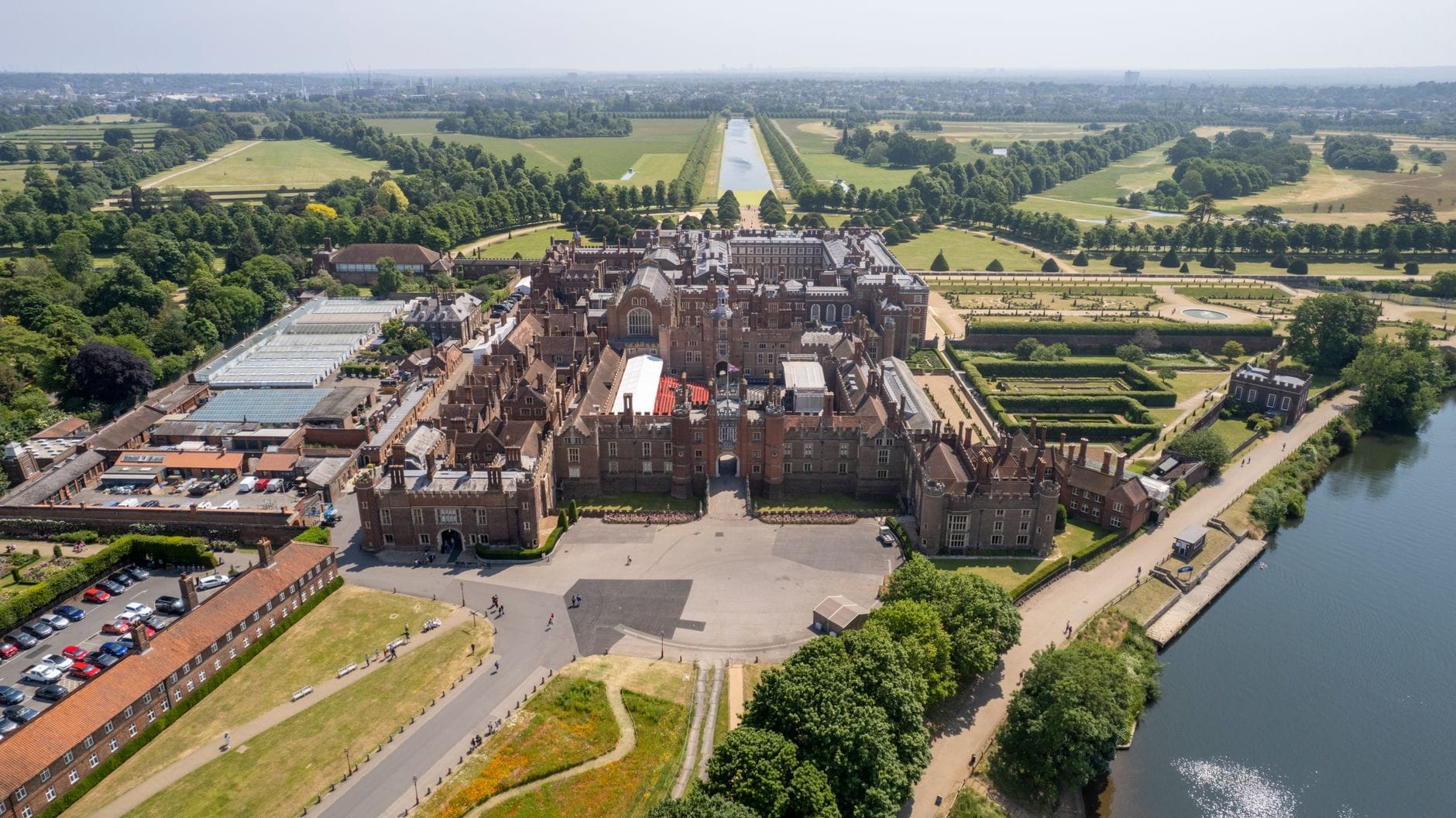
What Hampton Court Palace Actually Is
Hampton Court Palace is a Grade I-listed royal palace on the River Thames, managed by the independent charity Historic Royal Palaces and owned by the monarch in right of the Crown. It is not a single building but a vast complex: two distinct architectural periods sitting side by side, surrounded by approximately 60 acres of gardens that include formal parterres, a working kitchen garden, and the world-famous Hampton Court Maze.
The palace essentially contains two great building campaigns fused into one. The Tudor palace, begun by Cardinal Thomas Wolsey around 1515 and then seized by Henry VIII in 1529, is characterised by warm red brick, elaborate terracotta roundels, and the great hall with its hammer-beam roof. The later baroque state apartments were commissioned by William III and Mary II in the 1690s, with Sir Christopher Wren providing designs that were intended to rival Versailles — though the project was never fully completed. Walking between these two sections, the stylistic contrast is immediate and striking.
Queen Victoria opened the palace to the public in 1838, making it one of the earliest royal buildings in Britain to welcome visitors at no charge. Today admission is ticketed, but the legacy of that decision means the site is set up for public access rather than staged as a private tour.
⚠️ What to skip
Hours vary significantly by date and season. The palace currently operates Wednesday–Sunday (10:00–17:30 during standard periods, last admission one hour before closing), with extended or reduced hours on selected dates. Always confirm your specific date on the official Historic Royal Palaces site before travelling, and book tickets online in advance — entry is not guaranteed on the door.
Getting There: The Train Is the Easy Choice
The most reliable way to reach Hampton Court Palace is by train from London Waterloo. Direct services take approximately 30 minutes, and Hampton Court station is about a five-minute walk from the palace entrance. There is no London Underground station at Hampton Court, so the train is the most straightforward option for most visitors.
Bus services from Richmond and Kingston also stop near the palace and are worth considering if you are combining a visit with those areas. Driving is possible but on-site parking is limited and available for a payment charge — on peak summer days, this can be a source of real frustration. Disabled parking bays are available for Blue Badge holders.
If you are planning a broader day in southwest London, the area connects well with Kew Gardens, which is reachable from the same Waterloo line — making a combination of the two attractions a logical full-day itinerary for those with strong interests in royal history and landscape design.
Tickets & tours
Hand-picked options from our booking partner. Prices are indicative; availability and final rates are confirmed when you complete your booking.
Hampton Court full day access with guided tour and afternoon tea
From 160 €Instant confirmationHalf-day tour to Hampton Court Palace from London with tickets
From 83 €Instant confirmationFree cancellationHampton Court Palace tickets with gardens and maze
From 31 €Instant confirmationFree cancellationMamma Mia the Musical with a 2-course pre-show dinner
From 106 €Instant confirmation
The Tudor Rooms: Where the Palace Earns Its Reputation
The Great Hall, completed for Henry VIII around 1535, is the centrepiece of the Tudor section. It is one of the best-preserved Tudor great halls in England. The hammer-beam roof rises over 27 feet and is hung with reproductions of original tapestries depicting stories from the life of Abraham — the originals date from the 1540s and were commissioned by Henry himself. On a grey morning, when light filters dimly through the high windows, the scale of the room makes a different impression than in bright afternoon sunlight, when the colours in the tapestries warm considerably.
The Tudor kitchens are arguably the most atmospheric part of the palace. The smell of woodsmoke often lingers in these rooms, particularly on days when live cooking demonstrations are running. The scale is startling: these were industrial-level catering facilities designed to feed a court of several hundred people twice a day. The roasting ranges, boiling houses, and storage rooms sprawl across a considerable area and give a tangible sense of royal logistics that no portrait gallery can replicate.
Henry VIII's State Apartments follow the typical progression of increasing privacy from public rooms to private chambers. The Watching Chamber, Presence Chamber, and the remaining sections of the privy lodgings each carry costumed interpretation on many days, with staff available to answer specific historical questions — a noticeably higher quality of engagement than many comparable heritage sites.
💡 Local tip
Arrive when the palace opens at 10:00 to get the Tudor Great Hall and kitchens largely to yourself. Group tours and school visits tend to arrive mid-morning, and by 11:30 the kitchens in particular can become very crowded. The costumed interpreters are most accessible in the first hour of the day.
The Baroque Apartments and William III's Unfinished Ambition
The contrast when you move from the Tudor brick courtyards into Wren's baroque east wing is pronounced. The symmetry, the formal staircase painted by Antonio Verrio, the high painted ceilings, and the deliberate grandeur of the King's and Queen's State Apartments represent late 17th-century court display at its most concentrated. William III, who had come from the Dutch court at The Hague and had seen Versailles at close quarters, wanted a palace that could communicate monarchical power through architectural proportion and painted allegory.
The King's Great Bedchamber retains its original early 18th-century furnishings. The ceiling by Verrio depicting the goddess of sleep is largely intact. These rooms are not reconstructed period interiors — a significant distinction from many similar sites — which gives them an authenticity that is worth appreciating. The furniture is of the period, not reproduction, and the rooms are arranged as they would have functioned rather than as display cases.
The Georgian Rooms on the upper floors, which were occupied by members of the royal household well into the 20th century, offer a quieter and often overlooked section of the palace. The furnishings here reflect the more modest domestic scale of grace-and-favour apartments rather than state rooms, which provides a useful counterpoint to the ceremonial grandeur elsewhere.
The Gardens: Where Most Visitors Under-Invest Their Time
The approximately 60 acres of gardens at Hampton Court Palace represent one of the most significant historic designed landscapes in England. Most visitors spend an hour or less outside, which means they miss considerable depth. The Privy Garden, immediately south of the baroque apartments, was restored in the 1990s to its 1702 appearance under William III, based on an original survey drawing. The geometric parterres, wrought-iron screens by Jean Tijou, and the deliberate sight lines toward the Thames are all deliberate elements of a specific design moment — not general English garden aesthetics.
The Great Vine, planted in 1768 and attributed to the royal gardener Lancelot 'Capability' Brown, is the oldest and largest known grape vine in the world. It still produces grapes harvested each September. The vine house has a faintly humid, greenhouse quality even in early spring, and the twisted central stem — over two metres in circumference — is remarkable to see in person.
The Maze, planted in the 1690s as part of the William III redesign, covers approximately a third of an acre with yew hedges now standing well over two metres high. It typically takes between 20 and 45 minutes to solve, and the disorientation is real rather than theatrical — the hedges are dense enough that you cannot see over or through them. Children find it absorbing; adults who underestimate it sometimes find it mildly frustrating. It is included in the palace ticket.
If gardens are your primary interest, Hampton Court pairs logically with the Royal Botanic Gardens at Kew or, for a different scale and character, Richmond Park, both accessible from the same rail corridor.
How the Experience Changes by Time of Day and Season
Morning visits, particularly on weekdays outside of school holidays, offer the palace at its least crowded. The light in the Great Hall is better in the morning when sunlight enters from the east-facing windows, and the costumed interpretation is fresher earlier in the day. By early afternoon on summer weekends, the main courtyards and the maze queue can be congested.
Summer brings the Hampton Court Palace Festival, a series of outdoor concerts held in the palace's Base Court. The festival typically runs in June, and tickets sell separately from palace admission. The experience of live music in that setting, with floodlit Tudor brickwork as a backdrop, is particular to this venue. Check the Historic Royal Palaces events calendar for current programming.
Winter visits have their own character. The gardens are obviously quieter and largely stripped back, but the interiors are warm and uncrowded. The Christmas programme typically includes period decoration in the state rooms and special events in the kitchens. If your priority is the architecture and interiors rather than the gardens, an off-peak winter visit on a weekday may offer the best combination of atmosphere and space.
ℹ️ Good to know
Photography is permitted throughout most of the palace without flash. The King's Staircase, painted by Verrio, and the Great Hall tapestries are among the most photogenic interior spaces. In the gardens, the Privy Garden's symmetrical parterres photograph best in the early morning light before the fountains are switched on and create reflective interference on a wide-angle shot.
Practical Details and Who Should Consider Skipping
Allow at least four hours and ideally a full day. Packing a picnic is a reasonable strategy — the gardens have extensive grass areas and a full day at the palace with lunch at the on-site cafe can become expensive quickly. Wear comfortable walking shoes; the cobbled courtyards and extensive garden paths are not friendly to anything with a heel.
Accessibility across the palace is variable. The baroque apartments and many ground-floor Tudor rooms are accessible by wheelchair or mobility aid, but some areas involve uneven surfaces, low doorways, or stairs without lifts. Nine disabled parking bays are available free for Blue Badge holders. The official accessibility guide on the Historic Royal Palaces website is more detailed than most heritage sites and worth consulting in advance.
Hampton Court Palace sits at the top of the list when it comes to day trips from London that offer genuine historical depth rather than a quick photo stop. It also features in most well-constructed five-day London itineraries as a southwest London day.
Who might not get full value here: visitors with very limited time who cannot commit at least half a day will find the ticket price hard to justify relative to what they can cover. Those with no particular interest in British royal history or garden design may find the depth of interpretation less engaging than central London sites with broader appeal. The palace is also outside Greater London proper, requiring a specific journey rather than a detour on a Tube line — factor that into your planning honestly.
If you are weighing Hampton Court against other royal and heritage sites, the Tower of London and Kensington Palace are both managed by Historic Royal Palaces and offer membership that covers all five sites — worth calculating if you plan to visit more than two of them.
Insider Tips
- Buy a Historic Royal Palaces membership if you plan to visit Hampton Court and one or more of the other five HRP sites (Tower of London, Kensington Palace, Banqueting House, Kew Palace, Osborne). Adult membership starts at £72 per year and pays for itself in two visits to Hampton Court alone.
- The Base Court café gets very busy at midday. Either eat early (before 12:00) or bring a picnic and use the Tiltyard area near the north gardens, which is quieter and still well within the palace grounds.
- The Great Vine produces a harvest of Black Hamburg grapes each September. If you visit in late summer, the vine is at its most visually dramatic, and the harvest is sometimes open to the public — check the events calendar.
- The Tudor kitchens are the single most atmospheric space in the palace, but cooking demonstrations are not daily. Check the schedule on the Historic Royal Palaces website before your visit and time your arrival in that section to coincide with a demonstration if possible.
- The east front of the baroque palace, facing the Long Water canal and the Home Park, is most dramatic in the late afternoon when the low sun catches the brickwork and the canal reflects it. This part of the gardens is often quieter than the maze and Privy Garden side.
Who Is Hampton Court Palace For?
- History enthusiasts who want to understand the physical architecture of Tudor and Stuart court life rather than just read about it
- Families with children aged roughly 7 and above who can engage with the maze and costumed interpretation
- Garden and landscape design visitors, particularly those interested in formal 17th-century garden restoration
- Photography-focused travellers looking for architectural interiors and formal landscapes with genuine historical depth
- Visitors planning a full-day southwest London excursion who want a single site that justifies the journey out of central London
Nearby Attractions
Combine your visit with:
- Abbey Road
The Abbey Road zebra crossing in St John's Wood is one of the most photographed stretches of tarmac in the world, immortalised by the Beatles on the cover of their 1969 album. Entry is free, it's accessible around the clock, and the Grade II listed studios next door still operate as a working recording facility. Here's everything you need to know before you visit.
- Alexandra Palace
Perched on one of north London's highest ridges, Alexandra Palace is a Grade II-listed Victorian landmark that combines a 196-acre park, a restored theatre, a year-round ice rink, and a live music venue. Entry to the park is free, and the views across the city stretch further than almost anywhere else at ground level.
- Dulwich Picture Gallery
Opened in 1817, Dulwich Picture Gallery is Britain's first purpose-built public art gallery, designed by Sir John Soane and housing over 600 European masterpieces. Set in the quiet streets of Dulwich Village, it offers a rare combination of architectural beauty, world-class paintings, and a unhurried atmosphere that larger central London galleries rarely manage.
- Horniman Museum and Gardens
Set on a hilltop in Forest Hill, south-east London, the Horniman Museum and Gardens brings together anthropology, natural history, and musical instruments under one Grade II* listed roof. The gardens cover over 16 acres and offer sweeping views across the city. Admission to the museum and gardens is free, making this one of London's most rewarding afternoons for families, curious adults, and anyone who has already done the central museum circuit.